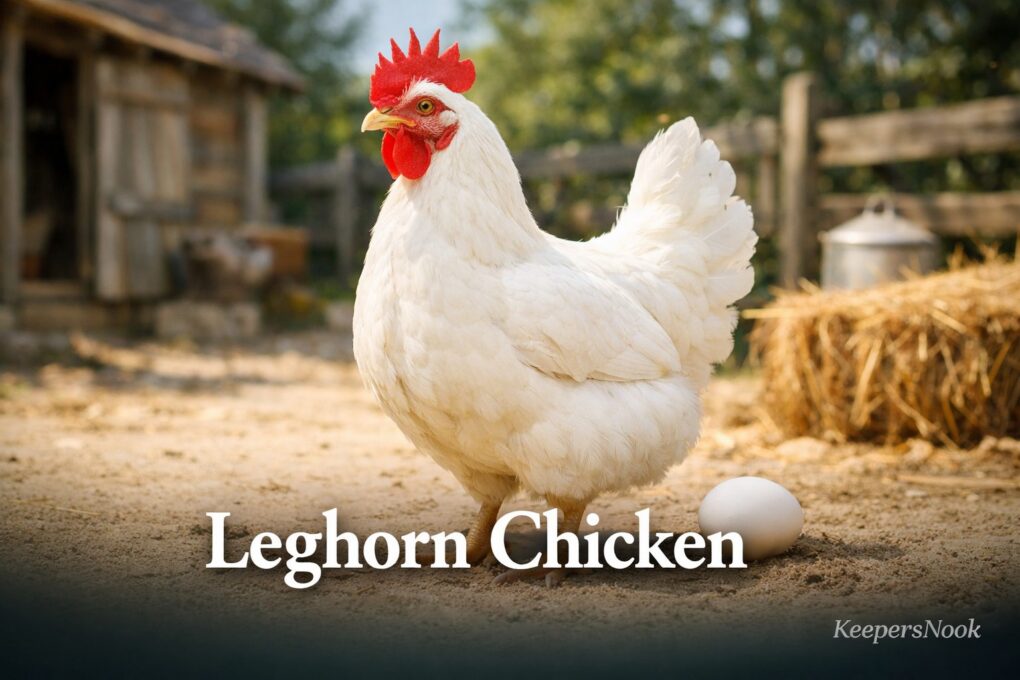
Leghorns arrived in the United States from Livorno, Italy, around 1853. Within decades, the White Leghorn became the foundation of the American commercial egg industry.
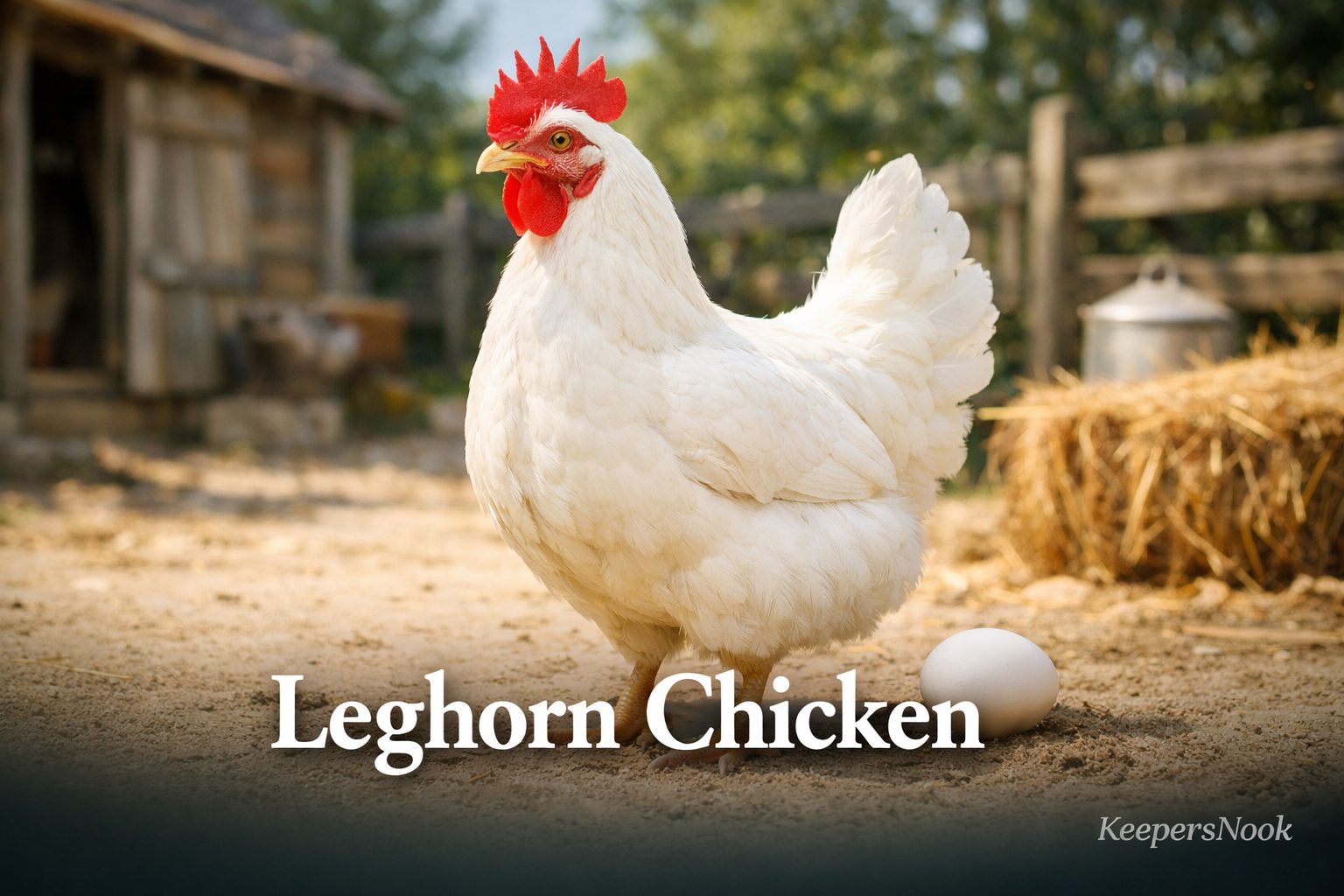
That commercial legacy is exactly what you get in a backyard flock: a bird engineered for one job, doing it better than any other heritage breed.
Before you order chicks, you need an honest picture of both sides of this breed. The egg count is extraordinary.
The personality is not for everyone.
If you have kept Rhode Island Red chickens and found them too calm, a Leghorn will be an adjustment in the other direction.
Leghorn Egg Production: 300-320 White Eggs Per Year
A healthy White Leghorn hen at peak production lays 300-320 white eggs per year. That works out to roughly six eggs per week, nearly every day from late winter through early fall.
Remember it later
Planning to try this recipe soon? Save it for a quick find later!
No other heritage breed matches that number. Production hybrids like ISA Browns can equal it, but those are purpose-bred crosses, not true heritage varieties.
Egg size is consistently large to extra-large with bright white shells. Shell integrity remains strong through the second year of production.
By year three, most Leghorns are laying at 60-70% of peak output. Commercial flocks replace birds annually.
Backyard keepers can extend useful production to three or four years with proper nutrition and low-stress housing.
Leghorns almost never go broody. That instinct has been bred out through generations of commercial selection.
No broody periods means no lost production weeks, which is the second major production advantage after raw egg count.
- Egg color: Always white in the White Leghorn variety. Brown Leghorns lay tinted eggs, but White Leghorns dominate backyard availability.
- Earlobe indicator: White earlobes reliably predict white-egg genetics in any breed, not just Leghorns.
- Shell quality peak: Years one and two. Quality declines alongside production in year three.
- Broodiness rate: Near zero. One of the lowest of any recognized heritage breed.
- Production comparison: A Leghorn outproduces a Rhode Island Red by 20-50 eggs per year at peak.
That five-egg advantage per week compounds over a three-year productive life to hundreds of additional eggs per bird. For anyone building a small flock purely for egg yield, the math is hard to argue with.
Leghorn Appearance: Single Comb Anatomy at 4.5-5 Lbs
Leghorns are a light Mediterranean breed with a slim, angular body and an upright carriage. The defining physical feature is the large single comb that dominates the head.
In hens, that comb grows so quickly during maturation that it topples to one side at the first point and stays flopped for life. This is breed-standard and completely normal, not a sign of illness.
| Trait | Hen | Rooster |
|---|---|---|
| Weight | 4.0-5.0 lb | 5.5-6.0 lb |
| Comb type | Single, flops to side | Single, 5 points, upright |
| Plumage (White variety) | Pure white | Pure white |
| Shank color | Yellow, clean | Yellow, clean |
| Earlobe | White | White |
| Body shape | Slim, angular, upright | Slim, angular, upright |
The American Poultry Association recognizes multiple Leghorn varieties: White, Brown, Black, Columbian, Buff, Silver, Golden Duckwing, and several others. The White variety accounts for the overwhelming majority of production and backyard birds.
Bantam Leghorns exist and follow the same temperament profile. They lay smaller eggs at lower volume and are kept primarily for show or small-space flocks.
Leghorn Temperament: Flighty Birds Versus the Foghorn Leghorn Myth
Leghorns are not the friendly, jovial birds Foghorn Leghorn from the cartoons suggests. That character is bluster and warmth.
Real Leghorns are alert, fast-moving, and easily startled.
They are not aggressive toward people, but they resist handling and rarely become tame, even when raised from day-old chicks.
Leghorns do best in single-breed flocks or paired with equally assertive, active breeds. Mixing them with docile breeds like Buff Orpingtons typically ends with the Orpingtons losing access to feeders and waterers.
If you want a calm flock that children can interact with, look at better suited for beginners before committing to Leghorns.
Leghorns are excellent foragers. In a free-range setup, they cover more ground than heavier breeds and find a meaningful portion of their diet through scratching and insect hunting.
Leghorn Heat Tolerance: Mediterranean Genetics Outperform at 95°F+
Leghorns were developed in Livorno, a hot Mediterranean coastal city. That origin gives them genuine heat tolerance that most dual-purpose American breeds cannot match.
Their small body mass generates less metabolic heat. The large comb acts as a radiating surface, dissipating body heat through increased blood flow to vascular tissue near the skin surface.
Leghorn production in cold weather drops sharply when temperatures stay below freezing for extended periods. Supplemental lighting on a timer to maintain 14-16 hours of light per day offsets some of the winter production loss.
Leghorn Coop Setup: Containment for a 5-Lb Bird That Flies Well
Leghorns are small birds, but their housing requirements are not minimal. Their flighty nature and strong flight capability create containment challenges that heavier breeds never present.
A fully covered run is not optional for Leghorns. They will exit any open-top enclosure and range far beyond intended boundaries.
See our coop setup guide for hardware cloth specifications and frame construction options.
White plumage makes Leghorns highly visible to aerial predators. Hawks and owls can spot a white bird against green grass from a significant distance.
Overhead cover in free-range areas reduces predation risk substantially.
Roost bar height matters less for Leghorns than for heavier breeds. They are agile enough to access higher bars without joint stress, which is a real concern for heavier breeds like Australorp chickens.
Feeding Leghorns: High-Calcium Diet for 300+ Eggs Per Year
Leghorns are feed-efficient by design. A laying Leghorn hen eats 3.5-4 ounces of feed per day.
A Plymouth Rock or Rhode Island Red eats 5-6 ounces. Over a flock of 10 birds, that 1.5-ounce daily difference adds up quickly.
The efficiency comes from body size. Less mass to maintain means more feed energy goes directly into egg production rather than body heat and muscle maintenance.
Limit treats to under 10% of daily feed intake. Leghorns are not prone to obesity the way Orpingtons are, but high-sugar treats can disrupt gut flora and cause loose stools that affect egg quality.
Safe treat options include plain cooked whole grain rice, which provides easy digestible carbohydrates without excess sugar. For something fresh, fresh grapes are fine in small amounts, cut in half to reduce choking risk.
Leghorns eat the same foods as all other chicken breeds. The risks are universal to the species, not breed-specific.
What changes with Leghorns is the treat frequency: because they eat less total volume, even small amounts of problematic foods represent a higher percentage of their daily intake.
- Safe vegetables: Leafy greens, cooked squash, chopped ripe tomatoes (no stems or leaves, which contain solanine).
- Protein supplements: Mealworms, black soldier fly larvae, and scrambled eggs support feather regrowth during molt.
- Scratch grains: Use as a cold-weather treat only. Scratch raises body temperature through digestion, useful in winter but counterproductive in heat.
- Foods to avoid entirely: Avocado flesh and skin (persin toxicity), raw potato skins (solanine), chocolate, onion, and any moldy feed.
Never feed tomato stems or leaves from garden plants. The ripe fruit itself is safe; the green parts are not.
This is one of the most common feeding mistakes in kitchen-scrap flocks.
Fresh water is the single most important input for a Leghorn's egg production. A hen deprived of water for even four hours in warm weather will drop production within 48 hours.
Leghorn Health: 3 Issues Every Keeper Sees
Leghorns are not a sickly breed. They carry minimal genetic health problems compared to some exhibition lines.
Three issues appear with enough frequency that every keeper should know them before the first winter.
Frostbite on the comb is the most common problem in northern climates. The large single comb is highly vascular and exposed.
It is the first tissue to freeze when temperatures drop below 20 degrees F without protection.
Predation from above is the second common issue. White birds against open ground are conspicuous.
A Cooper's hawk or Red-tailed hawk can spot a Leghorn from heights that would make a barred or mottled bird invisible.
Egg binding occurs more frequently in high-production layers. A hen that has laid 300 eggs in a year has worked her reproductive system hard.
Signs include straining in the nest box without passing an egg, lethargy, fluffed feathers, and a swollen or firm abdomen below the vent.
- Egg binding first response: A 20-30 minute warm soak can relax the muscles enough for the egg to pass. Keep the hen calm and warm afterward.
- When to call a vet: If the egg does not pass within two to three hours of warm soaking, veterinary intervention is needed. A retained egg can rupture internally.
- Prevention: Adequate calcium, consistent hydration, and low-stress housing reduce egg-binding frequency in high-production hens.
- Mites and lice: Active foragers that range through brush and leaf litter pick up external parasites more often than confined birds. Check under wings and around the vent weekly during warm months.
Leghorns live 5-8 years. Many high-strung younger birds become noticeably calmer after age three.
Keep that trajectory in mind before culling an older hen that has become manageable.
Comparing health profiles across breeds before choosing is worth the time. The Sussex chicken is one option with fewer cold-weather vulnerabilities if your climate runs cold more than six months per year.
Leghorn vs. Other Laying Breeds: Where the Numbers Land
Breed comparisons need real numbers to be useful. Here is how the Leghorn sits against other popular layer breeds on the metrics that matter most for backyard production flocks.
The comparison shows why commercial egg operations standardized on Leghorn genetics. No other heritage breed produces as many eggs with as little feed input per egg produced.
- Leghorn vs. Rhode Island Red: Leghorn wins on eggs per year (300-320 vs 250-300) and feed efficiency. RIR wins on temperament, cold hardiness, and dual-purpose value. If you want Rhode Island Red productivity with easier handling, the RIR is the better starting point.
- Leghorn vs. Australorp: Australorps hold the official world record for a single hen (364 eggs in a trial year). Average flock production favors Leghorns in typical backyard conditions. Australorps are significantly calmer and more cold-hardy. If temperament matters, Australorp chickens offer comparable production with a much easier personality.
- Leghorn vs. Sussex: Sussex hens lay 250-275 white and tinted eggs per year with a much friendlier temperament. They handle cold better and integrate into mixed flocks without the feeder competition Leghorns create. If Sussex chicken traits fit your climate and flock goals, you give up roughly 40-50 eggs per year for a substantially more manageable bird.
- Leghorn vs. Wyandotte: Wyandottes lay 200-220 eggs per year, well below Leghorns. They are cold-hardy, calm, and beautiful birds with rose combs that resist frostbite. The Wyandotte's traits suit mixed flocks in cold climates better than any Leghorn setup.
- Leghorn vs. production hybrids: ISA Browns and Golden Comets match or slightly exceed Leghorn production at 300-350 eggs per year. They are generally calmer than Leghorns. The tradeoff is shorter productive life and less breed stability if you want to hatch replacement chicks.
For anyone building a flock specifically around maximum white egg output, no heritage breed competes with the Leghorn. For anyone with children, cold climates, or mixed-breed flocks, the alternatives above deserve serious consideration before committing to Leghorn chicks.