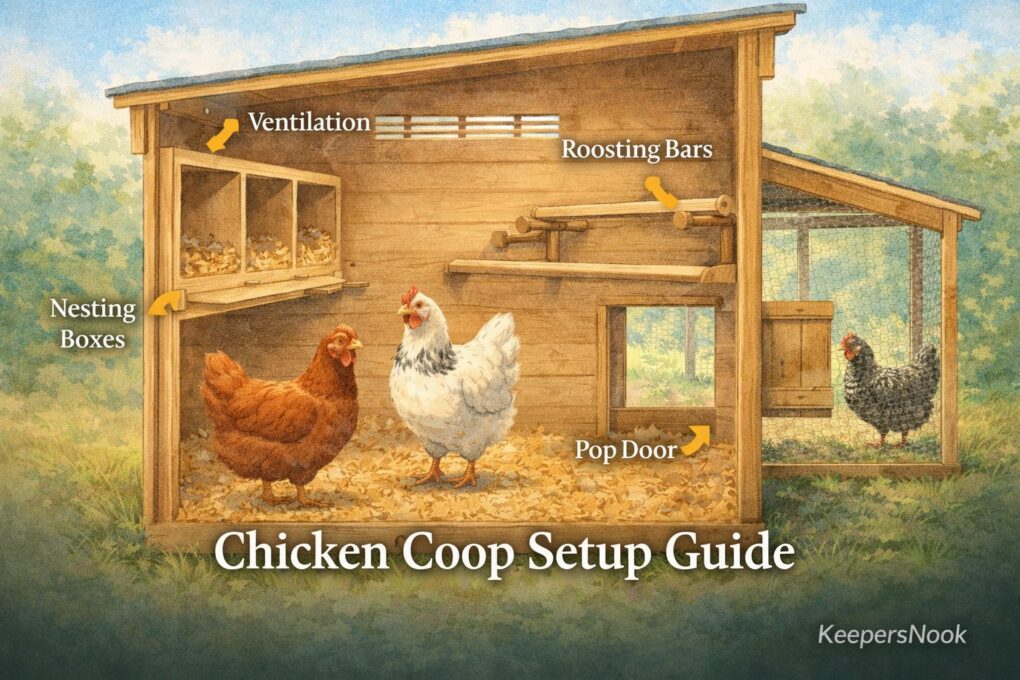
Building a chicken coop starts with two numbers: 4 square feet per bird inside and 10 square feet per bird in the attached run. Get those figures right from the start and every other decision follows from them. This guide walks you through each phase of construction, from site selection through a completed, flock-ready structure, covering all the poultry husbandry principles that determine whether a coop lasts two seasons or twenty years.
A coop that works is not one that looks good in photos. It is one that keeps birds dry, predator-free, and ventilated through summer heat and winter freezes.
Build it once and build it right. The eight steps below tell you exactly how.
Chicken Coop Build Materials: 14 Items to Source Before You Start
Pulling materials together before the first cut is the single habit that separates clean builds from stalled, half-finished ones. Lumber prices vary by region, so price everything locally and add a 10 percent buffer.
Remember it later
Planning to try this recipe soon? Save it for a quick find later!
For a 4x8-foot coop designed to hold 8 standard hens, plan a total material spend of $300 to $550 for a DIY build, or $350 to $650 for a kit upgraded to proper predator-proof hardware.
Buy hardware cloth by the roll, not by the linear foot. A 50-foot roll of 36-inch-wide, half-inch mesh covers most small coop openings and a section of run at a lower cost per square foot than pre-cut pieces.
Standard breeds like Island Red egg output and Australorp laying records require the full 4 square feet of indoor floor space per bird. Size the coop before you buy a single board, not after.
NOTE
Check local zoning ordinances before purchasing materials or birds. Many municipalities cap backyard flock size at 4 to 6 hens and prohibit roosters entirely. Building ahead of a permit denial can result in forced flock reduction or a structure you cannot legally use.
Chicken Coop Cost Breakdown: DIY vs. Kit for 8 Hens
The figures below reflect a DIY build for a 4x8-foot interior coop with an attached 8x10-foot run. Kit coops often cost less upfront but reach the same security level only after hardware cloth and latch upgrades.
Budget the full cost before starting. Running out of funds at the hardware cloth stage is the most common reason a coop stays unsecured longer than it should.
Item
DIY Cost
Kit Cost
Notes
Lumber (frame, walls, floor)
$120–180
Included
Pressure-treated for base contact only
Roofing material
$40–80
Included
Metal panels outlast shingles by decades
Hardware cloth (coop + run)
$60–100
Not included
Must replace chicken wire on any kit
Nest boxes
$15–30
Included
1 box per 4 hens, 12x12 inches minimum
Roost bars
$10–20
Included
2 linear feet of bar space per bird
Latches and screws
$20–40
Partial
Add carabiner clips to all kit latches
Feeder and waterer
$30–60
Not included
Hanging style cuts contamination
Bedding (first fill)
$15–25
Not included
Large-flake pine shavings only
Total DIY
$310–535
Total Kit + Upgrades
$350–650
After hardware cloth, latches, and bedding added
If you are comparing kit options, look at the interior dimensions first. Many kits are marketed for 6 to 8 birds but measure only 24 to 30 square feet of usable floor space, which is the minimum for 6 birds, not 8.
Work through the phases below in order. Skipping the foundation step to save a day almost always requires tearing apart finished walls later to fix a twist or a level problem that appears after the first rain.
1
Select and Level the Location
Choose a spot with natural drainage that slopes away from the coop footprint. Low spots turn bedding into ammonia-soaked compost within days of a rainstorm. A south or southeast exposure captures winter sunlight, which reduces indoor moisture buildup. Deciduous trees nearby provide summer shade while bare winter branches let sunlight in. Measure the full footprint, including the attached run, before breaking ground.
2
Build the Foundation
Construct a perimeter base frame from pressure-treated 4x4 lumber rated for ground contact. Level each corner before driving any fasteners: a level frame is the single most important factor in a coop that stays tight over time. On stable level ground, a skid foundation is sufficient. On clay soil, wet climates, or uneven terrain, use concrete deck blocks or pier footings at every corner. Unlevel walls create gaps within one to two seasons.
3
Frame the Walls
Build each wall section flat on the ground, then raise and attach to the base. Standard interior wall height is 6 to 7 feet: tall enough to stand upright during cleaning and tall enough to position ventilation openings above roost height. Cut rough openings for the access door, the pop door (10x12 inches minimum), and all ventilation panels before applying sheathing. Sheathing over a rough opening you forgot costs extra time and lumber.
4
Install the Roofing
A gabled or shed roof with a 4:12 pitch sheds rain and snow without pooling at the ridge or valleys. Metal roofing panels are the best long-term choice: they last 20 or more years, shed debris cleanly, and require no annual maintenance. Extend the roof overhang at least 12 inches past every wall face. Shorter overhangs allow rain to wick behind ventilation openings and into the wall cavity.
5
Cut and Secure Ventilation Openings
Ventilation openings belong in the top third of the wall, on at least two opposing sides of the coop. The total open area should reach a minimum of 1 square foot per bird. Cover every opening with half-inch welded hardware cloth secured with screws and finish washers. Staples alone pull free within one to two seasons. The objective is cross-ventilation above roost height, not airflow at bird level.
6
Build and Install Nest Boxes
Construct or mount one nest box per four hens, each measuring 12x12 inches for standard breeds. Position boxes 12 to 18 inches above the floor so they are accessible but still below roost bar height. Add a 4-inch lip at the front of each box to hold bedding in place. Fill each box 2 to 3 inches deep with clean pine shavings. Place a ceramic or wooden egg inside each box for the first two weeks: it guides pullets to lay in the correct location rather than on the coop floor.
7
Mount Roost Bars
Set roost bars 18 to 24 inches above the floor for standard-size breeds. Allow 2 linear feet of bar space per bird: a 6-bird flock needs 12 linear feet of roost, arranged across multiple bars at staggered heights. Position every roost bar higher than the nest box openings so hens choose roosts for sleeping rather than nests. A droppings board mounted 4 to 6 inches below each roost bar catches overnight waste and cuts floor-cleaning frequency in half.
8
Enclose and Predator-Proof the Run
Attach half-inch hardware cloth run panels to a sturdy wood or metal perimeter frame. Bury the hardware cloth 12 inches underground, or bend it outward in an L-shape along the ground surface to block digging entry. Cover the run overhead with hardware cloth or solid roofing to stop aerial predators. Fit every gate and access door with a two-step latch or carabiner clip. Test each latch with cold, gloved hands: if you can open it easily, a raccoon can open it faster.
CARE TIP
Build the run larger than the stated minimum. Ten square feet per bird keeps the peace, but 15 to 20 square feet per bird gives you a flock with fewer pecking problems and ground that stays green longer. Crowded runs turn to bare compacted dirt within weeks of flock introduction, removing any foraging benefit the run was meant to provide.
Chicken Coop Ventilation: 1 Square Foot Per Bird as the Baseline
Ventilation failures cause more flock health problems than any other single construction mistake. Chickens produce a high volume of moisture through respiration and droppings.
In an under-ventilated coop, that moisture accumulates in the litter and surfaces.
Wet litter produces ammonia gas. At 25 ppm, ammonia causes eye and respiratory irritation.
At 50 ppm, it damages lung tissue. You will smell it before your birds show symptoms, which makes your nose the first diagnostic tool.
WARNING
Never seal a coop for winter warmth. Chickens generate enough body heat to survive well below freezing in dry, draft-free air. Wet cold causes frostbite. Dry cold does not. Keep ventilation openings uncovered above roost height year-round, including January. If your glasses fog the moment you enter, or you detect any ammonia, you need more open vent area immediately.
The mechanical distinction between ventilation and drafts is positional: ventilation is air movement above the birds, drafts are air movement at bird level. Every vent must sit in the top third of the wall so incoming cold air rises and warms before reaching roost height.
Minimum open area: 1 square foot of vent per bird on at least two opposing walls
Vent placement: top third of the wall only, never at roost height or floor level
Winter practice: keep vents fully open year-round. Close only drafts that blow at bird level
Ammonia signal: any detectable smell inside means ventilation is already insufficient
Summer adjustment: add additional opening area or a second vent tier during heat above 90°F
Predator-Proofing Your Chicken Coop: 5 Entry Points That Get Flocks Killed
Predators probe the same weak point every night until it fails. Raccoons remember where they found a weakness and return.
Foxes and dogs work systematically. Weasels slip through openings the size of a quarter.
The two most common failure points: chicken wire instead of hardware cloth, and single-step latches that open in seconds under pressure.
WARNING
Half-inch welded hardware cloth is not optional. Chicken wire has hexagonal openings wide enough for a raccoon to reach through and pull a bird against the mesh. Weasels and mink pass through chicken wire gaps entirely and kill every bird in the coop in a single visit. Replace chicken wire on any kit coop before the first bird goes in.
Hardware cloth standard: half-inch welded wire on every vent, pop door, window, and run panel. Nothing larger, nothing thinner
Latch standard: two-step latches or carabiner clips on every door. Single-lever and hook-and-eye latches open under raccoon pressure within seconds
Buried perimeter: hardware cloth buried 12 inches straight down or bent outward 12 inches in an L-shape. Foxes, dogs, and rats dig at the base of the wall
Overhead cover: hardware cloth or solid roofing on the run. Hawks hunt midday, owls hunt at dusk and dawn
Gap audit: any opening wider than half an inch is a weasel entry point. Walk the perimeter at night with a flashlight: every point of light is a gap to close
For a practical look at what attracts predators to a property, note that food scraps left in the run increase night-time pressure immediately. Check tomato feeding safety and grape feeding guidelines for which treats to offer and how much to offer so scraps do not accumulate on the run floor overnight.
Nesting Box and Roost Bar Ratios for Chickens: 1 Box Per 4 Hens, 2 Feet Per Bird
The nesting box ratio is one per four hens. More boxes per bird is fine.
Fewer boxes cause competition during morning laying hours, which produces broken eggs and hens that lay on the coop floor.
The roost bar ratio is 2 linear feet per bird. Crowded roost bars cause pushing and displacement injuries overnight, which suppresses laying for days after each incident.
For 8 hens, that means 16 linear feet of roost, arranged across multiple staggered bars.
NOTE
Position every roost bar higher than the nest box opening. Hens always prefer the highest sleeping spot available. If nest boxes are at the same height or above the roost bars, hens sleep in the boxes and leave droppings in the nests overnight, contaminating eggs every morning. A 6-inch height advantage on the roost bars eliminates this problem completely.
Box dimensions: 12x12 inches minimum for standard breeds. Larger breeds like Silkie nesting needs can use 12x14 for comfort
Roost height: 18 to 24 inches off the floor for standard breeds. Heavy breeds like Orpingtons and Brahmas: 12 to 18 inches to prevent landing injuries
Roost profile: flat 2x4 lumber laid on edge allows hens to cover their feet with their breast feathers in cold weather. This matters below freezing
Bar spacing: 12 inches between parallel bars so each hen has room to step without landing on a neighbor
Bedding in nests: 2 to 3 inches of pine shavings, replaced when visibly soiled. Soiled nest bedding leads directly to soiled eggs
For a detailed look at how breed size affects both space requirements and egg production expectations, see our guides to best egg production results and beginner flock success before committing to a flock size.
Monthly and Seasonal Coop Maintenance Schedule
Daily tasks: Collect eggs. Confirm the pop door is latched at dusk.
Scrub waterers. Inspect latches and hardware cloth for damage or displacement.
Monthly tasks: Full bedding change or deep-litter turning. Inspect for red mites under roost boards at night using a red-light flashlight.
Clean and disinfect feeders. Trim any vegetation touching coop walls, which provides cover for predators and retains moisture against the siding.
Spring deep clean: Full cleanout with 1:30 dilute bleach solution on all interior surfaces. Rinse and dry completely before adding fresh bedding.
Inspect roofing for winter damage. Check buried hardware cloth perimeter for erosion or shift.
Treat proactively for external parasites before warm weather arrives.
Fall prep: Reduce vent area on the windward side only, never fully close. Add extra bedding depth for winter insulation from the floor.
Confirm the waterer has a heating element rated for your low temperature range.
THE BOTTOM LINE
A well-built coop for 8 standard hens costs $310 to $535 in materials and takes one to two weekends to complete. The non-negotiable items are half-inch hardware cloth on every opening, ventilation openings above roost height on opposing walls, and two-step latches on every door. Get those three things right and the structure will hold a healthy flock for a decade. Get them wrong and you will rebuild sections after the first predator event or the first respiratory illness runs through the flock.
Six standard hens need a minimum of 24 square feet of interior floor space (4 sq ft per bird) and 60 square feet of attached run (10 sq ft per bird). Build larger when the site allows: most keepers who start with 6 birds add 2 to 4 more within the first two years, and a coop built to the exact minimum becomes too small before the third season.
No. Chicken wire keeps chickens contained but stops almost no predator. Raccoons reach through hexagonal openings and pull birds against the mesh. Weasels slip through standard chicken wire gaps entirely. Use half-inch welded hardware cloth on every vent, pop door, window, and run panel. It is the only mesh that holds against the full range of common predators.
Two boxes at minimum (one per four hens), but three is better for 8 birds. Hens rarely use boxes simultaneously, so two usually suffice, but three eliminates all competition during peak morning laying hours. Each box should measure at least 12x12 inches. Smaller boxes cause hens to avoid them in favor of floor corners.
No. Chickens generate sufficient body heat to survive well below freezing in dry, draft-free conditions. The goal is dry air at roost height, not warm air. Heat lamps in coops cause fires and create a cold-dependency that makes birds vulnerable during outages. Keep ventilation above roost height open year-round. Use a flat 2x4 roost bar so hens can cover their feet with their breast feathers on the coldest nights.
The pop door opening should be a minimum of 10 inches wide and 12 inches tall for standard breeds. Larger breeds like Orpington flock keeping benefit from a 12x14-inch opening. An automatic pop door controller on a light sensor or timer eliminates the daily task of closing the door at dusk and opens it each morning, which removes the most common source of overnight predator entry.
SOURCES & REFERENCES
1.
Poultry Housing Management and Sanitation Standards
University of Kentucky College of Agriculture, Food and Environment, Cooperative Extension University
2.
Backyard Poultry Flock Management: Housing and Predator Control
Penn State Extension, Poultry Science University
3.
Predator-Proofing Small Poultry Facilities
USDA National Agricultural Library, Animal Welfare Information Center Government