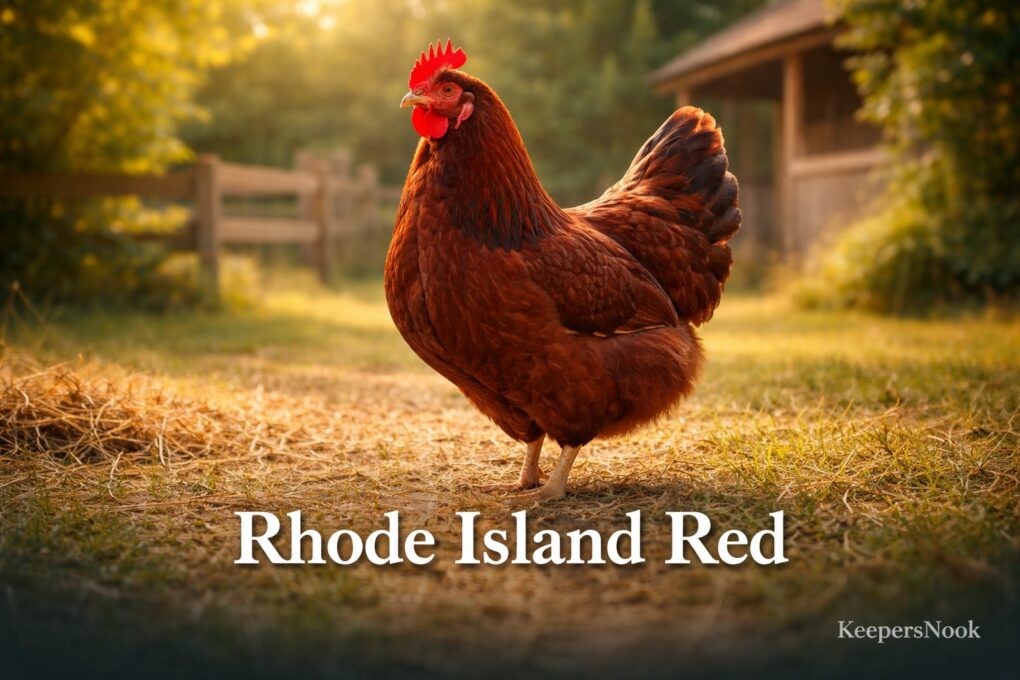
Good laying hen care keeps these birds at peak production for three to four years.
Rhode Island Reds were built to work. Developed in the 1880s across New England, they became the backbone of American poultry farming because they delivered consistent eggs and edible meat on the same bird without demanding specialized feeding or climate-controlled housing.
This guide covers everything you need before bringing your first RIRs home: egg numbers, production timelines, strain differences, temperament, coop requirements, health risks, and vaccination basics.
Rhode Island Red Egg Production: 250-300 Brown Eggs Per Year
A production-strain RIR hen in her first two years lays 250-300 large brown eggs annually. That works out to roughly five to six eggs per week at peak output, placing the breed at the top of heritage layers for raw numbers.
Remember it later
Planning to try this recipe soon? Save it for a quick find later!
Egg size starts at medium when hens first begin laying at 18-20 weeks. By week 24-26, eggs reach full large-to-extra-large size and stay there.
Production decline is gradual rather than sudden. Expect a 10-15% drop per year after the first full molt at around 18 months.
By year three, a well-fed hen typically delivers three to four eggs per week, and many continue laying usefully into years four and five. No other heritage breed matches that longevity at comparable output.
Heritage-strain RIRs lay slightly fewer eggs, roughly 200-250 per year, but they forage more aggressively, carry more body weight, and show higher broodiness rates. Production-strain hens from major hatcheries push toward the 280-300 range and rarely go broody, which is the right choice if eggs are the priority.
Broodiness is low in production-strain birds. When it does occur, break it within two to three days using a wire-bottomed cage with airflow underneath.
Heritage strains go broody more often. If you need a broody hen to hatch eggs naturally, pair RIRs with a broody-prone breed like selecting an Orpington for that role.
For a ranked comparison of annual egg output across popular breeds, see our breeds ranked by output.
Rhode Island Red Appearance: Production vs Heritage Strain Differences
RIRs have deep mahogany-red plumage that shows a beetle-green iridescence in direct sunlight. The color is the immediate visual identifier and the source of the name.
The two strains look noticeably different side by side. Production birds are lighter, less vividly colored, and have a more rectangular body profile.
Heritage birds are darker, nearly brick-red, with a rounder, heavier build and more prominent tail feathers.
| Trait | Production Strain | Heritage Strain |
|---|---|---|
| Plumage color | Medium mahogany-red | Dark brick-red to maroon |
| Body shape | Rectangular, lean | Round, stocky |
| Hen weight | 6.0-6.5 lbs | 7.0-8.5 lbs |
| Rooster weight | 7.5-8.0 lbs | 8.5-10.0 lbs |
| Annual eggs | 270-300 | 200-250 |
| Broodiness | Rare | Moderate |
| Foraging ability | Good | Excellent |
| APA Standard | No (does not meet SOP weight) | Yes |
Both strains carry the same comb type: single, five-pointed, standing upright. Yellow legs and feet, red-orange eyes, and red earlobes are consistent across strains.
Tail angle differs between the sexes. Hens carry a moderate tail at roughly 45 degrees.
Roosters hold a high, proud tail with long black-green sickle feathers that arc above the body.
Rhode Island Red Hen vs Rooster: Key Differences at a Glance
Hens and roosters differ in size, coloring, and behavior in ways that matter for flock planning. The tab below breaks down the key physical and behavioral differences so you can assess what's right for your setup before purchasing.
Rhode Island Red Temperament: Assertive, Not Aggressive
RIR hens rank high in almost every mixed flock. They are confident, active foragers who patrol aggressively for food and establish clear hierarchies with other breeds.
That assertiveness is not the same as aggression: hens rarely attack keepers and will not randomly attack flock mates without cause.
The problem arises in two situations. First, overcrowding: RIRs become feather-pickers and bully subordinate birds when space is too tight.
Second, breed mismatch: pairing RIRs with docile breeds like Silkies, Polish, or Cochins puts the smaller birds at a persistent disadvantage. They compete poorly for food and suffer feather damage.
Best flock pairings are breeds of similar assertiveness and size. comparable output from Australorps alongside RIRs is a common and effective combination.
Rocks for mixed flocks produces similar results. as a cold-climate addition also integrate without dominance problems.
RIRs are vocal. They announce eggs, issue predator alerts, and maintain a running narration of the yard.
Plan for that level of noise before you commit to the breed if neighbors are close.
For a beginner-focused comparison across popular breeds, see flock with beginner breeds. The RIR consistently places at the top for first-time keepers who prioritize egg production over docility.
Rhode Island Red Climate Tolerance: Cold and Heat Hardiness Compared
RIRs handle temperature extremes better than almost any other heritage breed. Their dense plumage insulates effectively in cold, and their body mass is moderate enough that heat doesn't overwhelm them the way it does heavier breeds like Cochins or Brahmas.
Cold tolerance: RIRs handle temperatures down to 0°F without supplemental heat, provided the coop stays dry and has adequate ventilation at the roofline. Below 0°F, the single comb becomes vulnerable to frostbite.
Apply petroleum jelly to the comb and wattles on nights forecast to drop below 10°F. Check for pale, waxy, or black patches the following morning.
Heat tolerance: Better than most dual-purpose breeds. RIRs show heat stress signs (panting, drooping wings, seeking shade) at sustained temperatures above 95°F.
On extreme heat days, provide shade across at least half the run, multiple water stations with ice, and high-water-content treats.
- Watermelon: High water content, birds eat seeds and flesh. Safe in large pieces.
- Frozen corn: Serves as a heat-day treat and keeps birds active.
- Cool water stations: Refresh twice daily above 90°F. Refusal to drink causes heat stress rapidly.
- Shade cloth: Cover at least 40% of the run area for summer months in hot climates.
For safe summer treat options, see our guide on as a hydration source and using garden tomatoes safely.
Rhode Island Red Coop Requirements: 4 Sqft Per Bird Minimum
RIRs are active birds. Confinement below the minimum space thresholds causes feather picking, aggression, and reduced laying within weeks.
They adapt to both fully confined and free-range setups, but the space minimums below are non-negotiable for a healthy flock.
For the full coop build process, see our chicken coop setup guide covering materials, predator-proofing, ventilation, and nesting box placement.
RIRs adapt to confinement better than high-energy breeds like Leghorns, but free-range access during the day dramatically reduces management headaches. A hen that spends four to six hours ranging daily eats less feed, forages for protein, and shows fewer behavioral problems in winter confinement.
Rhode Island Red Diet: Feed, Calcium, and Treat Guidelines
RIRs are not picky eaters and regulate their intake well. They rarely overeat on layer feed, which makes free-choice feeding the easiest and most effective approach.
Base diet: 16% protein layer pellets or crumble from point of lay (18-20 weeks). Switching before 18 weeks exposes growing pullets to excess calcium before their kidneys can handle it.
Calcium: Crushed oyster shell in a separate dish free-choice, not mixed into the feed. Hens self-regulate calcium intake based on shell quality.
Do not feed oyster shell to non-laying birds or roosters.
Protein during molt: Increase to 18-20% protein when hens begin their annual molt. Feather regrowth is protein-intensive.
A flock that molts slowly or incompletely is often protein-deficient.
- Layer pellets: 16% protein. Primary diet from 18 weeks onward.
- Grower/developer feed: 15% protein. Use from week 8-18 as pullets approach laying age.
- Chick starter: 20-22% protein. Use from hatch to week 8.
- Oyster shell: Free-choice, separate dish. Never mixed into chick or grower feed.
- Grit: Insoluble granite grit free-choice whenever birds receive whole grains or forage.
Treats should stay at or below 10% of total daily intake. High-value options include dried mealworms (protein boost during molt), as a grain supplement, and leafy greens.
There is no safe threshold. The same rule applies to dried or uncooked dried beans, which contain the lectin phytohaemagglutinin and can be fatal even in small quantities.
Keep both items out of the run entirely.
For a full breakdown of what RIRs can and cannot eat from the garden and kitchen, our tomato safety guide covers solanine thresholds and which parts are safe. The grapes feeding guide covers portion size and prep to prevent choking.
Rhode Island Red Health: Common Issues and What to Watch For
RIRs are among the healthiest production breeds. Most problems that appear in a flock are management-related rather than breed-specific genetic weaknesses.
A well-managed flock on adequate feed with proper housing rarely develops serious health issues in the first three years.
The most common issues are external parasites, bumblefoot, and egg binding. All three are detectable early with regular inspection and manageable before they become emergencies.
External parasites (mites and lice): Check weekly under the wings and around the vent. Mites hide in coop cracks during the day and feed on birds at night.
If you see mites during a daytime check, the infestation is already severe. Treat the coop structure and birds simultaneously with permethrin spray.
Provide a dust bath area with sand and food-grade diatomaceous earth so birds can self-treat.
Bumblefoot: A Staphylococcus infection entering through a small cut or abrasion on the foot pad. Presents as a black scab on the bottom of the foot.
Keep roost heights below 30 inches and check foot pads monthly. Early cases respond to Epsom salt soaks and veterinary-grade wound spray.
Advanced cases require debridement.
Egg binding: Uncommon in RIRs but possible in first-year layers. Signs include a hen sitting motionless in the nest box for more than an hour, lethargy, and fluffed feathers.
A warm soak (15-20 minutes in water at 105°F) relaxes the vent musculature. If the egg does not pass within four hours, contact a vet.
An unresolved egg binding becomes fatal.
- Respiratory illness: Rattling breath or nasal discharge. Quarantine immediately and identify the pathogen before treating.
- Marek's disease: Leg paralysis and grey iris in birds under six months. Vaccinate at hatch or purchase pre-vaccinated chicks.
- Infectious bronchitis: Coughing, sneezing, reduced egg production, and misshapen eggs. No cure; supportive care and biosecurity.
- Coccidiosis: Bloody or watery droppings in chicks 3-6 weeks old. Treat with amprolium. Vaccinate or use medicated starter to prevent.
Respiratory disease spreads fast in enclosed coops. Always quarantine new birds for 30 days before introducing them to an established flock.
Most biosecurity failures trace back to skipping the quarantine window.
Vaccinations are most important when sourcing birds from multiple suppliers, showing at fairs, or if disease has been reported in your county.
Marek's Disease: The single most important vaccine for backyard flocks. Vaccinate at hatch or purchase chicks pre-vaccinated from a NPIP-certified hatchery.
Marek's spreads through feather dander and persists in soil for years. It causes leg paralysis, gray iris, and wasting in birds under six months with no treatment available.
Prevention is the only option.
Newcastle Disease / Infectious Bronchitis (ND/IB combo): Administer at day one and again at 3-4 weeks using a live intranasal vaccine. Annual booster is recommended for flocks in high-density poultry areas or for birds shown at fairs.
Fowl Pox: Optional. Recommended in warm, humid climates where mosquito populations are high.
Wing-web stab vaccination at 8-12 weeks. Dry pox presents as wart-like lesions on the comb and face; wet pox affects the throat and is far more serious.
Infectious Bursal Disease (Gumboro): Optional. Administer at 2-3 weeks if sourcing birds from multiple suppliers.
Gumboro suppresses immune function in young chicks, leaving them vulnerable to secondary infections.
Salmonella (Typhoid/Pullorum): Required testing for NPIP certification in commercial flocks. For backyard flocks, purchase chicks from NPIP-certified sources and practice basic food hygiene: wash hands after handling birds or eggs.
Consult your state veterinarian or land-grant university extension for the current recommended protocol in your region. State-level Avian influenza risk maps update seasonally and should inform your biosecurity decisions.
Rhode Island Red vs Leghorn: Which Lays More?
The most common comparison keepers make is RIR vs Leghorn on egg output. The answer depends on what you value beyond raw numbers.
Leghorn egg production data shows 280-320 eggs per year from a production-strain white Leghorn. That's a genuine edge over the RIR in pure output.
But Leghorns are flighty, heat-sensitive compared to RIRs, poor in cold climates, and produce a smaller, lighter body with no practical meat value.
RIRs lay slightly fewer eggs but deliver them in a package that handles weather extremes, puts on useful body weight, and is far more manageable in a small backyard flock where you interact with the birds regularly.
If your sole metric is eggs per year and you have a warm climate, the Leghorn wins on numbers. For most backyard keepers in variable climates who want a dual-purpose bird they can actually work with, the Rhode Island Red is the better choice.
Heritage-strain birds add foraging ability and table weight at the cost of some egg volume. Either way, if you are building your first flock and want one breed that produces reliably across seasons without specialized care, the Rhode Island Red is where to start.