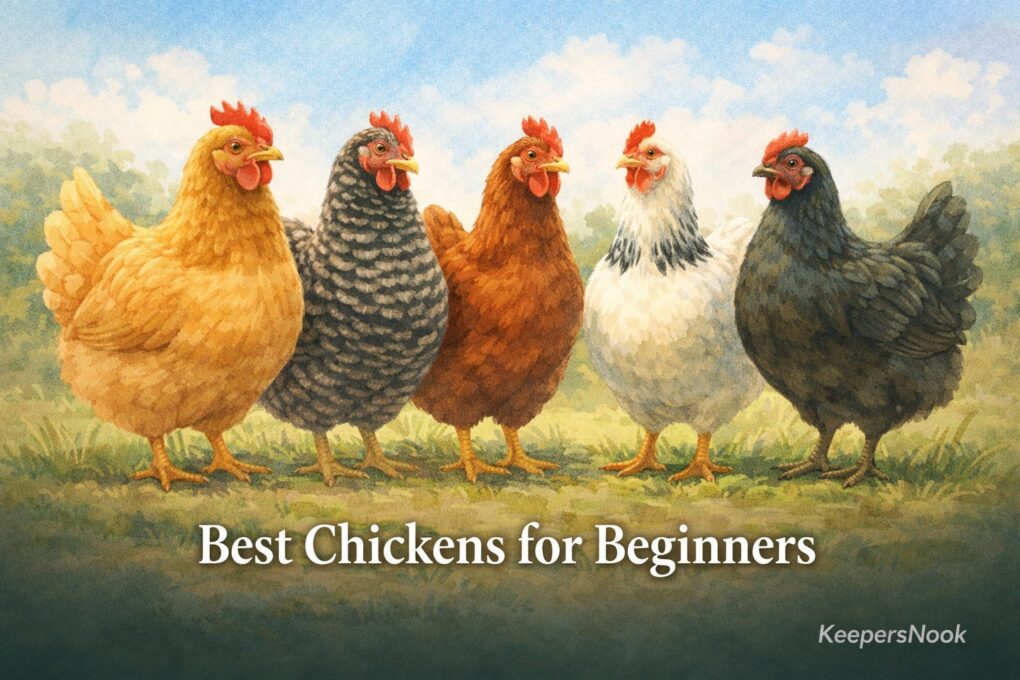
Whether you are starting a backyard flock of two or planning a small homestead setup, the breed you pick shapes your entire experience. We have kept every breed on this list and ranked them based on what actually matters when you are new: calm temperament, consistent egg production, and resilience to beginner mistakes.
Our full guide to backyard flocks covers housing, feeding, and health basics once you have settled on a breed.
Beginner Breed Rankings: Top 10 by Ease Score
We scored each breed across five categories: temperament, egg output, cold hardiness, heat tolerance, and forgiving nature toward keeper errors.
Remember it later
Planning to try this recipe soon? Save it for a quick find later!
| Breed | Eggs/Year | Temperament | Cold Hardy | Beginner Score |
|---|---|---|---|---|
| Rhode Island Red | 250-300 | Confident, active | Yes | 9.5 / 10 |
| Australorp | 250-300 | Gentle, calm | Yes | 9.2 / 10 |
| Plymouth Rock | 200-280 | Friendly, curious | Yes | 9.0 / 10 |
| Orpington | 175-200 | Docile, lap-friendly | Yes | 8.8 / 10 |
| Sussex | 200-250 | Calm, trusting | Yes | 8.7 / 10 |
| Wyandotte | 200-240 | Independent, hardy | Excellent | 8.5 / 10 |
| Easter Egger | 200-280 | Friendly, curious | Yes | 8.3 / 10 |
| Leghorn | 280-320 | Active, flighty | Moderate | 7.5 / 10 |
| Silkie | 100-120 | Gentle, broody | Poor | 7.0 / 10 |
| Speckled Sussex | 180-220 | Calm, curious | Yes | 8.4 / 10 |
#1 Rhode Island Red: 250-300 Eggs/Year with Maximum Forgiveness
The Rhode Island Red is the standard against which all other beginner breeds are measured. They lay 250 to 300 brown eggs annually, tolerate cold winters and hot summers without special care, and recover quickly from husbandry mistakes.
We have seen Rhode Island Reds bounce back from overcrowded coops, inconsistent feeding schedules, and predator stress that caused other breeds to stop laying entirely.
- Egg production: 250-300 large brown eggs per year
- Weight: hens at 6.5 lb, roosters at 8.5 lb
- Cold hardiness: excellent, single comb tolerates frost well
- Temperament: confident and active, rarely aggressive toward people
- Dual-purpose: yes, good meat yield from cockerels
#2 Australorp: Record-Holder at 364 Eggs in 365 Days
The Australorp holds the official world record for egg laying: 364 eggs in 365 days from a single hen. Modern hatchery stock averages 250 to 300 eggs per year.
You can raise Australorps in mixed flocks without incident because they rank at the bottom of most pecking orders.
Their all-black plumage with a green sheen is striking, and their calm nature makes them easy to handle from day one.
- Egg production: 250-300 large brown eggs per year
- Weight: hens at 6.5 lb, roosters at 8.5 lb
- Cold hardiness: very good, dense feathering helps in winter
- Temperament: gentle, submissive in mixed flocks, rarely flighty
- Dual-purpose: yes, strong meat production from heritage stock
#3 Plymouth Rock: 200-280 Eggs and Calm Handling
The Plymouth Rock, most often seen in the barred black-and-white pattern, is one of America's oldest production breeds. Hens lay 200 to 280 large brown eggs per year and continue producing through their second and third seasons.
Plymouth Rocks are genuinely curious birds. They follow you around the yard, investigate equipment, and become comfortable with handling faster than most other breeds.
- Egg production: 200-280 large brown eggs per year
- Weight: hens at 7.5 lb, roosters at 9.5 lb
- Cold hardiness: excellent, handles extreme cold well
- Temperament: friendly, curious, comfortable with daily handling
- Dual-purpose: yes, one of the best meat-to-egg ratio breeds
#4 Orpington: The Beginner's Lap Bird at 175-200 Eggs
If temperament is your first priority, the Orpington wins outright. These birds are famously docile, tolerate being picked up from a young age, and integrate into family settings.
You can keep Orpingtons in small urban flocks without worry about noise or aggression toward children.
The trade-off is egg production. Orpingtons average 175 to 200 eggs per year, which is lower than the top three.
#5 Sussex: 200-250 Calm-Laying Hens
The Sussex, most commonly kept in the Speckled or Light color variants, combines solid egg production with an approachable personality. Hens produce 200 to 250 large brown or tinted eggs per year.
Sussex hens are alert without being flighty, curious without being destructive, and trusting toward keepers who handle them regularly.
#6 Wyandotte: Cold-Weather Specialist at 200-240 Eggs
The Wyandotte earns its place primarily through cold hardiness. The rose comb sits flat against the head, eliminating the frostbite risk that affects single-comb breeds in northern climates.
Wyandottes are more independent than Orpingtons or Plymouth Rocks. They are not lap birds, but they tolerate handling without excessive stress.
Egg production runs 200 to 240 per year.
#7 Easter Egger: Colorful Layer at 200-280 Eggs
Easter Eggers are not a recognized breed but a hybrid carrying the blue-egg gene from Ameraucana or Araucana ancestry. Each hen lays a unique shade: blue, green, olive, pink, or cream.
You can find Easter Eggers at most hatcheries for a fraction of the cost of true Ameraucanas.
Their hybrid vigor makes them disease-resistant and adaptable. Egg production runs 200 to 280 per year.
#8 Leghorn: 280-320 Eggs But High Energy
The Leghorn is the commercial egg industry standard: hens produce 280 to 320 large white eggs per year with minimal feed input. If you want the highest possible egg count, you cannot beat a Leghorn.
The catch is temperament. Leghorns are flighty, nervous, and resistant to handling.
We rank them lower for beginners because the management challenge outweighs the egg advantage until you have a season of experience.
#9 Silkie: Pet Bird at 100-120 Eggs
Silkies are the most handle-tolerant chicken in existence, but they are not primarily a production bird. Hens lay 100 to 120 small cream-colored eggs per year and go broody frequently.
You can find a Silkie at most poultry swaps and farm stores.
Their fluffy feathering looks striking but comes with management costs: they cannot get wet without risk of hypothermia, and their foot feathering traps mud.
#10 Speckled Sussex: Forager at 180-220 Eggs
The Speckled Sussex earns its spot through attractive plumage, solid foraging instincts, and a forgiving temperament. Hens lay 180 to 220 large brown eggs per year.
Their speckled feathering also provides natural camouflage during free-range time.
Both breeds score above 9.0 on our beginner scale and lay 250 to 300 eggs per year. The deciding factors are temperament and flock dynamics.
Choose a Rhode Island Red if you want a confident, assertive bird that forages well and handles temperature extremes. They tend to rank higher in mixed flocks.
Choose an Australorp if you want a calmer, gentler bird that works well in peaceful mixed flocks and is easier to handle for routine health checks.
If you are building a flock of 4 to 6 birds as a beginner, consider two of each. The combination gives you maximum production with behavioral balance.
How to Start Your Beginner Flock: Practical Setup Steps
Picking a breed is only the first step. Before your chicks arrive, you need a brooder, a coop plan, and a feed schedule.
Our coop setup guide walks you through every measurement and material choice.
For egg production targets, our best egg-laying breeds comparison ranks every high-production option beyond this beginner list.