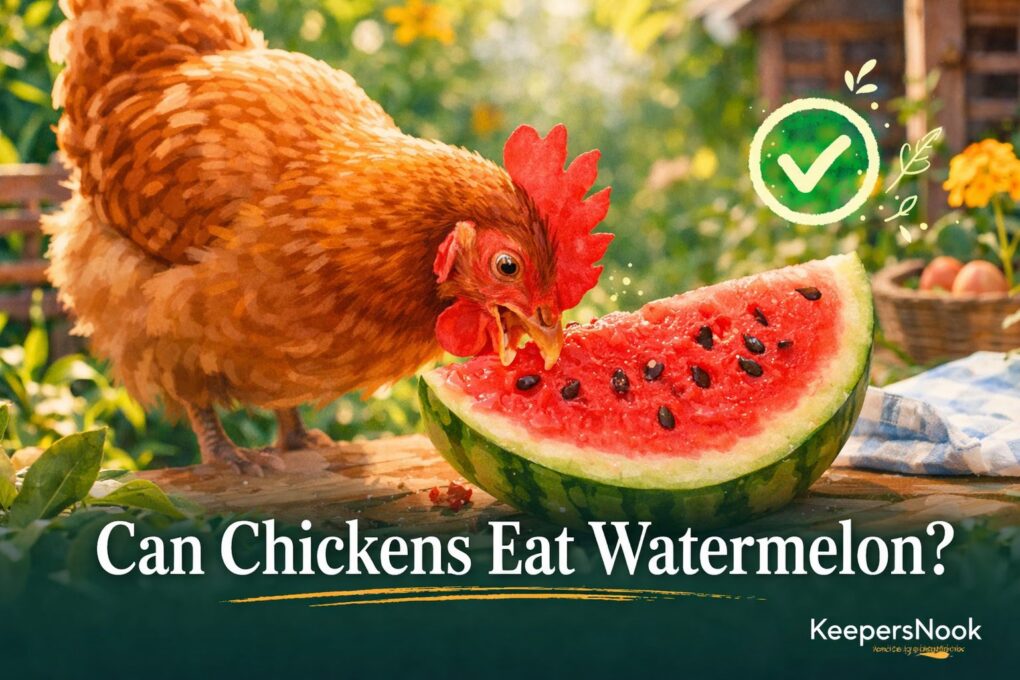
A balanced flock diet keeps birds laying consistently and staying healthy through seasonal extremes. Watermelon is one of the few treats that supports both goals at once, delivering hydration during heat while staying low enough in calories to fit the daily treat budget.
Unlike lycopene-rich tomatoes, where the green stem and leaves carry solanine and require careful removal before serving, watermelon has zero parts to discard. You cut it, set it down, and walk away.
The only practical limits are sugar content and portion size. Watermelon should supplement layer feed, not replace it.
One thick wedge per 3-4 hens keeps the session inside the 10% daily intake rule without requiring a kitchen scale.
Which Parts of Watermelon Can Chickens Eat? All 5 Are Safe
Watermelon needs less preparation than almost any other treat you will offer. There is nothing to peel, deseed, or trim away.
Remember it later
Planning to try this recipe soon? Save it for a quick find later!
Chickens work through every layer naturally, pecking outward from the red flesh toward the harder green skin, then stopping when nothing edible remains.
| Part | Safe? | Notes |
|---|---|---|
| Red flesh | Yes | Primary hydration source; contains lycopene and small amounts of potassium |
| White inner flesh | Yes | Lower sugar zone near the rind; higher fiber content |
| Green outer rind | Yes | Firm surface that slows pecking pace and keeps flesh off the ground |
| Black mature seeds | Yes | Small protein and fat contribution; no choking risk for standard-sized hens |
| White immature seeds | Yes | Fully edible; softer than black seeds and pass through the crop freely |
Compare that profile to higher-sugar grapes, which run 16g of sugar per 100g and need to be halved for bantams to prevent a choking risk. Watermelon seeds pass through a chicken's crop without any preparation at all.
Leaving the rind intact serves a practical purpose beyond simplifying prep. It gives the flock a solid, stable structure to peck against, which slows the rate of consumption and reduces competition between dominant and submissive birds.
The rind also holds the flesh off the ground, keeping it cleaner during the feeding session and reducing the fly attraction that comes with soft fruit dropped directly onto soil.
Why Watermelon Is the Best Summer Treat: 92% Water, Proven Cooling Effect
Chickens are vulnerable to heat stress once ambient temperatures climb above 85°F (29°C). Their resting core temperature runs between 104°F and 107°F, and they have no sweat glands to release that heat.
Panting and wing-spreading are their only cooling mechanisms, and both become less effective as humidity rises.
A treat that delivers direct, immediate hydration gives the flock real support during the hottest part of the afternoon. Watermelon's 92% water content means a single thick wedge delivers more fluid than most hens will drink voluntarily from a waterer between noon and 3 p.m. on a 95°F day.
Heat stress has measurable effects on laying performance. Poultry research consistently shows that egg production falls, shell quality drops, and feed conversion efficiency declines when hens experience repeated high-temperature exposure without adequate cooling support.
Offering high-moisture treats on a 2-3x weekly schedule during heat stretches supplements waterer intake even when hens are reluctant to walk across a hot run at peak afternoon temperatures.
Heat-sensitive Rhode Island Reds are especially affected because the metabolic heat generated by their high laying rate adds to the ambient heat load. High-production breeds benefit most from scheduled afternoon watermelon sessions during summer.
The red flesh also contains lycopene, the same antioxidant found in tomatoes, along with natural electrolytes including potassium and magnesium. Neither contributes dramatically to daily nutritional needs, but both are absorbed without known negative effect at normal serving sizes.
How to Serve Watermelon to Chickens: 4-Step Method
Preparation is simple enough that it takes under a minute from cutting board to run. The checklist below covers the steps most keepers skip and the one rule that prevents the single real risk watermelon carries.
Watermelon pairs well with other high-moisture treats in a rotating summer schedule. Alternating with high-water celery on non-watermelon days keeps hydration support going without concentrating any single fruit's sugar load across the week.
For antioxidant variety, rotating in antioxidant-rich blueberries adds anthocyanin content at only 10g of sugar per 100g, which is well below watermelon's already moderate 6g-per-serving load when portion-matched correctly.
How Much Watermelon Can Chickens Eat Per Week? The 10% Rule Applied
All treats combined should not exceed 10% of total daily feed intake. A standard-sized hen eats 120-130g of layer pellets per day, which leaves about 12-13g of treat budget across the full day.
A thick watermelon wedge weighs roughly 200-300g and is 92% water, so the actual dry-matter contribution to the daily treat budget is modest. The sugar load is the primary constraint, not the bulk weight.
- Frequency cap: 2-3 sessions per week during summer; reduce or stop in winter when hens need calorie-dense warming treats instead
- Per-session limit: One thick wedge per 3-4 hens; splitting into smaller pieces does not change the total sugar load per bird
- Daily rule: On watermelon days, skip other fruit treats; the sugar budget fills up faster than most keepers expect when multiple fruits appear in the same day
Two to three sessions per week is the right summer frequency. Daily watermelon feeding tips the moisture and sugar balance, particularly during weeks when temperatures are high and total feed intake is already suppressed because heat reduces appetite.
Spacing sessions also prevents the loose droppings that excess watermelon causes from becoming a persistent issue that owners mistake for illness.
In winter, watermelon loses its primary use case entirely. A fruit that is 92% water is not a warming treat.
Lower-sugar strawberries at 4.9g per 100g make a better cold-weather fruit option for the occasional treat, though even those should be reduced compared to summer frequency.
Can Watermelon Cause Diarrhea in Chickens? Signs of Overfeeding
The diarrhea risk from too much watermelon is temporary and not dangerous in itself. The real concern is that persistent loose droppings signal that the treat is displacing solid feed intake, which reduces the protein and calcium a laying hen receives from her layer pellets.
Soft-shelled eggs and reduced egg count are the first production signs of chronic treat overfeeding. Both resolve within one to two weeks of returning treats to the 10% limit.
- Loose watery droppings: First sign; appears within hours of overfeeding, resolves within 24 hours of portion correction
- Layer feed left in feeder: Hens waiting for treats rather than eating pellets; the clearest behavioral signal of treat overreliance
- Soft or thin-shelled eggs: Calcium deficit caused by feed displacement; takes 1-2 weeks of correction to resolve fully
- Reduced egg count: Protein shortfall; high-production breeds show this first because their laying demand is highest
If your flock shows two or more of these signs simultaneously, cut all treats for one full week and return to layer feed only. Reintroduce watermelon at half the previous portion after the reset period.
Which Chickens Eat Watermelon Best? Breed Notes for 3 Common Types
Most breeds accept watermelon immediately because the bright red color triggers foraging interest. There are some breed-specific notes worth knowing before you set up the first session.
Sussex hens are calm, methodical foragers that tend to work through a wedge systematically without the frantic scramble you see with more excitable breeds. Their steady pace means a single wedge lasts longer per session, which is a practical advantage when you want a longer afternoon cooling period during summer heat.
Wyandotte hens handle warm weather moderately well for a dual-purpose breed, and watermelon sessions are particularly useful during their summer laying dip. Wyandottes are confident birds and tend to dominate a single wedge, so scatter multiple pieces or use a wire holder to give submissive birds equal access.
High-production egg layers like Leghorns have the highest metabolic heat load from laying activity and benefit most from afternoon watermelon sessions during peak summer heat. Their higher feed conversion rate also means their 10% treat window is proportionally smaller, so strict portion control matters more for these breeds than for heavier dual-purpose hens.
Bantams need no special prep for watermelon. Seeds pass through small crops as easily as they pass through standard-sized hens.
Cut wedges into smaller pieces proportional to flock size, but do not reduce per-bird portion below what fits the 10% rule.
Building a complete treat rotation also means knowing what to exclude. Toxic avocado persin is the most important exclusion in the fruit category: persin is present in the flesh, skin, and pit, and causes cardiac distress in poultry.
Watermelon sits at the opposite end of that risk spectrum. Every part is safe, and the primary risk is simply overfeeding.
A well-structured summer treat rotation might include pesticide-washed strawberries two days per week, watermelon two days per week, and antioxidant blueberries one day per week, keeping the remaining two days treat-free so layer feed intake stays consistent. A proper coop setup with shaded areas and accessible waterers remains the primary heat management tool; treats supplement but do not replace good infrastructure.