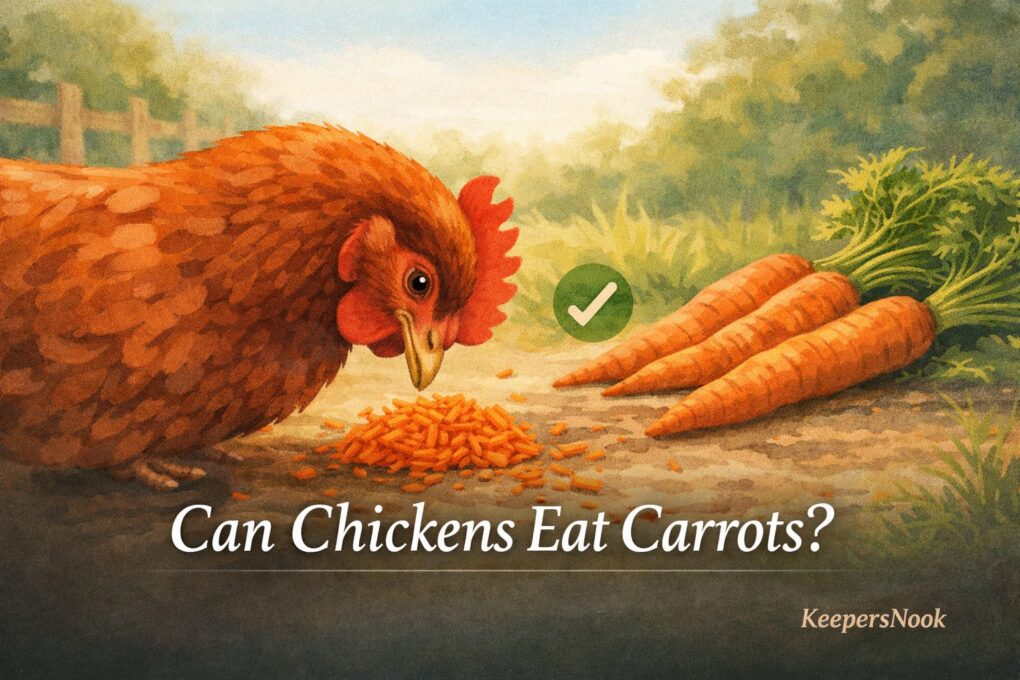
Chickens can eat carrots, and the whole plant is on the table. The root, the skin, and the leafy green tops all pass the safety test with no conditions attached.
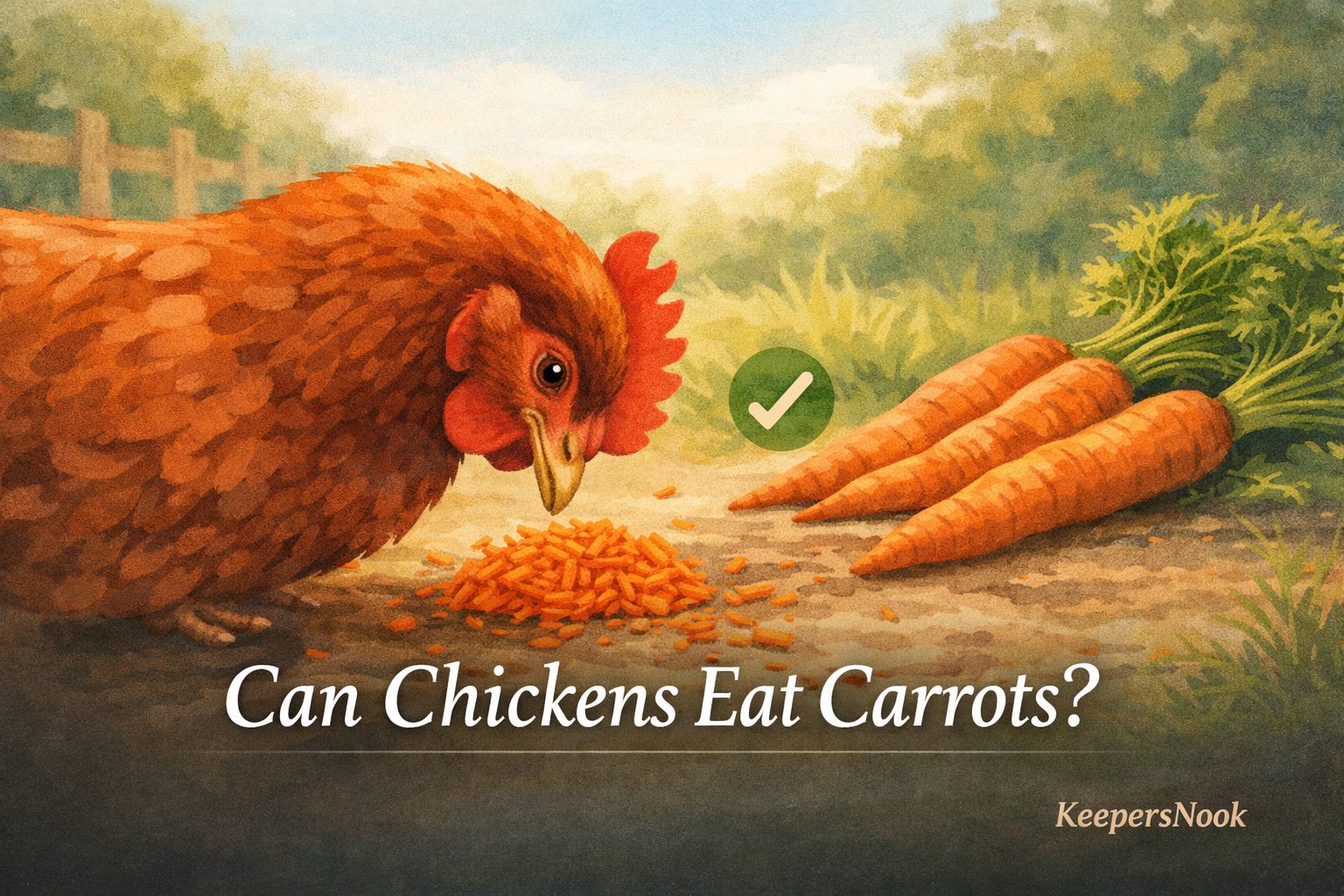
If you manage a backyard flock, you already know that sorting treat safety takes time. Carrots cut through the noise: no toxic compounds, no parts to discard, no elaborate prep.
Our raising hens guide covers the full treat framework, but carrots stand on their own as one of the cleanest options in the vegetable category.
The safety verdict is clean, but preparation method and portion size still matter. Raw shredded carrot is the best default because shredding breaks the dense cellular wall that makes whole raw carrots difficult for most birds to consume efficiently.
Are Raw Carrots Safe for Chickens? 8,285 mcg Beta-Carotene per 100g
Raw carrots are safe for chickens and deliver the highest nutritional yield of any preparation method. At 8,285 mcg of beta-carotene per 100 grams, carrots rank among the richest plant sources of this precursor vitamin available to backyard flocks.
Remember it later
Planning to try this recipe soon? Save it for a quick find later!
Beta-carotene converts to vitamin A in the digestive tract. Vitamin A supports immune function, reproductive health, and the mucous membranes that protect against respiratory infection.
A flock eating carotenoid-rich whole foods has a meaningful nutritional edge over one eating only commercial pellets.
- Beta-carotene: 8,285 mcg per 100g raw, one of the highest among common treat vegetables
- Vitamin K1: 13.2 mcg per 100g, supports blood clotting and bone metabolism
- Potassium: 320 mg per 100g, supports muscle function and hydration balance
- Water content: 88%, meaningful hydration value in warm weather
- Calories: 41 kcal per 100g, low density with minimal weight gain risk at treat portions
Whole raw carrots are technically safe, but most chickens peck inefficiently at them. Shredding or grating on a box grater takes 30 seconds and makes the carrot accessible to every bird in the flock, not just the dominant hens with the strongest beaks.
For breeds bred specifically for high production, consistent micronutrient coverage matters more than it does for exhibition birds. A Rhode Island Red producing 280-300 eggs per year has a higher vitamin A demand than a bird laying 150.
Regular carrot feeding closes that gap efficiently.
Raw vs. Cooked vs. Carrot Tops: Which Form Do Chickens Prefer?
All three forms are safe, but they are not nutritionally identical. The right choice depends on what you have available and which birds you are feeding.
| Form | Prep Required | Nutrition Retained | Best Use Case |
|---|---|---|---|
| Raw shredded | Grate or shred on box grater | Full beta-carotene, vitamin K1, potassium, biotin | Maximum nutrition; accessible to all birds |
| Raw whole or sliced | Cut into coins or short sticks | Full nutrition; slower to consume | Enrichment and beak activity; dominant hens only |
| Cooked plain | Chop into bite-sized pieces after cooking | Reduced water-soluble vitamins; intact carotenoids | Older hens, sick birds, kitchen scrap reuse |
| Carrot tops | None; toss directly into the run | Fiber, trace minerals, low calorie | Zero-waste treat; flock foraging and enrichment |
| Frozen shredded | Freeze flat on a sheet pan; store in bags | Comparable to raw once thawed | Hot weather cooling treat; extends shelf life |
Cooked carrot is a practical use for kitchen scraps. Plain boiled, steamed, or roasted carrot is safe as long as it was not seasoned with salt, butter, garlic, or onion, all of which are problematic for poultry.
Heat reduces water-soluble vitamins, but carotenoids survive light cooking.
Carrot tops are the sleeper option. Most keepers discard them, but the feathery green leaves and stems are completely safe and most flocks eat them with real enthusiasm.
No prep, no waste, no cost beyond what you already bought.
For variety in the same feeding session, grape treats provide a different micronutrient angle without duplicating what carrots already deliver on the carotenoid front.
How to Prepare Carrots for Chickens: 3-Step Process
Carrot prep is among the simplest of any vegetable you can offer a flock. The only step that genuinely matters for raw carrots is size reduction.
Whole raw carrots are too firm for most birds to break down efficiently, and some hens ignore them entirely when presented whole.
Unlike celery preparation, which requires careful cross-cutting to eliminate fibrous string hazards, carrots have no comparable prep risk. Shred and serve.
The cleanup step at the end matters more than most keepers realize. Vegetable matter left in the run on a warm day attracts flies and can begin fermenting within a few hours.
A quick sweep after each treat session keeps the run cleaner and removes the temptation for birds to eat spoiled food.
If you are also feeding as a summer treat, the same 2-3 hour removal rule applies. High-moisture foods decompose faster than grains and dry feed in warm conditions.
How Many Carrots Chickens Can Eat: The 10% Rule with Actual Numbers
All treats combined should stay under 10% of total daily food intake. A standard laying hen eats 100-130 grams of feed per day, which puts the treat ceiling at roughly 10-13 grams per bird.
One medium carrot weighs approximately 60 grams. Shared between three or four birds, each bird receives 15-20 grams, which is close to the daily ceiling for a single session.
That is why the recommended cadence is two to three times per week rather than daily.
- Daily treat ceiling: 10-13 grams per standard laying hen
- One medium carrot: approximately 60 grams total weight
- Serving size: 1 medium carrot per 3-4 birds per session
- Recommended frequency: 2-3 times per week, not daily
- On carrot days: reduce or eliminate other treats to stay within the 10% window
For high-output layers, staying within the 10% ceiling preserves the 16% protein and calcium in layer feed that hens need for egg production and shell formation. Stacking carrots alongside blueberry antioxidant treats in the same session can push daily treat intake well past the safe ceiling without obvious signs until egg quality drops.
For breeds with lower metabolic demands, the ceiling is the same rule applied less urgently. An Australorp laying 250-300 eggs per year still needs her layer feed as the dietary foundation, but a few extra grams of carrot on an occasional day will not cause the same production impact as it would in a high-stress commercial hybrid.
Beta-Carotene and Egg Yolk Color: Chickens Need 3-4 Weeks to Show Results
The link between dietary beta-carotene and yolk color is one of the best-documented relationships in backyard poultry nutrition. Carotenoids, including beta-carotene and xanthophylls, deposit directly into egg yolks during formation.
More carotenoids in the diet means deeper, more orange yolks. Standard commercial layer feeds use synthetic xanthophylls to produce marketable yolk color.
Backyard flocks eating carotenoid-rich whole foods regularly produce yolks that are visibly deeper than the layer-feed-only baseline.
- Timeline: 3-4 weeks of consistent feeding before visible yolk color change appears
- Mechanism: beta-carotene deposits into yolk fat during egg formation over several production cycles
- Best pairing: carrots alongside dark leafy greens for broadest carotenoid coverage
- Breeds that show it most: heavy layers with high daily yolk production
The color change is gradual, not immediate. If you start feeding carrots today, expect to wait three to four weeks before noticing a difference in yolk depth.
This is not a product of the amount fed on any single day. It reflects carotenoid accumulation across multiple egg formation cycles.
3-4 weeks to see resultsA Wyandotte laying consistently through winter will show the yolk color benefit as clearly as any production breed, provided the carotenoid feeding is consistent across the relevant window.
For keepers focused on egg quality across the flock, our best egg-laying breeds guide explains which birds respond most visibly to dietary carotenoid supplementation and why yolk color correlates with nutritional density in pastured flocks.
Chickens and Carrot Tops: Fully Safe with 0 Toxic Compounds
Carrot tops are the one part of this vegetable that most keepers throw away without thinking. That is a missed opportunity.
The feathery green leaves and stems attached to the root are completely non-toxic to poultry, mildly bitter in flavor, and most flocks eat them with genuine enthusiasm.
Unlike tomato plants, where green parts carry solanine that is harmful to poultry, carrot tops belong to the Apiaceae family and carry no toxic glycoalkaloids, no persin, and no cyanogenic glycosides. The safety profile is clean across the entire plant.
Carrots are not the only root vegetable worth adding to the rotation:
- Beets: Safe raw or cooked, red and golden varieties. Beet greens are also safe. Beet pigment can temporarily discolor droppings red, which looks alarming but is harmless.
- Turnips and rutabaga: Safe for chickens; shred or chop before serving. Good source of vitamin C and fiber.
- Parsnips: Safe with a nutritional profile similar to carrots; prepare the same way. Most flocks accept them readily.
- Radishes: Safe for chickens, though the peppery flavor means some birds are slow to accept them at first. Slice thin for fastest uptake.
- Sweet potatoes: Safe cooked plain. Small amounts of raw sweet potato are also fine for chickens.
- White potatoes (cooked only): Plain cooked white potato is safe. Raw green potatoes and potato skins contain solanine and must be avoided entirely.
Avoid onions, garlic, and rhubarb root entirely. All three are toxic to poultry and have no safe serving threshold.
Carrot tops can also provide a form of environmental enrichment that straight carrot shreds do not. Tossing a bunch of leafy tops into the run gives birds something to pull apart, scratch through, and compete for, behaviors that align with natural foraging instincts and reduce boredom-related pecking in confined spaces.
For a well-rounded coop environment that supports natural behavior alongside good nutrition, our coop setup guide details the spatial and enrichment requirements that keep laying flocks productive and lower-stress throughout the year.
Frequently Asked Questions About Chickens and Carrots
For keepers comparing treat options across the chickens silo, our avocado safety guide covers one of the few vegetables that is genuinely off-limits for poultry, and explains exactly why persin causes cardiac damage even in small amounts.