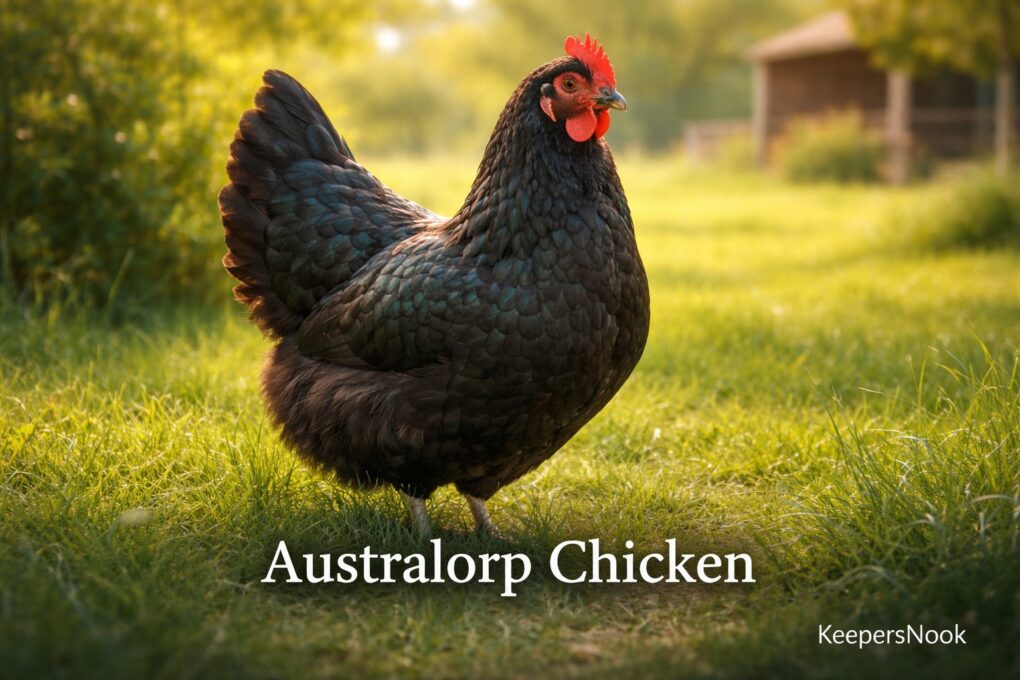
The Australorp is the benchmark for backyard egg production. These black-feathered birds hold the official world record for laying, and their real-world numbers back that reputation every season.
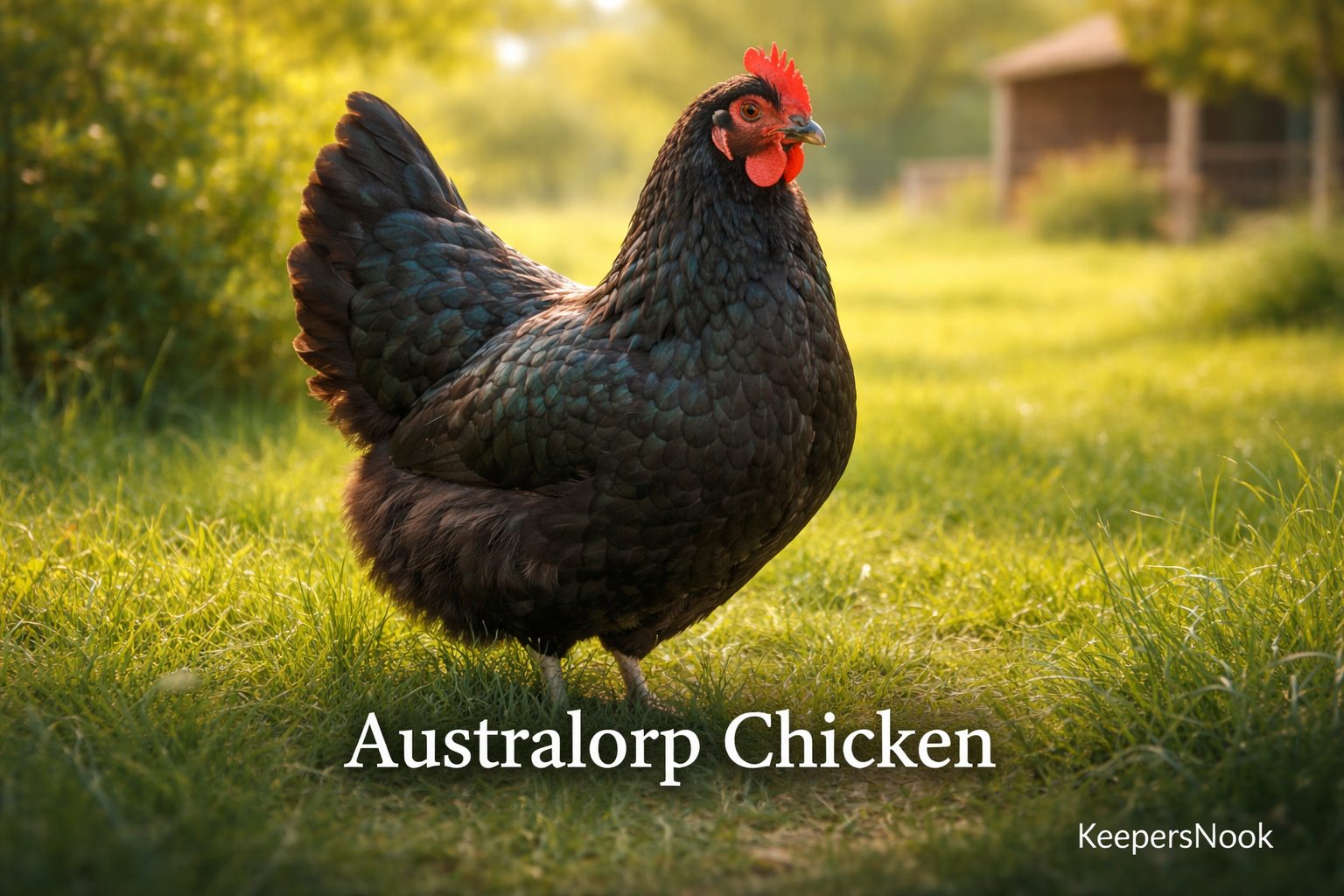
For flock nutrition and productivity, few breeds come close.
Developed in Australia from Black Orpington stock, the breed was purpose-built for output on working farms. The result is a hen that lays consistently, tolerates most climates, and stays calm enough for beginners to manage without frustration.
Australorp Egg Production: 364 Eggs in 365 Days and Still the World Record
In 1922, a team of six Australorps at a trial in Geelong, Victoria, Australia averaged 309.5 eggs per hen over 365 days. The top bird in that trial laid 364 eggs in 365 days.
Remember it later
Planning to try this recipe soon? Save it for a quick find later!
That record has never been officially broken by another breed.
Modern hatchery-sourced Australorps won't all match that peak, but a well-fed hen in her first two laying years will reliably deliver 250-300 large brown eggs per year. That is five to six eggs per week without pushing the bird.
Production holds strong from spring through fall. Australorps don't stop completely in winter, though output drops by roughly 30% during short days unless you supplement with 14-16 hours of artificial light.
A simple timer and a warm-white LED on the coop circuit is all it takes to maintain production through the darker months.
Hens typically lay for five to seven years, with peak output in years one and two. By year three, expect around 200 eggs annually.
That is still solid for a dual-purpose heritage breed.
Egg size is large to extra-large, and shells are consistently firm. Yolk color depends on diet.
Hens with access to pasture produce darker yolks than confined birds on pellets alone.
If you want to compare laying performance across top breeds, our guide to top laying breeds puts the numbers side by side in one place.
Australorp Origin: Built in Australia from Orpington Foundation Stock
The Australorp's name combines "Australian" and "Orpington," which tells the story directly. Australian breeders in the early 1900s imported Black Orpington stock from England and crossed it selectively with Minorca, White Leghorn, and Langshan bloodlines over several generations.
The goal was simple: keep the Orpington's docile temperament and meat yield, then sharpen the laying output until the bird could compete commercially. By 1920, the resulting breed was outperforming the Orpingtons it descended from by a wide margin.
The Australorp was formally recognized by the American Poultry Association in 1929 under the black variety. Blue and white varieties exist in Australia and the United Kingdom, but black remains the only APA-recognized color in the United States and the most common variety worldwide.
The Rhode Island Red took a similar path on the American side, breeding for dual-purpose output from working stock. Both breeds reflect a pre-industrial era when every bird on a farm had to earn its feed through eggs and eventually meat.
Australorp Appearance: Beetle-Green Sheen on Solid Black Plumage
The Australorp's most striking feature is its plumage. Jet-black feathers carry an iridescent beetle-green sheen in direct sunlight, one of the more dramatic looks in backyard poultry.
The sheen appears most clearly in bright outdoor light and disappears in shade.
The body is deep and rounded, with a full, broad breast that reflects the dual-purpose origins. There is enough mass to be useful as a meat bird while the reproductive system was optimized for laying.
| Feature | Detail |
|---|---|
| Plumage color | Black with beetle-green iridescent sheen |
| Comb type | Single, upright, 5-7 points |
| Skin color | White |
| Leg color | Dark slate to black |
| Eye color | Dark brown |
| Hen weight | 6.5-8 lb |
| Rooster weight | 8.5-10 lb |
| Body type | Deep, rounded, full-breasted |
| APA recognition | Yes (black variety, 1929) |
| Egg color | Light to medium brown |
The single upright comb has five to seven defined points. It is the primary vulnerability in freezing temperatures.
Combs on Australorps tend to be moderate in size, not as tall as a Leghorn's, but tall enough that frostbite protection matters in hard winters.
If you're weighing the Australorp's build against a similarly sized heritage breed, our notes on the Plymouth Rock cover a bird with a comparable dual-purpose profile but a slightly different production curve.
Australorp Temperament: Calm, Quiet, and Easy to Handle
Australorps are one of the gentler heavy breeds. They are not skittish or flighty, and most hens will take food from your hand within a few weeks of consistent interaction.
The breed's calm baseline makes them forgiving of handling mistakes that would stress higher-strung production breeds.
In a mixed flock, Australorps typically settle into the mid-range of the pecking order without aggression. They don't bully smaller breeds the way assertive Rhode Island Reds sometimes do, and they hold their own without retreating from more dominant birds.
Roosters are generally calmer than those of production-focused breeds, though individual temperament always varies. If you are in a no-rooster zone, Australorp hens are among the quietest layers you can keep.
Their even temperament makes them one of the standout options in any first-flock recommendation. They tolerate management mistakes without punishing you for them, which matters when you're still learning the basics of flock care.
Australorp vs. Similar Breeds: 4 Direct Comparisons
Australorps sit in a specific position: dual-purpose capability with production-class laying numbers. Not every breed that looks similar delivers the same combination.
Here is how the Australorp compares to four commonly weighed alternatives.
The Rhode Island Red and Australorp produce nearly identical egg counts: 250-300 per year in peak seasons. The RIR is slightly more assertive in temperament and tends to rank higher in the pecking order.
Australorps are calmer and better suited to mixed flocks with gentler breeds.
Heat tolerance is roughly equal. Cold hardiness slightly favors the RIR in extreme wet-cold climates because Rhode Island Reds have thicker plumage density.
Both breeds perform well with standard management.
If temperament is your top priority alongside production, the Australorp edges the Rhode Island Red for beginners. If you want a bird that asserts itself in a large mixed flock, the RIR holds its own more confidently.
The White Leghorn lays more eggs: 280-320 per year in peak production, with better feed efficiency per egg because of its smaller 4.5 lb body. The Leghorn converts feed to eggs at roughly 0.28-0.32 lb per egg.
The Australorp runs 0.35-0.38 lb.
The gap in temperament is significant. Leghorns are flighty, noise-sensitive, and difficult to handle.
They stress easily in confined setups. Australorps are calm and adapt to confinement without behavioral problems.
If pure egg-count efficiency is the only goal, the per pound of feed. If you want a bird you can manage easily and that pulls double duty for meat, the Australorp wins.
The Sussex is another calm, dual-purpose heritage breed with a similar temperament profile to the Australorp. Sussex hens lay 250-275 eggs per year on average.
The Australorp outproduces it by 25-50 eggs annually at the high end.
Sussex birds come in more color varieties (Light, Speckled, Red). The Light Sussex in particular has a striking appearance that many keepers prefer aesthetically.
Both breeds integrate well in mixed flocks.
The Sussex breed is a strong alternative if you want similar temperament and slightly more visual variety. The Australorp wins on raw production numbers.
The Barred Plymouth Rock lays 200-280 eggs per year. The Australorp's floor of 250 and ceiling of 300 consistently beat Plymouth Rock averages.
Both breeds are calm, dual-purpose, and good for beginners.
Plymouth Rocks handle cold slightly better because their feathering is denser and their comb is lower-profile in some strains. The Australorp's black plumage absorbs more heat in summer, giving the Plymouth Rock a marginal edge in hot climates.
If your winters are hard and your summers are moderate, the Plymouth Rock is a reasonable choice. If you want the highest production from a heritage breed, the Australorp is the pick.
The Australorp's combination of temperament and production output is genuinely difficult to beat in a single heritage breed. The tradeoffs are real but manageable with basic planning.
Australorp Heat and Cold Hardiness: What the Ratings Actually Mean
Australorps carry a "dual hardy" rating in most breed guides, meaning they tolerate both heat and cold. That rating is accurate, but it requires context to apply correctly.
On the cold side, Australorps handle freezing temperatures without difficulty. Their single comb is the main vulnerability.
Frostbite on comb tips occurs when temperatures drop below 20°F and coop humidity is high. A well-ventilated, dry coop prevents most frostbite even in deep winter.
On the heat side, the black plumage changes the equation. Black feathers absorb solar radiation.
A hen standing in full sun at 90°F is experiencing a much higher surface temperature than the air reading suggests. This is the tradeoff that "heat tolerant" ratings don't always capture clearly.
Provide shade covering at least 50% of the run during summer. Multiple water stations kept fresh and cool make a measurable difference in production and bird health above 85°F.
Australorp Coop Setup: 4 Sq Ft Per Bird for Consistent Output
Australorps are medium-to-large birds. Give them adequate space and they reward you with consistent production.
Crowd them and output drops, stress rises, and feather pecking starts.
Their wide-bodied build matters for roost bar sizing. A standard 8-inch allocation per bird that works for Leghorns is not enough for an Australorp.
Plan for 12 inches per bird on the roost bar.
Australorps are capable foragers. Giving them access to range, even a few hours daily, reduces feed costs and keeps hens mentally active.
Enrichment prevents vices in confined setups: hang cabbage, provide a dust bath area, and rotate scratch feeding locations.
For a complete build walkthrough including lumber dimensions, hardware cloth gauge, and predator-proofing, our coop setup guide covers the full process step by step.
Feeding Australorps: Fueling 300 Eggs Per Year
A 300-egg year demands nutritional consistency. Layer pellets at 16-18% protein with 3.5-4% calcium form the foundation.
Free-choice oyster shell on the side keeps shells firm without over-calcifying the main feed mix, which can cause kidney stress if calcium is too high.
Treats should stay below 10% of daily intake. High-volume, low-nutrition treats displace the protein and calcium the bird needs during peak laying.
Stick to options with genuine nutritional value.
- Safe fruit treats: blueberries (antioxidants, low sugar), grapes (limit to a few per bird), strawberries (vitamin C, low calorie)
- Protein supplements: Mealworms, scrambled eggs, black soldier fly larvae. Useful during molt when feather regrowth competes with laying for protein
- Greens and produce: Leafy greens, squash, cucumber. These add hydration and micronutrients without displacing pellet intake significantly
- Grit: Provide free-choice insoluble grit if birds don't have access to natural soil and gravel. Required for grinding whole grain or scratch
During molt, which typically runs 6-8 weeks in fall, drop the layer pellets and increase protein to 20%+. Feather regrowth is protein-intensive.
Pushing standard layer feed through molt delays regrowth and prolongs the off-lay period by weeks.
Australorps convert feed to eggs efficiently relative to their body size. A 7 lb Australorp hen producing 280 eggs per year uses approximately 0.35-0.38 lb of feed per egg.
This is competitive with smaller production breeds despite the larger body mass.
By comparison, a White Leghorn at 4.5 lb producing 300 eggs uses roughly 0.28-0.32 lb per egg. The Australorp's dual-purpose body adds overhead, but the difference is smaller than most keepers expect.
The Rhode Island Red runs similar dual-purpose ratios: roughly 0.36-0.40 lb per egg at production weight. The Australorp is not a feed-to-egg optimizer at the level of a Leghorn, but it is among the most efficient heritage breeds available.
The practical takeaway: the Australorp costs slightly more to feed than a Leghorn per egg produced, but you get a calmer bird, better meat yield, and a longer productive lifespan in exchange for that overhead.
Water intake increases sharply above 85°F. A single Australorp hen drinks roughly 500-700ml per day under normal conditions and significantly more in heat.
Multiple clean water stations prevent production dips during hot stretches.
Australorp Health: Hardy Heritage Stock with Few Genetic Issues
Australorps are one of the healthiest heritage breeds in production today. Decades of practical breeding focused on function, not show-ring aesthetics, kept the gene pool from accumulating the structural problems that affect some exhibition lines.
Expected lifespan is 8-10 years. Most hens remain active and healthy through their laying years with basic care and annual deworming.
- Heat stress: Primary risk for black-feathered birds in summer. Shade, cool water, and frozen treats mitigate it. Monitor for panting and wing-spreading above 90°F
- Frostbitten combs: Single comb exposed in wet-cold conditions. Petroleum jelly before hard freezes and a dry coop solve it
- Marek's disease: Vaccinate at hatch. Standard practice with hatchery chicks but worth confirming with your supplier
- External parasites: Mites, lice, and scaley leg mites affect all breeds. Check under wings and around the vent monthly. Dust baths with wood ash or diatomaceous earth reduce loads naturally
- Respiratory infections: Mycoplasma gallisepticum and infectious laryngotracheitis spread through new stock. Quarantine all incoming birds 30 days minimum before introducing them to your flock
The 30-day quarantine practice alone prevents most disease introductions. It is the single highest-return health practice you can implement for any flock expansion.
Egg binding is uncommon in Australorps but possible in first-year layers still developing their reproductive cycle. Signs include a hen straining in the nest box, lethargy, and fluffed feathers.
A warm soak bath and calcium supplement usually resolve it. Contact a vet if the egg does not pass within 24 hours.