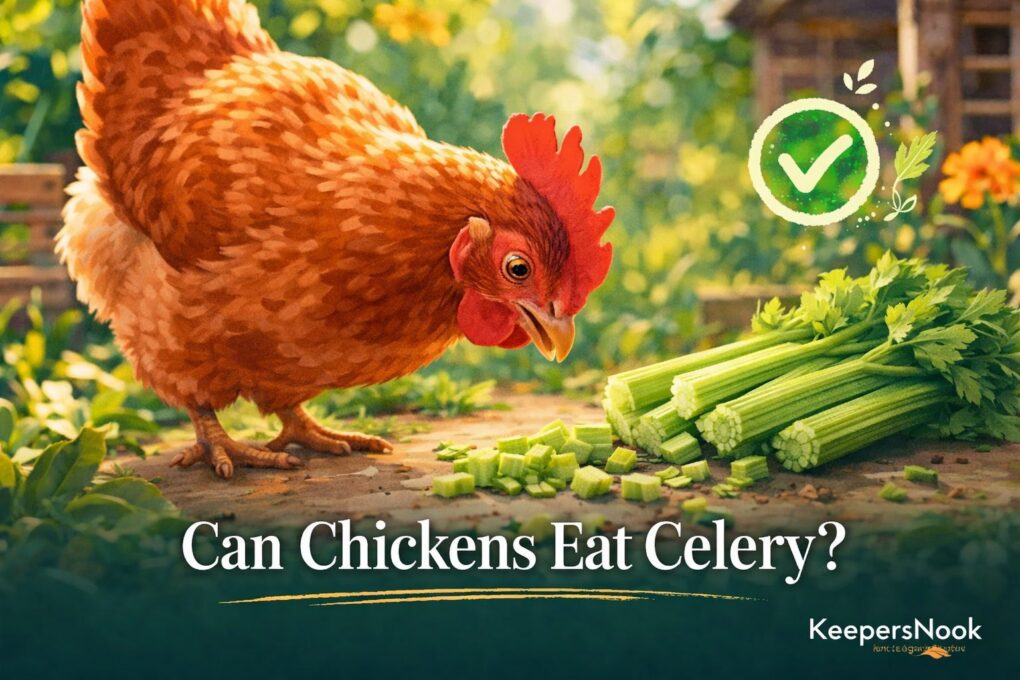
Celery is a kitchen staple, and the scraps pile up fast. Before you toss those stalks into the run, flock enrichment basics tell us one thing: not all safe foods are equally safe in their raw form.
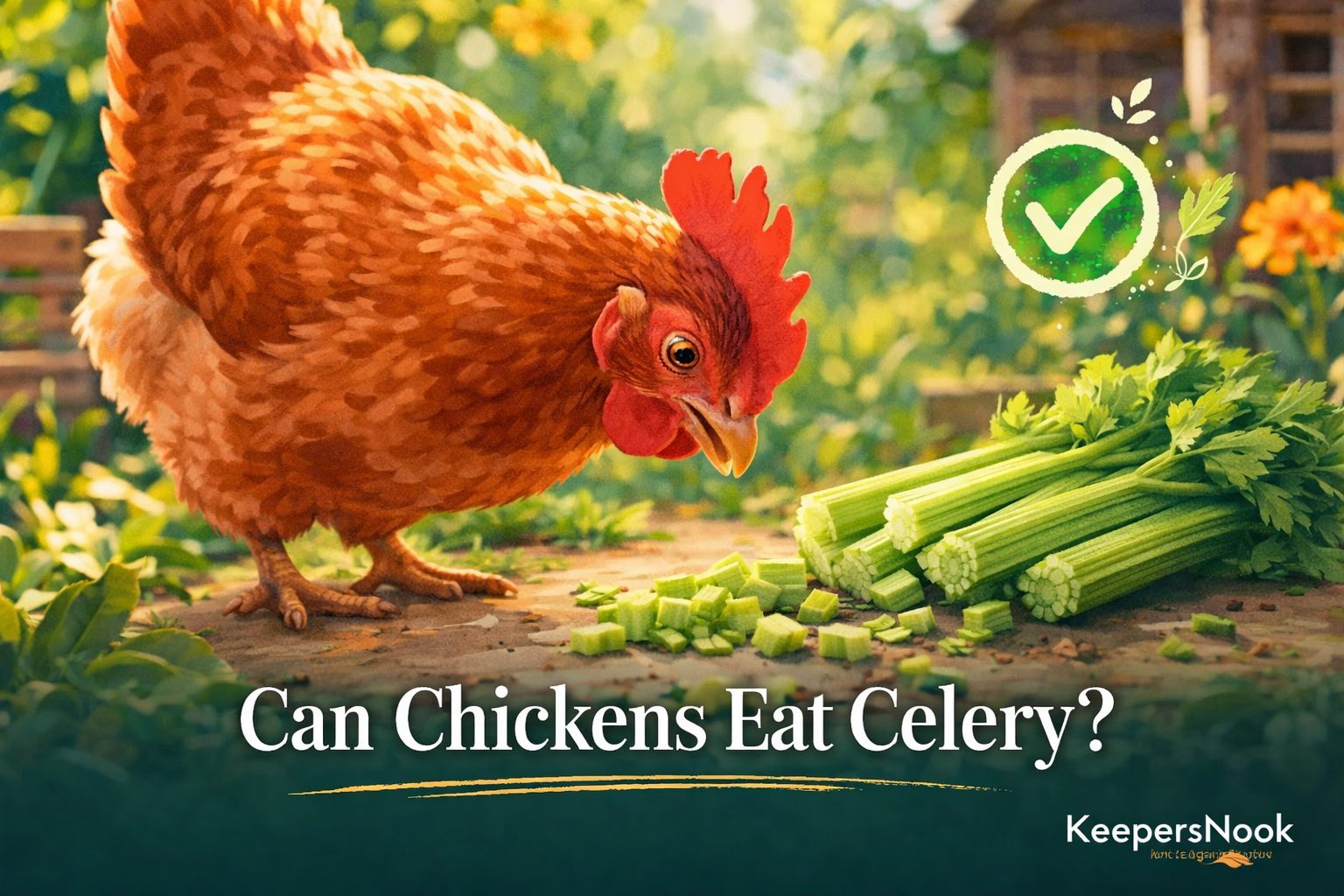
Celery falls into that category. It is non-toxic, but it requires thirty seconds of prep to eliminate a real risk.
This guide covers the string hazard, how to prep celery correctly, how much to feed, and what the leaves offer versus the stalks.
Why Celery Strings Put Chickens at Risk: Crop Impaction in 2 Steps
Celery stalks contain vascular bundles called collenchyma fibers. These are the strings you feel when you pull a stalk apart lengthwise.
Remember it later
Planning to try this recipe soon? Save it for a quick find later!
In humans they are a mild annoyance. In chickens they are a mechanical hazard.
Chickens do not chew. They tear off a piece and swallow it whole, relying on the crop and gizzard to break things down.
A long celery string swallowed intact can wrap around partially digested feed inside the crop, binding material together into a dense mass the bird cannot pass. That is crop impaction.
It stops normal digestion and, left untreated, is fatal.
Crop impaction from celery strings is not theoretical. Backyard keepers report it regularly on poultry forums, and poultry veterinarians list fibrous vegetables as a leading cause of non-infectious crop problems.
The fix is not avoiding celery. It is chopping it correctly, which takes under a minute.
Grated carrots outperform chopped celery on nutrition per prep-minute, but both require the same basic mechanical awareness before feeding.
Celery Leaves vs. Stalks for Chickens: Which Part Wins on 3 Nutrients
The stalk and the leaf are two different foods in terms of both safety and nutrition.
Stalks are roughly 95% water with trace amounts of vitamin K, potassium, and folate. They deliver hydration and a modest fiber load.
The string risk is the only drawback, and it disappears with correct prep.
Leaves carry significantly higher concentrations of vitamin C, vitamin K, and plant antioxidants than the stalk by weight. They are softer in texture.
They contain no long fibrous strings and can be scattered directly into the run without any cutting.
| Nutrient | Stalk | Leaf | Notes |
|---|---|---|---|
| Water | 95% | ~88% | Both are hydrating treats |
| Vitamin K | 29 mcg | ~80 mcg | Leaves deliver nearly 3x more |
| Vitamin C | 3.1 mg | ~12 mg | Leaves are the clear winner |
| Potassium | 260 mg | ~280 mg | Roughly equal between both |
| String risk | High (uncut) | None | Leaves are unconditionally safe |
If you have the choice between feeding only stalks or only leaves, prioritize the leaves. They are safer and more nutritious.
In practice, feed both: leaves as-is and stalks after a quick crosswise chop.
Heavy-bodied breeds like the Plymouth Rock eat quickly and in large gulps. Grating the stalk rather than just chopping it adds a second layer of protection for fast eaters.
How to Chop Celery for Chickens: Break Every String in Under 60 Seconds
The technique matters. Lengthwise cuts leave strings intact.
Crosswise cuts sever every string into short segments that pass through the crop without binding.
Celery prep is straightforward once you have done it once. The key is building the habit before the vegetable ever reaches the run.
a knife in half and is the lowest-prep hydrating treat in the rotation. On days when you want something faster, watermelon is the better call.
How Much Celery Can Chickens Eat? Serving Sizes for 3 Flock Sizes
Celery is low in calories, high in water, and delivers no meaningful protein or fat. It belongs in the treat category, not the feed category.
All treats combined should stay at or below 10% of total daily feed intake. A standard hen eats 120-130 grams of layer pellets per day, leaving 12-13 grams for treats.
- Small flock (3-4 hens): 1 stalk, twice per week, is sufficient and safe.
- Medium flock (6-10 hens): 2-3 stalks per session, two times per week. Scale leaves proportionally.
- Large flock (15+ hens): 5-6 stalks twice per week. Scatter pieces widely so dominant birds cannot monopolize.
These numbers assume celery is the only treat that day. If you are also feeding higher-sugar grapes or other fruit, reduce the celery serving accordingly.
Stagger high-moisture treats across the week rather than stacking them in a single day. Celery and plain cooked rice make a better same-day pairing than celery and watermelon, where the combined water load can temporarily loosen stools.
Signs of Crop Impaction: What to Watch After Feeding Celery to Chickens
Even with proper prep, it is worth knowing the signs of a crop problem. Impaction can occur from any fibrous material, and early detection matters.
A healthy crop empties overnight during the bird's sleeping fast. An impacted crop does not empty.
You can check by gently feeling the crop area at the base of the neck in the morning, before the bird has eaten.
- Hard or doughy crop 12+ hours after last meal: The primary indicator. Normal crops feel empty by morning.
- Loss of appetite: A bird that avoids feed when others are eating has a gut problem until proven otherwise.
- Lethargy and ruffled feathers: Consistent across most systemic problems. Combine with the crop check.
- Foul-smelling breath: Fermenting crop contents produce a sour odor. This is an advanced sign.
Contact a poultry vet if a bird shows two or more of these signs. Early-stage impaction can sometimes clear with massage and feed restriction.
Severe impaction requires veterinary intervention.
Prevention eliminates this entirely. A proper crosswise chop removes the risk before it can develop.
Breeds that eat aggressively, including high-production layers like the Rhode Island Red, benefit most from grating instead of chopping, since they swallow quickly and in larger pieces.
How Celery Compares to Other Common Treats Chickens Eat
Celery sits in the middle tier of chicken-safe treats: more nutritious than bread, less nutritious than leafy greens, easier to prep than most root vegetables.
- Safer than celery: Watermelon (no strings, no prep), grapes, blueberries, cooked egg.
- Comparable prep to celery: Carrots require grating or cooking; same level of effort, higher nutritional yield.
- Unconditionally avoided: Avocado flesh and pit contain persin, which causes cardiac damage in poultry. No safe serving size exists.
Celery earns its place in the rotation as a low-calorie, hydrating option that most hens accept readily. The string hazard is real but entirely manageable.
Cucumber: High water content, soft flesh, no string risk. Safe to feed in chunks with no prep beyond a lengthwise slice to expose the flesh.
Zucchini: Soft texture, seeds are edible. Slice in half and let the flock tear it apart.
No choking concern.
Cooked green beans: Raw green beans carry fibers similar to celery. Cooking softens them fully and removes the mechanical risk.
Serve warm, not hot.
Cooked sweet potato: Dense and starchy raw. Cooked, it breaks apart easily and is one of the best beta-carotene sources in the kitchen-scrap category.
Any of these work well on days when you want a fibrous treat without the crosswise-chop prep requirement of celery.
If you are building a treat rotation for a new flock, starting breeds for beginners often tolerate a wider treat range than high-production hybrids. Dual-purpose breeds are generally less food-motivated and eat more deliberately.
High-output layers like those covered in top egg-laying breed guides need to keep 90%+ of their diet as layer feed to maintain production. Treats are a supplement, not a category.