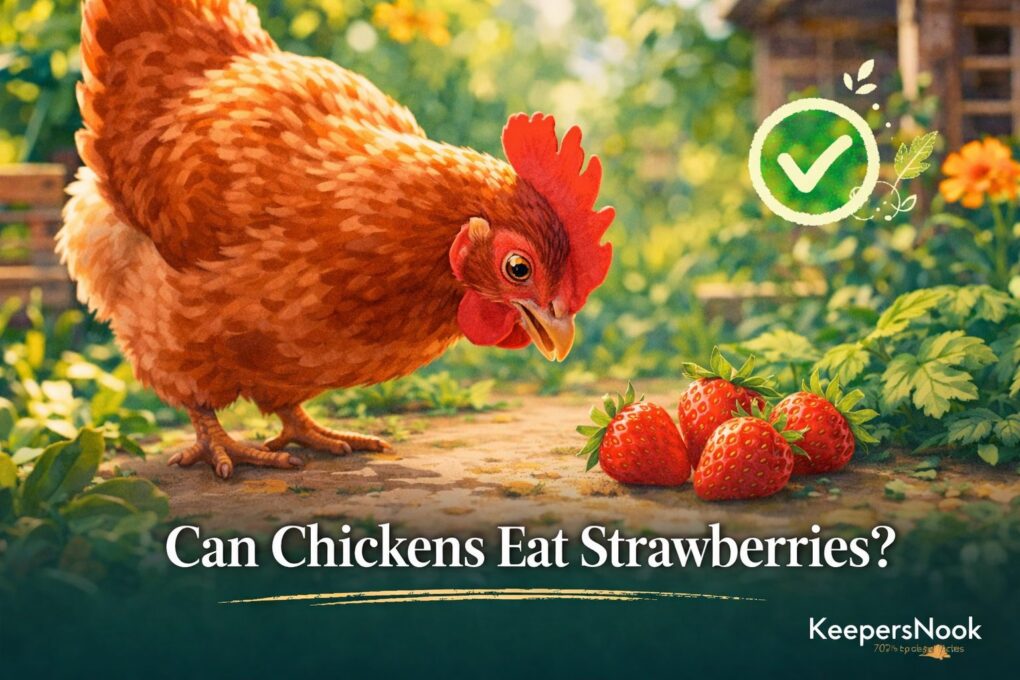
Strawberries are one of the cleanest fruit treats you can add to your poultry feeding rotation. Unlike some produce that requires careful part-by-part inspection, every component of the strawberry plant that your hens are likely to encounter is safe.
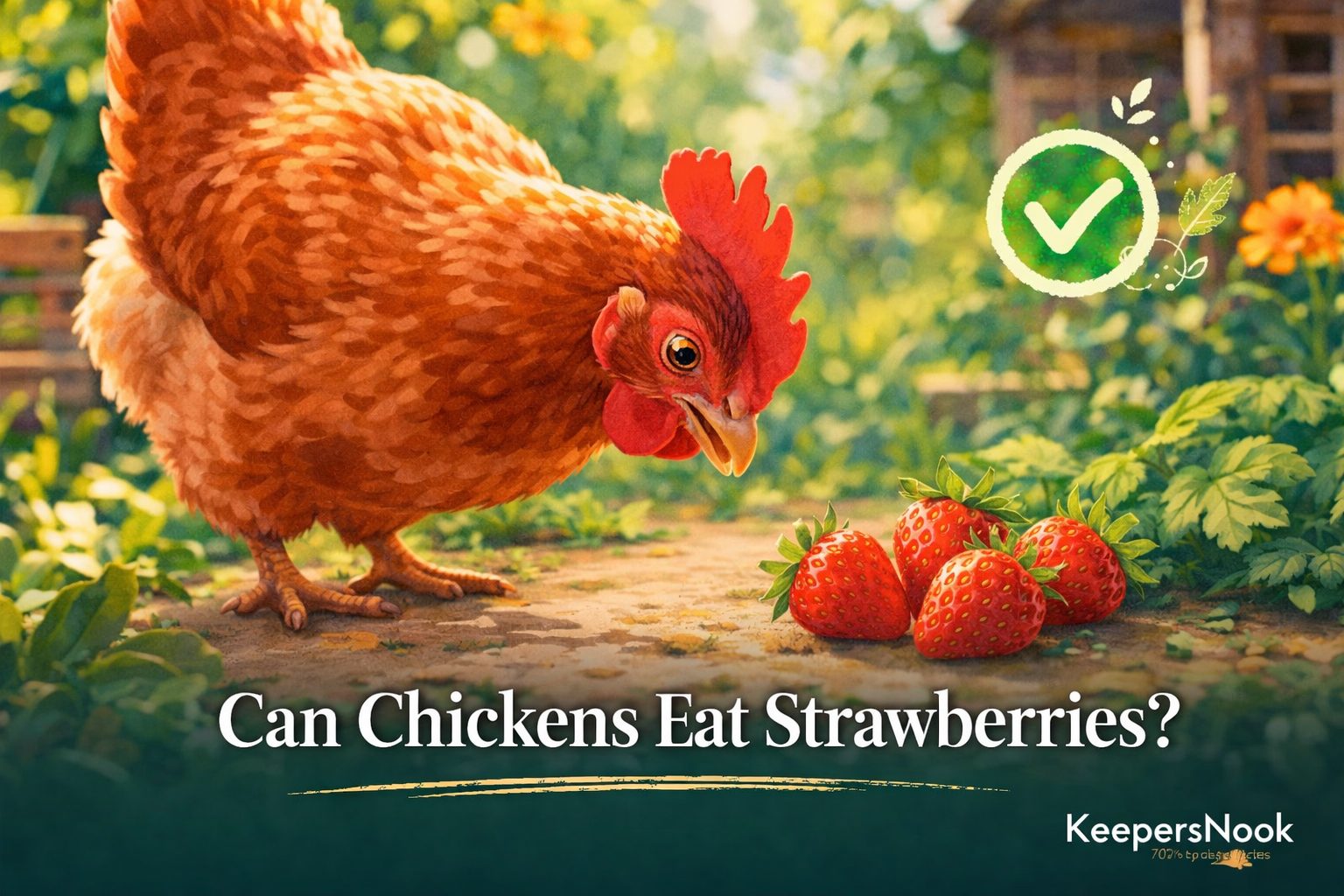
The red flesh, the small embedded seeds, and the leafy green tops all pass the same test: no toxins, no glycoside concerns, no compounds known to harm poultry.
The two real-world concerns are pesticide residue on commercially grown fruit and excess sugar if portions drift higher than the recommended range. Both are easily managed.
Which Strawberry Parts Can Chickens Eat? All 3 Components
Unlike avoiding green tomato parts for solanine risk, strawberries require no selective feeding. The entire plant part your chickens encounter at pick time is non-toxic.
Remember it later
Planning to try this recipe soon? Save it for a quick find later!
The green tops that most gardeners hull before eating are fully edible for poultry. Most hens peck them off first or eat berry and top together in a single bite.
- Flesh: High water content (91%), low sugar (4.9g per 100g), vitamin C at 59mg per 100g.
- Seeds: Tiny embedded achenes. No toxic compounds, no choking risk for standard birds.
- Green tops: Non-toxic hull and small leaves. Most hens eat them without hesitation.
The only part worth removing before feeding is visibly moldy fruit. Mold on soft berries produces mycotoxins that cause digestive damage in poultry.
Anything with white or gray fuzz goes in the compost, not the run.
For keepers who also feed lower-prep grape varieties, the safety profile is comparable: no part-specific exclusions, just attention to portions and freshness.
Pesticide Risk in Strawberries: Why Washing Matters for 22+ Residues
Strawberries consistently rank in the top three of the Environmental Working Group's annual pesticide load testing. Conventionally grown commercial berries have tested positive for 22 or more distinct pesticide residues in a single sample.
Chickens eat the entire berry, skin included. They get the full surface pesticide exposure that a human peeling their fruit would largely avoid.
Garden-grown strawberries treated with organic-approved inputs are the lowest-risk option. If you grow your own, your birds benefit from fruit with minimal external contamination.
The pesticide concern for strawberries parallels the consideration for washing blueberries before serving: commercially grown soft fruit receives heavy treatment, and a quick rinse is a low-effort habit that meaningfully reduces exposure.
How to Serve Strawberries to Your Chickens
Strawberry prep is minimal. The steps below take about 90 seconds per serving and eliminate the two controllable risks: surface contamination and competition between birds.
Scattering works better than a single pile. It forces every bird to cover ground, supports natural foraging behavior, and prevents one dominant hen from controlling access.
The cleanup step is the one most keepers skip. Unlike grain treats that dry out and stay stable, strawberries ferment within a few hours on a warm day.
Fermented soft fruit causes loose droppings and digestive upset. Set a timer if you tend to forget.
Prep complexity for strawberries is lower than for fibrous vegetables. Serving cooked vs.raw rice involves more preparation decisions.
Strawberries just need a rinse and a cut.
How Many Strawberries Can Chickens Eat Per Day? The 10% Limit
Strawberries are a treat, not a nutritional staple. All treats combined should stay under 10% of a hen's daily food intake.
A standard laying hen eats roughly 120 grams of feed per day. Ten percent is 12 grams for treats.
One medium strawberry weighs about 12 grams, so the 10% rule puts the ceiling around 2-3 medium berries per bird per feeding session.
- Standard hens: 2-3 medium berries per session, 2-3 times per week.
- Bantams: 1-2 berries per session. Halved to manage portion size.
- Pullets under 16 weeks: Limit to 1 berry per session. Growth nutrition takes priority over treat variety.
Spacing sessions 2-3 times per week rather than daily keeps strawberries as a variety item, not the default treat. Variety matters because no single fruit covers the full micronutrient spectrum your flock benefits from.
Compare the sugar load against other common treats: strawberries at 4.9g of sugar per 100g sit far below the sugar density of hydrating watermelon servings that still clock lower overall because of larger water content, and well below banana pieces that deliver 14g of sugar per 100g.
Strawberry Nutrition for Chickens: 59mg Vitamin C per 100g
| Nutrient | Amount | Benefit for Chickens |
|---|---|---|
| Water | 91g | Hydration support, especially in summer heat above 85°F |
| Vitamin C | 59mg | Antioxidant buffer during heat stress; endogenous production drops under high temps |
| Sugar | 4.9g | Quick energy; low relative to most fruit treats |
| Manganese | 0.39mg | Supports bone development and eggshell integrity |
| Folate | 24mcg | Cell division; relevant during molt and active feather regrowth |
| Anthocyanins | 25-35mg | Anti-inflammatory antioxidants; minor immune support |
Chickens synthesize their own vitamin C under normal conditions, so dietary supplementation is not strictly required. During periods of heat stress above 85°F, endogenous synthesis drops, and the birds benefit from dietary sources.
Anthocyanins are the pigment compounds that give strawberries their red color. They act as antioxidants in tissue, and while poultry-specific research is limited, the compounds are non-toxic and well-established as beneficial across mammalian biology.
The real nutritional headline for strawberries is the combination of high water content and low sugar at the same time. Most high-hydration fruits trade high sugar for that water.
Strawberries do not.
For breeds with exceptional production demands, 280 eggs per year need consistent layer feed protein and calcium as their nutritional base. Strawberries as a 2-3x weekly treat add enrichment and micronutrient variety without threatening that base.
How Strawberries Compare to Other Chicken-Safe Fruits
Understanding how strawberries compare to other common fruits helps build a rotation that maximizes variety without stacking too much sugar on any single day.
- Blueberries: 10g sugar per 100g. Higher than strawberries but lower than most fruit. No toxic parts. prep beyond a rinse.
- Grapes: 16g sugar per 100g. Among the highest sugar of common flock treats. Safe including seeds and skin. Cut for bantams.
- Watermelon: 6g sugar per 100g but very high water. Good summer cooling treat at larger volumes. Rind is also edible.
- Bananas: 14g sugar per 100g. Higher sugar load means smaller portions. Peel is rarely eaten but not toxic.
- Strawberries: 4.9g sugar per 100g. Lowest sugar of this group. Highest vitamin C. Safe in all parts.
Rotating across the list gives your flock a broader antioxidant and micronutrient profile than any single fruit provides. Strawberries sit at the low-sugar end, which makes them a strong default option for keepers who want to offer fruit treats without managing tight sugar limits.
One food to exclude entirely: avoiding avocado is the highest-priority exclusion in any chicken feeding context. Persin in avocado skin, flesh, and pit causes cardiac damage in poultry.
For keepers selecting breeds that handle treat variety well, Sussex hens are often cited by small flock owners for their calm foraging temperament. They tend to eat methodically rather than rushing, which reduces the competitive pecking that makes treat scattering less effective with more aggressive breeds.
If you are still selecting your flock, choosing beginner-appropriate breeds that tolerate heat and have moderate production demands gives you more flexibility in treat variety without the tight calorie accounting that high-production layers require.
Breed-Specific Strawberry Feeding Notes for 3 Common Chickens
Most feeding guidelines apply uniformly across breeds, but body size and production rate create real differences in how much treat budget each bird carries.
- Rhode Island Red (6-8 lbs): High production layer. Standard 2-3 berry portion. Monitor that layer feed consumption stays consistent on treat days.
- Orpington (7-10 lbs): Heavy breed with a docile temperament. Slightly larger treat budget by body weight, but the lower production rate means calcium and protein displacement from treats is less immediately visible. Keep to standard portions.
- Sussex (7-9 lbs): Dual-purpose bird with moderate production. Handles treat variety well. Similar portion guidelines to Rhode Island Red.
Bantam keepers should scale down: 1-2 berries per session, halved, at the same 2-3x per week frequency. Body size, not temperament, drives the portion adjustment.
Orpington owners managing heavier birds sometimes notice treats disappearing faster because of the breed's size and calm confidence at the feeder. Scattering rather than piling still works, but wider scatter distance helps ensure smaller or lower-ranked birds get their share.