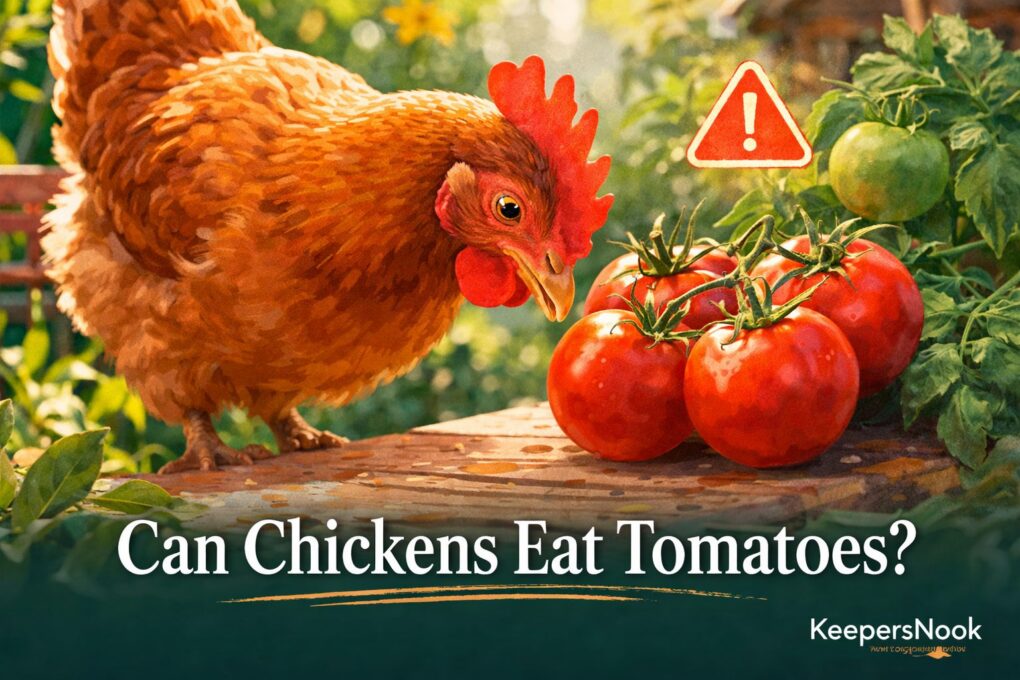
Tomatoes are one of the most common garden scraps people want to share with their flocks, and flock nutrition questions about nightshades come up constantly. The answer is conditional: the ripe red fruit is fine, and the green parts of the plant are not.
The distinction matters because tomatoes belong to the Solanaceae family. Every green part of the plant, including the stems, leaves, calyx, and unripe fruit, carries solanine and tomatine, two glycoalkaloids that are toxic to poultry at sufficient doses.
What Parts of the Tomato Are Safe for Chickens?
Ripe red flesh is the safe zone. Once a tomato fully ripens, the plant's natural ripening process breaks down most of the tomatine to non-toxic levels.
Remember it later
Planning to try this recipe soon? Save it for a quick find later!
The fully red interior is nutritionally harmless and mildly beneficial for your birds.
Seeds inside a ripe tomato are safe to leave in. Unlike apple seeds or cherry pits, tomato seeds carry no cyanogenic compounds.
You do not need to deseed before serving.
Overripe or split tomatoes from the garden are still fine, provided they show no mold. Soft, cracked, or blemished ripe tomatoes that you would no longer eat yourself are among the best garden scraps you can offer.
This is a practical way to reduce waste and give your flock a treat at the same time.
- Ripe red flesh: safe, feeds freely in moderation
- Interior seeds: safe, no need to remove them
- Overripe tomatoes: safe as long as no mold is present
- Plain cooked tomatoes: safe when unseasoned and without additives
- Tomato juice: safe in small amounts, no added salt
Which Tomato Parts Are Toxic? The Green Parts Carry Solanine.
The stem and calyx (the green leafy cap attached to the fruit) carry the highest solanine concentration of any part of the plant. Even a small amount can cause digestive upset.
Always snap the stem and calyx off completely before offering tomatoes.
Leaves are dangerous at much smaller quantities than the fruit. If your chickens free-range near a tomato garden, fence off the plants.
Most birds will instinctively avoid the bitter foliage, but "most" is not "all," and you should not rely on avoidance behavior.
Green or partially green tomatoes contain significantly more tomatine than ripe ones. A tomato that is still streaked with green, even on a small patch of the skin, has not fully completed the ripening breakdown.
Cut away any green areas or skip the tomato entirely.
- Stems: highest solanine concentration, always remove
- Leaves: toxic at small quantities, fence off plants from free-range birds
- Green calyx: snap off before serving, every time
- Unripe green tomatoes: not safe, solanine has not yet broken down
- Seasoned tomato products: ketchup, tomato sauce, and canned tomatoes with salt or garlic are not appropriate for poultry
How to Prepare Tomatoes for Chickens: A 30-Second Prep Checklist
Preparation eliminates almost all risk. The process is simple and takes under a minute for a full flock's serving.
One prep note: do not leave tomato scraps in the run overnight. Soft fruits attract flies and begin to mold quickly in warm weather, creating a secondary health risk separate from solanine toxicity.
How Often Can Chickens Eat Tomatoes? Frequency and Serving Size by Flock
Tomatoes are a treat, not a dietary staple. The standard rule for all supplemental foods is that treats should make up no more than 10% of total daily intake.
Layer feed should always be the primary food source.
Tomatoes are low in protein and calcium, the two nutrients laying hens need most for consistent egg production. Feeding too many tomatoes, or substituting them for feed, leads to soft-shelled eggs and reduced output over time.
| Flock Size | Serving Size | Frequency | Notes |
|---|---|---|---|
| 2 to 3 birds | 1 small tomato | 2 to 3x per week | Quarter before serving |
| 4 to 6 birds | 2 small or 1 large tomato | 2 to 3x per week | Halve or quarter |
| 8 to 12 birds | 3 to 4 medium tomatoes | 2 to 3x per week | Can scatter pieces on ground |
| 12+ birds | Scale by 1 tomato per 3 birds | 2 to 3x per week | Watch that subordinate birds get access |
For context on how tomatoes compare to other fruits and vegetables your flock can eat, see safe grapes for chickens and strawberry seeds cause issues. Both follow similar conditional rules based on ripeness and prep.
Tomato Nutritional Profile: 5 Benefits in Ripe Flesh
Tomatoes provide modest nutritional value as a treat. They are not a superfood for poultry, but they are not empty calories either.
Below is the breakdown per 100g of raw ripe tomato flesh.
- Water content: 95%, makes tomatoes an effective hydration source during summer heat
- Vitamin C: 14mg per 100g, supports immune function and tissue repair
- Vitamin A: 833 IU per 100g, important for vision, skin, and respiratory health
- Potassium: 237mg per 100g, supports muscle and nerve function
- Lycopene: 2.6mg per 100g, an antioxidant with no proven poultry-specific benefit, but not harmful
Tomatoes are low in calories at 18 kcal per 100g and carry negligible protein and calcium. rice for carbohydrate variety is another option that similarly provides energy without displacing essential protein.
bread as a treat carries the same caution: fine occasionally, not as a substitute for layer feed.
Ripe tomatoes fed in appropriate amounts do not negatively affect egg production. The lycopene in tomatoes is a carotenoid, and high-carotenoid diets can deepen the yolk color slightly in laying hens, though the effect from tomatoes at typical treat quantities is minimal.
What does affect egg production negatively is overfeeding treats at the expense of layer feed protein and calcium. Keep tomatoes within the 10% treat limit and egg production will remain unaffected.
Signs of Solanine Poisoning: What to Watch for After Accidental Exposure
If a chicken eats green tomato plant material, stems, leaves, or unripe fruit, symptoms typically appear within 2 to 12 hours. The severity depends on how much was consumed relative to the bird's body weight.
Smaller breeds like a leaner body mass, may show symptoms faster and at lower doses than heavier breeds. Larger birds like Orpington breed characteristics provide some buffer by body weight, but no breed is immune to glycoalkaloid toxicity.
- Drooling or excessive wet mouth: early sign within 2 to 4 hours
- Loss of appetite: bird stops eating or drinking voluntarily
- Diarrhea: loose or watery droppings
- Weakness or difficulty standing: bird appears lethargic, reluctant to move
- Confusion or disorientation: stumbling, failure to respond to flock activity
- Labored breathing or tremors: severe exposure, requires veterinary attention immediately
For mild symptoms, remove the bird's access to the plant material and provide fresh, clean water. Activated charcoal from a farm supply store can help absorb residual toxin if given early.
Most garden-exposure cases are mild because chickens rarely consume enough foliage to reach dangerous levels before the bitter taste deters them.
For severe symptoms, labored breathing, tremors, or complete lethargy, contact a poultry-experienced veterinarian. Reds handle stress well compared to some heritage breeds, but that applies to environmental stressors, not toxin exposure.
All breeds should be treated with equal urgency.
How Tomatoes Compare to Other Common Treats: Feeding Safety at a Glance
Tomatoes are one of many fruits and vegetables chickens can eat conditionally. Understanding the category helps with planning what to offer throughout the week.
as a chicken treat is generally safer than tomatoes because there are no toxic plant parts to prepare around. grape feeding for chickens requires the same attention to serving size but has no toxic parts to remove.
The tomato is more prep-intensive than most fruits because of the green-parts rule, but that prep takes under a minute and eliminates the risk entirely.
For keepers still building their flock, the breed you choose affects how much garden-grazing access matters. Australorps are active foragers that will range widely and may encounter garden plants more than a confined breed.
to mixed feeding routines, including supplemental treats. And for newer keepers still deciding on a breed, that tolerate flexible diets are worth reviewing before finalizing your setup.