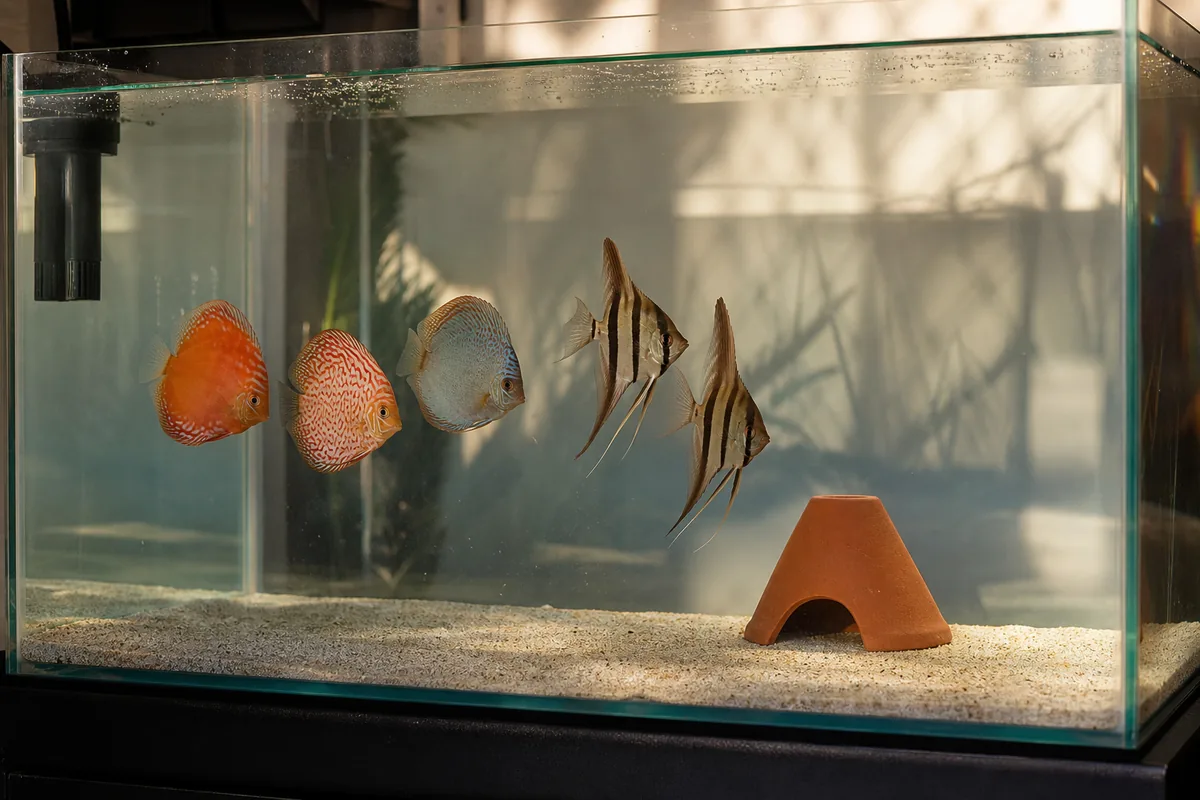
We see this question from keepers who have done their homework: same region, overlapping water chemistry, similar shape. The logic checks out on every point that does not matter.
The two points that do matter, disease transmission and feeding competition, are enough to make this a pairing we do not recommend, even for experienced keepers with large, well-filtered tanks.
Compatibility verdict
- Discus + AngelfishDependsDespite both being South American cichlids, angelfish are too aggressive and carry diseases that devastate discus.
The 40% figure reflects tanks where the keeper reports no immediate crisis. It does not reflect tanks where the discus are thriving.
A discus that is chronically stressed, underfeeding, or fighting early-stage hexamita does not always look sick to a keeper who has not kept discus before.
The disease vector alone is reason enough to avoid this pairing. The feeding competition is a second, independent reason.
Both exist simultaneously in every tank where these species are mixed.
Why Discus and Angelfish Seem Like a Match: 4 Points of Overlap
Both species are native to slow-moving, soft, warm, slightly acidic waters in the Amazon river system. That geographic origin is genuine, and it creates real parameter overlap that keepers notice when researching both species side by side.
The overlap is real. It is also insufficient.
- Geographic origin: both Symphysodon (discus) and Pterophyllum scalare (angelfish) are native to the Amazon basin and share soft, warm, acidic water as their natural environment.
- Water chemistry: both species do well at pH 6.0-7.0 and soft water below 8 dGH, so there is no forced chemistry compromise when housing them together.
- Temperature range: both species tolerate 82°F, which is within the acceptable range for each, though discus prefer the upper end and angels prefer the lower end of their respective ranges.
- Diet category: both are omnivores that accept high-protein pellets, frozen bloodworms, and live foods, so feeding logistics appear compatible on the surface.
These four overlaps explain why the pairing is so frequently attempted. A keeper building a biotope-accurate Amazonian tank sees two beautiful species that share the same water and the same feeding approach.
What the parameter sheet does not show is that one species is an asymptomatic carrier of pathogens that are lethal to the other.
Rummy-nose tetras are the most recommended discus companion in Amazonian community tanks. Our rummy-nose tetra care guide covers their exact temperature and water chemistry requirements, which align closely with what discus need.
Disease Transmission: Why Angelfish Are Lethal to Discus
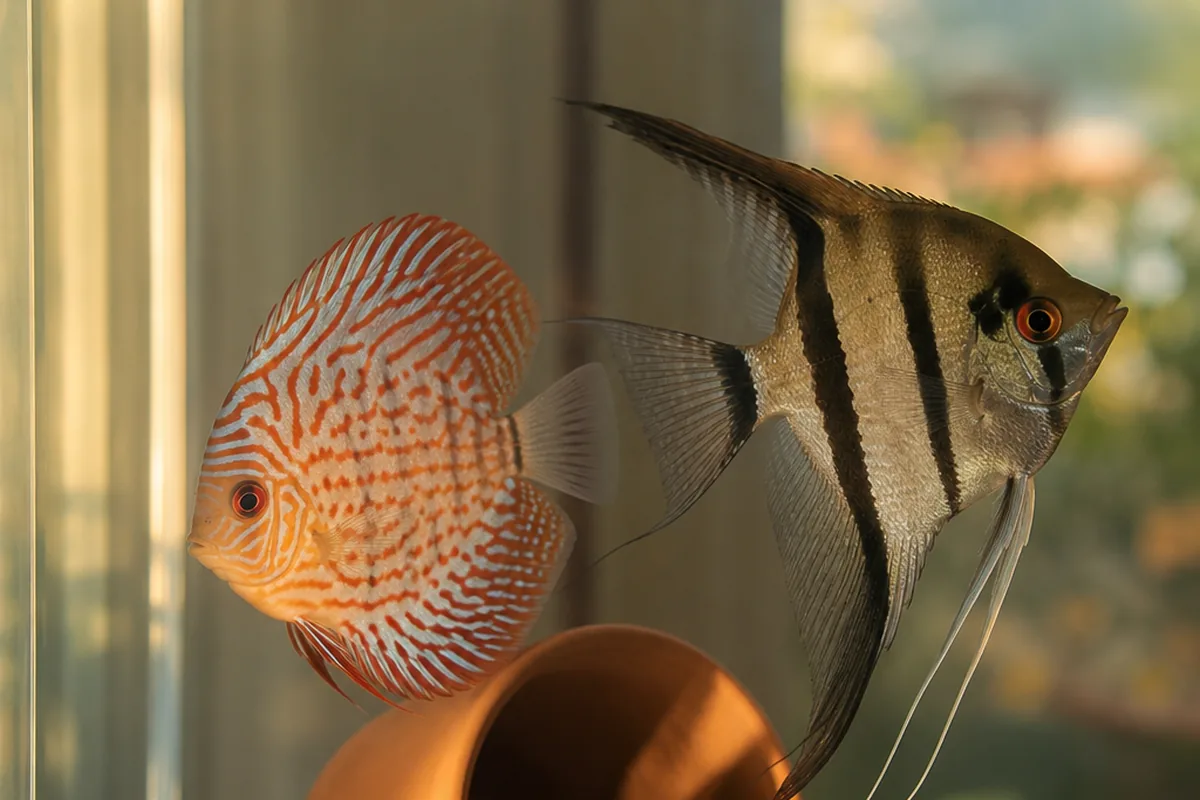
This is the primary reason experienced discus keepers universally avoid this pairing. Angelfish are asymptomatic carriers of two pathogens that are acutely dangerous to discus: angelfish herpesvirus and hexamita (Hexamita salmonis and related strains).
In angelfish these, these pathogens cause mild or subclinical disease that is easy to miss or mistake for minor stress. In discus, the same pathogens cause rapid deterioration, hole-in-the-head disease, and death at rates that catch keepers off guard.
- Angelfish herpesvirus: angelfish carry this virus as a latent infection with no external signs. Discus do not have the same immune tolerance and develop acute viral disease following exposure, often progressing faster than treatment can address.
- Hexamita: this protozoan parasite is widespread in angelfish populations at subclinical levels. Discus are significantly more susceptible to hexamita proliferation, and the stress of a shared tank with angelfish accelerates the progression from subclinical to clinical infection.
- Water-mediated transmission: both pathogens transmit through shared water. Physical separation within a tank does not reduce exposure. The angelfish does not need to make contact with the discus for transmission to occur.
The practical consequence is that a discus keeper who adds angelfish to an established discus tank is exposing every discus to pathogens they have no immunity against, introduced by a carrier that shows no signs of being sick.
This is not a risk that can be managed through tank size, water quality, or feeding routine. It is a biological incompatibility between these two species' disease profiles.
Cardinal tetras are another proven discus companion that tolerates the warm, soft Amazonian water discus require. Our cardinal tetra care guide explains why they are a safer and more reliable choice than neon tetras for high-temperature discus tanks.
Feeding Competition: Why Discus Lose Every Time
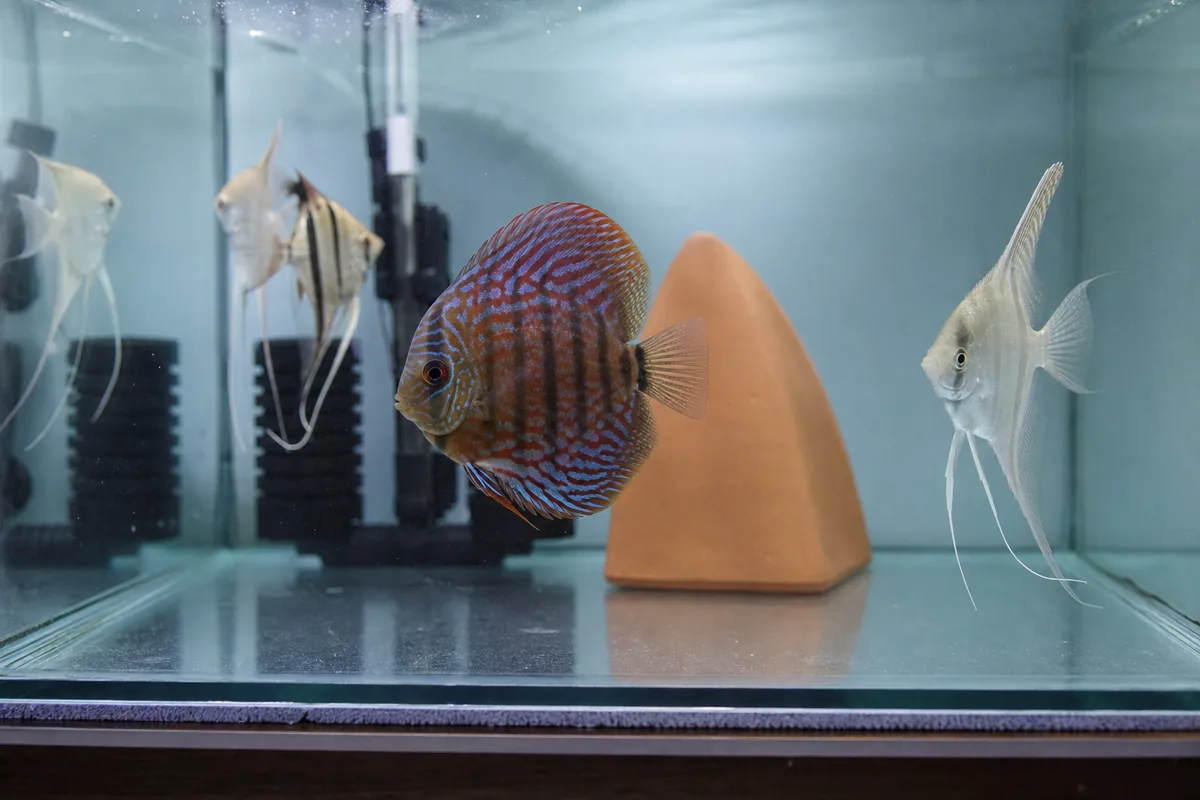
Even in a tank with no disease transmission, the feeding dynamic between these two species is a chronic problem. Discus are slow, deliberate, shy feeders.
Angelfish are faster, more assertive, and more competitive at the feeding zone.
In every mixed tank, the angelfish eat first, more often, and more completely. The discus get what is left.
Discus feeding behavior requires calm conditions. Discus approach food cautiously, particularly in established shoal-feeding routines that experienced keepers use to ensure every fish gets adequate nutrition. Any disruption to that calm, including an angelfish competing at the surface or mid-water feeding zone, causes discus to retreat and miss a meal.
Repeated missed meals compound quickly. Discus are metabolically demanding fish that require frequent feeding and consistent nutrition to maintain body condition and immune function. A discus that consistently misses portions of its meals due to angelfish competition begins losing body weight within weeks.
Weight loss in discus is a serious problem that accelerates disease susceptibility.
The angelfish aggression level at feeding time is not exceptional for a cichlid: it is normal cichlid feeding behavior. The problem is that normal cichlid feeding behavior is incompatible with what discus need to feed successfully.
Temperature Overlap Is Narrower Than It Looks
Keepers often point to the 82°F overlap as evidence of compatibility. That overlap exists, but it sits at the extreme ends of each species' preferred range rather than in the comfortable center for both.
| Parameter | Discus | Angelfish | Shared Range |
|---|---|---|---|
| Temperature (preferred) | 82-88°F | 75-82°F | 82°F only |
| pH | 6.0-7.0 | 6.0-7.5 | 6.0-7.0 |
| Hardness | 1-8 dGH | 3-8 dGH | 3-8 dGH |
| Minimum tank size | 75 gal (4-6 discus) | 30 gal (pair) | 75+ gal if attempted |
| Feeding style | Slow, cautious, shoal-dependent | Fast, assertive, competitive | Incompatible in practice |
| Disease tolerance | Low: highly susceptible | High: asymptomatic carrier | No safe overlap |
Running the tank at 82°F keeps discus at the cool edge of their comfort zone and angelfish at the warm edge of theirs. Neither fish is in its optimal range, and the discus is the one that suffers more from the compromise because discus immune function and digestion are temperature-sensitive in ways that angelfish physiology is not.
Angelfish Breeding Pairs Add Territorial Aggression
Angelfish that form a breeding pair become significantly more territorial. A pair that was mildly assertive at feeding time shifts into active territory defense once spawning behavior begins, which it will in any stable, well-fed angelfish pair housed in a large tank.
A breeding angelfish pair in a discus tank will chase, harass, and physically attack discus that enter the pair's claimed territory. Discus do not fight back effectively against this level of sustained cichlid aggression.
The result is a discus population under chronic territorial stress on top of the existing disease exposure and feeding competition.
Separating the pair before they breed is not a reliable solution. Angelfish form breeding pairs on their own timeline, and the behavioral shift happens quickly once the pair bonds.
Keepers who buy juvenile angelfish and plan to remove them before pairing frequently find the pairing happens faster than anticipated.
The better approach is to keep these species in separate tanks and replicate the Amazonian biotope with angelfish pairings that suit each species independently.
German blue rams are another Amazonian species that works alongside discus. Our ram cichlid care guide covers their temperature and pH requirements, which fall squarely within the warm, soft water discus tanks run at.
What Actually Need for a Community Tank
Discus are not impossible community fish. They have specific requirements, but those requirements can be met with species that do not carry incompatible disease profiles or compete at the feeding zone.
- Cardinal tetras: tolerate 82-86°F, share the soft Amazonian water discus require, and are too small and fast to compete with discus at feeding time.
- Rummy-nose tetras: a reliable discus companion that thrives at discus temperatures and adds schooling movement without any of the aggression or disease concerns that come with cichlid tank mates.
- German blue rams: share the warm, soft-water niche and are peaceful enough to coexist with discus without competing for food or territory in a properly sized tank.
- Bristlenose plecos: tolerate the temperature range, occupy the bottom zone discus ignore, and provide algae control without any feeding competition at the discus feeding level.
- Corydoras sterbai: one of the few corydoras species that tolerates discus temperatures above 82°F. Bottom-dwelling, peaceful, and compatible with the cichlid size matching principles that keep discus tanks stable.
All five options share the same property: they do not carry pathogens that devastate discus, and they do not compete at the feeding level where discus are most vulnerable.
Sources and references
- Hexamita infections in ornamental cichlids: prevalence, pathology, and treatment response in Symphysodon discusof Fish Diseases, Vol. 29, 2006
- Angelfish herpesvirus: characterization and host range in freshwater ornamental fishDiseases of Aquatic Organisms, Vol. 47, 2001
- Discus fish husbandry and disease management in recirculating aquaculture systemsof Florida IFAS Extension - Tropical Fish Production