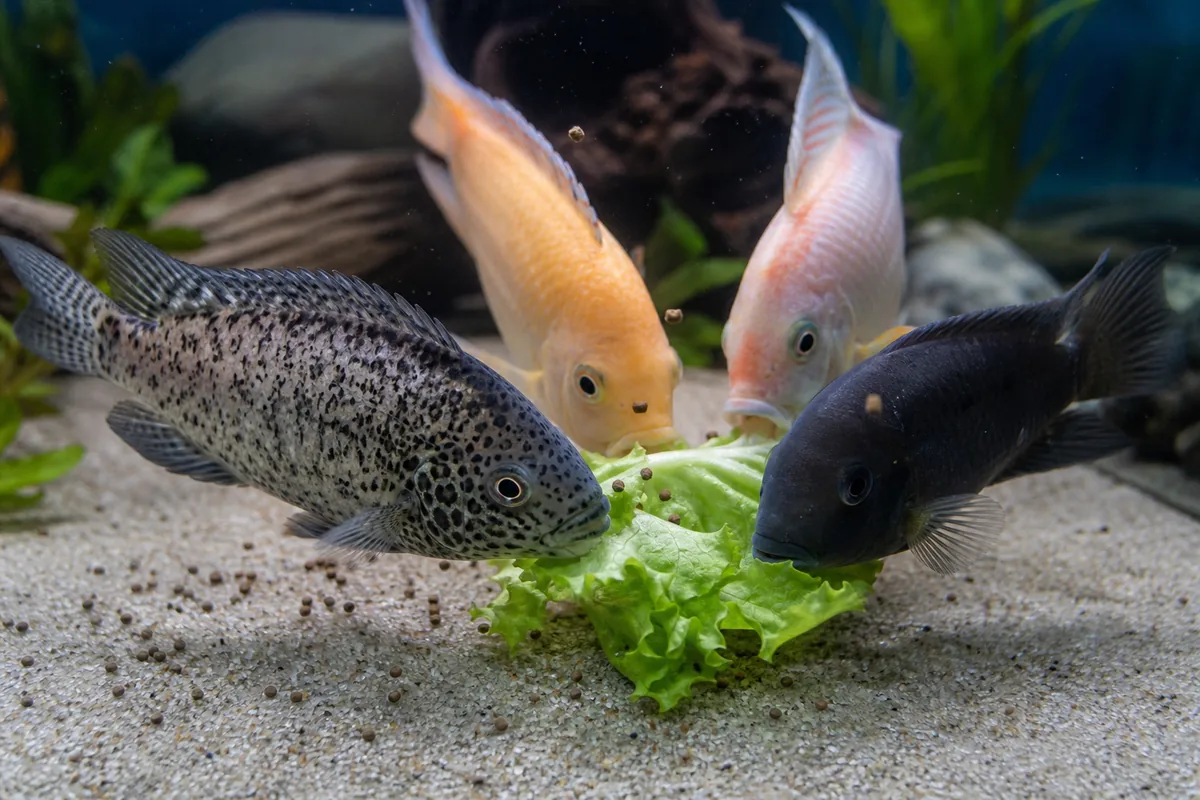
Lettuce is one of the simplest vegetable supplements you can offer a freshwater tank. No elaborate prep, no toxicity concerns, no species guesswork for herbivores.
The catch is variety selection. The wrong lettuce delivers almost nothing.
The right one gives your fish vitamin K, vitamin A, and folate at a calorie level so low that overfeeding is essentially impossible.
Lettuce for Freshwater Fish
- RomaineSafe
- butterheadSafe
- red leaf lettuce (blanched or raw)Safe
- None. but avoid seasonedUnsafe
- dressedUnsafe
- wiltedUnsafe
- or iceberg lettuceUnsafe
Prep: Rinse, blanch 30-60 seconds in boiling water, cool fully to tank temperature, clip to tank wall with a veggie clip or weigh down near the substrate Freq: 2-3x per week for herbivores Amount: One leaf section per 10 gallons; remove after 8-12 hours or when browning begins
Which Lettuce Varieties Are Safe for Fish
Not all lettuce performs the same in an aquarium. Variety choice determines whether your fish get genuine nutrition or just a wet leaf with no benefit.
Romaine is the clear first choice. It carries 102 mcg of vitamin K per 100g, meaningful amounts of vitamin A and folate, and its sturdy leaf structure stays intact in the water column rather than dissolving into debris within an hour.
- Romaine: Best overall choice; highest nutrient density, holds shape well after blanching, accepted by most herbivores
- Butterhead (Boston/Bibb): Softer texture, slightly easier for smaller fish to rasp; good folate content
- Red leaf lettuce: Good alternative to romaine; slightly lower vitamin K but acceptable nutrient profile
- Green leaf lettuce: Similar to red leaf; works well as a rotation option
- Iceberg lettuce: Avoid; 95% water by weight, negligible nutritional value, breaks apart quickly and clouds the tank
- Seasoned or dressed lettuce: Never use; salt, oil, vinegar, and spices are toxic to aquarium fish
Iceberg gets a special mention because it is the variety most people have on hand. The problem is not toxicity; iceberg is not poisonous.
The problem is that it delivers nothing nutritional while degrading water quality faster than romaine due to its high water content and fragile cell structure.
Stick with romaine as your baseline and rotate in butterhead or red leaf for variety.
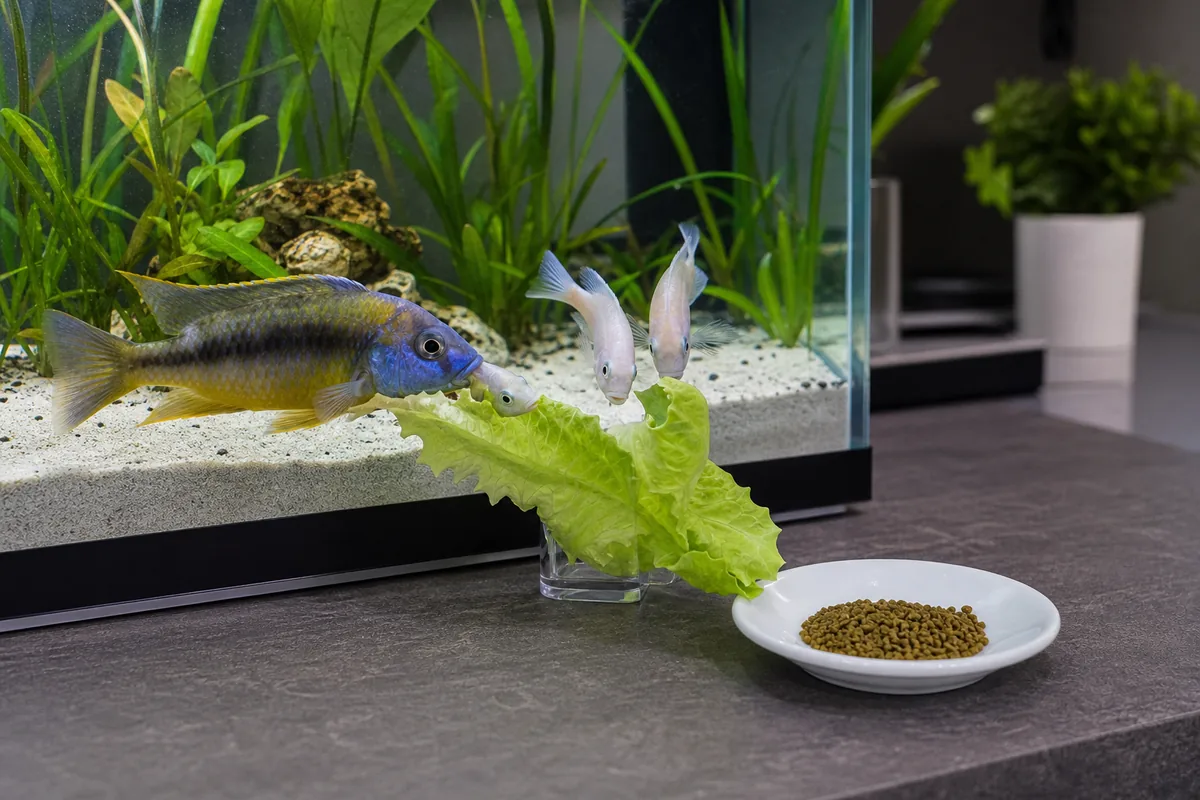
Which Fish Eat Lettuce: Herbivores That Actually Benefit
Lettuce is a vegetable, which means carnivores have no use for it and omnivores treat it as an occasional supplement. Herbivores and algae grazers are the primary audience.
have high vegetable needs and lettuce fills that role well between algae wafer feedings. A bristlenose pleco will rasp a blanched romaine leaf steadily over several hours, and the feeding behavior is easy to observe as the fish presses its sucker mouth against the leaf surface.
Goldfish plant grazing is instinctive behavior rooted in their natural diet of aquatic vegetation. They accept romaine readily and benefit from the plant-based variety it adds to a diet that otherwise skews heavily toward pellets.
Bristlenose plecos need vegetable matter as a core part of their diet, not just an occasional treat. Our bristlenose pleco care guide explains the full feeding schedule that combines algae wafers, fresh vegetables like lettuce, and wood for the cellulose that this species depends on for gut health.
- Bristlenose and common plecos: Primary beneficiaries; enthusiastic grazers that work a leaf for hours
- Otocinclus: Small algae grazers that supplement well with blanched lettuce when tank algae runs low
- Goldfish: Accept lettuce readily as part of a naturally plant-heavy omnivore diet
- Mollies: Algae grazers that benefit from leafy green supplementation 2-3 times per week
- Mystery and nerite snails: Will graze a blanched leaf for hours; no water quality risk at reasonable quantities
- Bettas: Carnivores; will ignore lettuce entirely, which is the expected and correct response
Otocinclus are particularly dependent on consistent vegetable access because they graze almost continuously and can starve quickly when tank algae is insufficient. Our otocinclus care guide explains the feeding schedule that combines algae wafers and fresh vegetables like lettuce to keep these small grazers well-fed.
Goldfish benefit from lettuce 2-3 times per week as part of a varied plant-heavy diet. Our goldfish care guide covers the full weekly feeding rotation that balances pellets, vegetables, and occasional protein treats for this popular species.
Carnivorous species like bettas and oscars are not the target audience. Offering lettuce to a carnivore is not harmful, but it will sit untouched and begin degrading water quality, which is why you should only feed lettuce in tanks where herbivores are present to consume it.
Key facts
- Best Variety
- Romaine lettuce: 102 mcg vitamin K per 100g, holds shape in water, accepted by most herbivores
- Avoid Iceberg
- 95% water by weight; near-zero nutritional value and degrades water quality faster than romaine
- Calories
- 17 calories per 100g: practically impossible to overfeed, safe in generous quantities for herbivores
- Leave Time
- 8-12 hours in the tank for grazing fish; remove before browning begins to prevent water fouling
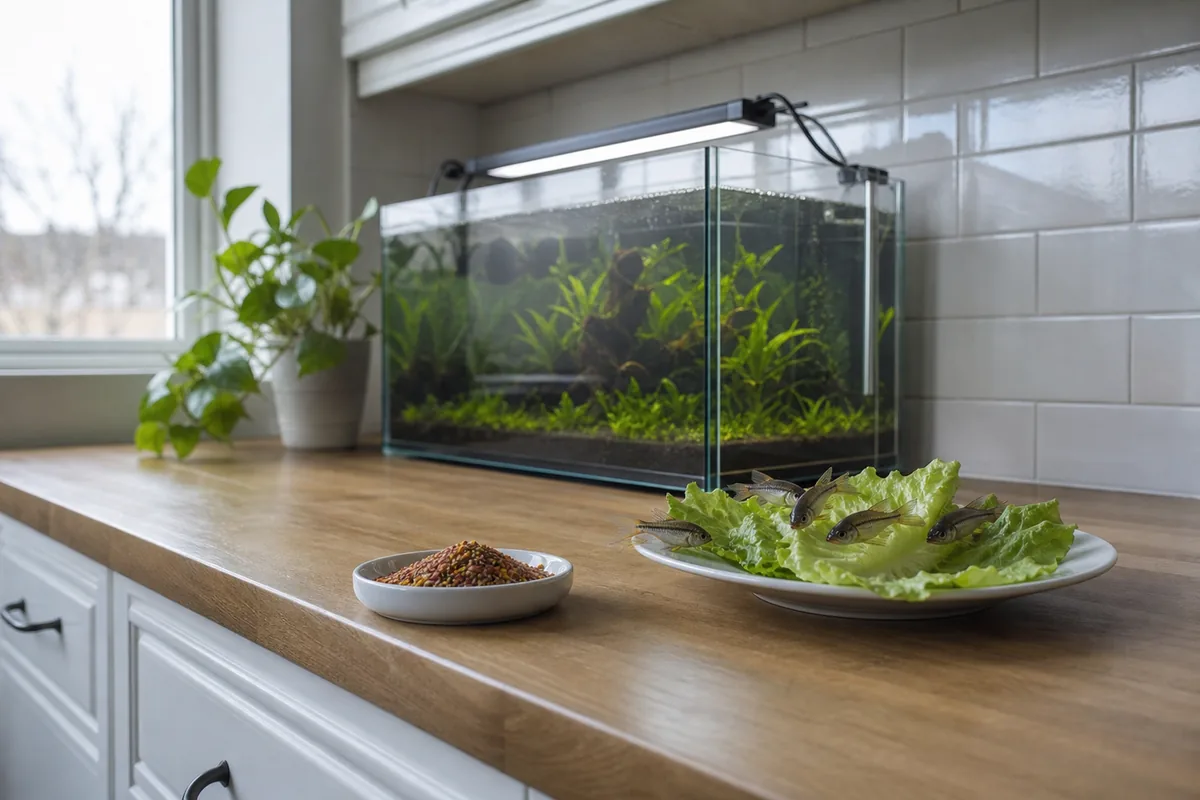
How to Prepare Lettuce for Aquarium Fish
Prep for lettuce is straightforward. The key steps are blanching to soften the leaf and cooling it fully before it enters the tank.
Raw romaine works for large plecos and goldfish, but blanching is recommended for smaller species and for any tank where you want the leaf to stay in one place rather than floating around the water column.
- Choose the right varietySelect romaine, butterhead, or red leaf lettuce. Skip iceberg entirely. Use fresh leaves only; wilted or slimy lettuce carries bacterial load that will spike ammonia in the tank.
- Rinse thoroughly under cold waterHold the leaf under running water for 30 seconds and rub the surface gently. This removes surface pesticide residue, dirt, and any loose debris.
- Blanch in boiling water for 30-60 secondsDrop the leaf section into actively boiling water. Hold for 30 seconds minimum. Larger, thicker romaine leaves can go 60 seconds. Over-blanching past 90 seconds turns the leaf mushy and it falls apart in the tank.
- Cool fully before adding to the tankRun cold water over the blanched leaf for 60 seconds, then let it rest in a bowl of cool water until it reaches room temperature. A warm leaf entering the tank causes localized thermal stress for fish near the drop point.
- Secure it in the tankUse a commercial veggie clip to attach the leaf to the side of the tank. Alternatively, use a rubber band to secure the leaf around a clean rock or stainless steel weight near the substrate. Plecos and otocinclus will not swim to the surface to feed.
- Remove after 8-12 hoursPull the leaf when it starts to turn brown or after 12 hours maximum. In tanks under 10 gallons, remove after 8 hours. Decomposing lettuce produces ammonia and clouds the water quickly.
Nutritional Value: What Fish Actually Get
Romaine lettuce earns its place in a herbivore's diet because of what it delivers per leaf. At only 17 calories per 100g, the calorie contribution is irrelevant, but the micronutrients are real.
Vitamin K at 102 mcg per 100g supports normal cellular processes. Vitamin A supports immune function and eye health.
Folate contributes to tissue repair. None of these are present in meaningful quantities in iceberg, which is why variety selection matters.
- Vitamin K: 102 mcg per 100g (romaine); supports cellular function in fish tissue
- Vitamin A: 436 mcg RAE per 100g; immune function and eye health support
- Folate: 136 mcg per 100g; contributes to tissue maintenance and growth
- Fiber: 2.1g per 100g; beneficial for digestive regularity in herbivores
- Water content: 95% in romaine (vs. 96% in iceberg); the difference is small but the nutrient gap is large
Lettuce does not replace a complete staple food. Algae wafers, spirulina-based flakes, and species-appropriate pellets carry protein and fat that lettuce does not provide.
Use lettuce as a supplement 2-3 times per week alongside a solid staple food, not as the primary calorie source. The cucumber feeding method follows the same supplemental logic and works well rotated with lettuce on alternating days.
Algae wafers cover the protein and fat gaps that lettuce leaves open, making them the natural pairing food for any tank where lettuce is served regularly. Our algae wafer guide explains the wafer-to-vegetable rotation schedule that keeps plecos, otocinclus, and snails fully nourished throughout the week.
Mollies graze lettuce actively and benefit from the fiber and vitamin K that romaine provides. Our molly care guide covers the plant-heavy feeding schedule that suits these algae-grazing livebearers, including which leafy greens are accepted most consistently.
Spinach is the most nutrient-dense leafy green alternative to lettuce but carries oxalic acid that limits feeding frequency. Our spinach feeding guide explains the once-per-week limit and why romaine lettuce is the safer default for 2-3 times per week supplementation.
Zucchini and lettuce are the two most versatile vegetable supplements in freshwater fishkeeping and rotate naturally across the week. Our zucchini feeding guide covers how to use a veggie clip and the 12-24 hour removal window that makes it more forgiving than lettuce for busy keepers.
Broccoli is a higher-fiber alternative to lettuce that works particularly well for goldfish and plecos prone to constipation. Our broccoli feeding guide explains how its vitamin K and fiber content exceeds romaine on both counts, making it the best swap when you want a more nutritionally dense leafy supplement.
Carrots pair well with lettuce in a rotation because they add beta-carotene for color support that no leafy green provides. Our carrot feeding guide covers the cooking requirement and the 4-6 hour removal window that prevents water fouling from this denser vegetable.
Common Lettuce Feeding Mistakes to Avoid
Most mistakes with lettuce come down to variety selection and removal timing. Both are easy to fix once you know what to watch for.
The comparison between bread versus vegetables is instructive here. Bread causes active harm through expansion and ammonia spikes.
Lettuce, by contrast, is benign when handled correctly, but the wrong preparation undoes that safety margin fast.
Leaving lettuce in the tank too long is the most common practical mistake. At 12 hours, a romaine leaf in a warm tank begins to soften and shed material.
By 24 hours, it is actively fouling the water in all but the largest, heavily filtered systems.
| Mistake | Problem | Fix |
|---|---|---|
| Using iceberg lettuce | Near-zero nutrition; breaks apart quickly and clouds the water | Switch to romaine or butterhead |
| Adding warm blanched lettuce | Thermal stress for fish near the insertion point | Cool fully to room temperature before placing in tank |
| Leaving lettuce over 12 hours | Decomposing leaf spikes ammonia and clouds the tank | Remove at 8-12 hours or when browning starts |
| Letting the leaf float freely | Bottom feeders cannot reach it; leaf covers more surface area and degrades faster | Use a veggie clip or weighted anchor near the substrate |
| Using dressed or seasoned lettuce | Salt, oil, and acids are toxic to aquarium fish | Use only plain fresh lettuce prepared specifically for the tank |
| Overfeeding to carnivores | Carnivores ignore it; uneaten leaf degrades water quality | Only feed lettuce in tanks with herbivores present |
Sources and references
- Nutrient requirements of fish and shrimpNational Research Council, National Academies Press, 2011
- Lettuce, cos or romaine, rawUSDA FoodData Central, Agricultural Research Service
- Leafy green vegetables: nutrition profile and food safetyUSDA FoodData Central
- The Diversity of Fishes: Biology, Evolution, and EcologyHelfman, Collette, Facey, and Bowen, Wiley-Blackwell, 2009
- Vegetable supplements in ornamental fish dietsof Florida IFAS Extension
- Feeding Tilapia in Intensive Recirculating SystemsNorth Central Regional Aquaculture Center, Michigan State Extension, 2003