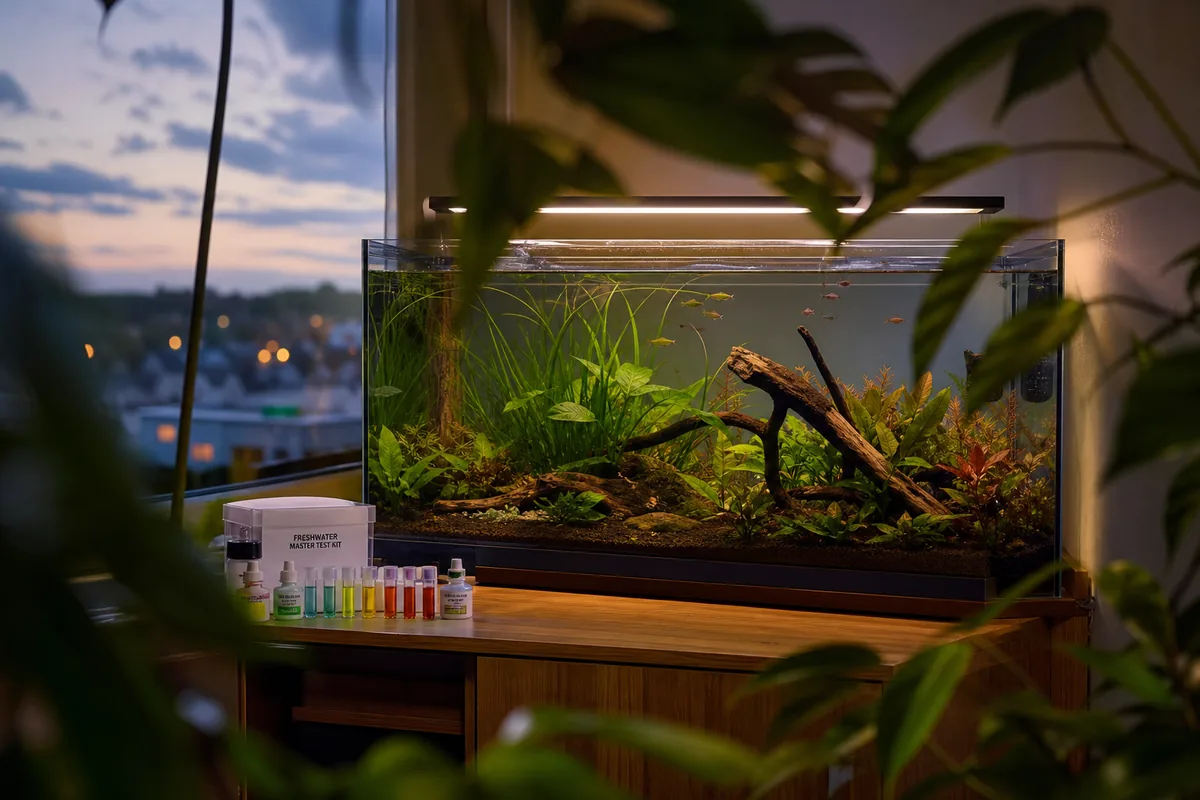
The nitrogen cycle is the single most important concept in freshwater fishkeeping. Every water quality problem, every unexplained fish death in a tank less than two months old, traces back to the same root cause: not enough beneficial bacteria to handle the waste load.
We put this guide together because the cycling process confuses beginners more than anything else in the hobby, and the consequences of skipping it are severe. Read it once before you buy a single fish.
Key facts
- Timeline
- 4-6 weeks (fishless) or 1-2 weeks (seeded media)
- Ammonia Target
- 0 ppm at all times in a cycled tank
- Nitrite Target
- 0 ppm at all times in a cycled tank
- Nitrate Safe Range
- Under 40 ppm; under 20 ppm for sensitive species
- Ideal Temperature
- 80-84°F accelerates bacterial growth during cycling
- Ammonia Dose (Fishless)
- 2-4 ppm pure ammonia to start the cycle
- Cycle Confirmed When
- 0 ammonia + 0 nitrite + rising nitrate on 3 consecutive days
How the Nitrogen Cycle Works in a Fish Tank
Fish produce ammonia constantly through waste and respiration. Ammonia is acutely toxic: even 0.25 ppm damages gill tissue and stresses the immune system.
Without bacterial colonies to process it, ammonia accumulates until it kills.
The nitrogen cycle runs in two stages, each handled by a different bacterial genus:
- Stage 1: Nitrosomonas bacteria convert ammonia (NH3) into nitrite (NO2). Nitrite is also toxic, roughly as dangerous as ammonia.
- Stage 2: Nitrospira bacteria convert nitrite (NO2) into nitrate (NO3). Nitrate is largely harmless at concentrations below 40 ppm and is removed through regular water changes.
- End result: A stable colony of both bacterial strains processes waste faster than your fish produce it, keeping ammonia and nitrite locked at 0 ppm.
These bacteria live primarily in your filter media, not in the water column. That is why filter maintenance matters so much: bleach, chlorinated tap water, or replacing all filter media at once can wipe out the colony and restart your cycle from zero.
Fishless Cycling: The Recommended Method
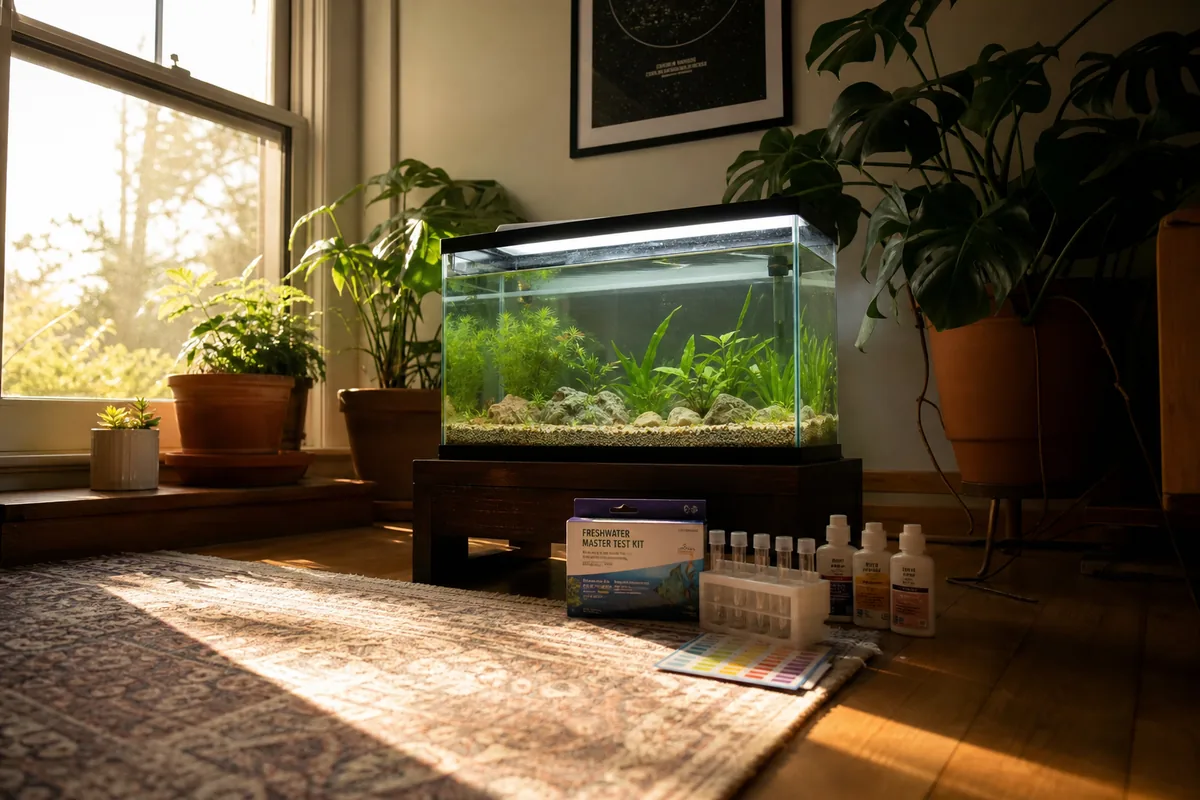
Fishless cycling builds your bacterial colony before any fish enter the tank There. There is no animal suffering involved, parameters can be pushed to extremes that would harm fish, and the colony that develops is large enough to handle a full stocking load on day one.
- Set Up the Tank CompletelySet up your tank with substrate, decor, filter, and heater running. Fill with dechlorinated tap water. Set the heater to 82°F: bacterial growth is significantly faster at warmer temperatures. Do not add fish.
- Source Pure AmmoniaBuy Dr. Tim's Ammonium Chloride or any fragrance-free, surfactant-free pure ammonia. Shake the bottle: if it foams, it contains surfactants and will harm your tank. Avoid hardware store ammonia that lists any additives.
- Dose to 2-4 ppm AmmoniaAdd ammonia until your API test kit reads 2-4 ppm. Start with a few drops per 10 gallons and test after 15 minutes. Record the exact number of drops required: you will repeat this dose each time ammonia drops to 0.
- Wait and Watch for NitriteTest every 2-3 days. Within 1-2 weeks you should see nitrite climbing above 0. This confirms Nitrosomonas bacteria have established. Continue dosing ammonia to 2-4 ppm whenever it drops to 0.
- Wait for Nitrite to CrashAfter nitrite peaks (often 5+ ppm or off the chart), it will begin dropping as Nitrospira bacteria establish. Nitrate will climb in parallel. Continue dosing ammonia every time it hits 0.
- Confirm the Cycle Is CompleteThe cycle is finished when: you dose ammonia to 2 ppm, check 24 hours later, and read 0 ammonia, 0 nitrite, and elevated nitrate. Repeat this test on two consecutive days before adding any fish.
- Do a Large Water Change, Then Add FishBefore stocking, do a 50-75% water change to bring nitrate below 20 ppm. Add your fish slowly: do not stock the full planned load at once. Add 25-50% of the intended fish count in the first week.
Cycling Timeline: What to Expect Each Week
The nitrogen cycle rarely runs on a fixed schedule, but the pattern is consistent. Use this table as a reference, not a guarantee.
Cold water, a new filter with no seed, and low ammonia doses all slow the process.
| Week | Ammonia | Nitrite | Nitrate | What This Means |
|---|---|---|---|---|
| Week 1 | 2-4 ppm (dosed) | 0 ppm | 0 ppm | No bacterial activity yet; keep dosing |
| Week 2 | Drops slowly | 0.25-2 ppm rising | 0-5 ppm | Nitrosomonas establishing; stage 1 underway |
| Week 3 | Drops faster | 2-5+ ppm (peak) | 5-20 ppm | Nitrite spike is normal; Nitrospira starting |
| Week 4 | Drops to 0 within 24h | Falling | 20-40 ppm | Cycle nearing completion; both colonies active |
| Week 5-6 | 0 within 24h of dosing | 0 ppm | 40+ ppm | Cycle complete; do a large water change and stock |
Fish-In Cycling: When You Have No Choice
Fish-in cycling means adding fish to an uncycled tank We. We do not recommend it as a first choice because it exposes fish to toxic ammonia and nitrite spikes throughout the entire cycling process.
However, it is sometimes unavoidable when someone receives fish unexpectedly or rescues animals already in poor conditions.
If you must cycle with fish in the tank, follow these non-negotiable rules:
- Test every single day with a liquid test kit. If ammonia or nitrite exceeds 0.5 ppm, do an immediate 25-50% water change.
- Dose Seachem Prime or Fritz AmGuard daily at the recommended rate. These conditioners temporarily detoxify ammonia and nitrite for 24-48 hours without interfering with bacterial growth.
- Stock lightly. Start with one or two hardy species like zebra danios or goldfish. Do not add sensitive fish like neon tetras to an uncycled tank under any circumstances.
- Feed minimally. Less food means less waste means slower ammonia accumulation. Feed once every other day during the cycle.
- Never do large water changes unnecessarily. Small, frequent changes (20-25%) control ammonia without crashing temperature or removing beneficial bacteria from the water column.
Fish-in cycling typically takes the same 4-6 weeks as fishless cycling. The only difference is that your fish endure sub-optimal water quality throughout.
Chronic low-level ammonia stress, even when managed with Prime, suppresses immune function and shortens life expectancy.
Once your cycle is complete, our 10-gallon stocking guide covers the species combinations and fish counts that fit within the biological limits of a newly cycled smaller tank.
Testing Your Cycle: How to Use the API Master Test Kit
Test strips give you a rough estimate at best The. The API Freshwater Master Test Kit uses liquid reagents that react with dissolved compounds, giving you accurate readings to 0.25 ppm increments.
This precision matters: the difference between 0 ppm nitrite and 0.25 ppm nitrite is the difference between a safe tank and a dangerous one.
- Shake bottle #2 vigorously for 30 seconds before each nitrate test. Failing to shake it is the most common reason people get false nitrate readings of 0 ppm.
- Read results in natural light, not under aquarium LEDs. Blue and pink LED spectra distort color comparisons.
- Rinse test tubes with tank water before each test, not tap water. Chlorine residue in tubes skews ammonia and nitrite readings.
- Log every result with the date and time. A pattern of slowly falling ammonia and slowly rising nitrite tells you more than any single data point.
During active cycling, test every 2-3 days. Once cycled and stocked, test ammonia and nitrite weekly for the first month, then drop to every 2 weeks once the tank is stable.
Always test after adding new fish, moving large amounts of decor, or doing any filter maintenance.
Keepers planning a larger community build after cycling should read our 20-gallon stocking guide for species combinations that work well in the most popular beginner tank size.
Troubleshooting a Stalled Nitrogen Cycle
If your cycle has not progressed past week 3 with no change in readings, something is interfering with bacterial growth. Check these causes in order:
- Water temperature below 70°F: Bacterial growth slows dramatically below 70°F and nearly stops below 60°F. Confirm your heater is working and set correctly.
- Ammonia source dried up: If you stopped dosing and ammonia has been at 0 for several days, bacteria may have started dying off from lack of food. Redose to 2 ppm immediately.
- Chlorine exposure: If you added tap water directly to the tank without dechlorinator, or rinsed filter media under the tap, you may have killed the colony. Start over with bottled bacteria.
- pH below 6.0: Nitrification slows sharply in acidic water. Test pH: if it is below 6.5, a small amount of baking soda (1 teaspoon per 50 gallons) can bring it up without crashing the tank.
- Ammonia dose too high: Concentrations above 4-5 ppm can actually inhibit bacterial growth. Do a 50% water change and redose to 2 ppm.
Sources and references
- Nitrification in freshwater recirculating aquaculture systemsAquacultural Engineering, Vol. 34, 2006
- Recirculating Aquaculture, 2nd editionTimmons and Ebeling, Cayuga Aqua Ventures, 2010
- Establishing biological filtration in new aquariaof Florida IFAS Extension
- Managing Ammonia in Fish PondsSouthern Regional Aquaculture Center Publication No. 4603, USDA SRAC, 2004
- Ammonia and nitrite toxicity in freshwater fishof Fish Biology, Vol. 86, 2015
- Comparative Analysis of Nitrifying Bacteria Associated with Freshwater and Marine AquariaHovanec and DeLong, Applied and Environmental Microbiology, 62(8), 1996