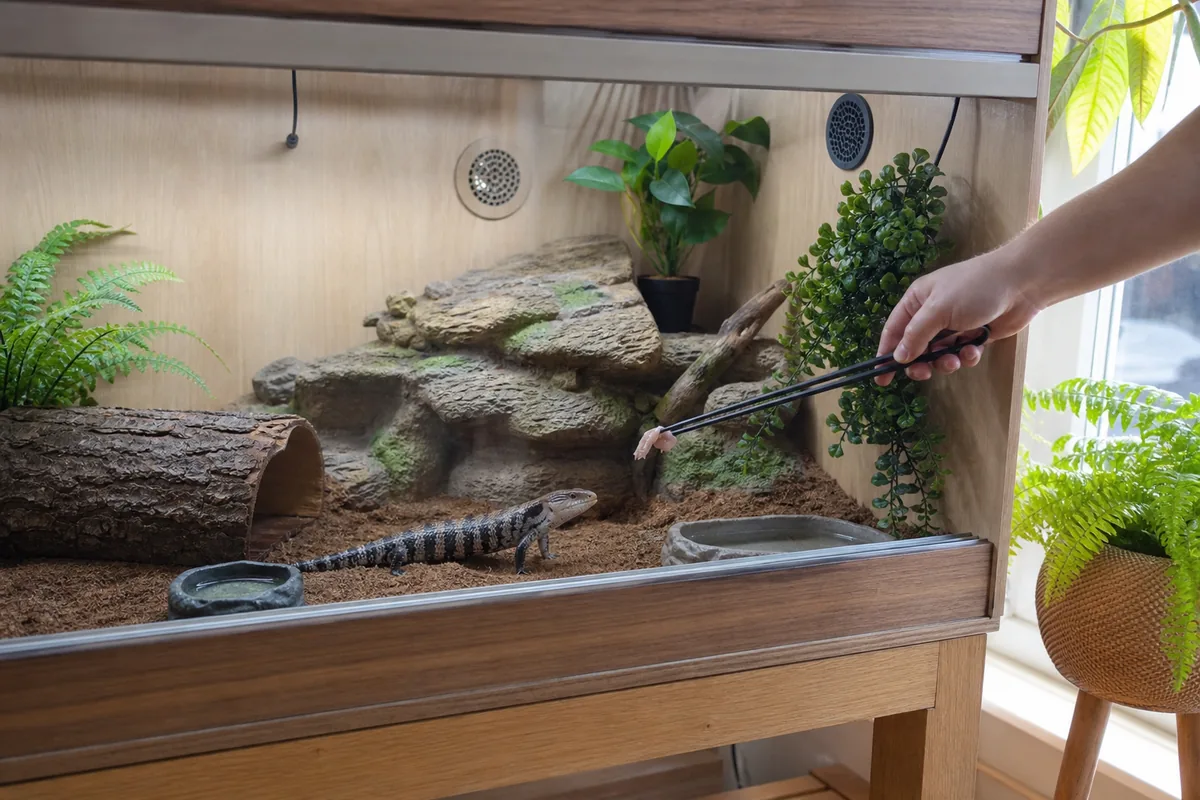
The blue-tongue skink encompasses several species in the genus Tiliqua, with the Northern blue-tongue (T.scincoides intermedia) and Indonesian blue-tongue (T.gigas) most common in captivity. These heavy-bodied, short-limbed lizards from Australia and Indonesia are ground dwellers that push through leaf litter and undergrowth in search of snails, berries, and carrion.
Our reptile care section covers species from beginner to advanced, and blue-tongue skinks occupy the sweet spot for keepers who want more engagement than a gecko provides.
The signature blue tongue is a threat display, flashed at predators alongside a loud hiss. In captivity, a settled blue-tongue rarely deploys it at its keeper.
Most adults become calm, food-motivated lizards that recognize their owners and approach the front glass at feeding time.
Key facts
- Lifespan
- 20 yrs
- Adult Length
- 18-24 in
- Basking Spot
- 100-105°F
- Humidity
- 40-60% (Northern)
Blue-Tongue Skink Enclosure: 4 × 2 Ft Floor Space With Deep Substrate
Blue-tongue skinks are terrestrial. They do not climb and have no need for vertical space.
The enclosure priority is floor space and substrate depth. Adults need a minimum 4 × 2 ft footprint, which corresponds to a 120-gallon equivalent or a purpose-built PVC tub.
PVC enclosures outperform glass for heat and humidity retention.
These lizards burrow. Substrate depth of 4-6 inches lets them dig and thermoregulate partially underground, which is natural behavior for Australian skinks in hot climates.
- Northern BTS substrate: Cypress mulch, coconut fiber, or a 50/50 mix of both. Holds moderate humidity without becoming soggy.
- Indonesian BTS substrate: Same mix but misted more frequently to maintain 60-80% humidity.
- Hides: One large hide on the warm side, one on the cool side. The hide must fit the full body of the adult.
- Water dish: Heavy ceramic bowl, stable and large enough to soak in before shedding.
| Parameter | Northern BTS | Indonesian BTS |
|---|---|---|
| Humidity | 40-60% | 60-80% |
| Temperament | Generally calmer | More defensive initially |
| Size | 18-24 in | 20-26 in |
| Captive-bred availability | Widely available | Less common |
| Beginner suitability | Better | Intermediate |
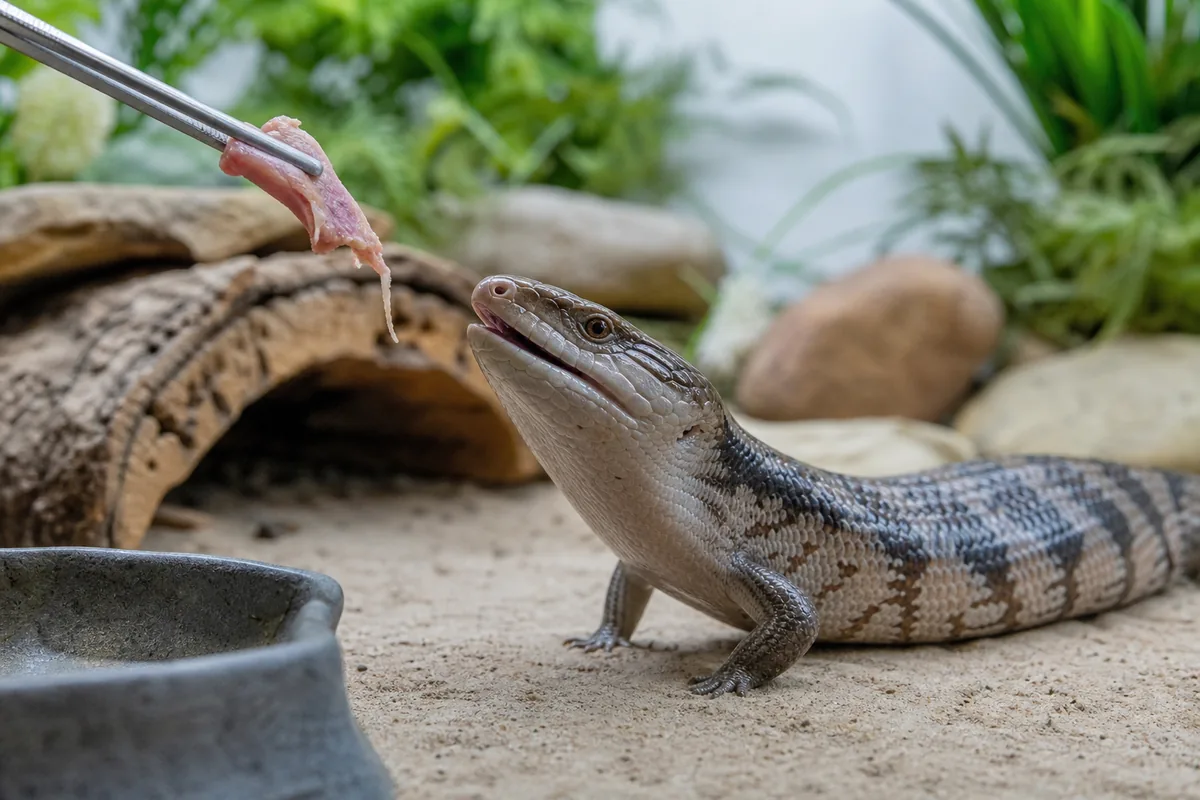
Temperature: 100-105°F Basking Spot With T5 HO UVB
Blue-tongue skinks are diurnal baskers. They need a strong overhead basking spot and full-spectrum UVB to synthesize vitamin D3 and properly metabolize calcium.
A T5 HO 10.0 UVB tube running at least two-thirds of the enclosure length is the standard.
The basking surface temperature should reach 100-105°F. Measure with an infrared temperature gun, not a stick-on dial thermometer.
Ambient warm side should be 85-90°F, with the cool side at 75-80°F.
- Basking surface: 100-105°F
- Warm side ambient: 85-90°F
- Cool side ambient: 75-80°F
- Nighttime low: No lower than 70°F
- UVB replacement: Every 6 months for T5 HO bulbs, even if they still emit visible light
Diet: 50% Protein, 40% Vegetables, 10% Fruit
Blue-tongue skinks are omnivores with a varied diet that changes in ratio as they age. The general adult formula is 50% protein, 40% vegetables, 10% fruit.
Juveniles need a higher protein ratio of roughly 60% protein to support growth.
Protein sources include lean ground turkey, canned low-sodium cat or dog food (40%+ protein, no fish-first ingredient), cooked chicken, and live or frozen-thawed dubia roaches. Variety prevents nutritional gaps better than any single staple.
Dust food with calcium (no D3) three times per week for adults with a UVB lamp. Add a reptile multivitamin once per week.
Juveniles under 12 months need calcium dusting at every meal.
Health: Parasites in Wild-Caught Animals and Vitamin A Deficiency
Captive-bred Northern blue-tongue skinks are robust animals that rarely develop health issues when kept at correct temperatures with a balanced diet. The greatest risks come from incorrect sourcing and nutritional imbalances.
- Parasites: Wild-caught and imported Indonesian skinks frequently carry heavy internal parasite loads. Fecal float test within the first week of ownership and treat as directed by a reptile vet.
- Vitamin A deficiency: Closed or swollen eyes, respiratory problems, and poor shedding. Caused by feeding primarily iceberg lettuce or low-nutrient greens. Add butternut squash and leafy greens rich in beta-carotene.
- Obesity: A common issue in adults fed too much high-fat protein. A healthy adult should have a firm, rounded body without folds of fat behind the limbs.
- MBD: Soft limbs, jaw deformity. Preventable with correct UVB and calcium supplementation.
Always source captive-bred Northern blue-tongue skinks from a reputable US breeder. Avoid imports marketed as "farm-raised" Indonesian BTS without documentation, as these are frequently wild-caught with parasite loads and adaptation stress.
Pros
- Personable and food-motivated
- 20-year lifespan
- Does not require live insects as primary food
- Varied omnivore diet is engaging to prepare
- Wide availability of captive-bred Northern BTS
Cons
- 4 × 2 ft floor space required
- Strong UVB lamp mandatory
- Indonesian BTS frequently wild-caught with parasites
- Daily feeding and diet preparation
- Heavier care requirements than beginner reptiles
Handling Blue-Tongue Skinks: Confident From 4-6 Weeks With Consistent Work
Hatchling blue-tongue skinks are defensive and may hiss and flatten their bodies when first handled. This settles with consistent short sessions.
Most captive-bred Northern BTS are calm and handleable within 4-6 weeks of regular 10-minute daily sessions.
Support the full body and all four legs at all times. These heavy-bodied lizards feel insecure when their hindquarters dangle.
A supported blue-tongue is a relaxed blue-tongue.
Breeding: Livebearers With 10-20 Offspring per Litter
Blue-tongue skinks are viviparous: they give birth to live young rather than laying eggs. This is a significant advantage over oviparous species because there is no incubation setup required.
Females give birth to 10-20 young after a gestation of approximately 100 days.
A brumation period of 6-8 weeks at 60-65°F from June through August (Australian winter) triggers breeding behavior when temperatures are restored. Introduce the male to the female's enclosure.
Mating is vigorous. Separate animals after confirmed mating to prevent the female from being exhausted by repeated attempts.
Neonate Blue-Tongue Skink Care
Neonates are fully formed and independent at birth. Separate them from the female within 24 hours to prevent defensive biting between individuals. House neonates individually in 10-gallon enclosures with the same temperature gradient as adults scaled down. Feed every other day with small portions of the same varied diet. First shed occurs within 2 weeks of birth.
Sources and references
- Home range and thermal ecology of Tiliqua scincoides in New South WalesCopeia, Kerr & Bull, 2006
- Nutritional disorders in reptiles: calcium and vitamin D3 metabolismVeterinary Clinics: Exotic Animal Practice, Donoghue, 2006
- Blue-Tongue Skink Husbandry and Medical ManagementMader's Reptile and Amphibian Medicine, 3rd Ed., 2019