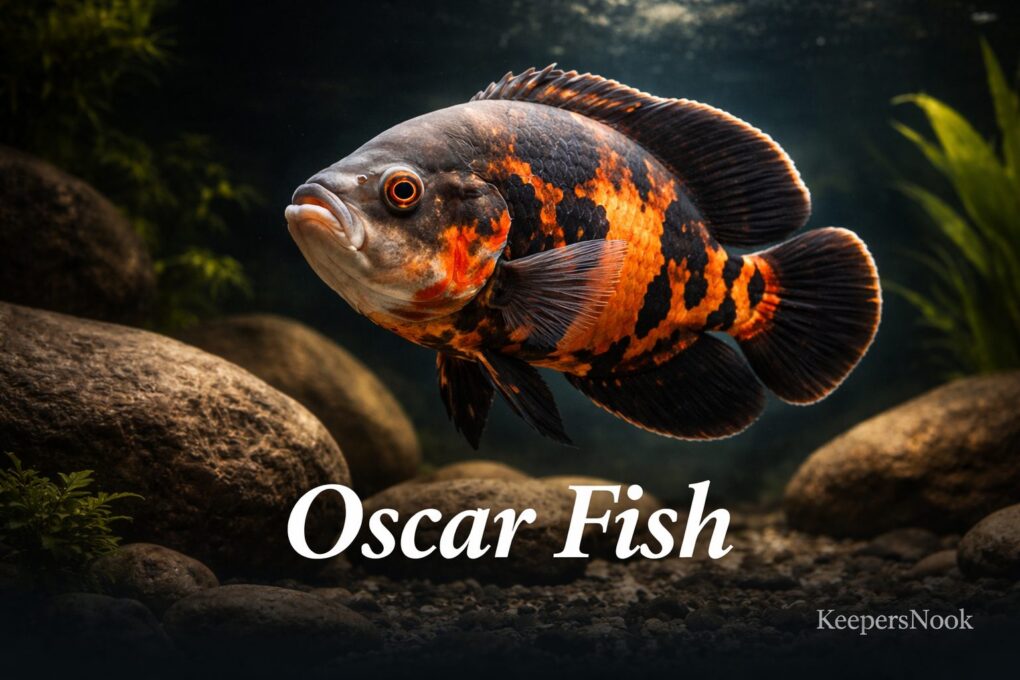
The Oscar fish (Astronotus ocellatus) is a large South American cichlid native to the Amazon and Orinoco river basins. Adults routinely reach 12 to 14 inches and live 10 to 20 years in captivity.
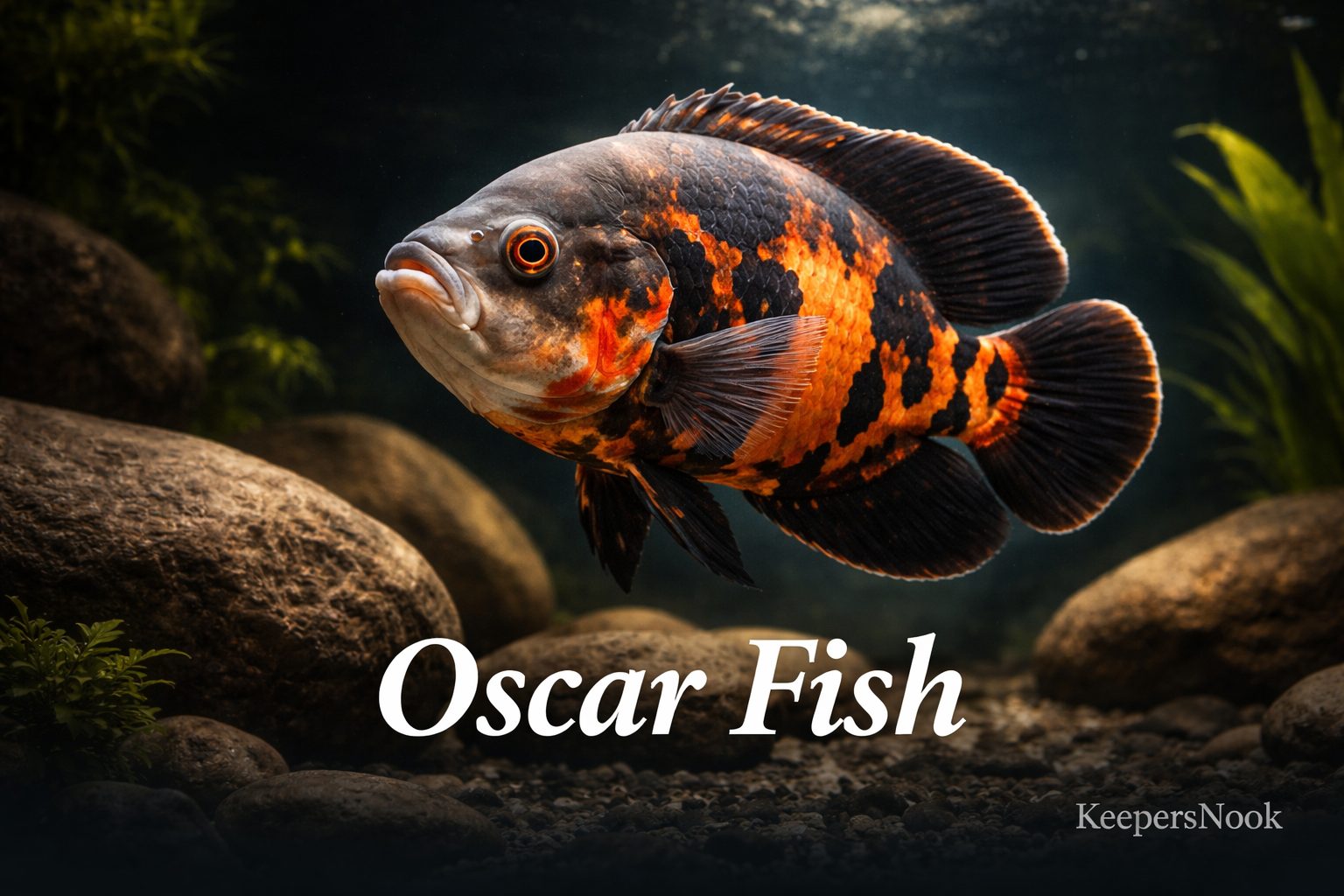
Plan for the long term before you buy one.
Oscars have earned a reputation as "the dog of the fish world." They recognize their keepers, beg for food, and rearrange their tank decorations on a weekly basis. That personality comes with tradeoffs: aggression, massive bioload, and equipment costs that surprise unprepared buyers.
Those numbers are not suggestions. An Oscar in a 55-gallon tank will grow too large for the space within 18 months.
Stunted growth causes skeletal deformities, organ compression, and early death. The 75-gallon figure is the starting point for a single Oscar.
Two Oscars need 125 gallons or more.
Oscar Fish Size and Growth Rate: Reaching 14 Inches in Under 2 Years
Oscar fish grow fast. Juvenile Oscars sold at 2 to 3 inches in pet stores reach full adult size within 12 to 18 months under good water conditions.
Remember it later
Planning to try this recipe soon? Save it for a quick find later!
Most keepers underestimate this growth rate and buy tanks that become too small within a year.
At 1 inch per month during the first year, an Oscar can outgrow a 30-gallon tank before you have time to plan an upgrade. Buy the correct tank from the start.
- Months 1-6: 2 to 4 inches, juveniles look manageable in smaller tanks
- Months 6-12: 5 to 9 inches, bioload increases sharply, filtration demand spikes
- Months 12-18: 10 to 12 inches, minimum tank size is no longer optional
- Year 2+: 12 to 14 inches, some specimens reach 16 inches in very large systems
- Max recorded: 18 inches in rare cases, typically in 200+ gallon ponds
Color variants include the classic wild-type (dark base with orange-red ocellus spot near the tail), tiger Oscar, red Oscar, albino Oscar, and lemon Oscar. All variants grow to the same size and have identical care requirements.
Do not let a colorful variant convince you to cut corners on tank size.
Weight matters as much as length. A 14-inch Oscar can weigh over 3 pounds.
That mass means the fish physically displaces a significant volume of water and produces waste proportional to its body size. Filtration has to account for this from day one.
Oscar Fish Tank Setup: Why 75 Gallons Is the Floor, Not the Goal
A 75-gallon tank (48" x 18" x 21") gives a single adult Oscar enough linear length to turn around and swim without constant stress. It is the minimum, not the ideal.
If your budget allows, a 100 to 125-gallon tank gives you meaningful buffer for water quality and behavioral space.
Tank length matters more than volume. A 75-gallon tank that is 48 inches long is better than a 90-gallon cube that is only 36 inches long.
Oscars are active swimmers that need horizontal space.
Decoration strategy matters with Oscars. They will uproot plants, knock over lightweight decorations, and rearrange substrate.
Use heavy ceramic or resin decorations anchored with suction cups, or skip decorations entirely and go for a minimalist setup. Live plants will not survive an Oscar tank unless you use heavily rooted species like Java fern attached to driftwood.
A tight-fitting lid is non-negotiable. Oscars are known jumpers, and a startled fish can clear a 6-inch gap.
Mesh lids or glass canopies both work, but verify there are no gaps around filter tubing or heater cables.
Filtration and Water Quality: Oscar Fish Produce Heavy Waste
Oscars are heavy waste producers. A single adult Oscar generates more ammonia than a school of 10 small community fish.
Standard aquarium filter ratings, which assume light community bioloads, are insufficient for Oscar tanks.
The rule: run filtration rated for at least 2 to 3 times your actual tank volume. For a 75-gallon Oscar tank, use a canister filter rated for 150 to 225 gallons per hour minimum, or run two filters simultaneously.
Canister filters outperform hang-on-back filters for this application because they hold more biological media.
Weekly water changes of 25 to 30 percent are the baseline for an Oscar tank. Some keepers with heavy bioloads do twice-weekly changes.
Skipping water changes for two weeks causes nitrate buildup that stresses the fish and suppresses immune function, leaving them open to Hole-in-the-Head disease (HITH).
- Ammonia: 0 ppm (anything above 0.25 ppm is dangerous)
- Nitrite: 0 ppm (toxic at any detectable level)
- Nitrate: under 20 ppm between changes (Oscars are sensitive)
- Temperature: 74 to 81°F, stable (swings over 2°F in 24 hours cause stress)
- pH: 6.0 to 8.0, stable (Oscars are adaptable, but consistency matters more than exact value)
Hole-in-the-Head disease is the most common Oscar health issue and is directly linked to poor water quality and nitrate accumulation. You will see small pits or lesions on the head and lateral line.
The treatment is aggressive water changes, improved filtration, and sometimes metronidazole. Prevention through consistent maintenance is far simpler than treatment.
Oscar Fish Diet: Pellets Are the Foundation, Live Food Is the Reward
Oscars are opportunistic predators in the wild, eating insects, crustaceans, smaller fish, and plant material. In captivity, a high-quality large cichlid pellet covers the nutritional baseline.
Hikari Cichlid Gold, New Life Spectrum, and Omega One Large Cichlid Pellets are reliable choices.
Feed adult Oscars once or twice daily, only what they consume in 2 to 3 minutes. Oscars will beg constantly regardless of how recently they were fed.
Overfeeding causes obesity and spikes ammonia from uneaten food.
Oscars can go 5 to 7 days without food during vacations or illness recovery without harm. Do not ask a neighbor to feed them unless that person is experienced with fish.
Overfeeding by an untrained helper causes more water quality problems than a brief fast.
Oscar Fish Aggression and Tank Mate Compatibility
Oscars are territorial cichlids. They will harass, injure, or kill fish that are too small to defend themselves.
Any fish that fits in an Oscar's mouth is a meal, not a tank mate. That rules out most community fish outright.
The compatibility question is not just about size. It is about temperament matching and tank space.
An Oscar in a 75-gallon tank with another large aggressive cichlid will fight for territory unless the tank is large enough for both to establish non-overlapping zones.
Workable tank mates must be large, fast, or armored enough to coexist. The best options are fish that Oscars cannot easily injure and that hold their own territory without constant confrontation.
- Bristlenose plecos: armored, bottom-dwelling, ignore the Oscar and clean algae effectively
- Large Severum cichlids: similar size and temperament, typically tolerated in 125+ gallon systems
- Jack Dempsey cichlids: match Oscar aggression, require 125+ gallons minimum for one of each
- Firemouth cichlids: borderline, may work in very large tanks but risk injury in smaller systems
- Common plecos: can work but reach 18-24 inches and require very large tanks long-term
Do not keep Oscars with angelfish, tetras, livebearers, corydoras, or any small-to-medium community fish. The size difference alone makes it a predation situation, not a community.
Oscar owners who try this combination lose the smaller fish within days or weeks.
Two Oscars can coexist, but the setup requirements increase significantly. You need at minimum 125 gallons, and even then, conflict is likely unless you introduce both fish as juveniles simultaneously.
An established adult Oscar will attack a new Oscar introduced to its territory. The safest approach for paired Oscars is a 150-gallon or larger system with clear territory breaks created by rockwork.
Same-sex pairs are more stable than mixed pairs, though sexing Oscars visually is not reliable without venting or observing breeding behavior.
If you want a community tank with a variety of mid-size fish, an Oscar is the wrong centerpiece. Look at dwarf gourami community setups or species-appropriate platy communities instead.
An Oscar tank is best treated as a species-only display or a large cichlid showcase.
Oscar Fish Health: 3 Common Conditions and How to Prevent Them
Oscars kept in clean, properly sized tanks are hardy fish. Most health problems are directly traceable to water quality failures, nutritional deficiencies, or physical injury from incompatible tank mates.
| Condition | Cause | Symptoms | Treatment |
|---|---|---|---|
| Hole-in-the-Head (HITH) | High nitrates, poor diet, flagellate parasites | Pits or lesions on head and lateral line | Aggressive water changes, metronidazole if needed |
| Ich (White Spot) | Temperature stress, new fish introduction without quarantine | White salt-grain spots on body and fins | Raise temperature to 86°F, aquarium salt, copper-based treatment |
| Bloat / Dropsy | Bacterial infection, overfeeding, freeze-dried food | Pinecone scaling, swollen abdomen | Epsom salt baths, kanamycin or API Melafix for bacterial cases |
| Fin Rot | Poor water quality, physical injury from tank mates | Ragged, disintegrating fin edges | Improve water quality, API Fin and Body Cure |
| Anchor Worm | Introduced via feeder fish or live food | Visible thread-like worms attached to body | Manual removal with tweezers, Dimilin-X treatment |
Quarantine every new fish for a minimum of 4 weeks before introducing it to an established Oscar tank. A $20 bare-bottom quarantine tank saves the cost and heartbreak of treating a diseased display tank.
This rule applies even to fish purchased from reputable stores.
Oscar Fish Varieties: Color Morphs at a Glance
All Oscar color morphs belong to the same species (Astronotus ocellatus) and have identical care requirements. Breeders have selectively developed these variants over decades.
- Wild-type Oscar: dark greenish-black base with orange-red ocellus spot near the tail, natural pattern
- Tiger Oscar: orange and black marbling across the body, the most common variant in pet stores
- Red Oscar: predominantly red-orange base, less black patterning than tiger
- Albino Oscar: white to pale yellow base with red eyes, same size and temperament
- Lemon Oscar: yellow-to-cream base with light patterning, less common than tiger or red
- Veil-tail Oscar: elongated flowing fins, any base color, fins are more fragile and susceptible to fin rot
Veil-tail Oscars require the same minimum tank size and have the same aggression level, but their extended fins are more vulnerable to injury in a tank with other cichlids. For tank mate situations, standard short-fin variants are more practical.
Price differences between variants reflect breeding supply and demand, not care difficulty. A tiger Oscar at $8 and an albino Oscar at $40 need the same 75-gallon setup, the same canister filter, and the same weekly maintenance schedule.