Filtration is the single most important decision you make for your tank Get.
Get it wrong and you're fighting algae, ammonia spikes, and sick fish for as long as you keep that setup.
The good news: the filtration essentials are well-established, and you only need to match the right filter type to your specific situation.
We tested and researched the top options across every filter category.
Below is what we actually recommend, and why each one earns its spot on this list.
Before you choose, read our freshwater fish filtration essentials guide to understand how each filter type fits into your tank's ecosystem.
The Three filter Stages Every Aquarium Needs
Understanding filtration types lets you evaluate any filter on the market. All three stages matter, but they don't all need to live in the same unit.
Mechanical filtration removes physical particles.
Sponge foam and filter floss trap uneaten food, fish waste, and debris before they break down into ammonia. This stage protects your biological media from clogging.
Biological filtration is the core of a healthy tank.
Ceramic rings, bio-balls, and porous media house the nitrifying bacteria that convert ammonia to nitrite, then nitrite to nitrate. This is the stage you never want to disrupt.
Read about the filter cycling role to understand why establishing this bacterial colony takes 4 to 6 weeks and why it cannot be rushed.
Chemical filtration uses activated carbon to pull dissolved compounds, tannins, medications, and odors out of the water. It is optional for most healthy setups.
Carbon is consumed within 4 weeks and must be replaced monthly to remain effective.
Many experienced keepers skip it entirely once their tank is stable.
The Four filter Types: Which One Fits Your Tank
Each filter design serves a different situation. Knowing the category before you shop saves you from buying the wrong unit.
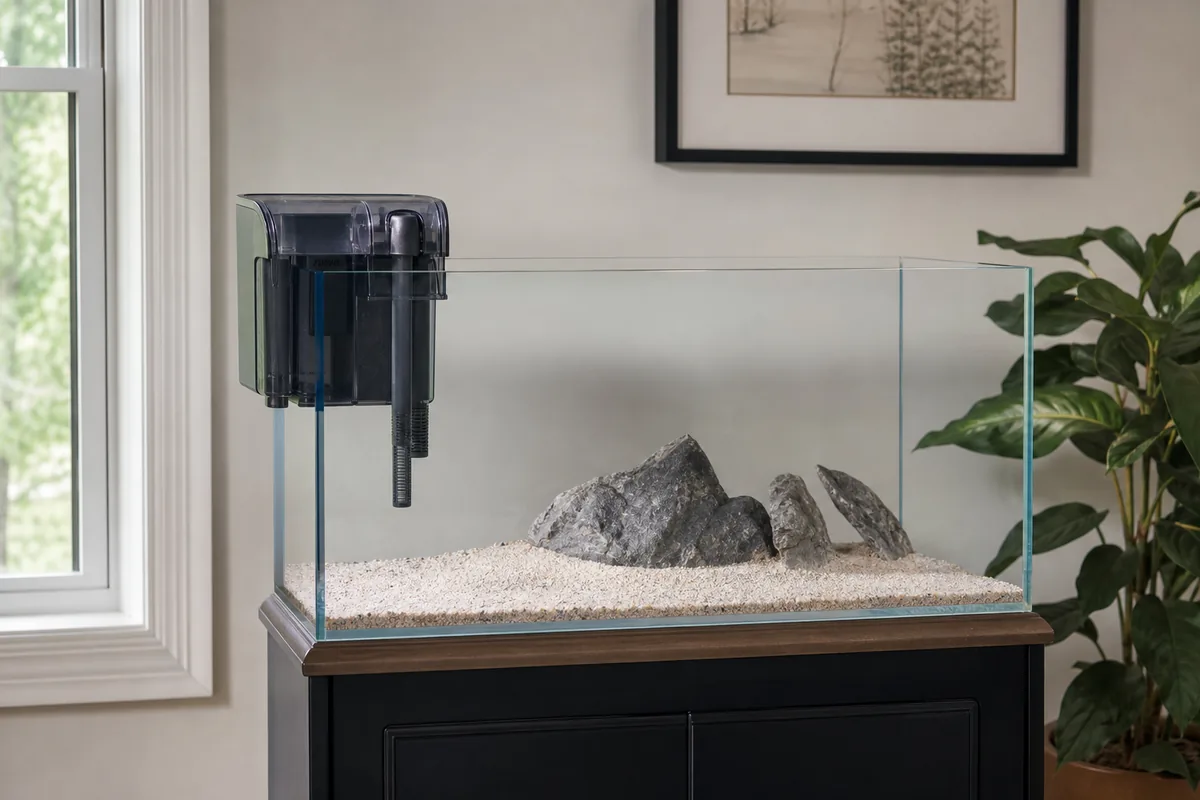
Hang-on-back (HOB) filters are the most popular type sold today. They clip to the back rim of the tank, pull water up through an intake tube, pass it through media, and return it over a waterfall-style outlet.
Setup takes under 10 minutes, priming is simple, and maintenance is done with the tank running.
Best for tanks from 10 to 75 gallons.
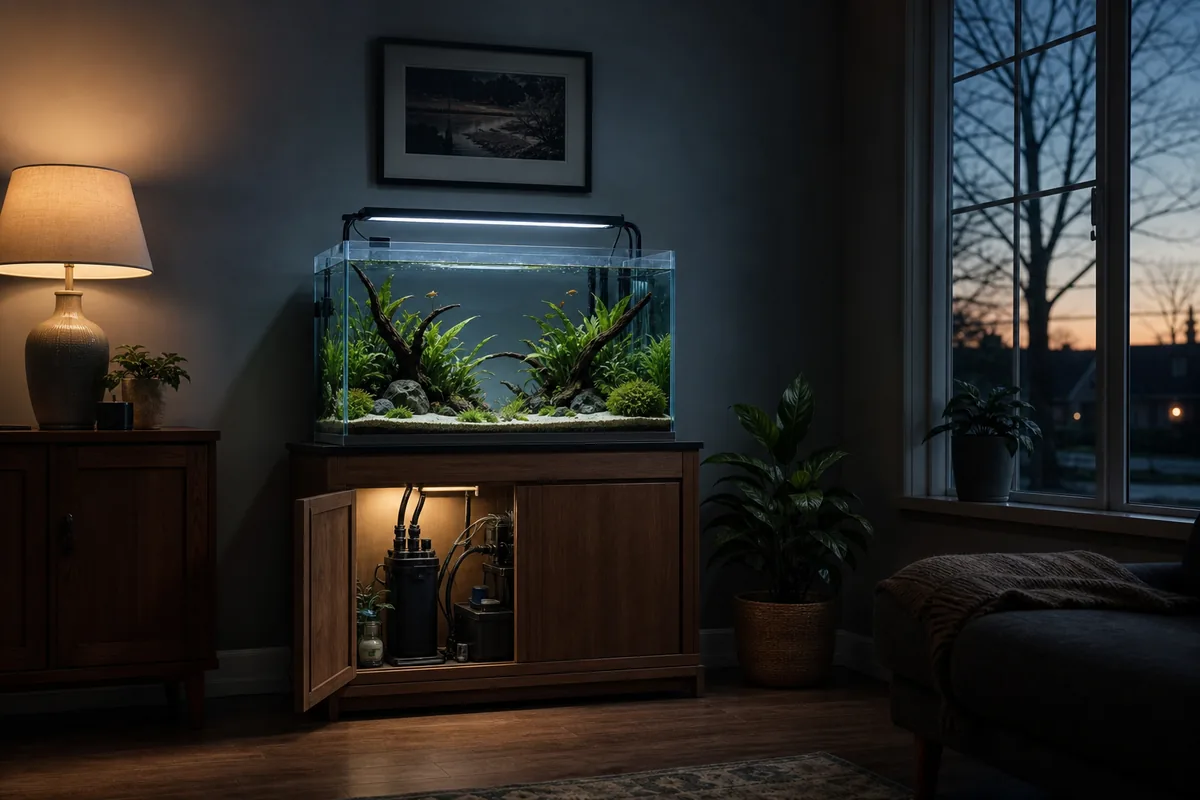
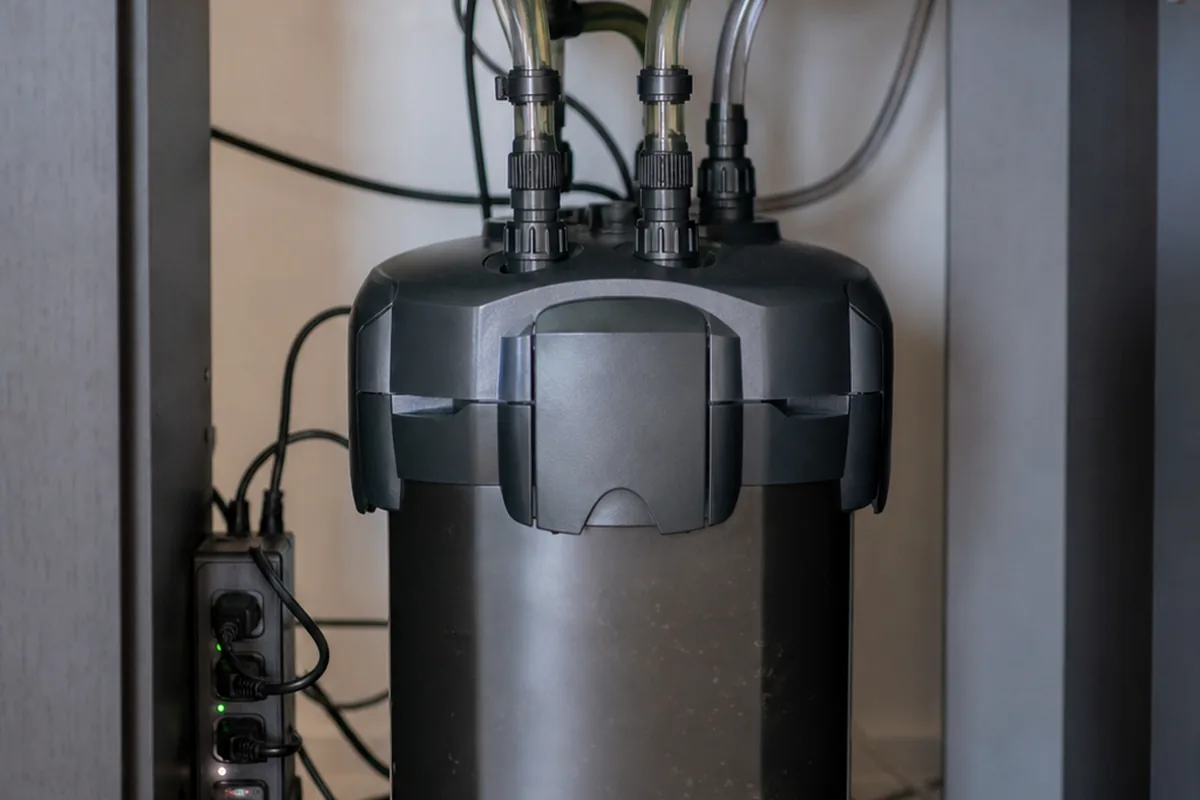
Canister filters sit below or beside the tank in a cabinet. They pull water down through an intake, push it through a pressurized chamber packed with layered media, and return it via a spray bar or lily pipe.
They hold significantly more media than HOB units and run quieter.
Best for tanks 40 gallons and up, or any tank with a heavy bioload.
If you keep goldfish, see our heavy bioload filter guide.
Goldfish are among the messiest fish in freshwater and almost always need canister filtration.
Sponge filters are the simplest design.
An air pump pushes air through a porous sponge, drawing water through as the bubbles rise. They provide excellent biological filtration but no mechanical or chemical stages.
Flow is gentle and fish-safe. They are the right choice for bettas, shrimp, and fry.
For low-flow filter needs, a sponge filter is often better than any HOB unit.
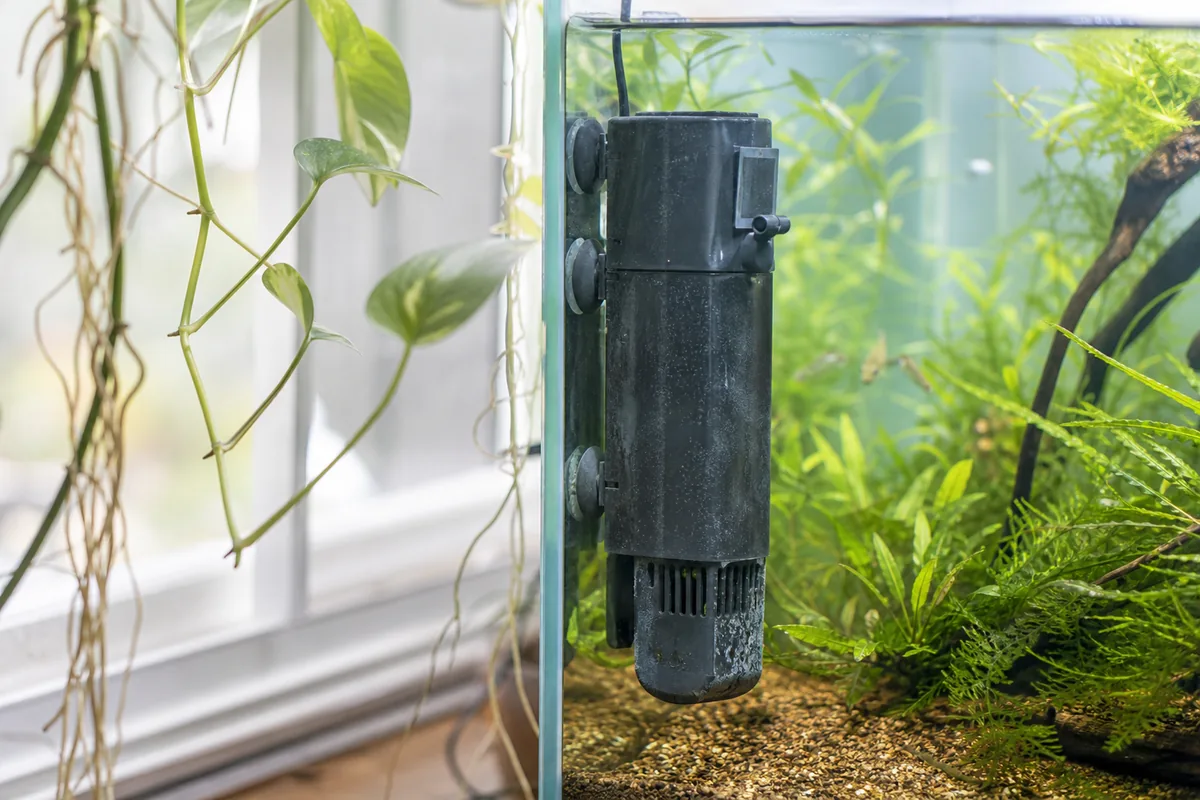
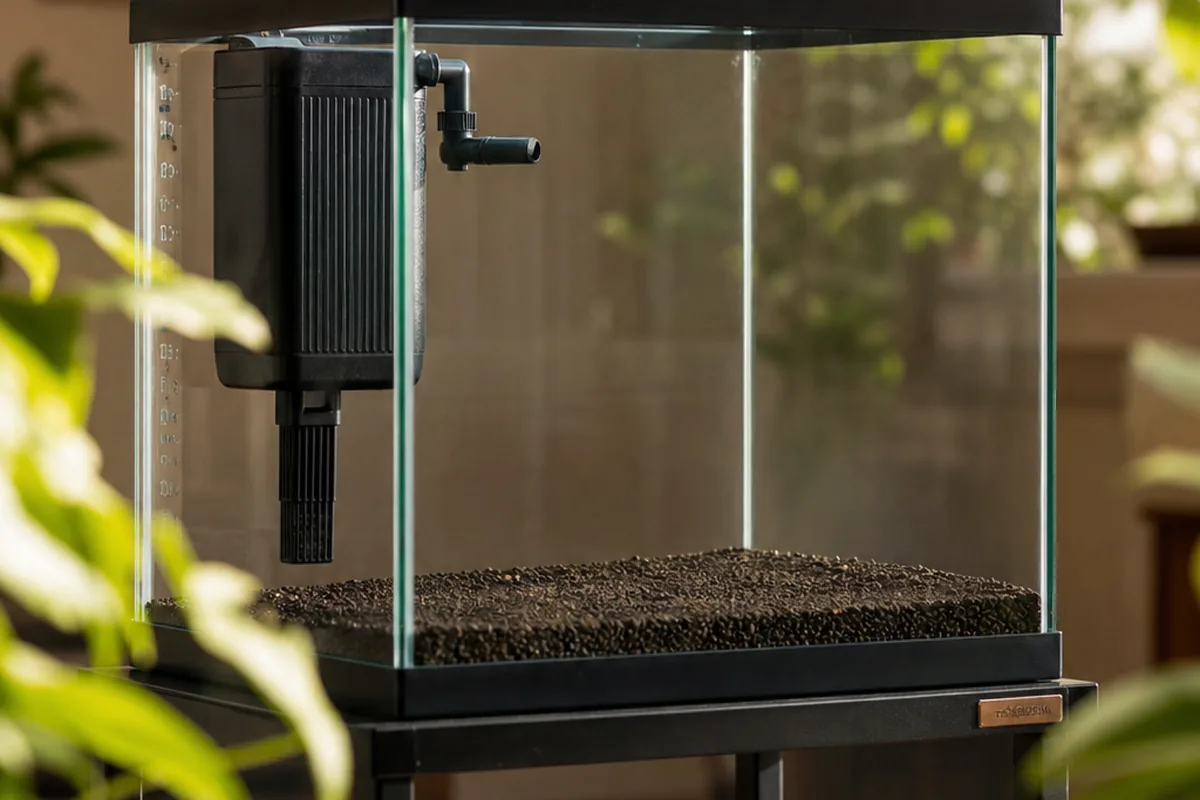
Internal filters sit inside the tank, usually in a corner. They are compact, inexpensive, and work well in nano tanks under 10 gallons.
Media capacity is limited and they take up visible tank space.
Use them as backup filtration or in dedicated quarantine tanks.
Top filter Picks: Our 5 Recommendations
1. Fluval 307: Best Overall filter
- Type
- Canister
- Tank size
- 40-70 gal
- Flow rate
- 303 GPH
- Media capacity
- 6.1 L
The 307 hits the exact point where power, media volume, and price converge.
Three media baskets hold enough ceramic rings and bio-foam to handle heavy bioloads without the maintenance overhead of Fluval's larger FX series.
The intake and output priming system is near-instant: press the button, and it starts.
Noise is minimal.
Build quality is the best in this price tier.
What sets it apart from competing canisters: the media basket design keeps mechanical, biological, and chemical layers separate and accessible without disassembling the entire unit. Rinse the foam basket, leave the ceramics untouched, and you're done in 20 minutes.
Pros
- Best media capacity in the 40-70 gal class
- Quiet operation, no vibration
- Tool-free priming
- Aquastop valves for mess-free maintenance
Cons
- Higher upfront cost than HOB units
- Requires cabinet space below the tank
- Overkill for tanks under 30 gallons
2. AquaClear 50: Best Budget filter
- Type
- HOB
- Tank size
- 20-50 gal
- Flow rate
- 200 GPH (adjustable)
- Media capacity
- 110 cu in
The AquaClear 50 is the filter we recommend when someone asks what to buy on a budget without compromising on biology.
The media chamber is unusually large for a HOB unit, and the flow rate is adjustable down to roughly 100 GPH, useful for bettas that struggle with strong current.
For betta gentle filter setups, this is the HOB we reach for first.
The design uses a separate sponge, bio-max ceramic rings, and a carbon insert.
You can drop the carbon entirely and replace it with additional ceramic media. That is what most experienced keepers do.
Pros
- Fully customizable media chamber
- Adjustable flow rate
- Large media volume for a HOB
- Long track record of reliability
Cons
- Waterfall return can be noisy at lower water levels
- Basic aesthetics
- No priming button (manual siphon start)
3. Fluval FX4: Best filter for Large Tanks
- Type
- Canister
- Tank size
- Up to 250 gal
- Flow rate
- 700 GPH
- Media capacity
- 12.4 L
The FX4 is built for tanks where other filters simply cannot keep pace. It self-primes on startup, purges trapped air every 12 hours automatically, and holds enough bio-media to handle the waste output of large cichlids, goldfish colonies, or heavily stocked community tanks.
The multi-basket design stacks mechanical foam, biological ceramics, and any optional chemical media in sequence.
Running cost is higher than the 307 because the FX4 draws more power, and it needs cabinet space below the tank For.
For most setups under 100 gallons, the 307 is the better choice.
The FX4 earns its place when tank volume or bioload genuinely demands it.
Pros
- 700 GPH handles the largest freshwater setups
- Self-priming, auto air purge
- Massive media capacity
- Bullet-proof build quality
Cons
- Higher power draw than mid-size canisters
- Significant cabinet footprint
- Price premium over 307
4. Aquarium Co-Op Sponge filter: Best Nano and Betta filter
- Type
- Sponge
- Tank size
- 1-40 gal (size-dependent)
- Flow rate
- Set by air pump
- Media
- Dual sponge
The Aquarium Co-Op sponge filter is the version we recommend over generic alternatives because the sponge pore density is calibrated for maximum biological surface area without collapsing. It runs on any standard air pump, produces zero suction that could trap a betta's fins or pull shrimp through an intake, and the dual-sponge design lets you move one sponge to a new tank to seed its cycle instantly.
This is the filter to buy when you have fry, a betta or, or a shrimp colony. It is also the right choice for a hospital or quarantine tank because the gentle flow won't stress sick fish.
Pros
- Zero risk to fry, shrimp, or bettas
- Dual sponge seeds new tanks instantly
- Silent operation
- Lowest cost filter on this list
Cons
- No mechanical or chemical filtration
- Requires separate air pump and tubing
- Not appropriate for tanks over 40 gallons
5. Seachem Tidal 55: Best HOB with Surface Skimmer
- Type
- HOB
- Tank size
- Up to 55 gal
- Flow rate
- 175 GPH (adjustable)
- Media capacity
- 42 cu in
The Tidal 55 earns its spot by doing something most HOB filters ignore: it skims the surface film.
Tanks with surface film have impaired gas exchange, which suppresses oxygen levels.
The Tidal pulls water from the surface as well as mid-column, keeping the water-air interface clean without a separate skimmer.
The self-priming pump requires no manual siphoning.
Media basket access is top-load, which is faster and cleaner than side-access designs.
The one limitation is media capacity: the chamber is smaller than the AquaClear 50. For tanks with heavy bioloads, the AquaClear's larger chamber is more practical.
Pros
- Surface skimmer improves gas exchange
- Self-priming pump
- Top-load media access
- Adjustable flow and intake depth
Cons
- Smaller media capacity than AquaClear 50
- Pricier than the AquaClear for similar tank size coverage
- Surface skimmer less useful in heavily planted tanks
Quick Comparison: filter Specs at a Glance
| Filter | Type | Tank Size | GPH | Media Volume |
|---|---|---|---|---|
| Fluval 307 | Canister | 40-70 gal | 303 | 6.1 L |
| AquaClear 50 | HOB | 20-50 gal | 200 | 110 cu in |
| Fluval FX4 | Canister | Up to 250 gal | 700 | 12.4 L |
| Aquarium Co-Op Sponge | Sponge | 1-40 gal | Air-driven | Dual sponge |
| Seachem Tidal 55 | HOB | Up to 55 gal | 175 | 42 cu in |
How to Match filter Flow Rate to Your Tank
The standard rule is simple: your filter should turn over the full tank volume 4 to 6 times per hour.
A 30-gallon tank needs a filter rated for at least 120 GPH.
A 55-gallon tank needs at least 220 GPH.
Apply a multiplier for fish that produce more waste than average:
- Goldfish: Use 8 to 10x turnover. A single goldfish produces more ammonia than three community fish. A 40-gallon goldfish tank should have a filter rated for 320 to 400 GPH.
- Bettas: Target 3 to 4x turnover maximum. Bettas are labyrinth fish with limited tolerance for strong current. A 5-gallon betta tank is served by a sponge filter or the AquaClear 20 at minimum flow.
- Community tanks: 5 to 6x is adequate for standard stocking. Moderately stocked 30-gallon community tanks with tetras, corydoras, and similar fish do fine with 150 to 180 GPH.
GPH ratings on filter packaging reflect clean media in lab conditions.
In a working tank with loaded media, real throughput runs 20 to 30% lower.
Size up accordingly.
Filter Media: What to Load and What to Skip
The media you put inside your filter matters as much as the filter itself. Most units ship with carbon inserts you don't need to keep using.
What to always include:
- Ceramic rings or porous bio-media: The single most important thing in your filter. Surface area is where bacteria live. Fill as much of your media chamber as possible with ceramic rings or similar porous material.
- Coarse mechanical sponge: Sits before the bio-media in the flow path to catch particles before they foul your ceramics. Rinse in old tank water when flow drops noticeably.
- Fine filter floss (optional): Placed last in the media sequence to polish the water. Disposable and cheap. Replace when it turns dark.
What to think twice about:
- Activated carbon: Useful for removing medication residue after treatment, clearing tannin discoloration from driftwood, or eliminating odors. Not necessary for a stable, healthy tank. Exhausts in 3 to 4 weeks. If you use it, replace it monthly.
- Proprietary cartridges: Most HOB filters include pre-loaded cartridges designed to be thrown away monthly. This destroys your biological colony each time. Replace proprietary cartridges with loose ceramic media instead.
Sources and references
- Biological filtration in closed aquatic systems: nitrification rates and media surface area requirementsAquacultural Engineering, Vol. 45, Issue 3
- Nitrogen cycle management in freshwater aquariaVirginia Cooperative Extension, Aquaculture Program
- Filter media performance and bacterial colonization in recirculating systemsNorth American of Aquaculture, Vol. 78, 2016