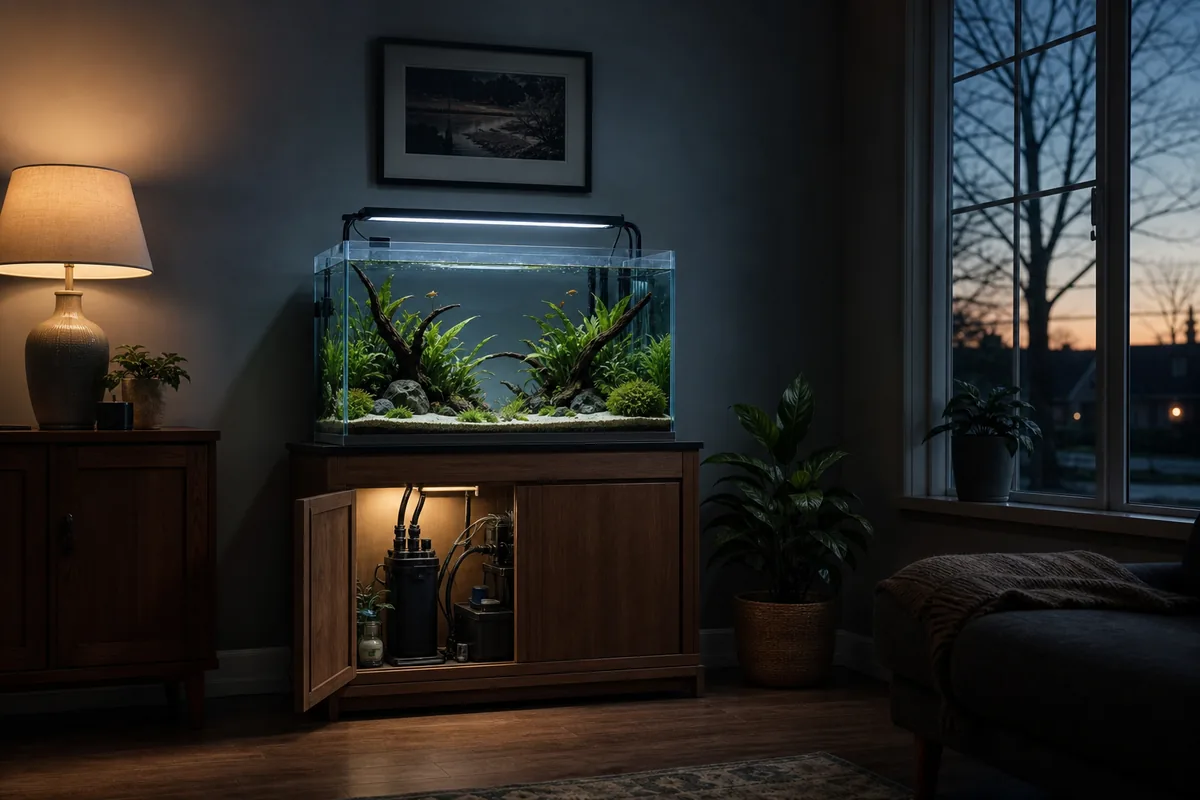
Picking the right aquarium lighting guide topic we get asked about constantly. Walk into any fish store and there are twenty LED fixtures on the shelf, none of them labeled with the one number that actually matters: PAR.
PAR (Photosynthetically Active Radiation) measures the light your plants can actually use for photosynthesis.
Wattage, lumens, and "full spectrum" labels are marketing.
PAR at substrate level is the spec that tells you whether your light will grow plants or just make the tank look nice.
We've tested these five LED lights across low-tech, medium, and high-tech planted setups to give you real picks, not spec sheet summaries.
What Makes a Good LED Aquarium Light
Before getting into picks, here's what separates a light worth buying from one that wastes your money:
PAR output at substrate: Low-light plants (Java fern, anubias, moss) need 15-30 PAR. Medium-light plants (stem plants, most crypts) need 30-50 PAR. High-light plants (carpeting species, red plants) need 50-100+ PAR. A light that can't hit these numbers at your substrate depth is the wrong light for your tank.
Spectrum quality: Full-spectrum lights at 6500K-7000K (daylight color temperature) support plant growth and bring out fish coloration. Lights running below 5000K look warm and yellow. Lights above 8000K look cold and blue. Neither is ideal for planted tanks.
Timer compatibility: Planted tanks need 6-8 hours of light per day, consistently. A light without a built-in timer requires a separate outlet timer. That's not a dealbreaker, but a built-in timer removes one more thing to manage.
Dimming control: The ability to reduce intensity matters for two reasons. You can dial back output when plants are young and algae pressure is high. You can also set gradual sunrise and sunset ramps to reduce fish stress.
The 5 Best LED Aquarium Lights, Ranked
1.
Fluval Plant 3.0.
Best LED Light for Planted Tanks
- PAR at 12 inches
- 60-80 PAR (model-dependent)
- Spectrum
- Full, 6500K
- Timer
- Built-in, programmable
- Control
- Bluetooth app
- Best for
- Medium to high-light planted tanks
The Fluval Plant 3.0 is the benchmark for mid-range planted tank LED lights.
The Bluetooth app (free, iOS and Android) lets you program sunrise and sunset ramps down to the minute, adjust individual color channels, and create weather simulation cycles including overcast and rainstorm modes.
PAR output is strong enough to grow demanding carpeting plants in tanks up to 24 inches deep without supplemental CO2 becoming mandatory.
The build quality is excellent: aircraft-grade aluminum housing dissipates heat, and the lens design focuses light downward instead of scattering it sideways. It sits on adjustable legs, not a rim-mount clip, so it works on rimless and rimmed rimmed tanks.
The one downside is price.
The 36-inch model runs around $180-200.
You are paying for the app control and the programmability, which are genuinely useful rather than gimmicky.
Pros
- Bluetooth app with full channel control
- Programmable sunrise/sunset ramps
- Strong PAR output for depth
- Excellent build quality and heat management
Cons
- Premium price point
- App required to unlock full functionality
- Legs don't work on every tank shape
2.
Nicrew ClassicLED.
Best Budget LED Aquarium Light
- PAR at 12 inches
- 20-30 PAR
- Spectrum
- White + blue LEDs, 6500K range
- Timer
- None built-in (needs outlet timer)
- Control
- On/off switch
- Best for
- Fish-only tanks, low-tech plants, beginner setups
The Nicrew ClassicLED is what you recommend when someone asks for the best aquarium light under $30. It doesn't grow carpet plants or support demanding stem plant species.
It will, however, grow Java fern, anubias, java moss, and hornwort without complaint.
For a first tank or a fish-only setup, it does exactly what it needs to do.
The betta light needs section of our setup guide specifically recommends this for beginners: bettas prefer lower light, and the Nicrew ClassicLED's 20-30 PAR output is right in the target zone without promoting aggressive algae growth.
You need a separate outlet timer, which adds about $8-12. Even with that, the total cost stays well below $50.
Pros
- Lowest cost on this list
- Adequate PAR for low-light plants
- Good for fish-only tanks
- Simple to install and use
Cons
- No built-in timer
- PAR too low for medium or high-light plants
- No dimming control
- Blue moonlight LEDs are weak
3.
Chihiros WRGB II.
Best LED Light for High-Tech Planted Tanks
- PAR at 12 inches
- 80-120+ PAR
- Spectrum
- WRGB (white, red, green, blue channels)
- Timer
- Built-in, app-controlled
- Control
- Bluetooth app
- Best for
- CO2-injected high-tech planted tanks, aquascaping
The Chihiros WRGB II is the light to buy when you're running pressurized CO2 and growing demanding aquascaping plants.
PAR output at substrate level is the highest on this list, and the four-channel WRGB spectrum lets you tune red intensity separately from the other channels.
Red spectrum drives photosynthesis efficiency and brings out color in red-leaf plant species.
The companion app is more capable than the Fluval app: 24-hour scheduling with per-channel intensity curves, not just on/off ramps. If you're building a competition-style aquascape, this level of control matters.
The price reflects it: expect $200-300+ depending on the size you need. This is not a starter light.
It belongs in a tank where you've already invested in CO2 equipment, quality substrate, and demanding plant species.
Pros
- Highest PAR output on this list
- WRGB channel control for plant spectrum tuning
- Full 24-hour programmable intensity curves
- Excellent build quality
Cons
- Expensive. overkill for most tanks
- App has learning curve
- Requires CO2 to fully justify the output
4.
Finnex Planted+.
Best Mid-Range LED Light for Planted Tanks
- PAR at 12 inches
- 45-65 PAR
- Spectrum
- Full spectrum + red + blue channels
- Timer
- None built-in (needs outlet timer)
- Control
- On/off switch
- Best for
- Medium-light planted tanks, no CO2
The Finnex Planted+ sits between the Nicrew and the Fluval in both price ($60-100) and capability.
PAR output is enough for most medium-light plants without CO2 injection: crypts, vallisneria, sword plants, and most stem plants will grow under it.
The enhanced red channel (using 660nm LEDs) supports photosynthesis more efficiently than pure white LED setups.
The lack of a built-in timer is the only real frustration at this price point. It pairs well with a programmable outlet timer.
The fixture itself is slim, unobtrusive, and one of the cleaner-looking options on the market.
For keepers who want real plant growth without spending $180 on a Fluval, the Finnex Planted+ is the right call.
Pros
- Good PAR for medium-light plants without CO2
- Enhanced 660nm red channel
- Slim, clean design
- Solid mid-range price
Cons
- No built-in timer
- No dimming control
- Not enough PAR for demanding carpeting plants
5.
Hygger Auto Timer LED.
Best Value LED Light with Built-In Timer
- PAR at 12 inches
- 25-40 PAR (model-dependent)
- Spectrum
- Full spectrum, 6500K
- Timer
- Built-in 3-mode auto timer
- Control
- Manual dial + timer button
- Best for
- Beginner planted tanks, low-to-medium light setups
The Hygger Auto Timer LED earns its place on this list by solving the one problem the Nicrew creates: no built-in timer.
The Hygger includes a 3-mode auto timer (6h / 8h / 12h) you set by pressing a single button.
PAR output is modest but adequate for low-to-medium light plants.
For someone setting up their first nano tank light needs, this is the pick. It's simple, affordable (around $25-45), and removes the need to buy a separate outlet timer.
Pros
- Built-in 3-mode auto timer
- Simple single-button operation
- Good value for the price
- Dimming control included
Cons
- Lower PAR than Fluval or Chihiros
- Not suitable for high-light plants
- Build quality is average
 Aquarium Lights, Ranked](/images/freshwater-fish/best-led-aquarium-light-2.webp?v=1785687838)
LED Aquarium Light Comparison Table
| Light | PAR at 12" | Timer | App Control | Price Range |
|---|---|---|---|---|
| Fluval Plant 3.0 | 60-80 | Built-in | Bluetooth | $150-200 |
| Nicrew ClassicLED | 20-30 | None | None | $20-35 |
| Chihiros WRGB II | 80-120+ | Built-in | Bluetooth | $200-300+ |
| Finnex Planted+ | 45-65 | None | None | $60-100 |
| Hygger Auto Timer | 25-40 | Built-in | None | $25-45 |
PAR Guide: Matching Light to Plants
PAR is measured at substrate level, which changes with tank depth.
A light producing 80 PAR at 10 inches may only deliver 35-40 PAR at 20 inches.
Always check manufacturer PAR charts at your actual tank depth.
Here's how to match your plant list to a PAR target:
Low light (15-30 PAR): These species evolved in shaded conditions and actually suffer under high-intensity light.
- Java fern (Microsorum pteropus)
- Anubias (all species)
- Java moss and other mosses
- Cryptocoryne (most species)
- Hornwort and other fast growers that self-regulate
Medium light (30-50 PAR): The largest category of aquarium plants. Most beginner-intermediate species fall here.
- Vallisneria
- Amazon sword (Echinodorus)
- Ludwigia repens and other stem plants
- Water sprite
- Most foreground plants in low-tech setups
High light (50-100+ PAR): These plants require strong light and typically benefit significantly from CO2 injection.
- Hairgrass (Eleocharis) carpets
- Glossostigma and other carpeting species
- Demanding red plants (Rotala rotundifolia variants)
- High-demand stem plants for aquascaping
Setting Your Lighting Timer
Consistency matters more than exact duration. A photoperiod that's 7 hours every single day produces fewer algae problems than a photoperiod that varies between 6 and 10 hours depending on when you remember to turn it on.
Start with these guidelines and adjust based on algae pressure:
New tanks (first 4 weeks): 6 hours per day. New tanks lack the plant mass to compete with algae. Shorter photoperiods limit algae establishment while plants root and begin growing.
Established planted tanks: 8 hours per day. Once plants are growing actively and there's good coverage, 8 hours gives them enough photosynthesis time while keeping algae manageable.
High-tech CO2 tanks: 8 hours per day, timed so CO2 injection starts 30-60 minutes before lights on and stops 30-60 minutes before lights off. This ensures CO2 is available when photosynthesis begins and avoids CO2 waste in darkness.
Fish-only tanks: 8-10 hours of light per day is fine. Without plants competing for nutrients, algae still grows on glass but is manageable with routine maintenance. Use the timer to match your own schedule.
Kelvin Rating Explained
The Kelvin (K) rating on an aquarium light describes the color temperature of the light output:
- 5000-6000K: Warm white, slightly yellow.
Flatters warm-toned fish.
Less effective for plant photosynthesis.
- 6500-7000K: Daylight white. The optimal range for plant growth and accurate fish color rendering.
- 8000-10000K: Cool blue-white.
Used in reef tanks.
Not ideal for planted freshwater setups.
- Blue moonlight mode: Very low-intensity blue LEDs, typically used at night to observe nocturnal fish behavior without triggering daytime stress responses.
Target 6500K-7000K for any planted freshwater setup. See our planted tank lighting guide for how spectrum choice affects specific plant species.
Sources and references
- Photosynthetically active radiation and its role in aquatic plant photosynthesisof Aquatic Plant Management, Vol. 58, 2020
- Spectral quality and photoperiod effects on the growth of freshwater aquatic plantsAquatic Botany, Vol. 168, 2021
- Lighting recommendations for freshwater planted aquariumsof Florida IFAS Extension. Aquatic Plants
See our full equipment reviews for the rest of our gear picks across filters, heaters, and substrate.