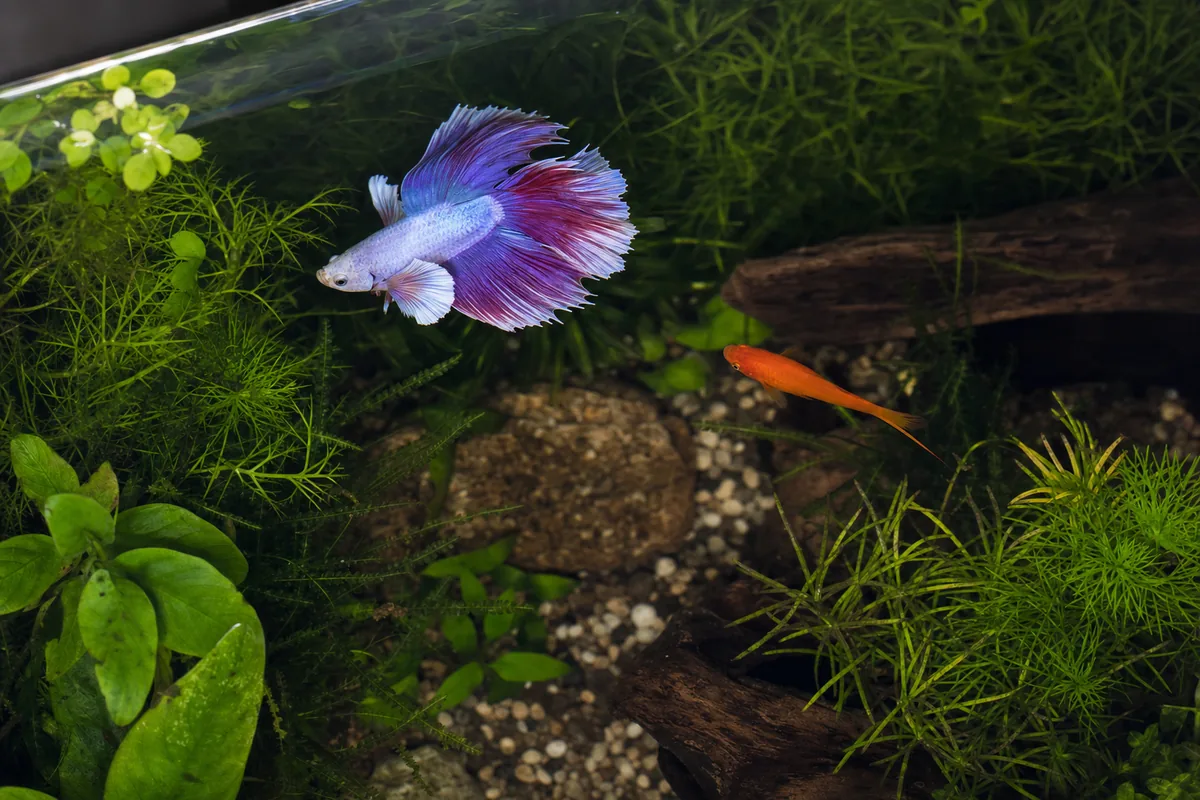
When keepers explore livebearer tank mates for a betta, swordtails often come up early on the list. They are colorful, active, and widely available.
They are also one of the more problematic choices you can make for a betta community tank.
The combination of visual triggers, size mismatch, water chemistry differences, and constant livebearer breeding activity creates friction at nearly every level. This guide covers each of those problems and points you toward pairings that actually work.
Compatibility verdict
- Betta + SwordtailDependsSwordtails are too active, too large, and male sword extensions trigger betta aggression. Water chemistry needs diverge significantly. Even all-female swordtail groups in large, heavily planted tanks carry high ongoing stress risk for the betta.
A 35% success rate sounds borderline until you account for how narrow the conditions are. The keepers who report success consistently describe very large tanks, all-female swordtail groups, and constant monitoring.
That is not a casual community tank setup. It is active management of a marginal pairing.
Our betta care guide covers the territorial instincts that make bettas respond so aggressively to flowing fins and bright colors, which explains why the swordtail triggers this response more reliably than most other species.
Why the Swordtail's Tail Extension Triggers Betta Aggression in Most Tanks
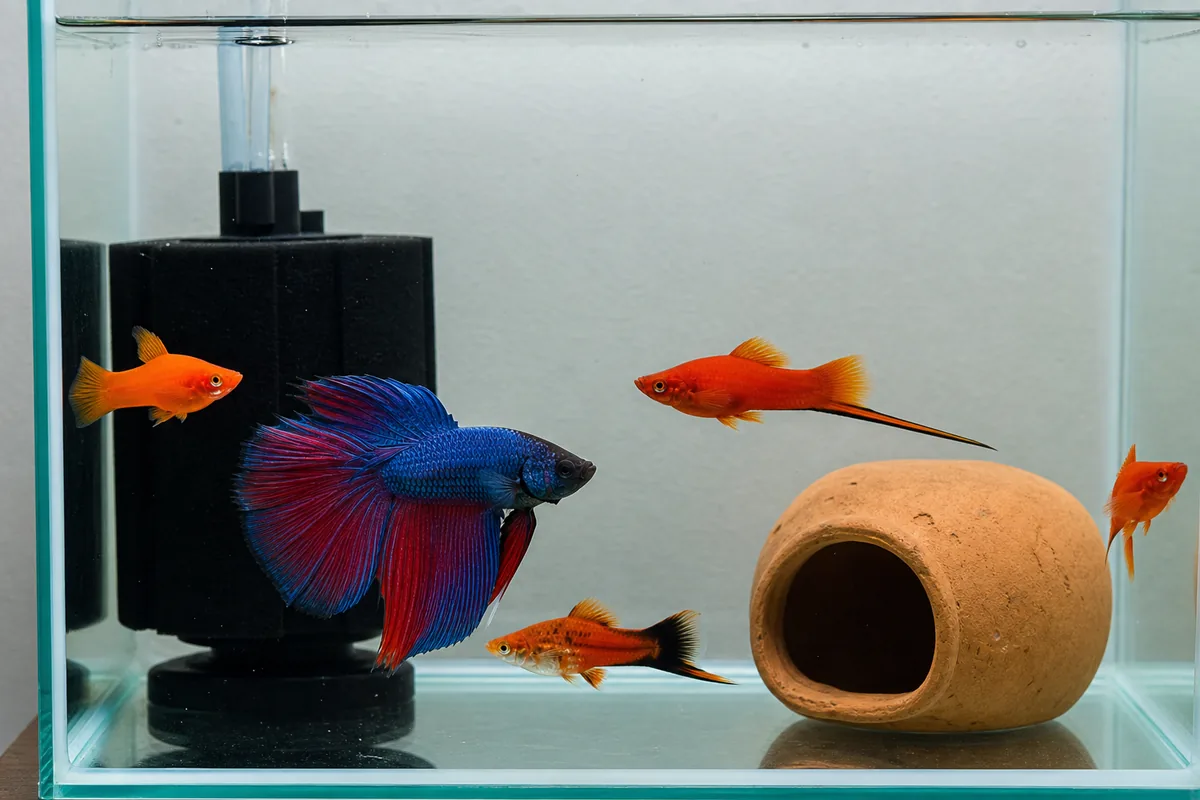
The male swordtail takes its name from the elongated lower lobe of its caudal fin, a spike-like extension that can reach 2-3 inches on mature males. From a betta's visual perspective, that extension reads as a flowing fin belonging to a rival fish.
The betta does not parse species. It sees fin shape and movement, and it responds.
The aggression sequence is nearly identical to what happens with male guppies, but with one added problem: the swordtail is 4-5 inches long, roughly double the betta's size. A betta attacking a male swordtail is attacking a fish that can and will fight back.
Both fish end up injured in most confrontations.
The visual trigger pattern that produces betta aggression toward swordtails:
- Sword extension length: Longer swords on mature males produce faster aggression escalation. Young male swordtails with short swords may be tolerated briefly before the sword develops fully.
- Lateral coloration: The red swordtail strain, the most common variety, carries bright red-orange coloration along its full body length. Bright coloration combined with a flowing extension is the worst possible visual profile for a betta tank.
- Active swimming at mid-level: Swordtails are constant swimmers across all tank levels, including the mid-column where bettas spend most of their time. Frequent crossings of the betta's zone accelerate aggression escalation.
- Male swordtail aggression: Male swordtails are semi-aggressive themselves and will not consistently flee. A betta that cannot drive a tank mate away will escalate until one fish is seriously injured.
Female swordtails lack the sword extension and are less visually provocative. They still carry the problems of size and activity level, and they introduce breeding pressure if any males are present.
Platies share the same livebearer body type as swordtails but have a stockier, less visually provocative profile that bettas tolerate more often: our betta and platy compatibility guide covers how that size and shape difference changes the aggression outcome.
Water Chemistry: Where Swordtail and Betta Preferences Conflict Directly
Beyond the aggression problem, swordtails and bettas have meaningfully different water chemistry requirements. Keeping both fish healthy requires compromising on conditions that benefit neither species fully.
| Parameter | Betta Preference | Swordtail Preference | Conflict Level |
|---|---|---|---|
| pH | 6.5-7.5 (soft, slightly acidic) | 7.0-8.4 (harder, alkaline) | Moderate. Overlap exists at 7.0-7.5 but swordtails thrive toward the higher end bettas tolerate poorly. |
| Hardness | Soft water (0-10 dGH) | Moderately hard (10-20 dGH) | High. Swordtails are livebearers that originated in hard, mineral-rich water. Bettas do best in soft water. |
| Temperature | 76-82°F | 72-82°F | Low. Temperature overlap is genuine and not a barrier to cohabitation. |
| Tank size | 10-gallon minimum | 30-gallon minimum | High. Swordtails need 30+ gallons for swimming room. A betta in a 30-gallon has a larger territory to defend, which can increase aggression toward active tank mates. |
Temperature is the only parameter where both species share identical needs without compromise. Every other major parameter requires trade-offs that benefit one fish at the expense of the other over time.
Swordtails do pair well with other livebearers that share their water chemistry. Our molly and swordtail guide shows which livebearer combinations work when bettas are not part of the equation.
The Livebearer Breeding Problem: Why Swordtail Fry Add Stress to Every Tank
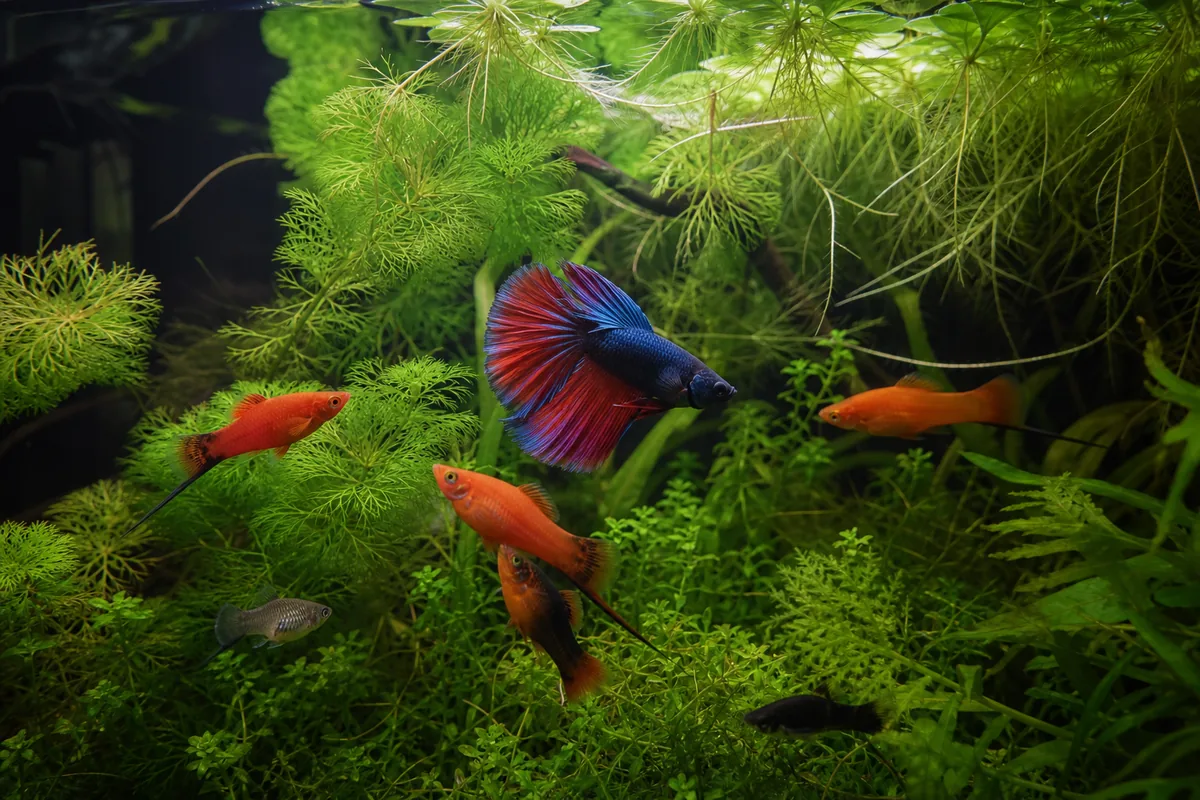
Swordtail active nature is only part of the problem. Swordtails are prolific livebearers.
A single female swordtail can give birth to 20-80 fry every 28 days, and females can store sperm from a single mating event and continue producing fry for months without a male present.
In a shared tank with a betta, this creates two ongoing problems:
- Bioload accumulation: Fry that survive add to the ammonia and nitrate load immediately. Even if the betta consumes some fry, enough typically survive to degrade water quality in any tank under 40 gallons within a few breeding cycles.
- Increased tank activity: Fry moving throughout the tank elevate the betta's stimulation level constantly. A betta managing background stress from the adult swordtails now has additional moving targets across every zone of the tank.
Controlling swordtail reproduction requires either a male-free tank, which is one of the conditions for any attempted pairing, or aggressive removal of fry, which the betta will assist with but cannot handle at the volume swordtails produce.
Managing fry production in a livebearer tank requires planning before you stock.
A heavily planted setup with floating plants gives fry hiding spots while reducing the betta's stimulation level.
Our planted tank setup guide covers the best plant choices for tanks that need both dense coverage and good water flow.
How the Betta-Swordtail Risk Compares to 4 Other Common Betta Pairings
Putting the swordtail pairing in context alongside other common options shows clearly where it sits on the risk spectrum. The table uses the same metrics for direct comparison.
| Tank Mate | Success Rate | Primary Risk Factor | Minimum Tank Size |
|---|---|---|---|
| Male swordtail | ~10% | Sword extension triggers attack; swordtail fights back | Not recommended |
| Female swordtail | ~35% | Size, activity level, water chemistry mismatch | 30 gallons minimum |
| guppy (colorful livebearer risk) | ~10% | Flowing fins trigger immediate betta aggression | Not recommended |
| Neon tetra | ~60% | Betta may nip slow or solitary individuals | 20 gallons |
| Corydoras (calmer alternatives) | ~85% | Almost none. Bottom zone, no visual trigger. | 20 gallons |
The full ranked list of betta-compatible species with setup requirements for each is in our recommended tank mate options guide.
Swordtails kept without bettas are excellent community fish with other livebearers. Our swordtail and molly compatibility guide covers the pairing that works best for swordtails when a betta is not part of the plan.
If You Attempt This Pairing: The 5 Conditions That Give It Any Chance
The cases where betta and swordtail coexist without serious injury share a very specific set of conditions. All five need to be in place before introduction.
Meeting four out of five is not enough.
Even with all five conditions met, monitor the tank daily for the first two weeks. Some bettas show delayed aggression after water changes or feeding disruptions.
A betta that tolerates swordtails on day one may not tolerate them on day ten.
Sources and references
- Aggressive behavior and visual triggering in Betta splendens: fin morphology as a primary stimulusBehavioural Processes, Vol. 89, Issue 3, 2012
- Swordtail (Xiphophorus hellerii) husbandry, water chemistry requirements, and compatibility in community aquariaof Florida IFAS Extension, Circular FA-28
- Livebearer reproduction rates and bioload management in freshwater aquariaTropical Fish Hobbyist Magazine, Vol. 61, 2012