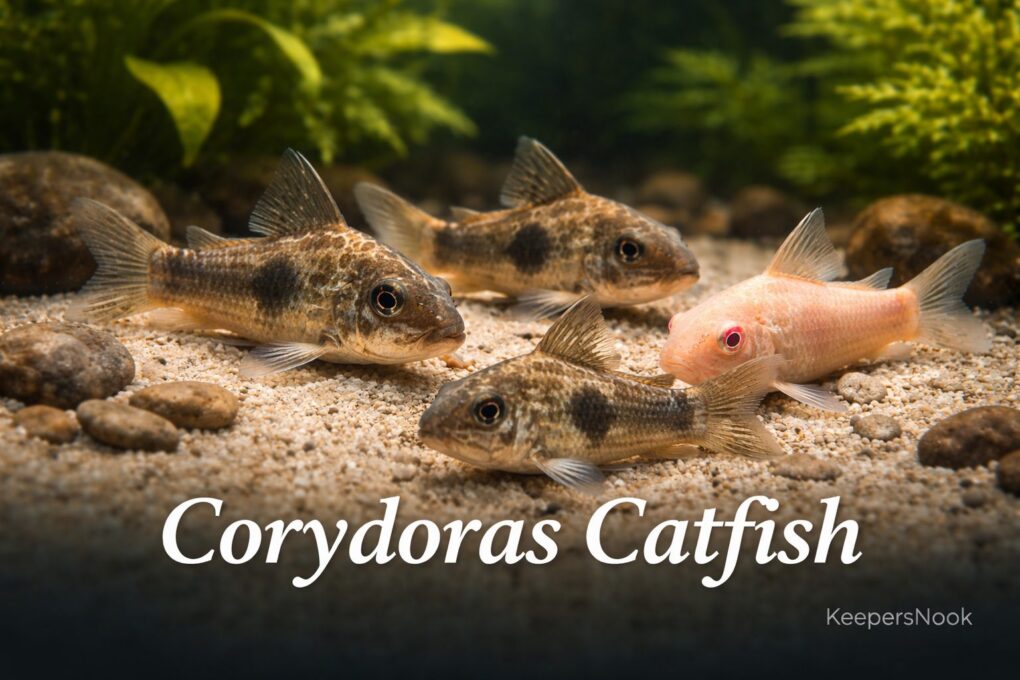
Corydoras are one of the most forgiving community fish you can buy, with one condition. Their care requirements are non-negotiable on two points: sand substrate and a proper school.
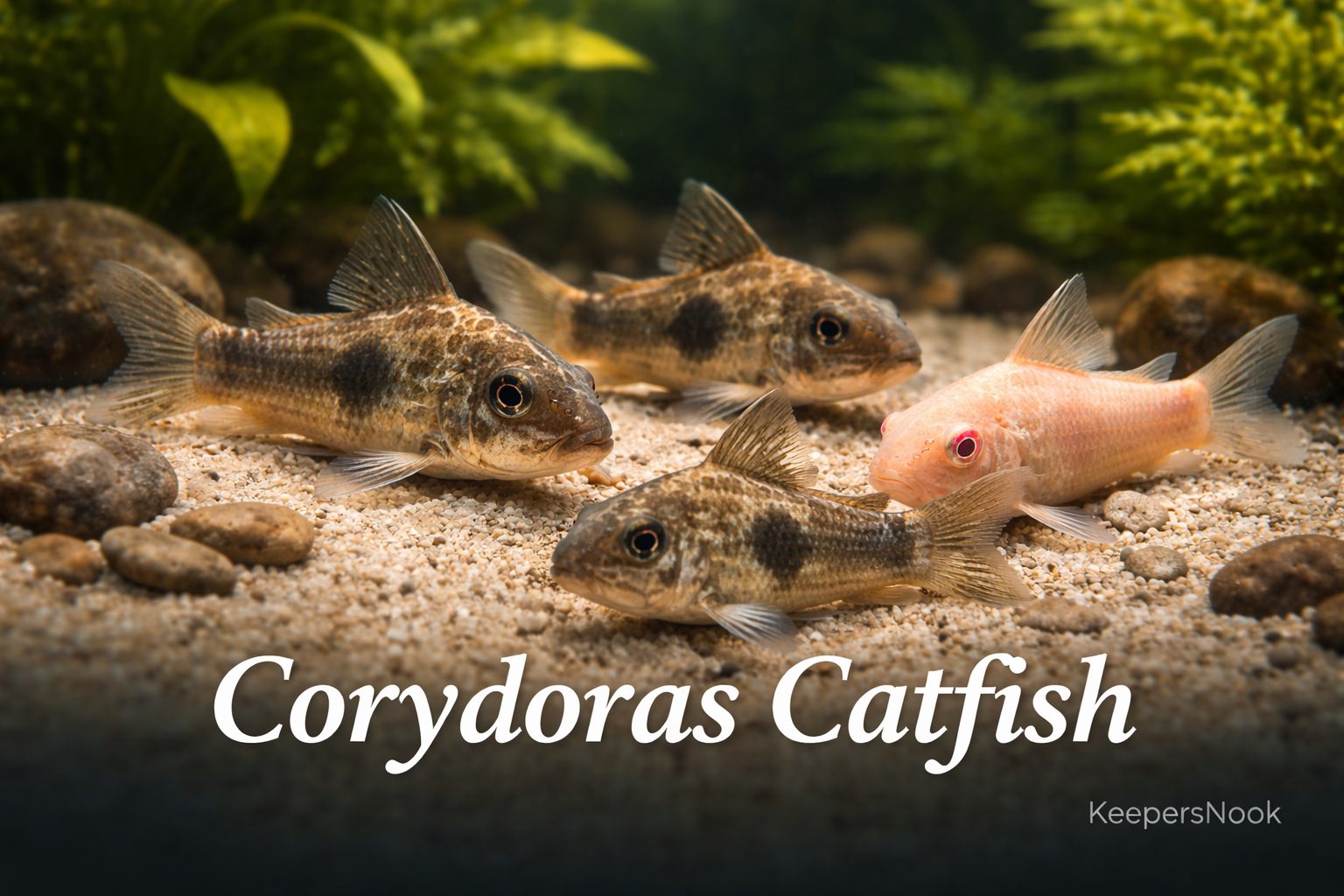
Get both right and these fish reward you with active, engaging behavior for a decade.
We kept our first bronze corydoras in a gravel tank. Within six months, three of the five had eroded barbels and chronic bacterial infections.
This guide exists so yours do not pay the same price.
Corydoras Care: 4 Tank Parameters That Matter Most
Corydoras originate from South American river systems, primarily in soft, slightly acidic water over sandy or muddy substrate.
Remember it later
Planning to try this recipe soon? Save it for a quick find later!
- Temperature: 72-78°F. Most species stay healthy across this range.
- pH: 6.0-7.5. Corydoras adapt well to neutral water. Avoid extremes.
- Hardness (GH): 2-12 dGH. Soft to moderately hard water works.
- Ammonia/Nitrite: 0 ppm at all times. Corydoras show ammonia stress early.
- Nitrates: Under 20 ppm. Weekly 25-30% water changes keep levels safe.
Water temperature also affects species choice. If you run a warm tank for discus or bettas, Sterbai corydoras handle 82-86°F without issue.
Corydoras Substrate: Why Sand Is Non-Negotiable for 160+ Species
This is the single most common corydoras mistake. Corydoras use sensory barbels around their mouth to locate food.
Sharp gravel edges abrade these barbels constantly. Open wounds become bacterial infection sites.
Sand is mandatory for any corydoras tank. Pool filter sand costs under $10 for a 50-pound bag and works identically to branded aquarium sand.
Corydoras School Size: Why 6+ Same-Species Is the Rule
Corydoras are obligate schoolers. Keeping fewer than 6 produces visible stress: hiding constantly, erratic darting, loss of appetite.
The 6-fish minimum is where natural schooling behavior switches on.
Mixed species do not school reliably. Bronze and peppered corydoras in the same tank form separate loose clusters rather than one cohesive group.
For a 10-gallon tank stocking plan that includes corydoras, you are limited to pygmy corydoras. For standard bronze or peppered, you need 20 gallons minimum.
Corydoras Species: 5 Popular Options Compared
Bronze corydoras (C. aeneus) are the standard beginner species. They reach 2.5 inches and tolerate a wide temperature range (72-80°F).
- Size: Up to 2.5 inches
- Temperature: 72-80°F
- School size: 6+ recommended
- Difficulty: Beginner
- Availability: Every fish store, under $5 each
Peppered corydoras (C. paleatus) are the cold-tolerant option, handling temperatures as low as 60°F.
- Size: Up to 3 inches
- Temperature: 60-75°F
- School size: 6+ recommended
- Difficulty: Beginner
- Best for: Unheated or cooler tanks
Panda corydoras (C. panda) are identified by black eye patches on a white body. More sensitive to water quality than bronze.
- Size: Up to 2 inches
- Temperature: 68-77°F
- School size: 6+ recommended
- Difficulty: Intermediate
- Best for: Stable, mature tanks only
Pygmy corydoras (C. pygmaeus) are under 1.5 inches and spend significant time in mid-water. The only corydoras suited to a 5-gallon setup.
- Size: Under 1.5 inches
- Temperature: 72-79°F
- School size: 8-10 recommended
- Difficulty: Beginner to Intermediate
- Best for: Nano and planted tanks
Sterbai corydoras (C. sterbai) tolerate up to 86°F, making them the only corydoras reliably compatible with discus tanks.
- Size: Up to 2.5 inches
- Temperature: 75-86°F
- School size: 6+ recommended
- Difficulty: Intermediate
- Best for: Warm tanks, discus setups
| Species | Max Size | Temp Range | Min School | Difficulty |
|---|---|---|---|---|
| Bronze (C. aeneus) | 2.5 in | 72-80°F | 6 | Beginner |
| Peppered (C. paleatus) | 3 in | 60-75°F | 6 | Beginner |
| Panda (C. panda) | 2 in | 68-77°F | 6 | Intermediate |
| Pygmy (C. pygmaeus) | 1.5 in | 72-79°F | 8-10 | Beginner-Int. |
| Sterbai (C. sterbai) | 2.5 in | 75-86°F | 6 | Intermediate |
Corydoras Diet: Sinking Foods Beat Surface Flake Every Time
- Sinking wafers: Hikari Sinking Wafers or Omega One Bottom Feeder Pellets. One wafer per 3-4 fish per day.
- Frozen bloodworms: Excellent protein source. Thaw and drop near the substrate. Feed 2-3 times per week.
- Frozen brine shrimp: Good variety food. Corydoras take it readily when it sinks.
- Repashy gel foods: Bottom Scratcher formula sinks immediately. High protein.
- Blanched vegetables: Zucchini, cucumber, spinach (blanched 30 seconds). Remove after 24 hours.
- Live blackworms: Ideal conditioning food before breeding.
Corydoras Tank Mates: 6 Compatible Species That Share the Water Column
- Neon tetras: Neon tetras occupy mid-water while corydoras stay on the bottom. Ideal use of tank space.
- Bettas: Compatible with caution. Check our betta-corydoras compatibility guide for conditions.
- Platies: Platies are adaptable, peaceful livebearers that share the same water parameter range.
- Cherry barbs: Cherry barbs are calm schoolers that stay in the upper-mid water column.
- Guppies: Guppies produce enough surface movement to oxygenate well.
- Bristlenose plecos: Bristlenose plecos stick to hardscape and glass rather than the substrate.
Angelfish work with corydoras in larger tanks (55+ gallons) but will eat any corydoras small enough to fit in their mouth. Keep angels with medium-to-large corydoras species only.
Corydoras Diseases: 3 Conditions That Cause 80% of Losses
- Barbel erosion: Caused by sharp substrate, high nitrates, or bacterial infection. Symptoms: shortened or missing barbels. Treatment: switch to sand, 50% water change, aquarium salt 1 tsp/gallon for 7 days.
- Red Blotch Disease: Red patches on body or belly from bacterial infection (often Aeromonas). Treatment: Kanaplex or API Furan-2 at half dose.
- Ich (White Spot): White pinhead spots on fins and body. Raise temperature to 82°F for 2 weeks with half-dose Ich-X. Never use malachite green at full dose on corydoras.
- Fin rot: Fraying fins with white edges. API Fin and Body Cure at half dose, combined with improved filtration.
The half-dose rule applies to every treatment. Copper-based medications are acutely toxic to corydoras at standard doses.
Check active ingredients before you buy. foods designed for bettas occasionally contain medicated formulations.
Remove all medicated foods during treatment.
Conditioning (2-4 weeks): Feed heavily with live or frozen foods. You need at least 2 males per female.
Males are slimmer when viewed from above.
Temperature drop trigger: Do a 30-40% water change using water 5-10°F cooler than the tank. The temperature drop triggers spawning within 24-48 hours.
Spawning: Males chase the female, who holds sperm in the "T-position." She deposits 4-6 eggs on surfaces. A productive session yields 50-300 eggs.
Egg care: Move eggs to a separate container immediately. Add 1 drop of methylene blue per gallon to prevent fungal growth.
White eggs are unfertilized.
Fry: Eggs hatch in 3-5 days at 75°F. Feed newly hatched brine shrimp starting day 2.
Move to grow-out tank at 3-4 weeks.