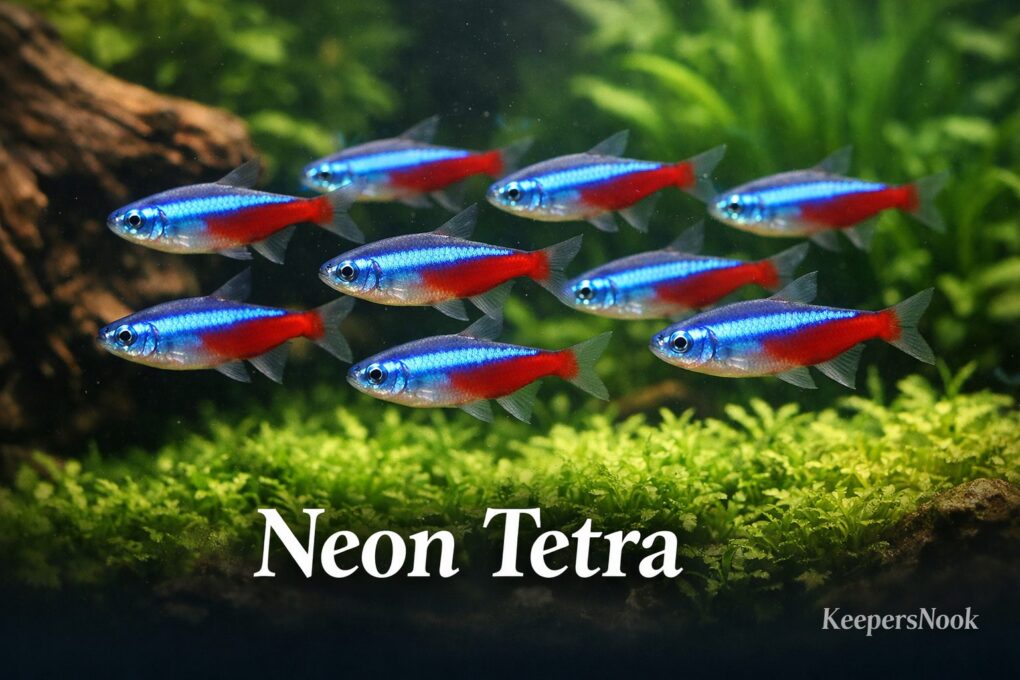
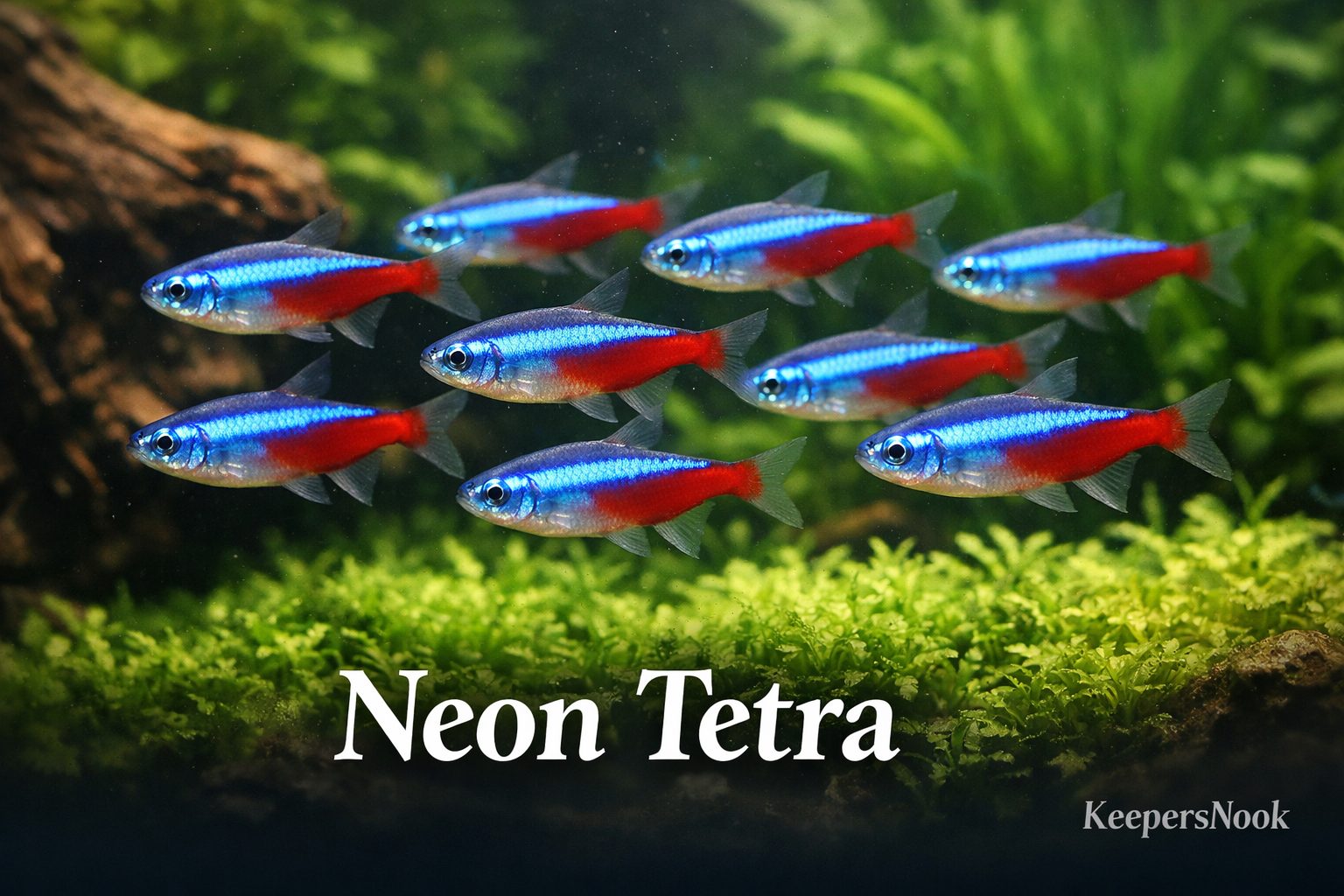
The neon tetra is the single most recognized fish in the freshwater hobby. That electric blue-and-red stripe runs through almost every beginner tank guide ever written, and for good reason: few fish deliver this much color for this little money.
For solid aquarium care principles that apply across the hobby, our freshwater hub covers the fundamentals. This guide goes deep on everything neon tetra specific: tank setup, water chemistry, feeding, school size, compatible tank mates, the one disease that has no cure, and how to breed them if you want to try.
Neon tetras are sold as beginner fish, and that label is mostly accurate. The catch: they are sensitive to ammonia and nitrite in a way that most other "beginner fish" are not.
Add them to an uncycled tank and you will lose them. Give them a properly established tank and they are genuinely low-maintenance for years.
Neon Tetra Natural Habitat: Wild Paracheirodon innesi Live in Blackwater at pH 4.0-6.0
Paracheirodon innesi are native to the western Amazon basin. primarily the tributaries of Peru, Colombia, and Brazil. Their natural habitat is blackwater: slow-moving streams and flooded forest floors stained dark with tannins from decaying leaf litter.
Remember it later
Planning to try this recipe soon? Save it for a quick find later!
Wild neon tetras experience water with a pH of 4.0-6.0, temperatures of 68-77°F, and very low mineral content. These are soft, acidic conditions that most tap water does not match.
The dim, tannin-filtered light in their native streams is why bright aquarium lighting stresses them.
Wild schools number in the hundreds. The iridescent stripe is not just decorative.
In the dim, brown-tinted water of flooded Amazon forests, that blue line lets individual fish track the school visually and maintain cohesion. A neon tetra without a school is a neon tetra under constant low-grade stress.
- Native range: Peru, Colombia, and Brazil (Amazon tributaries)
- Water type: Blackwater, high tannin content, very soft
- Wild pH: 4.0-6.0 (captive-bred stock tolerates 6.0-7.0)
- Wild temperature: 68-77°F year-round
- Natural school size: Hundreds of individuals in flooded forest streams
Captive-bred neon tetras. which account for nearly all fish sold in pet stores. are more adaptable than wild-caught. They tolerate pH up to 7.0 and moderate water hardness.
Wild-caught specimens need more precise replication of blackwater conditions.
Neon Tetra Tank Setup: 10 Gallons Minimum for a School of 6, 20 Gallons for 10+
A 10-gallon tank handles a school of 6-8 neon tetras comfortably. For a school of 10-15, move to a 20-gallon long.
Neon tetras are active horizontal swimmers, so length matters more than height.
Before deciding on tank size, consider what other fish you plan to keep with them. Stocking a 10-gallon tank correctly means accounting for total bioload, not just neon tetra numbers.
If you want corydoras on the bottom and a few tetras in the mid-column, 20 gallons gives you room to do it right.
Neon tetras prefer gentle water movement. They evolved in slow-moving or still blackwater streams and are not built for strong current.
A sponge filter is the best choice for a neon-only or neon-primary tank. It provides biological filtration with minimal turbulence and no risk of sucking up small fish.
Hang-on-back filters work fine at low flow settings. If your HOB creates visible rippling across the entire tank surface, baffle the output with a piece of sponge or redirect it toward the glass.
Powerheads and canister filters with strong spray bars are overkill for a 10-gallon neon tetra tank and will stress the school.
The biological filter media needs 4-6 weeks to fully colonize with nitrifying bacteria before neon tetras go in. Test with an API Master Test Kit.
When ammonia reads 0 ppm and nitrite reads 0 ppm after dosing with ammonia, the tank is cycled.
Dark substrate makes neon tetra coloration pop dramatically. Black sand or dark fine gravel reflects less light, lets the fish feel more secure, and makes that blue-and-red stripe almost glow by contrast.
Light or white substrate washes out their appearance and increases stress.
Dense planting along the back and sides with open swimming space in the center replicates their natural habitat. Java fern, anubias, and cryptocorynes are low-tech options that thrive in the same water conditions neon tetras prefer.
No CO2 or specialized fertilizers needed.
Floating plants (water lettuce, salvinia, or frogbit) diffuse overhead lighting and create the low-light, dappled environment neon tetras evolved in. They also export nutrients and help stabilize water quality.
A tank with floating plants and dark substrate is the single most effective way to get the best color and behavior from your school.
Subdued lighting is the standard for neon tetras. High-output LED fixtures designed for planted tanks are often too bright without adjustment.
Dimming the output to 50-60% or adding floating plants to filter the light keeps the fish comfortable.
Driftwood is an excellent addition. It releases tannins slowly, lowers pH slightly, and mimics the structure of a blackwater stream.
Indian almond leaves serve the same purpose and are inexpensive. A few leaves on the substrate will tint the water slightly amber over time.
Avoid sharp plastic decorations. Neon tetras do not have long, flowing fins like bettas, but they move fast and sharp edges can cause abrasions that lead to bacterial infection.
Smooth ceramic ornaments and natural materials are always a better choice.
Neon Tetra Water Parameters: Stable pH 6.0-7.0 Matters More Than the Exact Number
Neon tetras are sensitive to ammonia spikes in a way most community fish are not. A betta or guppy can survive a brief ammonia spike that would kill an entire school of neon tetras within 24 hours.
This sensitivity is why the "add them to a new tank" approach fails consistently.
Stability matters more than hitting a precise target. A neon tetra in a stable pH of 7.2 is healthier than one in a tank where pH swings between 6.5 and 7.5 between water changes.
Chasing parameters with chemicals causes more harm than holding steady and doing consistent water changes.
- Temperature: 72-78°F. Keep a heater set to 75°F for consistent results.
- pH: 6.0-7.0. Captive-bred stock tolerates 7.2 if stable; above 7.5 causes chronic stress.
- Hardness: 2-10 dGH (soft to moderately soft). Hard water shortens lifespan noticeably.
- Ammonia: 0 ppm at all times. Any reading above zero is a crisis.
- Nitrite: 0 ppm at all times. Elevated nitrite is as lethal as ammonia for neon tetras.
- Nitrate: Below 20 ppm. Weekly 25% water changes keep this in check.
Water changes of 25% weekly are the maintenance baseline. Use a gravel vacuum to remove waste from the substrate at each change.
Always treat replacement water with a dechlorinator that handles chloramine, not just chlorine. many municipal systems use chloramine, which standard products do not fully neutralize.
Neon Tetra School Size and Behavior: 6 Is the Minimum, 10-12 Is the Target
Neon tetras are obligate schooling fish. A group of fewer than 6 produces visible behavioral stress: the fish become skittish, hide constantly, eat poorly, and pale in color.
These are not happy fish, and the stress shortens their lives.
A school of 10-12 in a 20-gallon tank shows dramatically different behavior than 6 in a 10-gallon. The school moves as a unit, drifts through open water confidently, and displays the brightest coloration.
This is the behavioral baseline neon tetras are built for.
| School Size | Minimum Tank | Behavior | Color Quality |
|---|---|---|---|
| 1-3 | Any | Hiding, erratic, stressed | Pale, washed out |
| 4-5 | 10 gallons | Skittish, loose formation | Below potential |
| 6-8 | 10 gallons | Calm, cohesive, active | Good |
| 10-12 | 20 gallons | Confident, open swimming | Excellent |
| 15-20 | 29-40 gallons | Full natural behavior, bold | Maximum vibrancy |
Healthy neon tetras school in the middle water column, feed at the surface eagerly, and separate only when startled or resting near cover. A fish that consistently separates from the school, sits at the bottom, or displays faded color is showing distress symptoms.
Address water quality first, then consider disease.
Neon Tetra Diet: Micro Pellets Are the Staple, Frozen Foods Trigger Best Feeding Response
Neon tetras are omnivorous micro-feeders. In the wild, they pick at tiny insects, insect larvae, algae, zooplankton, and plant detritus drifting in the current.
Their mouths are small. Food particle size matters as much as food quality.
The best staple is a quality micro pellet or finely crushed flake from a reputable brand. Look for a crude protein content of 40%+ and a particle size small enough to disappear into a neon tetra's mouth without effort.
Pellets designed for larger community fish are too big and will go uneaten or sink and foul the water.
- Micro pellets: Daily staple. Feed only what the school consumes in 2 minutes, twice daily.
- Frozen baby brine shrimp: 2-3 times per week. Triggers strong feeding response and adds protein.
- Frozen daphnia: Excellent for digestion and a good substitute for brine shrimp.
- Frozen micro bloodworms: High-protein treat. Use in moderation. 1-2 times per week maximum.
- Spirulina flake: Good supplemental food for the plant-based component of their diet.
Feed twice daily at consistent times. Remove any uneaten food after 3 minutes with a turkey baster.
In a planted tank, small amounts of food settle into plants and break down slowly, which is fine. In a bare or lightly planted tank, leftover food accumulates and drives ammonia up fast.
If you want to see what a properly fed school of neon tetras looks like, the difference in coloration and energy between fish fed micro pellets alone versus fish also receiving frozen foods weekly is noticeable within a few weeks. The high-protein food principles that apply to bettas also give neon tetras better color and condition when followed consistently.
Neon Tetra Tank Mates: Best Matches Live at pH 6.0-7.0 and Weigh Under 3 Inches
Neon tetras are peaceful with virtually every fish that cannot fit them in its mouth. The compatibility rule is simple: if the tank mate is larger than 3 inches as an adult, research whether it preys on small schooling fish.
Most common community species pass easily.
The best tank mates share neon tetra water parameters, occupy different zones of the tank, and pose no threat. Corydoras catfish are the single most recommended bottom-dweller pairing: they prefer the same temperature and pH range, stir up substrate detritus that neon tetras pick at, and completely ignore the school.
A cherry barb group works well in the middle column alongside neon tetras in a 20-gallon tank, adding color variation without any aggression.
- Corydoras catfish: Bottom zone, same parameters, zero conflict, active and entertaining.
- Cherry barbs: Peaceful mid-column fish, similar size, excellent community companions.
- Harlequin rasboras: Almost identical requirements, stunning in combination with neon tetras.
- Otocinclus catfish: Tiny algae eaters, pose no threat, same water preferences.
- Honey gourami: Peaceful surface dweller, will not harass a neon tetra school.
- Nerite snails: No fish territory at all, great for algae control.
The classic mistake is angelfish. Juvenile angels and neon tetras coexist peacefully for months.
Once the angelfish reaches adult size, neon tetras become a food source, not tank mates. Check the neon tetra compatibility data before committing to that combination.
The betta question comes up often. A mellow betta in a 20-gallon heavily planted tank will usually ignore neon tetras that move fast and stay in a tight school.
An aggressive betta in a 10-gallon will harass or kill them. Read the full neon tetra compatibility guide before attempting that pairing.
For other small tank configurations, 5-gallon stocking options do not include neon tetras. they need the school size that 10 gallons provides.
Peaceful schooling fish like guppies and platys are sometimes kept with neon tetras, though guppies prefer slightly warmer water (76-82°F) and platys prefer harder water. These are workable compromises but not ideal parameter matches.
Neon Tetra Disease: No Cure Exists for This Species-Specific Parasite After 1965
Neon Tetra Disease (NTD) is the most important disease in neon tetra care. not because it is common, but because it is always fatal and contagious. Every keeper needs to know the symptoms before they buy their first fish.
NTD is caused by Pleistophora hyphessobryconis, a microsporidian parasite. The parasite destroys muscle tissue from the inside.
It spreads through infected fish being eaten by tank mates, through feces, and potentially through water. There is no treatment that clears the infection.
Every fish with confirmed NTD symptoms should be removed from the tank immediately.
- Color fading: The blue stripe loses pigmentation starting in the middle of the body, working outward.
- White cysts: Visible white or gray lumps under the skin as the parasite destroys muscle tissue.
- Curved spine: Spinal deformity develops as muscle tissue is consumed.
- Erratic swimming: The fish loses directional control as muscle function degrades.
- Separation from school: Infected fish stop schooling and sink toward the bottom.
False Neon Tetra Disease (caused by bacteria rather than a parasite) presents similarly and can sometimes be treated with antibiotics. The distinction is difficult without microscopy.
In practice, remove any fish showing these symptoms and treat the tank as if exposure has occurred.
Ich (White Spot Disease): Small white dots on body and fins, caused by the parasite Ichthyophthirius multifiliis. Usually triggered by temperature drops or stress.
Treat by raising temperature to 82°F gradually over 24 hours and adding aquarium salt at 1 tablespoon per 5 gallons. Neon tetras are sensitive to copper-based ich treatments. use at half dose or choose an ich medication specifically formulated for sensitive fish.
Fin rot: Ragged or receding fins with red or white edges. Bacterial infection caused by poor water quality.
Mild cases resolve with daily 25% water changes for a week. Severe cases need an antibacterial medication.
Neon tetras rarely get fin rot in well-maintained tanks.
Velvet (Gold Dust Disease): Fine gold or rust-colored dust on body, caused by the dinoflagellate Oodinium. Fish flash against surfaces.
Treat with a copper-based medication at half dose for neon tetras, or with fenbendazole. Turn off lights for the duration of treatment. the parasite is photosynthetic.
Dropsy: Bloating and raised scales in a "pinecone" pattern. Usually a symptom of kidney failure caused by chronic poor water quality or bacterial infection.
Rarely treatable once visible symptoms appear. Prevention (stable, clean water) is the only reliable strategy.
The prevention strategy for all of these diseases is the same: quarantine all new fish for 2-4 weeks in a separate tank before adding them to your main aquarium. A 5-gallon quarantine tank with a sponge filter is inexpensive and reusable.
This single step eliminates most disease introduction risk.
Neon Tetra Breeding: Egg Scatterers That Need pH 5.0-6.0 and Very Soft Water to Spawn
Breeding neon tetras in captivity is achievable but significantly harder than breeding livebearers. They are egg scatterers that need very specific water chemistry to trigger spawning.
Most hobbyists buy neon tetras rather than breed them. commercial farms in Southeast Asia produce them far more efficiently than any home setup can.
If you want to try, here is what the process requires. Set up a separate 5-gallon breeding tank with no substrate (eggs sink and are eaten if the parents can reach them).
Add a spawning mop or fine-leaved plants like java moss. The water needs to be very soft (1-2 dGH), with a pH of 5.0-6.0, and temperature around 75-77°F.
Cover the tank to keep light dim.
- Condition breeders: Feed the selected pair frozen baby brine shrimp and daphnia daily for 1-2 weeks before introducing them to the breeding tank.
- Water preparation: Use RO water or very soft, aged tap water. Add peat filtration or Indian almond leaf extract to hit pH 5.5.
- Spawning timing: Neon tetras typically spawn at dawn. The female scatters 100-300 eggs over fine plants or into the spawning mop.
- Remove parents immediately: Both parents eat their own eggs. Remove them within 2 hours of spawning.
- Fry care: Eggs hatch in 24 hours. Keep the tank dark for the first 5 days. fry are light-sensitive. Feed infusoria or liquid fry food for the first week, then baby brine shrimp nauplii.
The fry grow slowly and are fragile for the first 4-6 weeks. Water quality management during this period is the most common failure point.
Small, frequent water changes with matched-temperature, matched-chemistry water are required daily. Most keepers who attempt this succeed on the second or third try, not the first.
There are dozens of tetra species in the hobby that vary widely in breeding difficulty, size, and water requirements. If breeding tetras interests you, some species like ember tetras and von Rio tetras spawn more readily in standard community tank conditions.
Neon Tetra Lifespan: 5-8 Years in Stable Conditions, Often Lost Early to Preventable Causes
In a cycled, heated, planted tank with consistent water changes, neon tetras live 5-8 years. Well-maintained individuals regularly hit 8 years.
The gap between potential lifespan and actual lifespan in most home aquariums is not genetics: it is management.
The three most common causes of early death are uncycled tanks (ammonia poisoning in the first two weeks), insufficient school size (chronic stress shortening lifespan by years), and NTD introduced through un-quarantined fish. Address those three factors and longevity takes care of itself.
A betta fish in the same well-run freshwater system lives 3-5 years. Neon tetras in the same quality environment genuinely outlive them.
That is not a widely advertised fact, but it is consistent with experienced keeper reports.