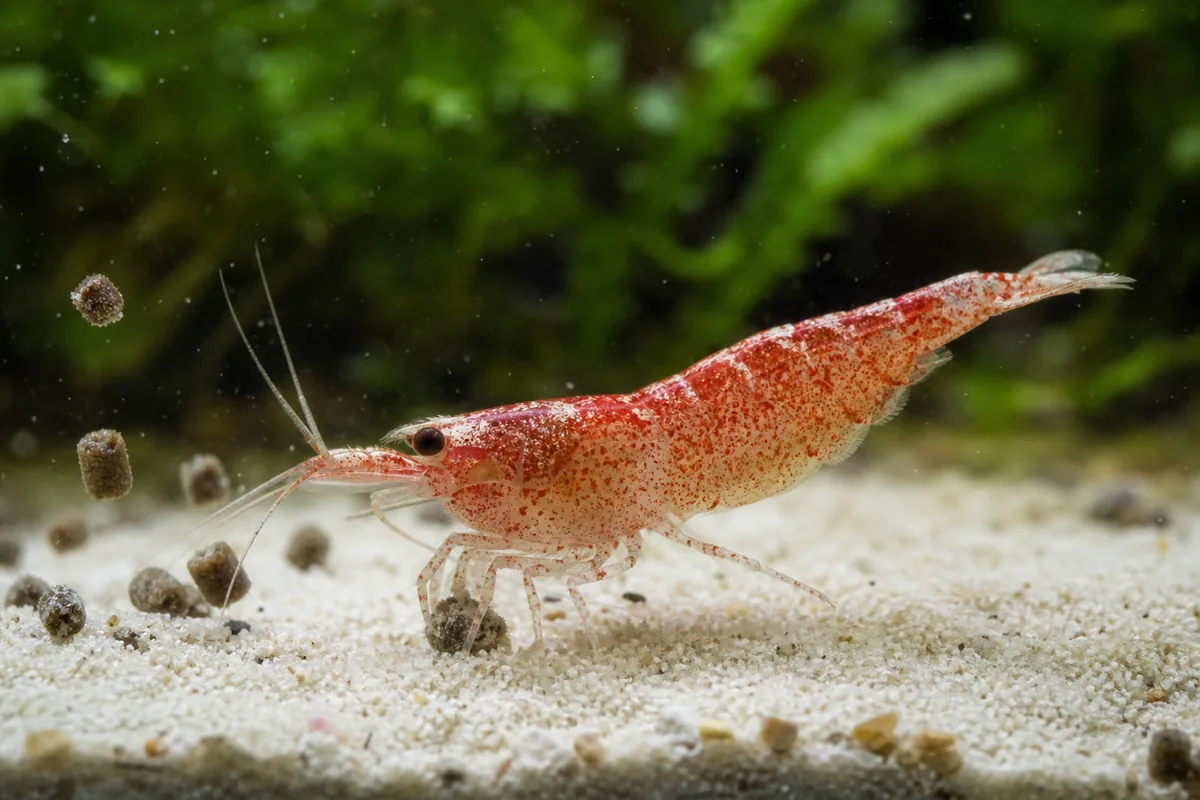
Cherry shrimp (Neocaridina davidi) are the entry point for most keepers into the world of nano invertebrate care. They are small, visually striking, and do real work in a planted tank.
We have kept cherry shrimp colonies for years across tanks ranging from 5 gallons to 30 gallons. This guide covers everything from grading and sexing to water parameters, feeding, molting, and which fish will eat them before you realize it.
Key facts
- Min Tank
- 5 gallons
- Temp
- 65-80°F
- Ph
- 6.5-8.0
- Lifespan
- 1-2 years
Cherry Shrimp Grades: What the Color Levels Actually Mean
Cherry shrimp are graded by color intensity. All grades are the same species. Neocaridina davidi. bred selectively over generations for increasingly saturated red coloration.
Understanding the grading system saves you from paying premium prices for shrimp that will fade to pale pink once they settle into your tank.
| Grade | Color Description | Transparency |
|---|---|---|
| Cherry | Pale pink to light red | Body partially see-through |
| Sakura | Medium red, more solid coverage | Slightly opaque body |
| Fire Red | Deep red, dense coverage on body and legs | Mostly opaque |
| Painted Fire Red | Full red saturation including legs and underside | Fully opaque, no transparency |
Females carry color more intensely than males. A female fire red shows a solid brick-red body with colored legs.
Males of the same grade look noticeably paler and are about 20% smaller.
If you plan to hold grade over generations, keep only one Neocaridina color in the tank. Blue dream, orange sakura, yellow, and green jade are all the same species.
They will interbreed freely and offspring revert toward the brown wild-type within two to three generations.
Tank Setup: Plants First, Then Everything Else
Cherry shrimp do not need a large tank, but they need a mature one. A cycled, planted 5-gallon produces a thriving colony.
A brand-new 20-gallon with no biofilm will kill a shrimp batch within days.
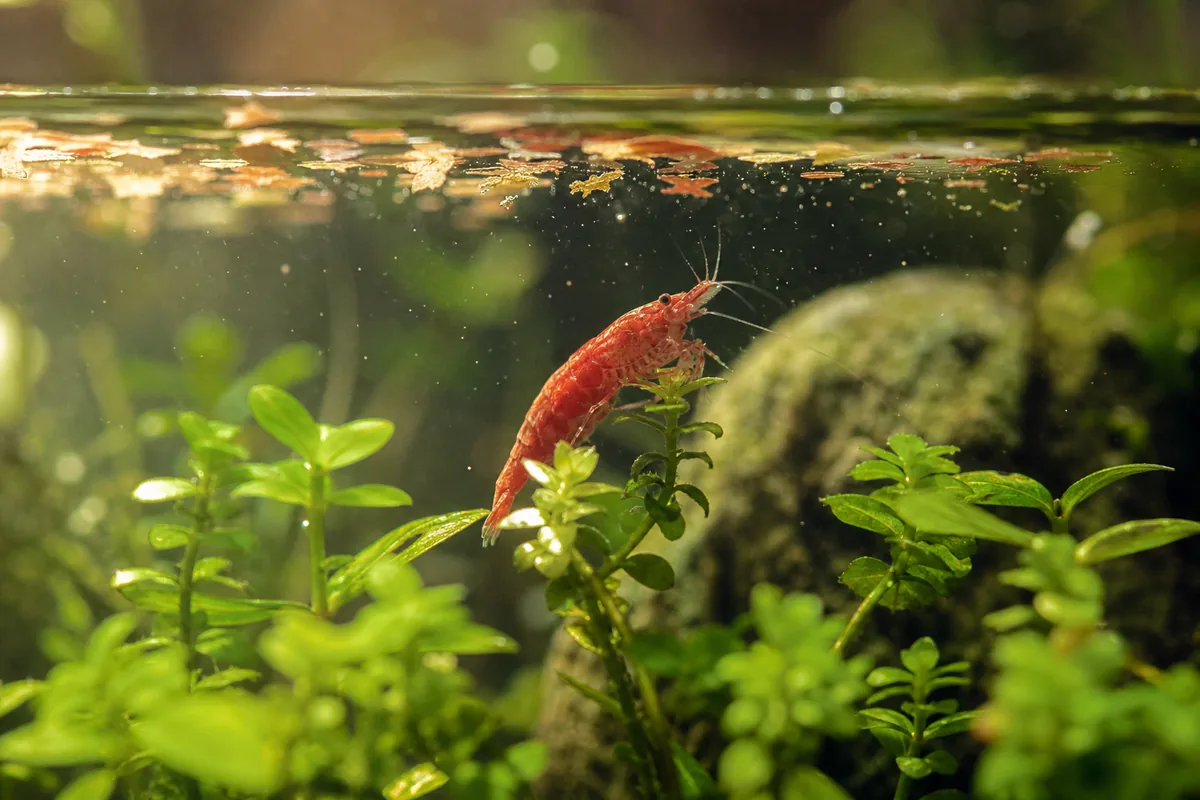
The single most important setup element is live plants. Plants provide biofilm for grazing, cover during molting, and refuge from tankmates.
- Java moss and Christmas moss: Dense growth that traps biofilm and gives shrimplets hiding space
- Anubias: Slow-growing broad leaves that develop thick biofilm coatings. shrimp graze these constantly
- Hornwort and guppy grass: Fast-growing stems that oxygenate water and provide cover without demanding high light
- Marimo moss balls: Biofilm surfaces in a compact form, no planting required
Filtration must be shrimp-safe. Standard hang-on-back filters draw shrimplets directly into the intake and kill them.
Cover any filter intake with a foam pre-filter sponge. A dedicated sponge filter is the cleanest solution for a shrimp-only tank.
Substrate choice matters for long-term colony health. Plain gravel works fine.
Darker substrates make red coloration pop visually. Avoid calcium-rich substrates like crushed coral in cherry shrimp tanks unless your water is very soft.it can push pH above 8.0 over time.
Water Parameters: Stable Beats Perfect
Cherry shrimp tolerate a wide parameter range but collapse when parameters swing fast. A tank that reads 7.8 pH consistently is far safer than one that cycles between 6.8 and 7.6 through the week.
Do not chase perfect numbers. Chase stability.
| Parameter | Ideal Range | Tolerable Range |
|---|---|---|
| Temperature | 70-76°F | 65-80°F |
| pH | 7.0-7.6 | 6.5-8.0 |
| GH (General Hardness) | 6-8 dGH | 4-12 dGH |
| KH (Carbonate Hardness) | 2-6 dKH | 1-8 dKH |
| TDS | 150-250 ppm | 100-400 ppm |
| Ammonia / Nitrite | 0 ppm | 0 ppm only |
| Nitrate | Under 10 ppm | Under 20 ppm |
Shrimp are far more sensitive to ammonia and nitrite than fish. A level that merely stresses a guppy will kill shrimp outright.
This is why a fully cycled tank is non-negotiable before the first shrimp goes in.
Do smaller, more frequent water changes rather than large infrequent ones. A 10-15% change twice per week stresses shrimp less than a 30% change once per week.
Always match the replacement water temperature within 2°F before adding it.
Diet: Biofilm Is the Foundation
In a mature planted tank, cherry shrimp get the majority of their nutrition from biofilm, algae, and organic debris without any input from you. The tank feeds them.
Your job is to supplement, not replace, that natural food source.
Overfeeding is the most common mistake in shrimp tanks. Uneaten food degrades rapidly, spikes ammonia, and clouds water.
- Blanched vegetables: Zucchini, cucumber, spinach, kale, and sweet potato. Blanch briefly, let cool, drop in. Remove after 24 hours.
- Shrimp-specific pellets: Brands like Hikari Shrimp Cuisine, Borneowild, or similar sinking pellets formulated without copper additives
- Catappa bark and leaves: Provide continuous biofilm growth between feedings
- Repashy gel foods: Soilent Green or similar gel foods spread slowly, reduce overfeeding risk
Feed every other day for an established colony. Watch how quickly food disappears.
If it sits for more than 3-4 hours, you fed too much. Reduce the amount rather than removing it constantly.
Newly hatched shrimplets need no special food in a planted, mature tank. They graze biofilm from day one.
Adding powdered fry food in a densely stocked shrimp tank often does more harm than good through water quality spikes.
Molting: The Most Dangerous 48 Hours
Cherry shrimp shed their exoskeleton every 4-6 weeks as they grow. Molting is a normal, essential process.
It is also when most unexplained shrimp deaths occur.
A shrimp that fails to complete its molt, or cannot harden its new shell quickly, dies. This is called failed molt or "stuck in molt" syndrome.
The two main causes are mineral deficiency and sudden parameter changes.
- Shrimp need calcium and magnesium (measured as GH) to build a new exoskeleton. If GH drops below 4 dGH, molts fail.
- Large water changes with a significant temperature or pH difference trigger forced premature molts. The shrimp molts before its body is ready and cannot harden properly.
- Iodine supports molting. A drop of lugol's iodine solution per 10 gallons monthly helps colonies that show chronic molting problems.
Do not remove shed exoskeletons from the tank. They are rich in calcium and minerals.
Shrimp consume them within hours. This is completely normal behavior.
Breeding: Colony Growth Without Effort
Cherry shrimp breed readily in any stable, mature tank. You do not need to do anything special to trigger breeding.
Your job is to maintain conditions and stay out of the way.
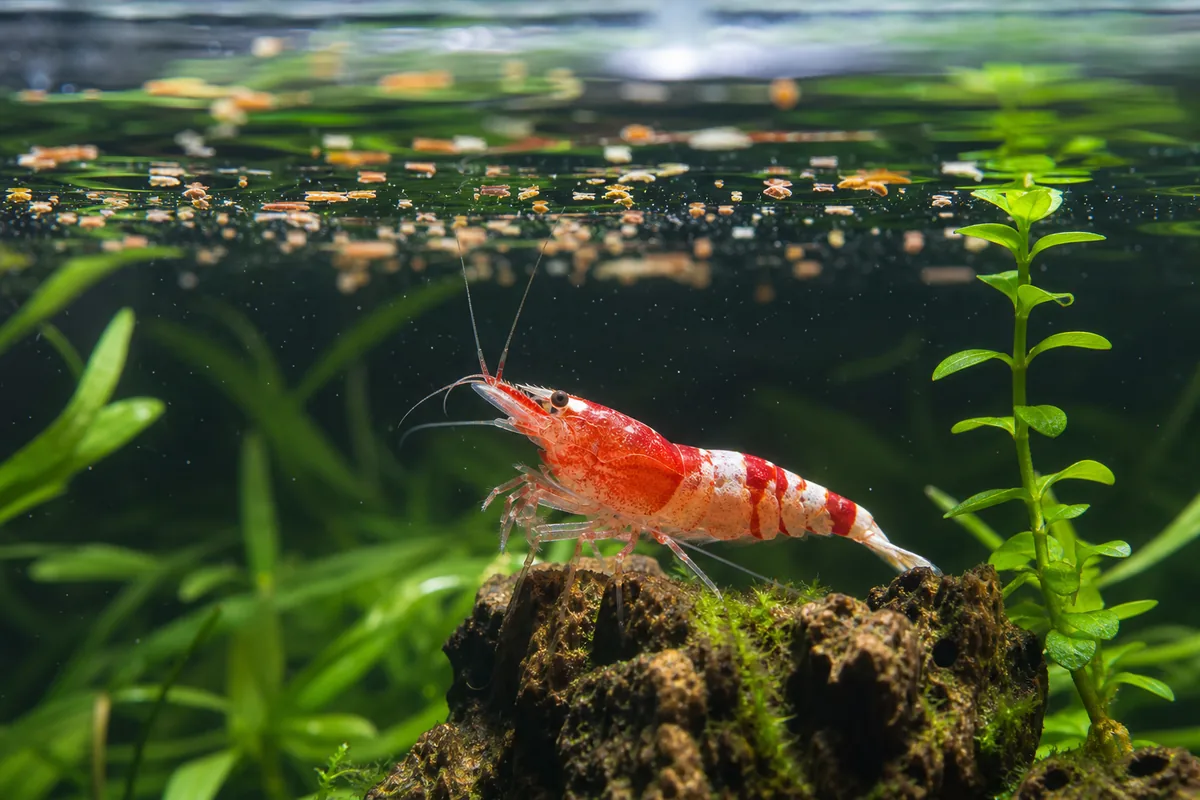
The female carries eggs under her tail (she is "berried") for 25-35 days before shrimplets hatch. A single berried female produces 20-30 shrimplets per clutch.
In a shrimp-only tank, virtually all of them survive.
Breeding happens every 30-45 days per female in optimal conditions. A colony of 10 shrimp (4 females, 6 males) can reach 80-100 individuals within three months without any intervention.
Pros
- Breeds readily without any special triggers
- Colony produces its own food source through biofilm
- Excellent algae and detritus cleaners
- Wide parameter tolerance compared to caridina shrimp
- Many color variants from the same species
- Low bioload. large numbers fit in small tanks
Cons
- Sensitive to copper in any amount
- Short 1-2 year lifespan means constant attrition
- Will interbreed with other Neocaridina colors and degrade grade
- Vulnerable during molting and after large water changes
- Not compatible with most fish beyond tiny nano species
- Shrimplets require foam filter covers or they get sucked in
A shrimp-only tank with heavy planting produces the largest colonies. When fish share the tank, survival rate for shrimplets drops sharply even with peaceful species.
For keepers who want shrimp alongside fish, read our guide on betta shrimp risk before stocking. Bettas are the most common cause of shrimp colony wipeouts in community tanks.
Tank Mates: Small, Peaceful, and Slow
The safest tank mate for cherry shrimp is another cherry shrimp. Most fish that fit in a 5-gallon or 10-gallon tank will eat shrimplets, even fish marketed as "shrimp safe."
If you want fish in the same tank, choose the smallest, most docile nano species available and provide very dense planting to give shrimplets refuge.
- Ember tetras: 0.8 inches, peaceful, mouths too small to eat adult shrimp
- Chili rasboras: 0.6-0.8 inches, similar temperament, compatible water parameters
- Pygmy corydoras: Bottom-level, 1 inch, slow-moving, no interest in shrimp
- Otocinclus catfish: Algae eaters, 1.5 inches, completely shrimp-safe in practice
- Nerite snails: No fish, but excellent cleanup companions that do not compete with shrimp
Our otocinclus care guide covers the feeding and group requirements for one of the best shrimp-safe algae eaters you can add to a planted shrimp tank.
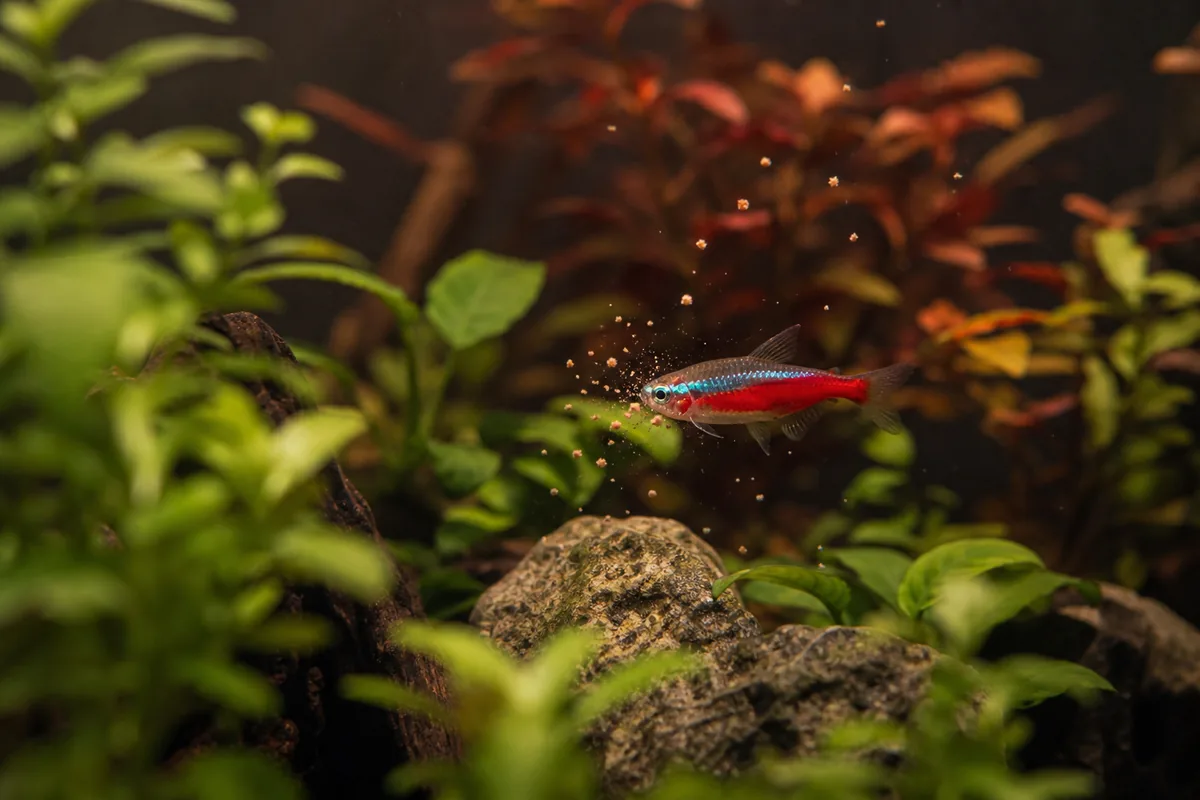
Neon tetras present more risk than most keepers expect. Adult cherry shrimp survive alongside them with adequate plant cover, but shrimplets disappear at a steady rate.
See our full breakdown on tetra shrimp setup before mixing these species.
For community tank mate planning, the general rule is: if the fish has a mouth large enough to fit a shrimplet (under 0.25 inches), it will eat them. Even if it ignores adult shrimp completely.
For nano tank stocking guidance beyond shrimp, our nano stocking guide covers the full range of 5-gallon compatible species and how to build a balanced, low-bioload setup.
Keepers ready to move up from a shrimp-only tank will find our 10-gallon stocking guide useful for planning the first community setup that pairs cherry shrimp with a small school of nano fish.
Sources and references
- Neocaridina davidi breeding and color geneticsof Crustacean Biology, Vol. 37, 2017
- Effects of pH, temperature and salinity on immune parameters of the freshwater prawn Macrobrachium rosenbergiiCheng and Chen, Fish and Shellfish Immunology, 10(4), 2000
- Freshwater ornamental shrimp husbandryof Florida IFAS Tropical Aquaculture Laboratory
- Spatial and temporal variation in algal and bacterial biofilm growth under differing light and nutrient regimesMuylaert and Vyverman, Hydrobiologia, 561, 2006
- Copper toxicity thresholds in freshwater invertebratesEnvironmental Toxicology and Chemistry, Vol. 35, 2016
- Neocaridina davidi species profileSeriously Fish, seriouslyfish.com