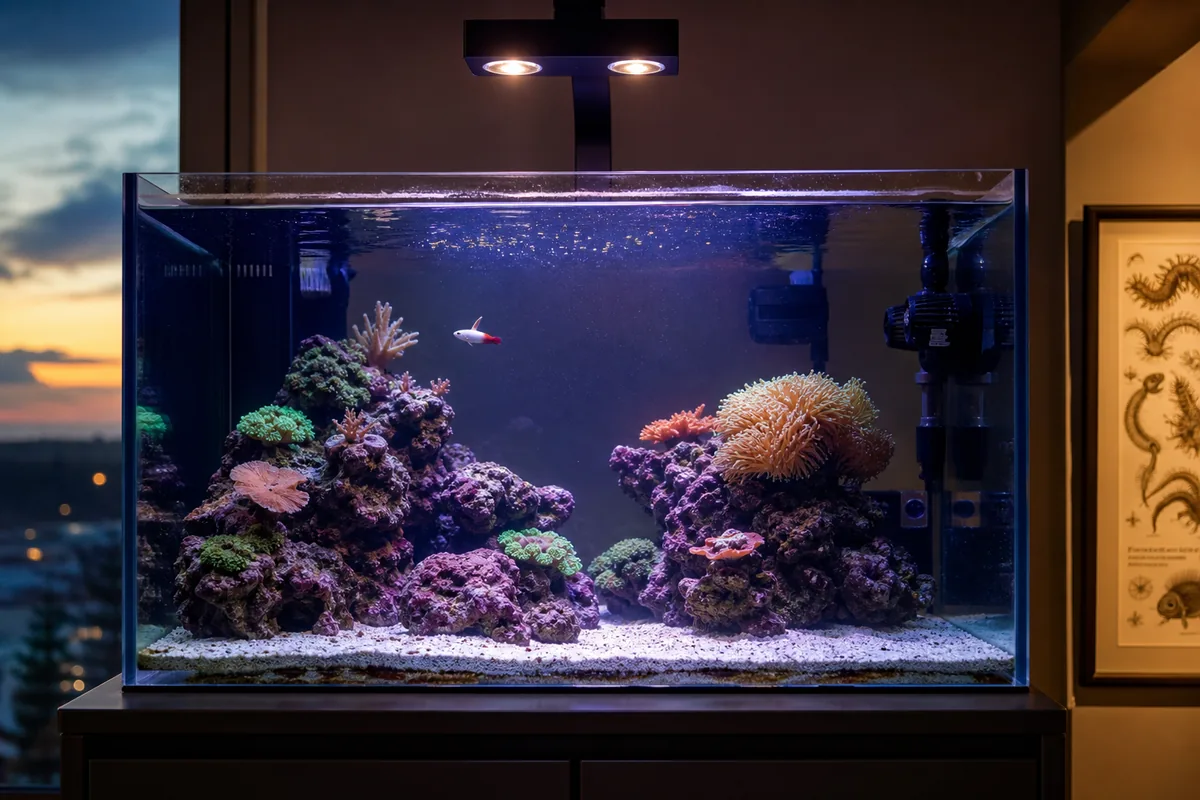
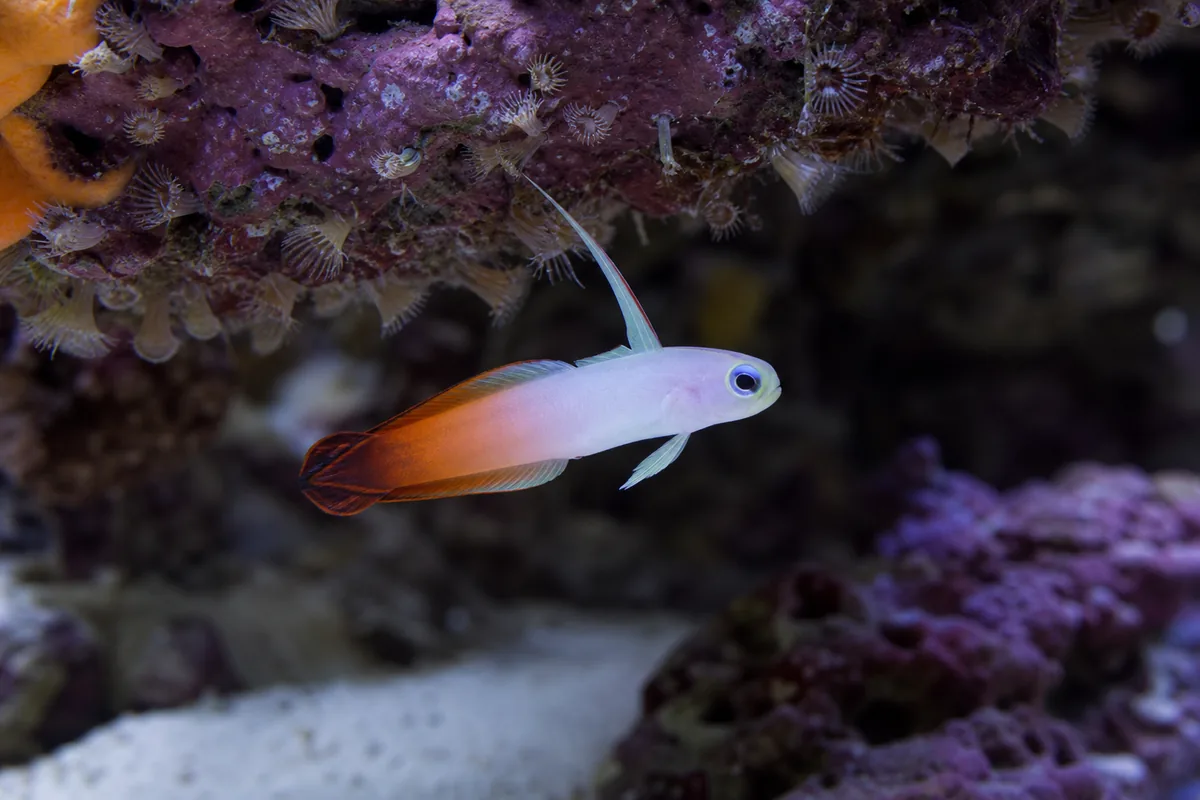
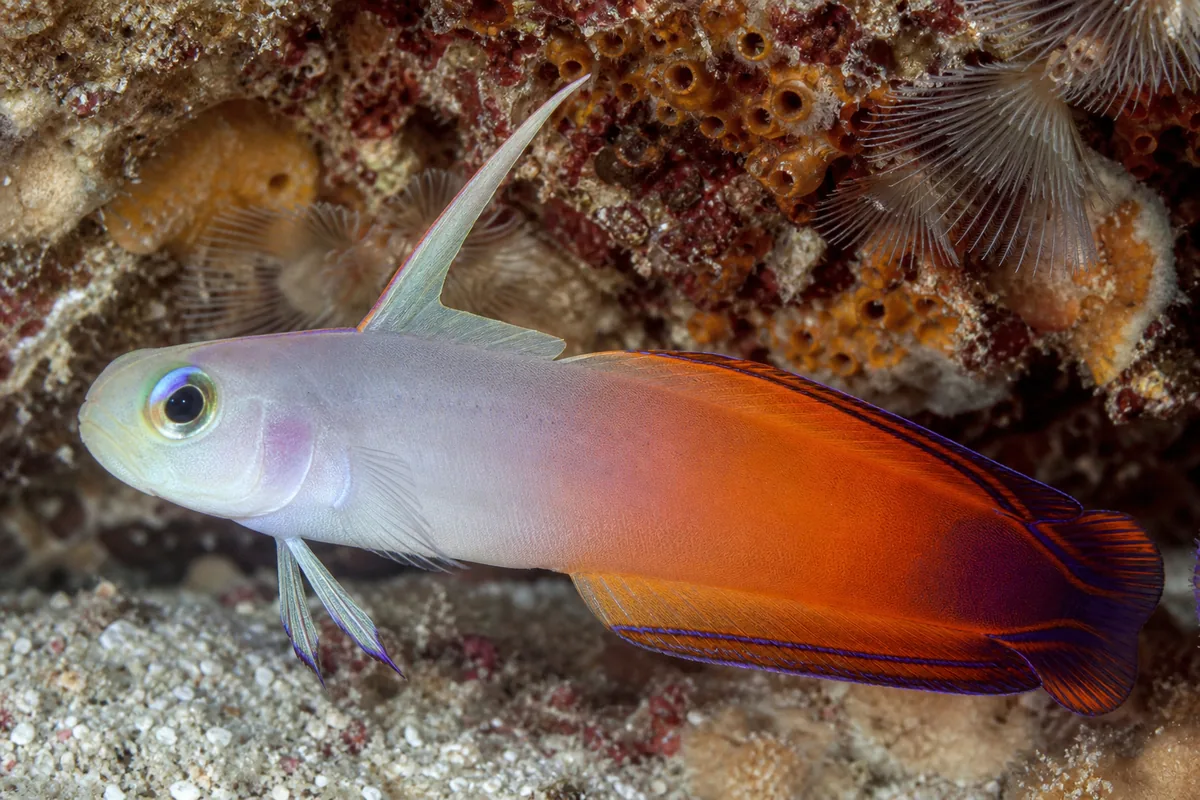
Firefish are one of the few saltwater fish that work in a genuine nano reef. Nemateleotris magnifica is slender, peaceful, and brilliantly colored, with a white-to-yellow body that transitions into a vivid red-orange tail.
They're a natural fit for any saltwater aquarium setup, from a 10-gallon nano to a 90-gallon reef. The care is simple, the temperament is easy, and the payoff is a fish that's as engaging as it is colorful.
Firefish consistently rank among the easiest marines to keep. Our best beginner saltwater fish guide explains where they fit in a starter stocking plan and how to build a complete 30-gallon community around them.
Key facts
- Min Tank
- 10 gallons
- Temp
- 72-80°F
- Salinity
- 1.020-1.025
- Lifespan
- 3-5 years
Firefish natural habitat: Indo-Pacific rubble zones at 6-70 meters
Firefish are native to the Indo-Pacific, ranging from the Red Sea and East Africa east to the Pitcairn Islands. In the wild, they inhabit rubble-bottom zones at the outer edge of reef slopes, typically at depths of 6-70 meters.
They hover just above the substrate in pairs or small groups, facing into the current to pick plankton from the water column. When threatened, they dart backward into a burrow in under a second.
This dart-and-hide behavior is where the "dartfish" common name comes from, and it explains why a secure lid is non-negotiable in captivity.
Tank setup: nano-friendly with one critical requirement
A 10-gallon tank fully cycled with live rock and a quality protein skimmer handles a single firefish without issue. Pairs need 20 gallons to establish separate territories without persistent aggression.
Groups of three or more require 30+ gallons with multiple burrow options.
Before adding any fish, the tank must complete the nitrogen cycle. Our beginner saltwater tank setup guide covers the full process including how to test for cycle completion before stocking.
The substrate should be fine sand or rubble at 2-3 inches depth. Firefish don't burrow as aggressively as true gobies, but they prefer a substrate they can modify if threatened.
They'll use a PVC elbow or a small cave in the live rock as their primary shelter.
The cave structure comes from quality live rock. Our live rock guide explains how much rock a 10 or 20-gallon nano needs and how to aquascape it before adding water.
Water parameters: Caribbean-tolerant but stable
Firefish tolerate a broader parameter range than many marines and adjust well to the water quality that a properly maintained 10-gallon produces. They're not as sensitive to nitrate as blue tangs or mandarins, but they still require a fully cycled tank before introduction.
| Parameter | Target | Notes |
|---|---|---|
| Temperature | 74-79°F | Avoid rapid temperature changes above 2°F per day |
| Salinity (SG) | 1.022-1.025 | NSW salinity preferred |
| pH | 8.1-8.4 | Test morning and evening in new tanks |
| Ammonia/Nitrite | 0 ppm | Strictly zero before introduction |
| Nitrate | Below 20 ppm | Weekly water changes in small tanks |
In a 10-gallon, water parameters shift faster than in larger tanks. Test twice weekly for the first three months, then weekly once the system demonstrates stability.
Even a nano tank needs a skimmer. Our protein skimmer guide covers hang-on-back models that fit tanks without a sump, including the Tunze 9004 that works well in systems under 30 gallons.
Diet: planktivore feeding in captivity
Firefish are planktivores. They hover in the water column and pick individual food particles from the passing current.
This feeding strategy works perfectly in a tank with moderate flow, as pellets and frozen foods suspended in the water column mimic their natural prey.
- Frozen mysis shrimp: The primary food, offered daily or every other day
- Frozen brine shrimp: Lower nutrition than mysis but accepted readily - good for variety
- High-quality marine pellets: New Life Spectrum or Hikari Marine S sized for small mouths
- Live copepods: Excellent enrichment and natural foraging stimulation
- Reef Roids or similar coral foods: Fine particle foods that firefish will pick from the water
Health and common problems
Firefish are hardy when kept in stable conditions. Their most common health issue isn't disease.
It's stress-induced hiding and refusal to eat, usually caused by an aggressive tank mate or a tank with insufficient shelter.
Pros
- One of the few marines suitable for 10-gallon nano reefs
- Peaceful with virtually all non-aggressive reef fish
- Striking red-orange coloration on a white body
- Easy to feed - accepts prepared foods without training
Cons
- Jumps without warning - lid security is critical
- Two males in the same tank will fight
- Shy and may hide for weeks after introduction
- Short lifespan of 3-5 years compared to other marines
- Stress hiding: New firefish may hide for 1-3 weeks. This is normal acclimation behavior, not disease. Keep the lights low and feed near their cave entrance.
- Marine ich: Can occur but less common than in tangs. Treat in quarantine with copper or hyposalinity if white spots appear alongside lethargy.
- Aggression injuries: Torn fins or wounds from tank mate harassment. Remove the aggressor, not the firefish.
Tank mates: peaceful community fish
Firefish are compatible with virtually any peaceful reef fish that won't actively harass them. Their only persistent tank mate conflicts are with other firefish of the same species in tanks under 30 gallons.
The worst tank mates are large dottybacks, hawkfish, and any fish that actively hunts the substrate layer. Hawkfish in particular will stress firefish constantly, as hawkfish perch on rock and actively stalk small fish near the bottom.
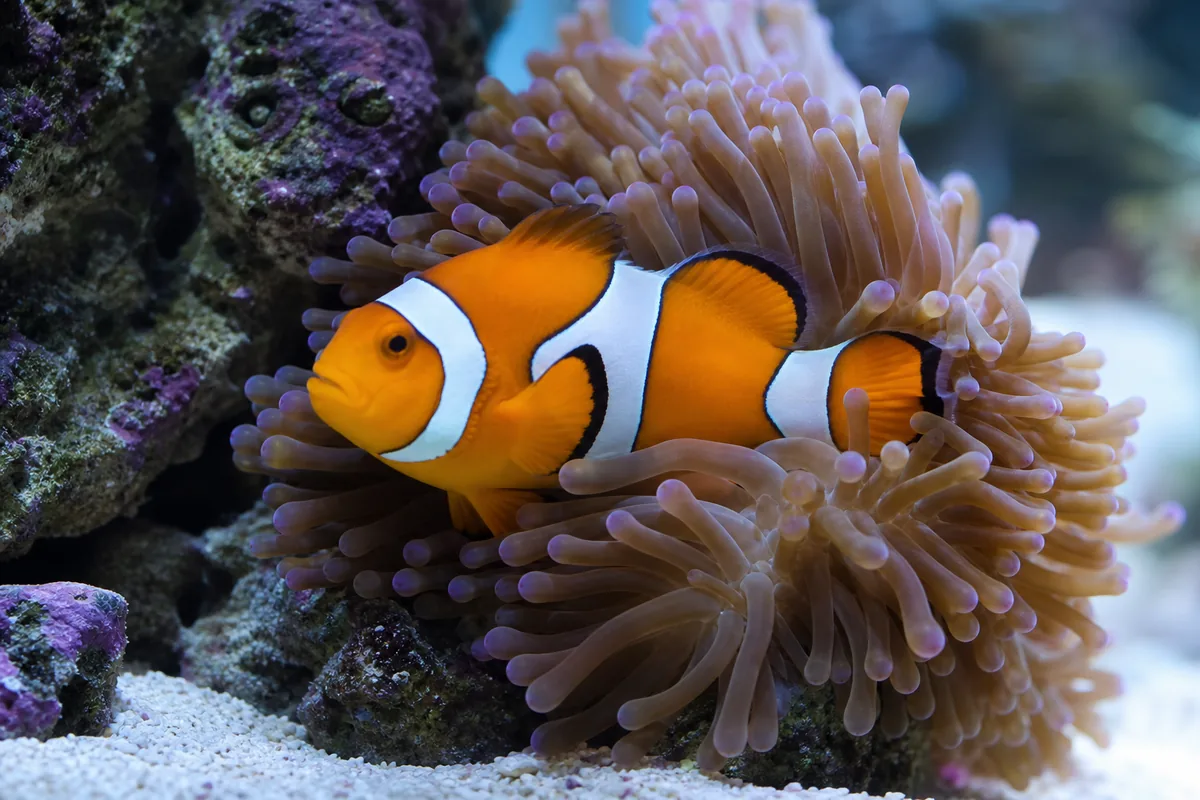
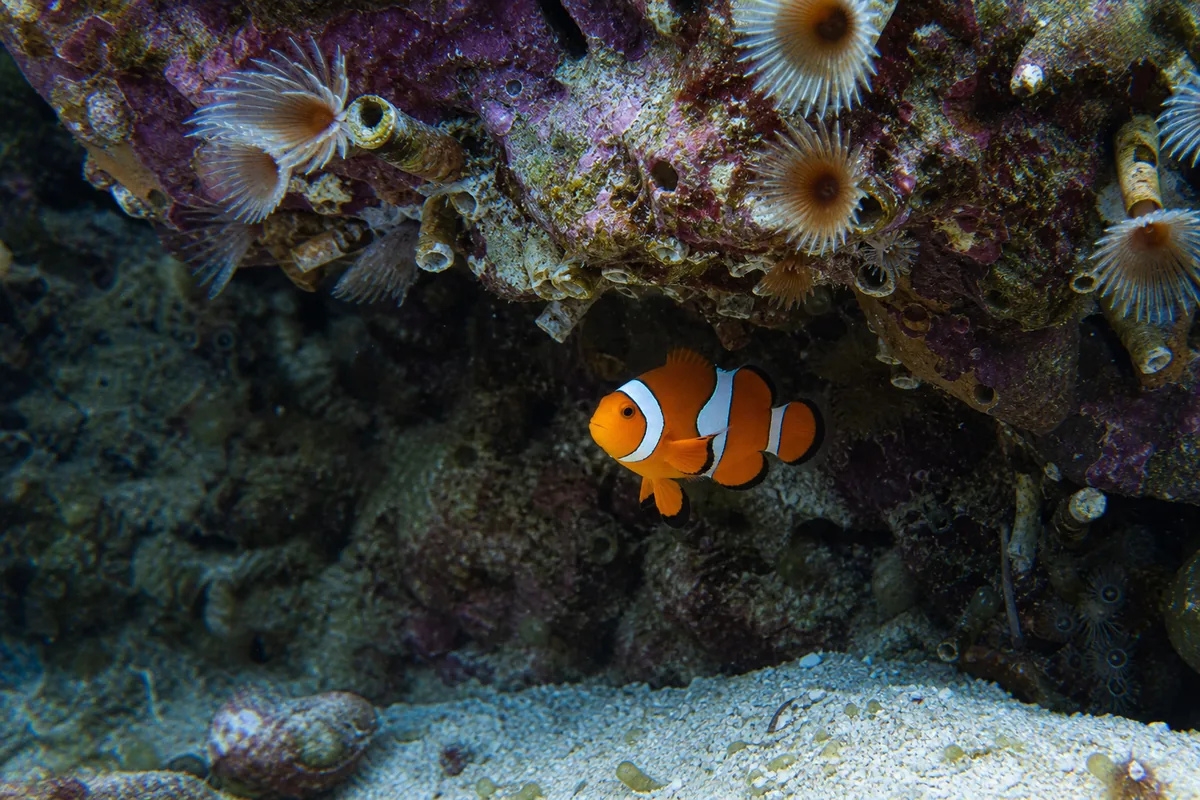
Clownfish are the safest companion species for a firefish. The clownfish care guide explains why the pair's surface-zone territory and the firefish's near-substrate position create a natural separation that prevents conflict.
Royal grammas occupy a mid-depth cave that keeps them out of firefish territory. Read the royal gramma care guide to see how these three species form the ideal 30-gallon community combination.
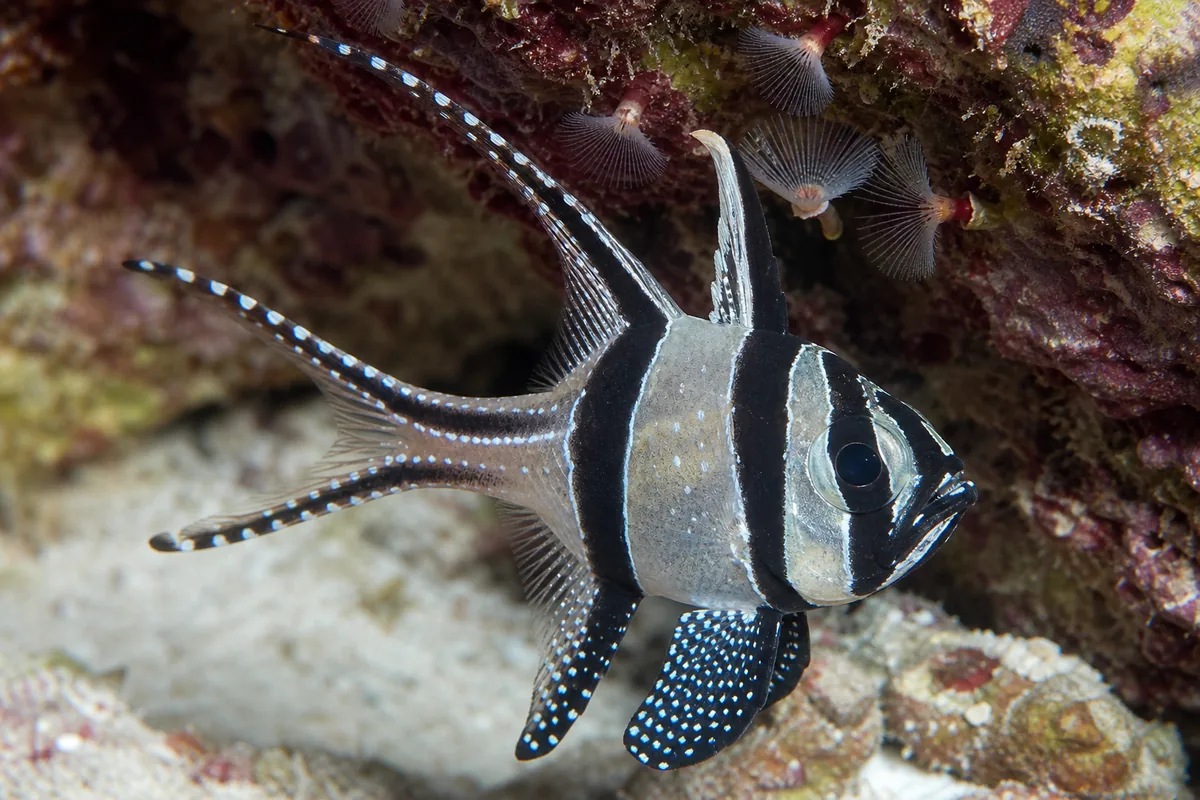
Banggai cardinalfish are another low-aggression mid-water species that pairs well. The Banggai cardinalfish guide covers their calm water preference, which suits a firefish tank's lower-flow requirement.
Six-line wrasses can become aggressive toward small passive fish as they mature. Our six-line wrasse guide explains which tank sizes and introduction sequences reduce the risk of harassment toward firefish.
Damselfish species vary widely in aggression. Our article on clownfish and damselfish compatibility covers which species like chromis are safe alongside firefish and which aggressive damsels to avoid entirely.
For a ranked overview of every species that works alongside firefish in a community build, our best tank mates for clownfish guide covers the same compatible species list with tank size and introduction order details.
Sources and references
- Nemateleotris magnifica ecology and behavior in the wildCopeia, Ichthyology , 2016
- Nano reef husbandry guidelines for dartfish speciesof Miami Rosenstiel School, 2019
- Dartfish aggression and territory establishment in captive systemsMarine and Freshwater Behaviour and Physiology, 2020