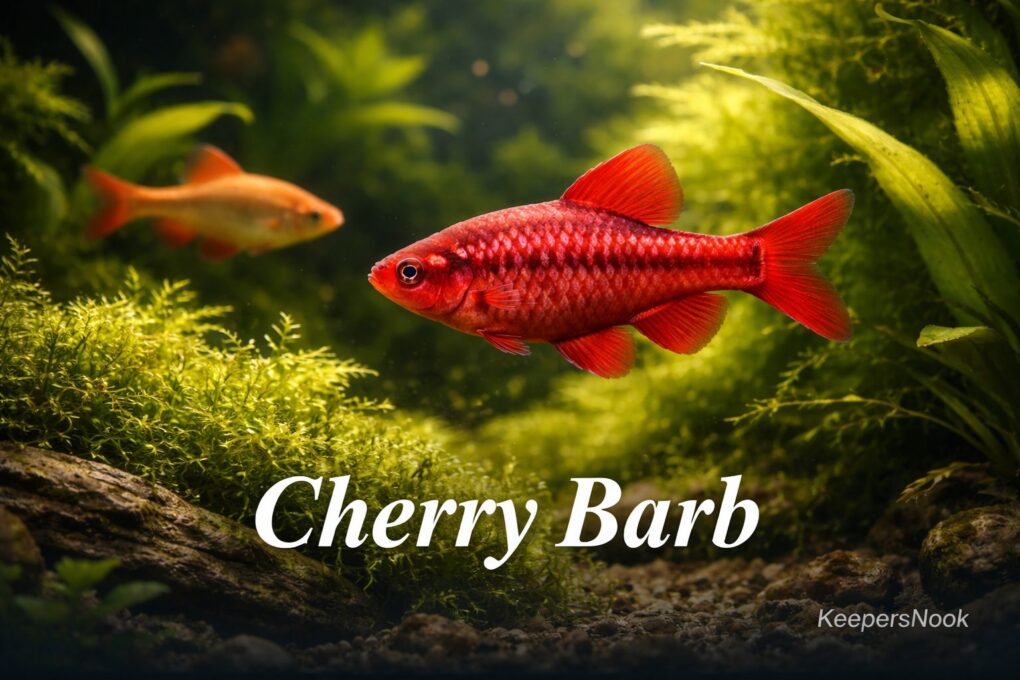
Cherry Barb Origin: Sri Lankan Endemic with Vulnerable Status
Puntius titteya is native to the wet zone river basins of Sri Lanka, particularly the Kelani and Nilwala river drainages. These are shaded forest streams with soft, slightly acidic water, heavy leaf litter on the substrate, and low ambient light filtered through a dense canopy overhead.
Remember it later
Planning to try this recipe soon? Save it for a quick find later!
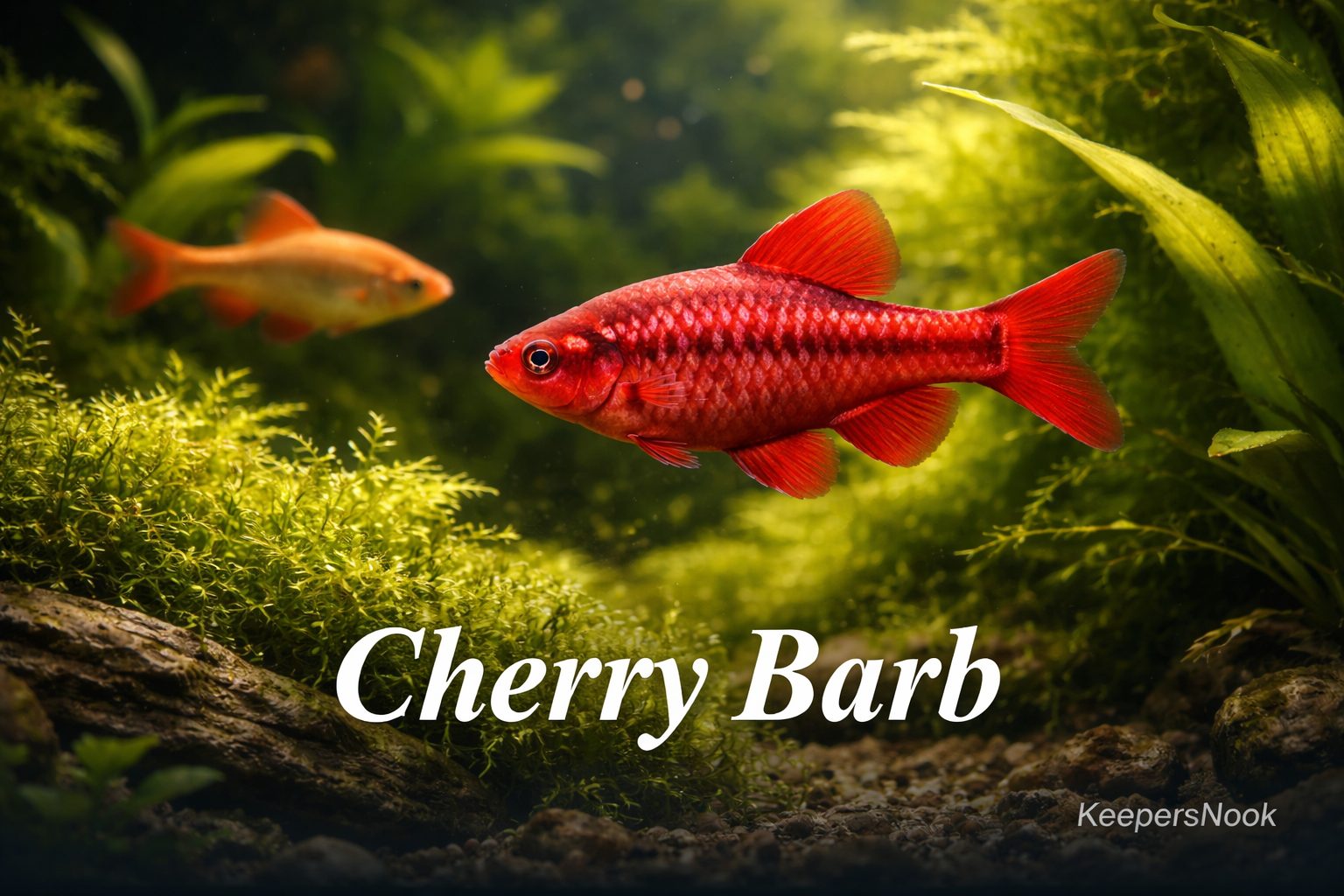
The IUCN lists the cherry barb as Vulnerable in the wild. Deforestation and agricultural runoff have reduced its natural range significantly since the 1980s.
Nearly all cherry barbs sold in the hobby today are captive-bred, most originating from farms in Sri Lanka, Czech Republic, and Southeast Asia.
Understanding their origin matters for two practical reasons. First, they are soft-water fish by evolution, and trying to keep them at pH 7.5 or in hard tap water will stress them long before it kills them.
Second, the captive-bred population is the species at this point. Good husbandry here is not abstract.
- Native range: Wet zone rivers of Sri Lanka (Kelani, Nilwala, Kalu basins)
- Wild status: Vulnerable (IUCN 3.1), habitat decline ongoing
- Captive origin: Virtually 100% of hobby fish are farm-raised
- Wild water: Soft, acidic, heavily shaded, low current
- School behavior: Found in loose groups of 20–50 in natural streams
The behavioral shift between a solo cherry barb and a proper school of eight is stark. In the wild, these fish rely on group behavior for predator avoidance and spawning cue synchronization.
That pressure does not disappear in captivity.
Tank Setup for Cherry Barbs: 20 Gallons Is the Starting Point
A 20-gallon long is the minimum tank size for a school of six cherry barbs. The extra horizontal footprint of a long tank matters more than water volume here.
Cherry barbs swim at mid-level and need lateral space to move as a cohesive group.
Planted tanks are the right environment for this species. Dense vegetation along the back and sides gives individual fish visual refuge from one another, which reduces stress within the school even when no external threat exists.
Java fern, Cryptocoryne wendtii, and Amazon sword all work well in the soft, slightly acidic water this species prefers.
Floating plants are worth adding. Water sprite, frogbit, or salvinia cuts surface light and creates the dappled, dim environment that matches their native shaded streams.
Males kept under reduced lighting often show better color than those in brightly lit tanks, because they feel more secure.
Dark substrate amplifies the red of males visibly. Black sand or fine dark gravel reflects less ambient light than white or beige substrates.
This single change produces a measurable difference in how deep and saturated the males appear, particularly during breeding display.
Current should be gentle. Cherry barbs come from slow-moving forest streams and are not built for powerhead turbulence.
A sponge filter or a hang-on-back with a spray bar is better than a directional outlet pushing flow across the tank.
Water Parameters: Cherry Barbs Need Soft, Acidic Conditions
The target range for cherry barbs reflects their Sri Lankan origin: soft water, mild acidity, and warm but not hot temperatures. They tolerate a broader range than their native habitat in captivity, but they thrive and display best when kept within the ideal band.
| Parameter | Ideal Range | Tolerance Limit |
|---|---|---|
| Temperature | 75–79°F | 73–81°F |
| pH | 6.2–6.8 | 6.0–7.0 |
| Hardness (GH) | 4–10 dGH | 2–15 dGH |
| Ammonia | 0 ppm | 0 ppm |
| Nitrite | 0 ppm | 0 ppm |
| Nitrate | <15 ppm | <25 ppm |
Soft-water tanks lose buffering capacity faster than alkaline setups. A pH swing from 6.5 to 6.0 overnight is more stressful to cherry barbs than it would be to a fish living at pH 7.8, because the absolute acid load is higher relative to the buffer reserve.
Indian almond leaves and driftwood both release tannins that soften water naturally and provide a mild pH buffer toward acidity. They also tint the water amber, which reduces light penetration and further replicates the blackwater stream environment these fish evolved in.
Diet: Cherry Barbs Accept Almost Anything, But Quality Matters
Cherry barbs are opportunistic omnivores. In Sri Lankan streams, they feed on small insects, algae, plant debris, and microinvertebrates.
In captivity, they eat nearly any food offered without hesitation.
A high-quality micro pellet or crushed flake is the right daily staple. Standard adult flake is often too large for juvenile cherry barbs.
Crush it between your fingers before feeding young fish. Adult cherry barbs handle whole small flakes without issue.
Supplement the diet two to three times per week with frozen or live food. Daphnia, baby brine shrimp, and micro worms are all accepted readily.
Live daphnia in particular triggers intense foraging behavior and visibly intensifies breeding coloration in males within a few days of regular feeding.
- Daily staple: Micro pellet or crushed flake, high protein content
- Frozen supplement: Daphnia, baby brine shrimp, micro bloodworms
- Live food: Daphnia, micro worms, vinegar eels for fry
- Avoid: Large pellets, high-fat foods, starchy kitchen scraps
- Frequency: Twice daily, two-minute portions each session
Starchy or high-fat foods foul the water faster in soft, low-buffering-capacity tanks. Keep the diet protein-focused and the portions small.
Cherry Barb Tank Mates: Who Works and Who Does Not
Cherry barbs are among the safest fish in the freshwater hobby for community tanks. They do not nip fins, do not chase smaller fish, and retreat from confrontation rather than engaging it.
The compatibility problem runs the other direction: cherry barbs are small enough that larger or aggressive species prey on them or out-compete them for food.
If you are building a 10-gallon community tank, cherry barbs are borderline on space. Six fish in 10 gallons works for a species-only setup, but the 20-gallon long is the better choice for any community configuration.
Cherry Barb Sexing: Males Display Brilliant Red, Females Stay Pale
Cherry barbs are one of the easiest freshwater fish to sex visually once they reach three to four months of age. The difference in adult coloration is dramatic.
- Males: Deep crimson to burgundy body color, especially intense during breeding display. Dark lateral stripe runs from snout to tail base but is often obscured by the red pigmentation.
- Females: Pale pinkish-brown body with a clear, dark lateral stripe running the length of the body. Rounder belly, especially when carrying eggs.
- Juveniles: Both sexes look similar until about 12 weeks. The lateral stripe is visible on both, and coloration is uniformly pale.
- Intensity variation: Male color deepens with age, better nutrition, darker substrate, and larger school size. A pale male is not necessarily a female.
Keep cherry barbs in a 2:1 ratio of females to males. A surplus of females distributes spawning harassment across the group and prevents any single female from being exhausted by persistent male attention.
Cherry Barb Breeding: Egg Scatterers That Spawn Without Intervention
Cherry barbs are egg scatterers that will attempt to spawn in any well-planted tank without special intervention. The challenge is not triggering spawning.
It is saving enough fry to be worth the effort.
Males in breeding condition turn an intense burgundy-red and pursue females through the vegetation. Spawning typically occurs in the morning, with the male driving the female through fine-leaved plants while both release eggs and sperm simultaneously.
The eggs are small, slightly sticky, and transparent.
To trigger deliberate spawning: feed live or frozen food for one to two weeks, then perform a 25–30% water change with slightly cooler water and lower the pH toward 6.2. Males begin displaying within hours.
The spawning itself follows within one to two days.
- Breeding tank: Separate 10-gallon with Java moss, hornwort, or a spawning mop as egg deposition sites
- Trigger: Live food conditioning for one to two weeks, then a cool water change
- Egg hatch time: 24–48 hours at 77°F
- First fry food: Infusoria or liquid fry food for five days, then baby brine shrimp
- Fry coloration: Juvenile sex coloration visible at 10–12 weeks
- Adult removal: Move adults out of the breeding tank immediately after spawning concludes. Both parents eat eggs and fry without hesitation.
In a community tank without a separate breeding setup, fry survival is near zero. Dense java moss gives fry some refuge, but most are eaten within 24 hours.
A dedicated 10-gallon breeding setup with fine plants and no other inhabitants is the only reliable way to raise a meaningful number of fry.
Fry reach juvenile size at six weeks and adult coloration at three to four months. Males begin showing red tinting at about ten weeks.
Cherry barbs spawn readily enough that accidental breeding in a community tank is common. If you notice males displaying intensely and chasing females through the plants, expect eggs within a day or two.
A fine-leaved plant like Java moss in the corner gives eggs a small chance at surviving in a community setup.
Common Diseases and Health Risks in Cherry Barbs
Cherry barbs are reasonably hardy once settled into stable water, but their small body mass means they respond to water quality problems faster than larger community fish. A nitrate spike that a platy tolerates for a week will show on a cherry barb within two to three days as clamped fins and color loss.
Ich is the most common threat, particularly after introduction to a new tank. White salt-grain spots on the body and fins are the diagnostic sign.
At cherry barb scale, ich progresses quickly.
- Ich: White spots on fins and body. Raise temperature to 82°F (tolerated briefly) and treat with half-dose copper medication. Their small size makes them more sensitive to full-dose medication than larger fish.
- Fin rot: Frayed or dissolving fin edges. Almost always follows a water quality event. Test nitrates first. Clean water resolves mild cases without medication.
- Velvet: Fine gold or rust-colored dust on the body, not discrete spots like ich. Spreads aggressively. Treat with medication and blackout the tank (velvet relies on light to complete its lifecycle).
- Internal parasites: Cherry barbs that isolate from the school, lose color, and stop eating are frequently carrying internal parasites. Metronidazole-laced food treats most internal infections before they progress to fatal wasting.
Quarantine all new fish for two weeks before adding them to a cherry barb community. A separate 10-gallon quarantine tank is the single most effective disease prevention tool you can have.
The relationship between protocol and disease spread applies across all schooling fish at this size. The smaller the fish, the faster a disease outbreak moves through a group.
Lifespan and Long-Term Care: Cherry Barbs Live 4–7 Years
Cherry barbs live 4 to 7 years in a well-maintained planted aquarium. That range reflects the difference between minimum-care husbandry and optimized conditions.
Fish kept in the lower range of the temperature tolerance, in schools of exactly six, with infrequent water changes, tend toward the four-year end. Fish kept in schools of eight to ten, with weekly water changes and a planted tank, regularly hit six years and sometimes seven.
The most common cause of shortened lifespan is inadequate school size. A cherry barb kept solo or in a pair is chronically stressed.
Chronic stress suppresses immune function, reduces feeding motivation, and bleaches color in males within weeks.
Weekly water changes of 25–30% are non-negotiable in soft-water tanks. Low-buffering water loses stability fast between changes, especially in a system with biological load from a school of six or more fish.
- Optimal school size: 8–10 produces visibly calmer, better-colored, longer-lived fish than the minimum six
- Water changes: 25–30% weekly, temperature-matched and dechlorinated
- Testing schedule: pH and nitrates every two weeks in a mature planted tank
- Diet for longevity: Varied diet with regular live or frozen food supplements maintains color and immune function
Cherry barbs are listed as Vulnerable in the wild. Their range in Sri Lanka has contracted significantly due to deforestation and agricultural runoff.
The captive population is stable and self-sustaining, but that context gives the species some weight beyond its $3 price tag at the fish store.