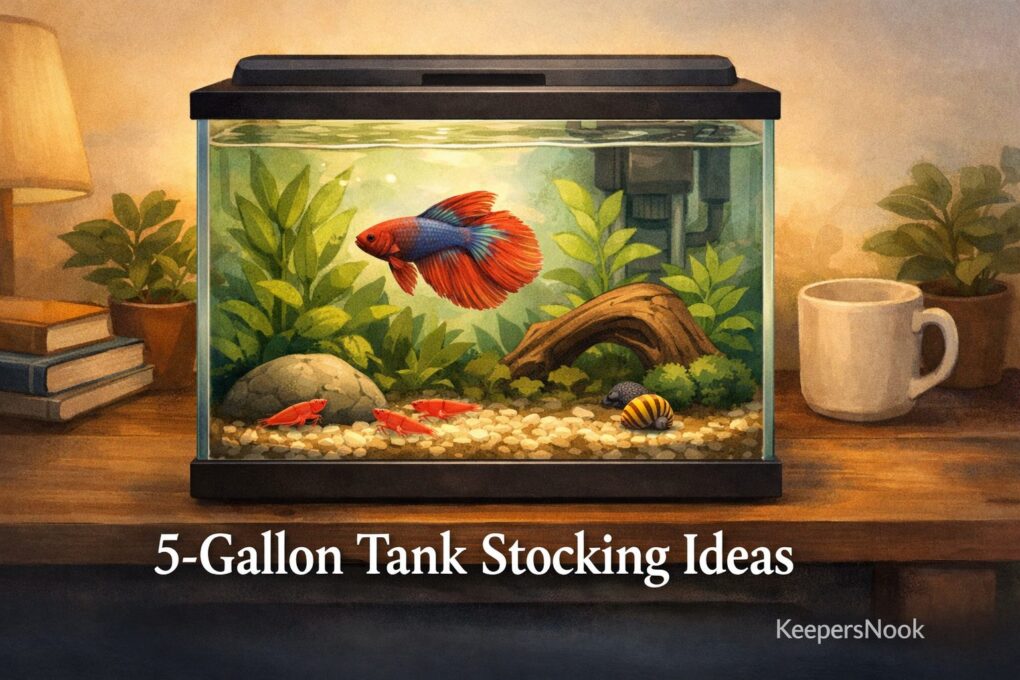
For a full picture of tank stocking across all tank sizes, start with our freshwater fish hub. This guide focuses on the 5-gallon specifically: what works, what does not, and how to set it up so your inhabitants stay alive past the first month.
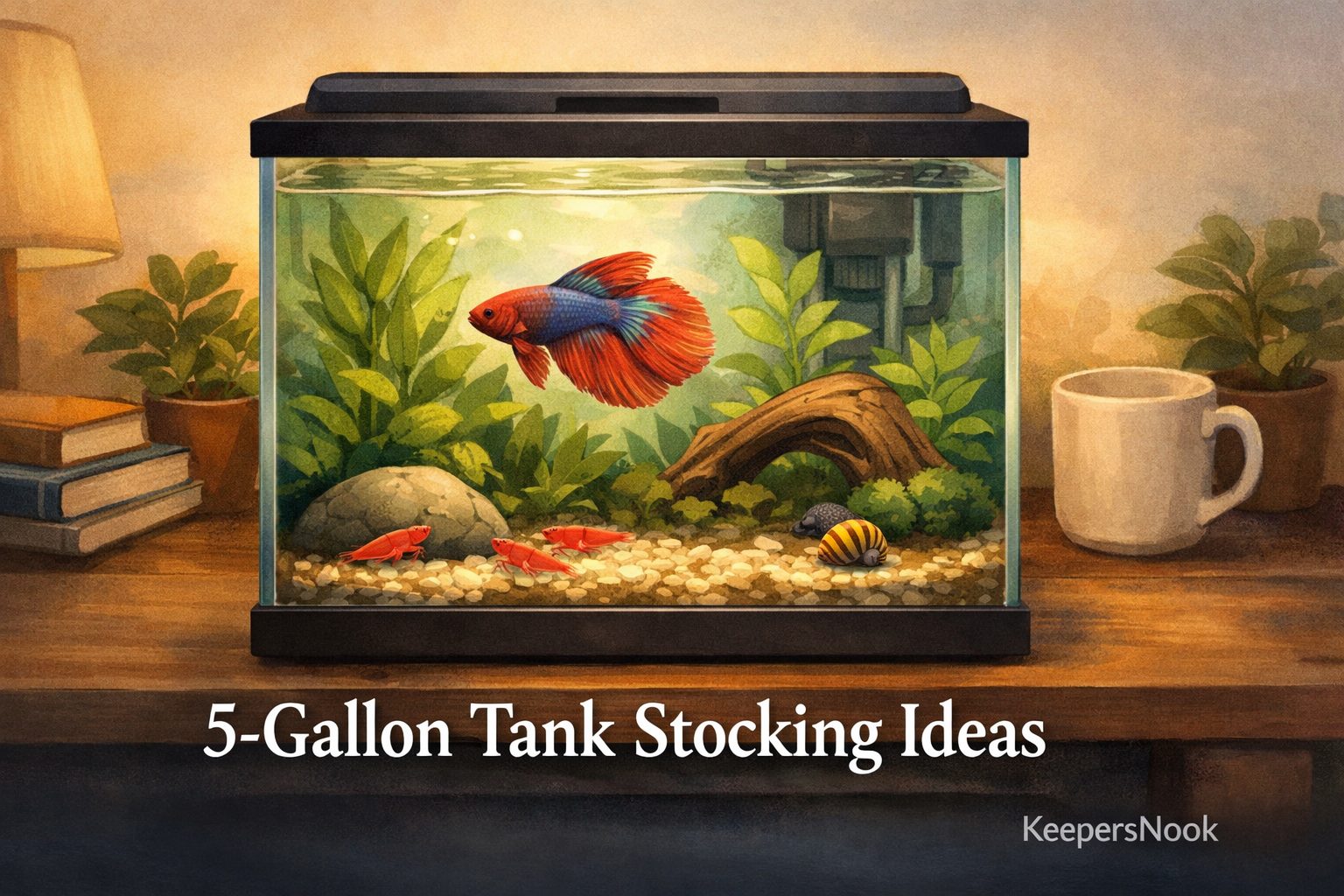
Most beginners buy a 5-gallon because it looks manageable. The tank is small, the price is low, and the box promises it is "starter friendly." That framing causes problems.
Small water volume means faster ammonia spikes, less thermal stability, and almost no room for error. Understanding those constraints is the first step toward stocking it correctly.
Why a 5-Gallon Tank Limits You to 3 Species Categories
The standard "one inch of fish per gallon" rule breaks down at small volumes. A single 3-inch fish in 5 gallons produces more ammonia per gallon than the same fish in a 20-gallon.
Remember it later
Planning to try this recipe soon? Save it for a quick find later!
Beneficial bacteria colonies are smaller, dilution is lower, and temperature swings are faster when the water volume is low.
Three categories of livestock can genuinely thrive in 5 gallons:
- Betta splendens (one male, solo): territorial, low-activity, adapted to still water
- Dwarf freshwater shrimp (Neocaridina or Caridina, up to 20): tiny bioload, thrive in densely planted nanos
- Snails (Nerite or Mystery, 3-5): minimal bioload, useful algae control, require no special oxygenation
Micro rasboras (Boraras brigittae or Boraras maculatus) are sometimes listed as 5-gallon candidates. They technically fit the bioload math, but their schooling behavior needs a minimum group of 8-10, and that many fish in 5 gallons stresses your filtration at the edges.
We treat them as a 10-gallon species in practice.
If you want a community setup, our 10-gallon stocking guide covers the smallest tank size where community fish are viable.
The Betta 5-Gallon Setup: Parameters That Keep Them Alive
A betta fish is the most forgiving 5-gallon resident for one reason: it is a labyrinth fish. Bettas breathe atmospheric air from the water surface, which means they survive lower dissolved oxygen levels that would kill other fish.
That does not mean they tolerate bad water. It means they tolerate the specific constraint of low volume longer than most species.
Target parameters for a betta in a 5-gallon:
- Temperature: 76-82°F. Use a reliable 25W adjustable heater, not a preset "betta heater."
- pH: 6.8-7.5. Bettas are flexible; tap water in this range needs no adjustment.
- Ammonia / Nitrite: 0 ppm at all times. Any reading above zero is a crisis.
- Nitrate: below 20 ppm. A 25-30% weekly water change keeps this stable.
- Flow rate: low. Bettas have large fins and weak swimming muscles. Strong current stresses them.
The single biggest mistake in betta 5-gallon setups is choosing the wrong filter. Most starter kits include hang-on-back filters sized for 10-20 gallons.
The turnover rate is too high for a betta's fins and too powerful for the small volume. A sponge filter rated for 5-10 gallons is the correct choice: it has gentle output, doubles as a bacterial colony surface, and creates surface agitation without a current.
Our betta tank setup guide walks through the exact equipment list.
5-Gallon Tank Equipment Checklist
Whether you stock with a betta, shrimp, or snails, the equipment requirements are similar. The differences are in heater wattage for shrimp species that need lower temperatures and the addition of a substrate for planted tanks that support shrimp colonies.
Live plants are not optional if you want a stable 5-gallon. They absorb ammonia and nitrate directly, outcompete algae for nutrients, and provide cover that reduces stress.
A bare 5-gallon with only a filter is harder to keep stable than a planted one.
For feeding, quality over quantity matters more in a small tank than a large one. Uneaten food decays fast in 5 gallons.
Feed your betta only what it consumes in 2 minutes, once or twice per day. Our betta food guide breaks down the best pellet and frozen food options by ingredient quality.
Shrimp Colonies: The Underrated 5-Gallon Option
Neocaridina shrimp (Cherry shrimp, Blue Dream, Yellow Fire) are the best livestock for a planted 5-gallon if you do not want a betta. A colony of 15-20 shrimp produces less bioload than a single small fish, actively grazes algae and biofilm, and breeds in stable conditions without any intervention from you.
Shrimp are more sensitive to water chemistry than bettas in one specific way: they cannot tolerate copper. Any medication with copper sulfate, any fertilizer with trace copper, and many tap water supplies with copper pipes will kill an entire colony within 24 hours.
Use only shrimp-safe fertilizers and test your tap water for copper if you are starting a shrimp-only tank.
Do not mix betta fish with Neocaridina shrimp in a 5-gallon. Bettas eat shrimp.
The tank is too small for the shrimp to avoid predation. Some keepers report success with heavily planted 10+ gallon tanks where shrimp can hide, but in 5 gallons the betta will clear the colony within weeks.
Stocking Combinations That Work in a 5-Gallon Tank
The viable combinations for a 5-gallon are narrower than most guides admit. Here are the setups that hold stable water parameters over time, based on the bioload math and behavioral compatibility of each species.
| Setup | Livestock | Bioload | Difficulty | Notes |
|---|---|---|---|---|
| Betta Solo | 1 male betta | Low-Medium | Beginner | Most forgiving; weekly 25% water changes |
| Shrimp Colony | 15-20 Neocaridina shrimp | Very Low | Beginner | Planted tank strongly recommended; no copper |
| Snail Focus | 3-4 Nerite snails | Very Low | Beginner | Nerites do not breed in freshwater; no overrun |
| Shrimp + Snails | 10-15 Neocaridina + 2-3 Nerites | Very Low | Beginner | Excellent algae control; peaceful combination |
| Betta + Snails | 1 male betta + 2-3 Nerite snails | Low-Medium | Beginner | Monitor betta for snail harassment; some bettas attack snail antennae |
Mystery snails and bettas are a frequently asked combination. Mystery snails are large enough that most bettas ignore them, but some bettas bite their antennae repeatedly.
Watch the betta's behavior for the first 48 hours after introduction. If it attacks the snail more than twice, remove the snail.
Species That Do NOT Fit in a 5-Gallon Tank
This is the section most guides skip. The fish below are regularly sold as "nano fish" or "starter fish" in stores that stock 5-gallon starter kits.
None of them belong in 5 gallons.
- Neon tetras: school of 6 minimum, each fish needs swimming room; 5 gallons causes chronic stress. Our neon tetra guide recommends a 10-gallon minimum.
- Guppies: males harass each other and breed rapidly. Three guppies in a 5-gallon become 30 in 8 weeks. The bioload crashes the tank.
- Platies: active swimmers that need 10 gallons minimum. A single platy will pace the tank walls in a 5-gallon, showing chronic stress.
- Cherry barbs: schooling fish, active swimmers. A group of cherry barbs needs 25+ gallons to school naturally.
- Corydoras: bottom-dwellers that need groups of 6 and horizontal swimming space. Even pygmy corydoras need a 10-gallon minimum.
- Dwarf gourami: a single dwarf gourami reaches 2 inches and is territorial enough to pace a 5-gallon. Minimum tank is 10 gallons.
- Goldfish: produce more ammonia per body mass than almost any freshwater fish. Even a single juvenile goldfish will foul a 5-gallon within days.
- African dwarf frogs: need 5+ gallons per frog and are sensitive to poor water quality. A 5-gallon fits one frog comfortably but leaves no margin for error.
The pattern across all of these is the same: either the bioload exceeds what a 5-gallon filter can process, the species has schooling requirements that need more fish than 5 gallons supports, or the swimming activity causes chronic stress in a confined space. If you want any of these fish, look at our 10-gallon stocking guide or the best tank mates resources for each species.
For betta keepers who want tank mates, our betta tank mate guide covers which species are genuinely compatible and what tank size each combination actually requires.
How to Stock Your 5-Gallon Tank Step by Step
The order of operations matters. Most beginner mistakes happen not from choosing the wrong fish, but from adding fish before the tank is biologically ready.
Follow this sequence and you avoid the ammonia spike that kills 80% of first-time setups.
The cycle step is where most beginners lose patience. Four to six weeks feels like a long time when there is an empty tank sitting on your desk.
Skip it and you are gambling on whether your fish survives ammonia poisoning in the first month.