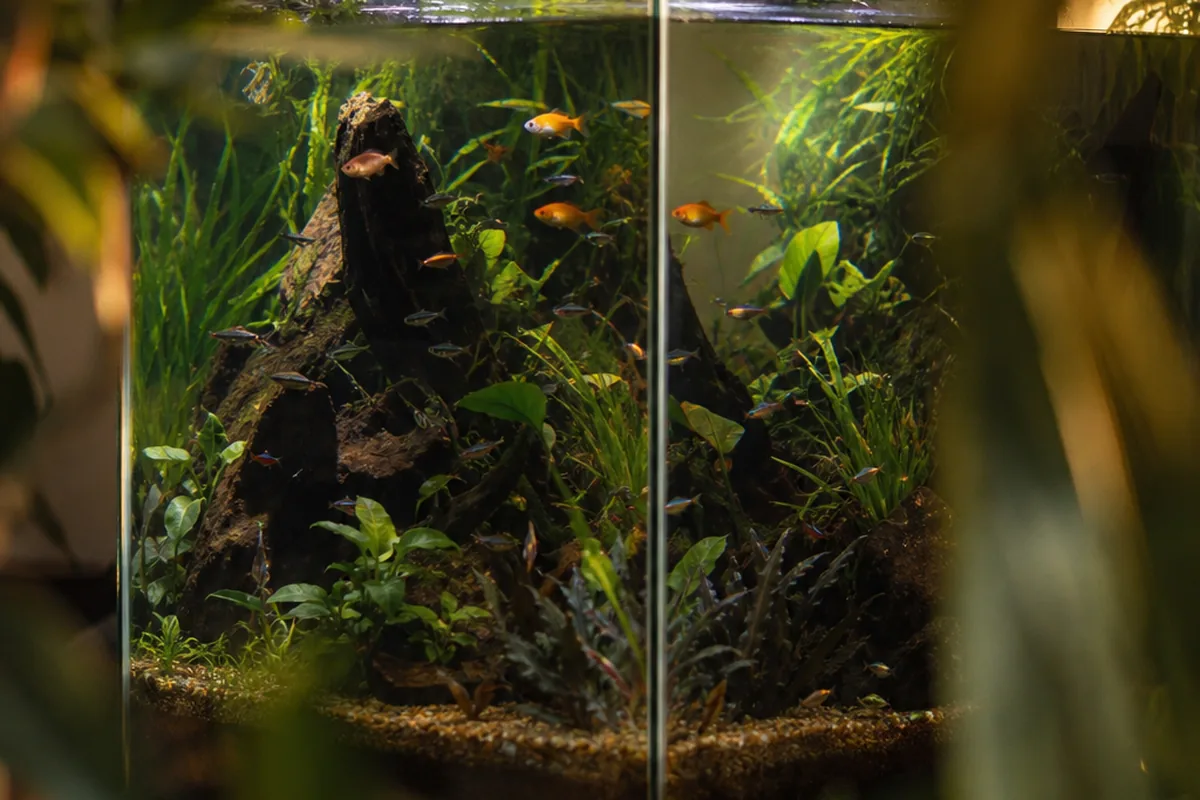
What 55 Gallons of 55 Gallon Tank Stocking Actually Gives You
The 55-gallon tank measures 48 inches long by 13 inches wide by 21 inches tall. Those dimensions matter more than the volume number.
Forty-eight inches of horizontal run opens up active schooling species, territorial fish that need sight-line breaks, and groups that simply cannot turn around comfortably at 36 inches. The 21-inch depth suits tall-bodied species like angelfish and discus that are squeezed in shorter shorter tanks.
The 13-inch front-to-back depth is the constraint most keepers do not notice until after purchase. It is narrow.
Cichlid territories, large driftwood arrangements, and wide-bodied fish all feel that compression. If your shortlist includes species that patrol the full width of a tank, a 75-gallon at 18 inches deep is a meaningfully better choice.
For the four combinations in this guide, 13 inches is workable with the right aquascape approach.
For perspective on what smaller volumes allow, our guide to smaller stocking options covers the 40-gallon range where some of these species also fit at reduced group sizes.
Key facts
- Dimensions
- 48 x 13 x 21 inches (standard footprint)
- Actual water volume
- approximately 50 gallons after substrate and hardscape displacement
- Loaded weight
- 625 lbs minimum (stand must be rated for this)
- Minimum filtration
- canister filter rated at 300+ GPH, or dual hang-on-back filters
- Heater
- 200-300W adjustable unit with a separate external thermometer
- Weekly maintenance
- 30-40% water change, substrate vacuum, filter rinse as needed
- Best for
- angelfish groups, African cichlid colonies, discus starters, large community schools
4 Proven 55 Gallon Tank Stocking Combinations
Every combination below is built around species that share compatible water parameters, occupy separate swimming zones where possible, and stay within the bioload capacity of a properly filtered 55-gallon tank.
Pick one combination. These are not mix-and-match menus.
Adding species from two different combos combines incompatible parameter requirements or pushes the bioload past what weekly maintenance can correct.
| Combo | Key Species | Difficulty | Temp / pH | Water Change |
|---|---|---|---|---|
| Angel Community | 4 angels, rummy-nose tetras, sterbai corys | Intermediate | 78-84°F / 6.5-7.0 | 30-40% weekly |
| African Cichlid Mbuna | 12-15 mixed mbuna | Advanced | 76-82°F / 7.8-8.5 | 40% twice weekly |
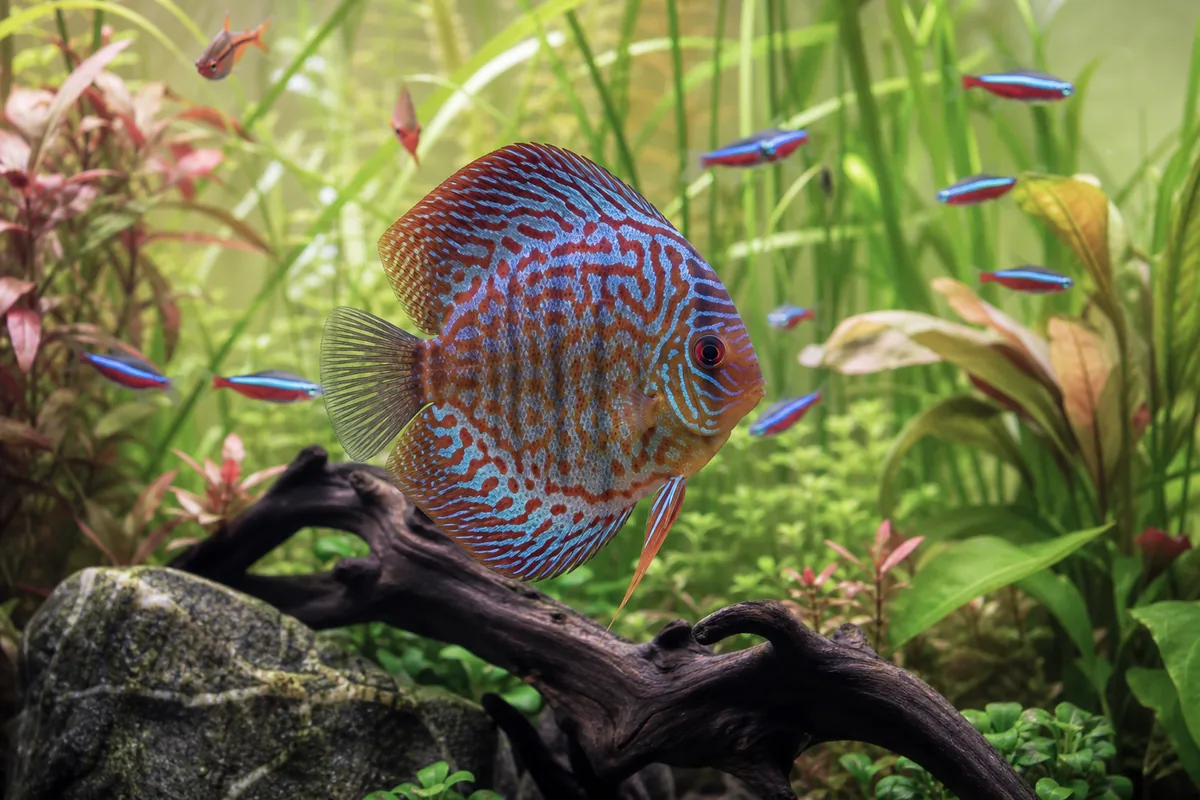
| Discus Starter | 5 discus, cardinal tetras, sterbai corys | Advanced | 82-86°F / 6.0-7.0 | 30-40% daily or every other day |
| Large Community | Rainbowfish, cherry barbs, corys, bristlenose | Beginner-Intermediate | 74-80°F / 7.0-7.6 | 30% weekly |
Each combination is detailed below with exact species counts, parameter targets, and specific setup notes that apply to the 55-gallon footprint.
Combo 1: Angel Community (Recommended Starting Point)
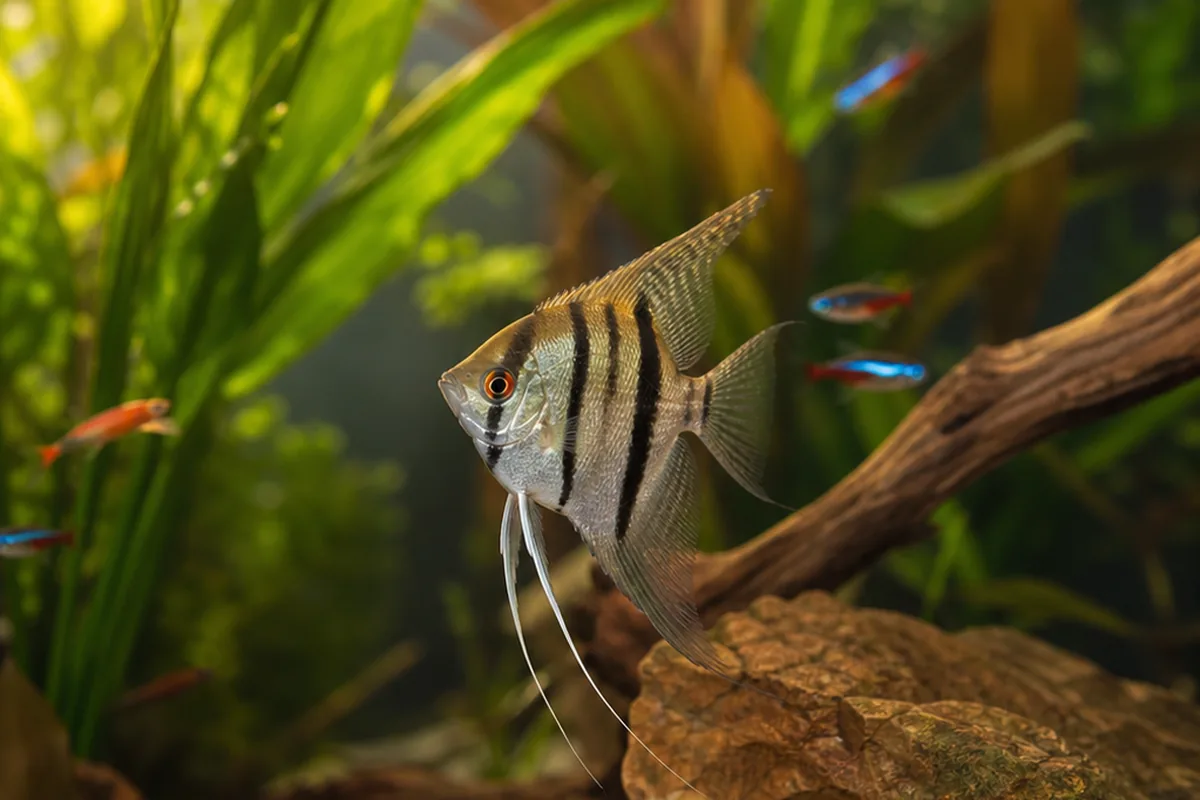
Four in a group tank is where the 55-gallon earns its reputation. At 48 inches long, four angels can establish a loose dominance hierarchy without chronic chasing.
In a 36-inch tank, the subordinate fish have nowhere to retreat.
The full stocking list: 4 angelfish, 12 rummy-nose tetras, 10 sterbai corydoras, 1 bristlenose pleco, 1 pearl gourami. That fills all three zones without pushing the bioload past what a canister filter can handle with weekly changes.
- Angelfish (4): start with 6 juveniles, let a natural pair form, rehome the extra two as adults. Do not buy adults that are already bonded pairs from separate sources and expect them to coexist.
- Rummy-nose tetras (12): tight schoolers that stay out of the angelfish's vertical territory. The color contrast against planted backgrounds is visually high-impact.
- Sterbai corydoras (10): the warmest-tolerant corydoras species, rated for 82-86°F which overlaps with angelfish requirements. Most other cory species stress above 79°F.
- Bristlenose pleco (1): handles algae on glass and hardscape, stays under 5 inches, does not compete with the angels for territory.
- Pearl gourami (1 female or 1 male): occupies the upper swimming zone alongside the angels without triggering their territorial response. Avoid flame gouramis or dwarf gouramis, which are too small and too easy for large angels to intimidate.
Dense planting is not optional for this combo. Angels use plants as visual territory markers.
Without them, the dominant pair will chase the other two constantly. Tall stem plants in the back corners and broad-leaf plants like Amazon swords at mid-ground are the standard layout.
If you want to build out the planted side of this setup, our planted tank setup guide covers substrate, lighting, and plant selection for exactly the kind of mid-to-high-light environment angelfish tanks require.
Combo 2: African Cichlid Mbuna Colony
The African cichlid approach for a 55-gallon is counterintuitive: cichlid colony setup works through deliberate overstocking. Twelve to fifteen mixed mbuna in 55 gallons distribute aggression across so many targets that no single fish absorbs enough to be injured.
The rules for this method are not flexible. Break them and the aggression concentrates on weak individuals.
- Minimum count: 12 fish. Fewer means aggression concentrates and weak fish get killed.
- Species mix: choose 3-4 compatible mbuna species, 3-4 fish of each. Do not mix one of every species you like. Overstocking only works with species redundancy.
- Males: one male per species maximum. Multiple males of the same species in 55 gallons fight without pause.
- No open water: stack rocks from substrate to waterline. Mbuna live in rock crevices in the wild. Open aquascape design produces chronic stress and constant chasing.
- Water chemistry: pH 7.8-8.5, GH 10-20, temperature 76-82°F. These are not community tank parameters. Do not mix with any species from the other three combos.
Filtration for mbuna is the most demanding of any combination on this list. Two canister filters or one large canister plus a hang-on-back is standard.
Twice-weekly 40% water changes are required, not optional. The cichlid waste load at this stocking density produces nitrate faster than weekly changes can remove.
The rummy-nose tetra is one of the few schooling fish that holds tight formation and adds genuine visual contrast to an angelfish tank. Our rummy-nose tetra care guide covers their water parameter requirements and minimum school size so you can plan the right count before stocking.
Combo 3: Discus Starter Group
Five in a starter tank is the minimum group size for this species to show natural behavior. Discus kept as pairs or trios are chronically stressed.
In a group of five, they establish a social structure and feed with confidence.
The full stocking list: 5 discus, 12 cardinal tetras, 8 sterbai corydoras. This is deliberately light.
Discus require water conditions that limit the companion species you can add.
- Temperature: 82-86°F eliminates most community species. Cardinal tetras and sterbai corydoras are among the very few that thrive at this range.
- Water changes: daily or every other day at 30-40% during the first 6 months. Discus are ammonia-sensitive at a level that makes weekly changes insufficient while the group is establishing.
- Feeding: discus require high-quality protein multiple times daily. Beefheart mix, frozen bloodworms, and high-protein pellets. They do not compete well with fast feeders. Feed the corys and tetras separately after the discus have eaten.
Discus are rated advanced for a reason that has nothing to do with fish aggression: it is the maintenance load. If daily water changes are not sustainable for your schedule, the large community combo produces a more rewarding outcome with less chronic risk.
The bristlenose pleco is the standard algae-control choice for community tanks because it stays under 5 inches and does not compete with midwater fish for territory. Our bristlenose pleco guide covers feeding, habitat, and why it outperforms common plecos in most stocking situations.
Combo 4: Large Community (Rainbowfish-Centered)
The most accessible combination on this list. Eight rainbowfish in 55 gallons show the full-color display and active schooling behavior that smaller tanks suppress entirely.
Rainbowfish are fast, open-water swimmers that need horizontal run. The 48-inch length of a 55-gallon is the minimum where they look comfortable rather than pacing.
Full stocking: 8 rainbowfish (boesemani, turquoise, or threadfin are the reliable choices), 10 cherry barbs, 8 corydoras (bronze or pepper), 2 bristlenose plecos. Water changes are weekly at 30%.
Parameters are forgiving at pH 7.0-7.6 and temperature 74-80°F.
- Rainbowfish species selection: boesemani rainbowfish reach 4.5 inches and show the strongest color contrast. Turquoise rainbowfish (Melanotaenia lacustris) are slightly more active. Threadfin rainbowfish stay under 2 inches and are better suited to a gentle community without fast feeders.
- Cherry barbs (10): the safest mid-size barb species for a community tank. Males are territorial toward each other but not damaging. Females are uniformly peaceful. A 1:1.5 male-to-female ratio keeps male coloration bright without constant pursuit.
- Corydoras (8): bronze or peppered corydoras are the best-matched species for the 74-80°F temperature range. Sterbai are rated slightly warmer and work as well.
55-Gallon Equipment That Actually Matters
The 55-gallon tank is unforgiving about one piece of equipment: the filter. Everything else scales with species choice.
Filtration does not.
| Equipment | Specification | Notes |
|---|---|---|
| Canister filter | 300+ GPH, 4-6x tank turnover | Required for all four combos. Hang-on-back filters alone are insufficient at this volume. |
| Heater | 200-300W adjustable | Two 150W units are more reliable than one 300W. If one fails, the other maintains temperature. |
| Thermometer | External probe, separate from heater | Heater dials are not accurate. An independent thermometer is how you verify actual water temp. |
| Light | Full-spectrum LED, 48 inches | Planted tanks need a spectrum with PAR rating suited to plant density. Budget LEDs lack the blue spectrum that shows fish color accurately. |
| Substrate | Sand or fine gravel, 2-3 inches | Sand is required if corydoras are in the combo. Coarse gravel damages their barbels within months. |
| Test kit | API Liquid Master Test Kit | Test ammonia, nitrite, nitrate, and pH weekly. Strips are not accurate enough for the parameter ranges discus and mbuna require. |
Canister filter maintenance matters as much as filter selection. A canister that has not been cleaned in 8 weeks is housing a bacterial colony dying in its own waste product.
Clean the media in removed tank water, not tap water, every 4-6 weeks for community and angel setups. Mbuna and discus tanks need media inspection every 3-4 weeks.
55-Gallon Tank Setup Checklist
Complete every item on this list before adding any livestock. Steps completed out of order are the most common cause of preventable fish loss in the first 30 days.
The nitrogen cycle in a 55-gallon takes 4-6 weeks with a pure ammonia source, or 1-2 weeks with established filter media from a cycled tank. Do not skip or abbreviate this step.
If you have not cycled a tank before, our tank cycling guide walks through the full nitrogen cycle process, including how to read test results and confirm the cycle is genuinely complete before adding fish.
Adding fish to an uncycled tank causes an ammonia spike that kills livestock within days and forces a full restart.
Sources and references
- Cichlid Aggression and Social Structure in Captive Lake Malawi Speciesof Fish Biology, Vol. 81, Issue 4, 2012
- Water Quality Parameters for Ornamental Fish Production and HusbandrySouthern Regional Aquaculture Center, SRAC Publication No. 453
- Symphysodon (Discus) Husbandry, Water Chemistry, and Disease Managementof Florida IFAS Extension, Tropical Fish Series