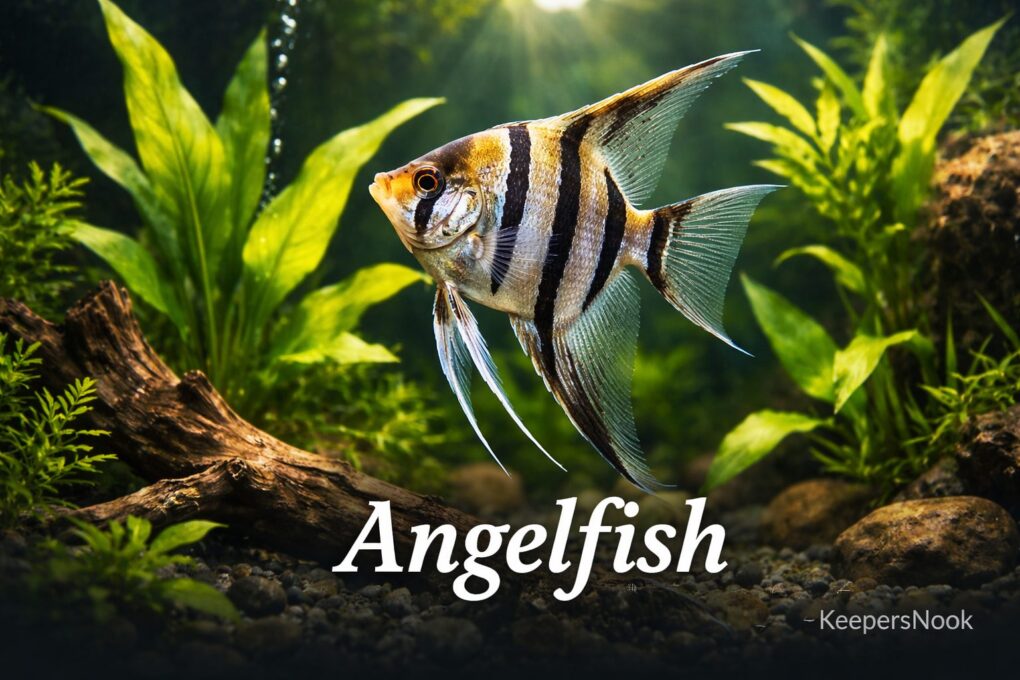
Angelfish (Pterophyllum scalare) are the fish that stop people in front of aquarium store tanks. Their disc-shaped bodies, flowing fins, and bold striping are unlike anything else in freshwater fishkeeping.
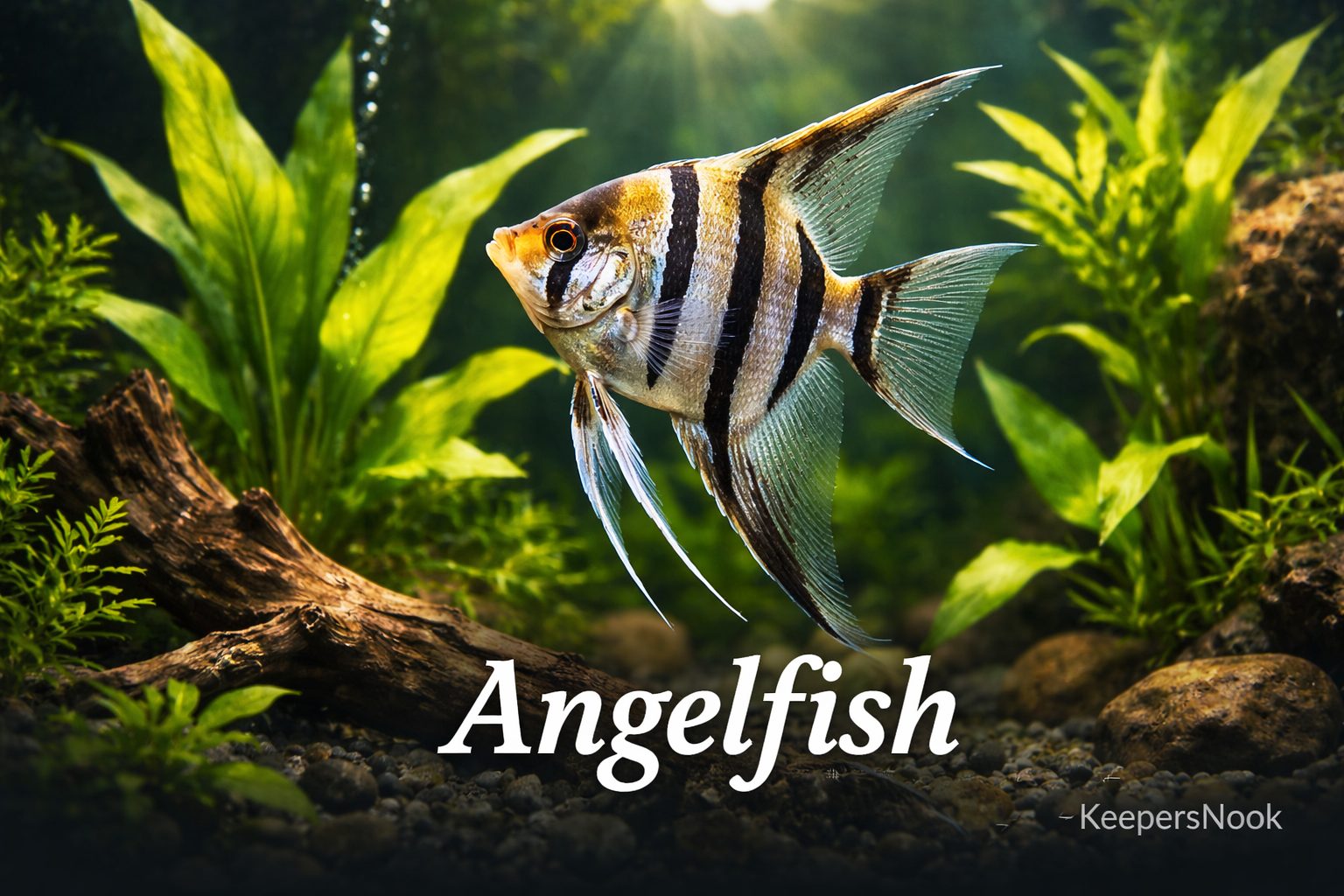
They also come with a temperament and a space requirement that catches unprepared keepers off guard.
We have kept angelfish through multiple spawning pairs, juvenile growout tanks, and community setups. This guide gives you the honest picture: what they need, what they will eat, and how to build a tank where they actually thrive.
Those numbers are ranges, not targets. The sweet spots for everyday keeping are 78–82°F and pH 6.5–7.0.
Stability within those ranges matters more than hitting an exact figure.
Here is what separates angelfish from most community fish, starting with the tank itself.
Angelfish Tank Height: Why 18 Inches Minimum for a 6-Inch Fish
Angelfish grow tall. A mature adult reaches up to 6 inches from dorsal fin tip to ventral fin tip.
Remember it later
Planning to try this recipe soon? Save it for a quick find later!
Standard 30-gallon tanks at 12 inches of height leave almost no usable swimming space above and below the fish.
You need a tank with at least 18 inches of vertical clearance. 24 inches is better for a pair or a community setup.
A 55-gallon tall or a 75-gallon is the practical choice for a pair. The "30-gallon tall minimum" is the absolute floor for a single specimen, not a comfortable long-term home.
- 30-gallon tall: absolute minimum for one adult; no community fish at this size
- 55-gallon tall: practical minimum for a pair; allows 3-4 compatible bottom-dwellers
- 75-gallon: best for a small community with angelfish as the centerpiece
- 90-gallon+: breeding colony of 4-6 with room to form natural pairs
Angelfish are slow-moving fish that use vertical space constantly. They hover mid-water, glide up to feed, and cruise down to investigate the substrate.
A wide, shallow tank wastes their preferred water column. A tall, moderately planted tank with clear swimming lanes suits them perfectly.
If you are uncertain whether your tank footprint works, the 10-gallon stocking guide explains why volume alone does not determine suitability for a given species.
When shopping for juvenile angelfish for a community setup, buy a group of 6 and let natural pair bonding occur. Bonded pairs become obvious by 6–8 months: the two fish stay close, chase others from their territory, and eventually spawn.
Remove unbonded juveniles to avoid chronic aggression once the pair establishes a permanent territory.
Angelfish Water Parameters: Warm, Soft, and Stable Above All Else
Wild Pterophyllum scalare come from slow-moving tributaries of the Amazon. These are blackwater environments: soft, slightly acidic, and tannin-rich.
Captive-bred angelfish are more adaptable, but they show best color, breed most willingly, and live longest in conditions closer to that baseline.
The parameter most keepers underestimate is stability. A tank holding steady at pH 7.2 will keep angelfish healthier than one swinging between 6.5 and 7.5 during every water change.
| Parameter | Ideal Range | Acceptable Range |
|---|---|---|
| Temperature | 78–82°F | 76–84°F |
| pH | 6.5–7.0 | 6.0–7.5 |
| Hardness (GH) | 3–8 dGH | 2–12 dGH |
| Ammonia | 0 ppm | 0 ppm only |
| Nitrite | 0 ppm | 0 ppm only |
| Nitrate | Under 20 ppm | Under 40 ppm |
Weekly 25–30% water changes are non-negotiable. Angelfish produce significant waste and are sensitive to nitrate accumulation above 40 ppm.
Run a canister filter with biological and mechanical media. Add a small bag of peat to the filter to soften water and release natural tannins if your tap water is hard and alkaline.
Angelfish Varieties: 12+ Color Forms from a Single Wild Species
All domestic angelfish trace back to Pterophyllum scalare. Selective breeding over 60+ years has produced more than a dozen recognized color forms.
Each variety has the same care requirements. The differences are cosmetic.
Here are the most common forms you will encounter at retailers and breeders.
| Variety | Description | Availability |
|---|---|---|
| Silver | Silver body with 3 vertical black bars; the wild-type pattern | Very common |
| Black Lace | Heavy black barring with a lace-like overlay on the body and fins | Common |
| Zebra | Multiple narrow black bars across a silver or gold body | Common |
| Gold | Solid yellow-gold body with no bars; result of the gold gene | Common |
| Marbled | Black and white irregular patches across the entire body | Common |
| Variety | Description | Availability |
|---|---|---|
| Koi | Orange, white, and black patches; named for koi carp resemblance | Common |
| Platinum | Solid bright white body with no pattern; striking in planted tanks | Moderate |
| Smokey | Dark grey-brown base with diffuse darker shading | Moderate |
| Blue Blushing | Clear body showing internal organs; gill covers lack pigment | Moderate |
| Albino | White-pink body with red eyes; from two copies of the albino gene | Less common |
| Altum | Taller, more pointed; true altum is a separate species (P. altum) | Specialist |
| Pearlscale | Bumpy, textured scales on a standard color form; a gene mutation | Less common |
Altum angelfish (Pterophyllum altum) are technically a separate species and have stricter water requirements: pH 4.5–6.0 and very soft water. They are not suitable for typical community setups and are best left to specialist keepers.
For standard domestic varieties, the color form has no bearing on temperament or hardiness. Choose the pattern you prefer and apply identical care.
Angelfish Diet: Cichlid Appetite with a Wide Menu
Angelfish are omnivores with a strong predatory streak. In the wild, they eat small fish, invertebrates, insect larvae, and plant matter.
In captivity, they accept almost anything that fits in their mouths, including your expensive neon tetras.
The best staple food is a high-quality cichlid pellet or flake with 40%+ protein. Angelfish feed primarily at mid-water level and will swim to the surface for floating food, but they prefer suspended foods they can intercept on the way down.
- Cichlid pellets: 40%+ protein; staple base for daily feeding
- Frozen bloodworms: trigger strong feeding response; feed 3-4x weekly
- Brine shrimp: excellent conditioning food; thaw before serving
- Mysis shrimp: higher protein than brine shrimp; useful for conditioning breeding pairs
- Blanched spinach or zucchini: accepted readily; provides plant matter and variety
Feed twice daily in amounts consumed within 3 minutes. Underfed angelfish become more aggressive and more likely to target smaller tank mates.
A well-fed angelfish is a calmer angelfish.
Angelfish Tank Mates: Which Fish Survive Alongside a Semi-Aggressive Cichlid
Angelfish are semi-aggressive predators. Small fish under 1.5 inches are food.
Slow, long-finned fish are targets for nipping. Fast, mid-size fish that stay out of angelfish territory are usually left alone.
The safest community setup pairs adult angelfish with large bottom-dwellers with armor plating, robust mid-size tetras, and species that occupy different water levels entirely.
- Corydoras catfish: armored, different level, ignored by angelfish; sterbai and emerald catfish are ideal
- plecos for algae control: max 5 inches; stays on glass and wood, out of angelfish territory
- Large tetras: black skirt, lemon tetra, and barbs for color contrast are large enough not to be eaten
- Hardy platy companions: adults at 2.5 inches are generally too large to be eaten; prefer similar temperatures
- as a mid-water alternative: moderate risk; depends on individual angelfish temperament
A breeding pair will attack everything in the tank during spawning season. Move them to a dedicated breeding tank or be prepared to remove all tank mates during that period.
Angelfish parental aggression is not situational. It is total.
For a detailed breakdown of one of the most common stocking mistakes, see our angelfish and neon tetras. The reasoning applies to any small, schooling species under 1.5 inches.
Species to avoid completely: and larger cichlid competition (they outcompete and injure angelfish), goldfish (temperature and water chemistry mismatch), and any fin-nippers like tiger barbs or serpae tetras.
If you are still building your stocking knowledge, our overview of mates for territorial fish covers the same principles that apply here. Angelfish and bettas both require a bottom-up approach to compatibility planning.
Angelfish Diseases: Hexamita and Hole-in-the-Head Affect 3 in 10 Neglected Tanks
Angelfish share the cichlid family's vulnerability to Hexamita (an internal flagellate parasite) and the related condition called Head and Lateral Line Erosion (HLLE, commonly called hole-in-the-head disease). They also suffer from standard freshwater diseases when water quality lapses.
Know these before they appear. Early recognition is the difference between a two-week recovery and a permanent scar.
- Hexamita: internal parasite causing white stringy feces, weight loss, pale color, and loss of appetite; treat with metronidazole mixed into food
- HLLE (hole-in-the-head): small pits or erosions on the head and lateral line; caused by poor water quality, activated carbon overuse, and nutritional gaps; treatment is large water changes and stopping carbon use
- Ich: white salt-grain spots on fins and body; raise temperature to 84°F temporarily and treat with ich medication
- Bacterial infections: cloudy eyes, fin rot, and body ulcers; almost always triggered by water quality problems; clean water first, then antibiotics if no improvement in one week
- Angelfish virus: rapid gill movement, lethargy, and death within 48 hours in juveniles; no treatment; quarantine all new fish for 3 weeks minimum
Hexamita and HLLE often appear together in the same fish. A cichlid showing pitting on the head with concurrent digestive symptoms needs both metronidazole treatment and an immediate water quality overhaul.
Preventing all of these conditions follows the same logic: stable temperature, zero ammonia and nitrite, nitrate under 40 ppm, and a varied diet with protein supplementation. A cichlid under chronic water stress will contract Hexamita.
A cichlid in clean water rarely does.
If you are also keeping for tank mate selection alongside angelfish, monitor the smaller fish as early indicators. Tetras show ich and water stress symptoms faster than cichlids and give you earlier warning.
Angelfish Breeding: Pair Bonding Produces 100–400 Eggs per Spawn
Angelfish form monogamous pair bonds that are among the strongest in the freshwater hobby. A bonded pair stays close together, moves in sync, and jointly chases all other fish away from a preferred territory.
They may rest side by side against a plant or piece of driftwood.
Males and females are nearly visually identical. The most reliable sexing method is observing behavior after a spawn: the female has the ovipositor (a small, blunt tube) visible when she is laying eggs, while the male has a narrower, pointed breeding tube.
Spawning begins with the pair selecting a flat vertical surface: a broad plant leaf, a piece of slate, a smooth clay pot, or the aquarium glass itself. Both fish clean the surface obsessively for 24–48 hours before laying begins.
The female lays rows of eggs in neat lines. The male follows closely to fertilize each row.
A single spawn produces 100–400+ eggs. Unfertilized eggs turn white within 24 hours; remove them with a turkey baster to prevent fungal spread to healthy eggs.
Fertilized eggs are amber-colored and adhesive. At 80°F, they hatch in 48–60 hours.
Both parents fan the eggs continuously with their fins to oxygenate them and pick off fungused eggs.
The wriggling larvae are moved by the parents to a new surface multiple times during the first week. They become free-swimming at 5–7 days and need baby brine shrimp or commercial fry food immediately after they absorb their yolk sacs.
First-time spawning pairs often eat the eggs. This is stress behavior that typically stops after the second or third spawn.
Separating the spawn to an artificial hatching setup (slate in a container with an airstone and methylene blue) gives better survival rates for new pairs.
Experienced pairs that have successfully raised fry become reliable, attentive parents. Watching a bonded pair guard and fan a clutch of eggs is one of the most compelling behaviors in the freshwater hobby.
If you want to understand why angelfish are such aggressive parents compared to community species, reading about freshwater fish establish space provides useful context for the behavior.
If you choose not to breed your angelfish, the key takeaway is this: any bonded pair will go through the motions of spawning whether or not you intervene. The aggression associated with spawning is hardwired.
Plan for it or remove the pair to a species-only tank before it happens.
Angelfish Lifespan: 10–12 Years in Proper Conditions
Angelfish are a long-term commitment. A healthy specimen purchased as a 2-inch juvenile will still be living, growing, and breeding 10 to 12 years later in a properly maintained tank.
Some captive angelfish have reached 15 years.
The longevity is a function of genetics, water quality, and temperature. Cooler water within the acceptable range slows metabolism and extends lifespan, similar to most ectotherms.
The lifespan killers are chronic temperature instability, nitrate accumulation from insufficient water changes, poor diet leaning too heavily on flake food without protein supplementation, and stress from incompatible tank mates. An angelfish that spends its life defending territory from fin-nippers ages faster than one in a calm, species-appropriate setup.
Compare this to the 2–3 year span of a standard community fish. Angelfish are the long-game fish in the freshwater hobby, outpaced only by goldfish and large plecos in potential lifespan.
Buy them knowing you are making a decade-plus commitment to their care and setup.