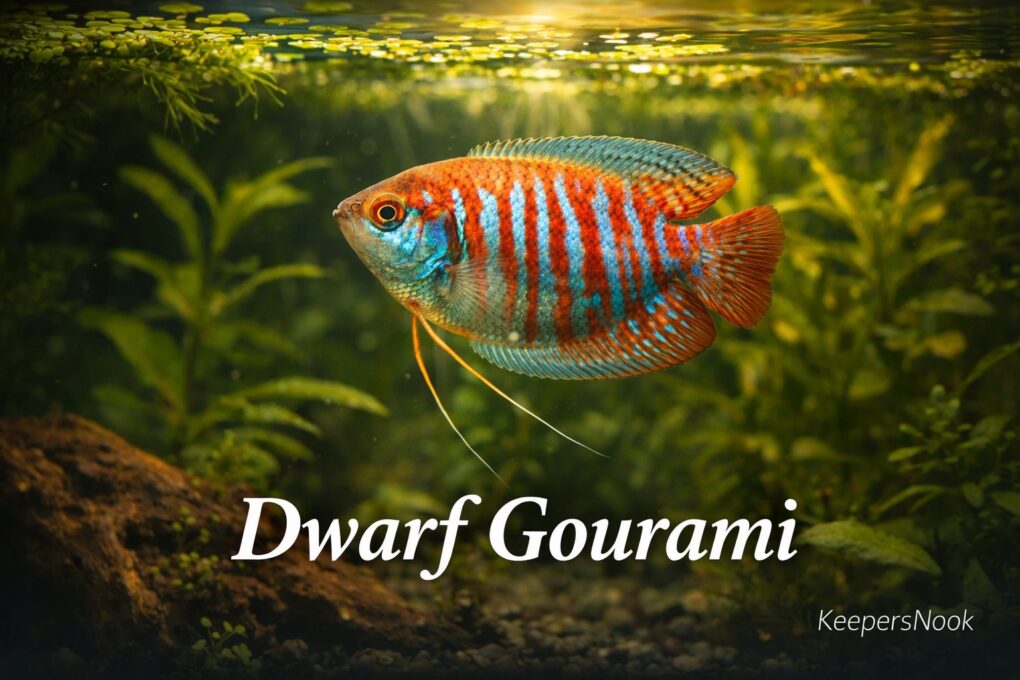
Dwarf Gourami Stats: Labyrinth Breather Reaching 2 Inches at Full Growth
The Dwarf Gourami (*Trichogaster lalius*) originates from the slow, heavily vegetated waterways of India, Bangladesh, and Pakistan. Males reach 2 inches in length and display the species' signature iridescent banding: alternating stripes of electric blue and deep red-orange that run diagonally across the body.
Remember it later
Planning to try this recipe soon? Save it for a quick find later!
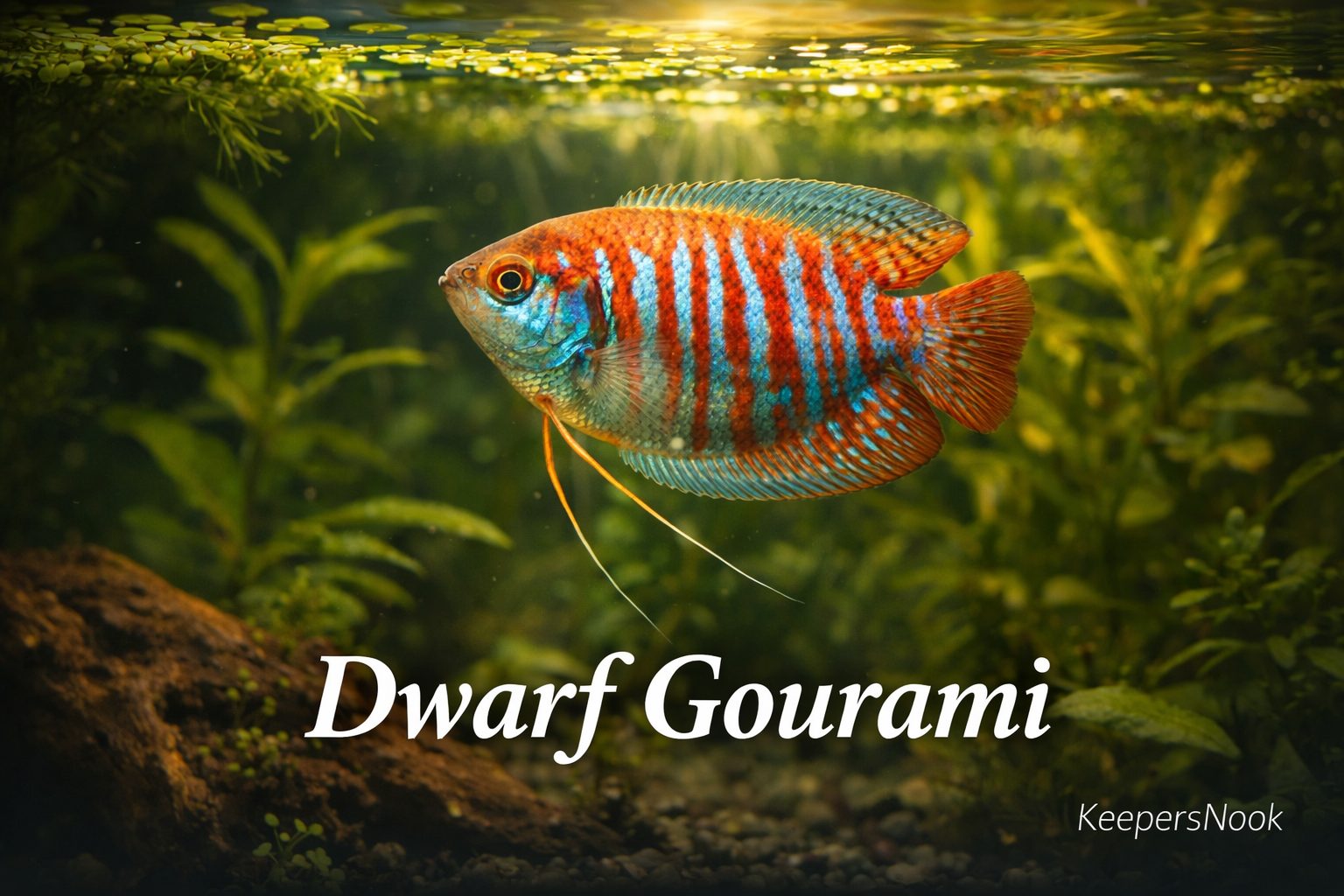
Females are noticeably plainer, carrying a silver-grey base with faint vertical barring. Most keepers maintain males only or a single male-to-female pair.
The labyrinth organ is what separates Dwarf Gouramis (and their related betta cousins) from most other aquarium fish. This accessory respiratory organ sits above the gills and extracts oxygen directly from atmospheric air.
A Dwarf Gourami will rise to the surface every few minutes to gulp air, even in well-oxygenated water.
That adaptation allows them to survive oxygen-depleted environments like rice paddies and seasonal backwaters. In your tank, it means the water surface must remain accessible at all times.
Dwarf Gourami Color Morphs: 3 Captive-Bred Variants Available in Stores
The wild-type coloration is what most people picture: blue and red iridescent diagonal stripes on a silver base. Selective breeding over decades has produced several named morphs that differ significantly from the wild form.
All four entries below are the same species. Water parameters, diet, and care requirements are identical across morphs.
The differences are purely cosmetic.
| Morph | Primary Color | Pattern | Notes |
|---|---|---|---|
| Wild Type | Blue and red-orange | Diagonal iridescent stripes | Most disease-resistant; closest to natural genetics |
| Powder Blue | Solid pale blue | Uniform with orange-red ventral fins | Most popular retail morph; slightly higher DGIV reports |
| Flame (Red) | Deep orange-red | Solid body with blue-tipped fins | Vibrant under warm-spectrum lighting; less common |
| Neon Blue | Intense electric blue | Metallic sheen, faint red barring | Bright under LED; same care as wild type |
Powder Blue Dwarf Gouramis are the morph most commonly found in chain pet stores. They are also the morph most associated with higher Dwarf Gourami Iridovirus (DGIV) rates, likely because intense selection for color has reduced genetic diversity in breeding lines.
Wild-type fish sourced from specialist breeders tend to carry less disease burden.
Tank Setup for Dwarf Gouramis: Replicate Slow, Planted Waterways
Ten gallons is the minimum for a single male Dwarf Gourami. A 20-gallon gives you room for a male-female pair or a small community build, and it reduces the territorial pressure the male exerts on every other fish in the tank.
The most common setup mistake is using a filter with too much flow. Dwarf Gouramis come from still or sluggish water.
A filter that creates strong surface agitation stresses them and disrupts bubble nests. A sponge filter or a hang-on-back unit with a spray bar set horizontally at or below the water surface keeps flow gentle without sacrificing biological filtration.
Floating plants do two jobs simultaneously. They provide surface cover that makes the Gourami feel secure, and they give the male raw material for bubble nest construction.
Males use plant debris, mucus, and air to build nests directly at the water surface. Without floating plants, males will still build, but nests are smaller and collapse more quickly.
For specific equipment recommendations that apply equally to labyrinth fish setups, our 10-gallon tank stocking guide covers filter selection and layout in detail.
Water Parameters: Soft, Warm, Stable Conditions Dwarf Gouramis Require
Dwarf Gouramis originate from the Indian subcontinent, where slow rivers and paddies carry soft, slightly acidic water warmed by tropical temperatures. They adapt to a wider range than their origin suggests, but soft to moderately hard water within a neutral pH produces the strongest color and the lowest disease susceptibility.
Stability matters more than perfection. A tank holding steady at pH 7.2 and 80°F produces healthier fish than one that swings between 6.5 and 7.4 weekly due to inconsistent water changes or poor buffering.
- Temperature: 77-82°F. Ideal is 78-80°F for daily care; raise to 80-82°F to trigger breeding behavior
- pH: 6.0-7.5. Ideal is 6.5-7.0 for long-term health and color expression
- Hardness (GH): 4-10 dGH ideal; tolerates up to 15 dGH without visible stress
- Ammonia and Nitrite: 0 ppm at all times. Non-negotiable for any fish, critical for immune-compromised Gouramis
- Nitrate: Under 20 ppm. Weekly 20-25% water changes maintain this range in a planted tank
Perform weekly water changes of 20-25%. Use a dechlorinator that neutralizes chloramine as well as chlorine.
Match the temperature of new water to within 1-2°F of tank temperature before adding it. Cold-water additions from the tap are a common stress trigger that suppresses immune function and opens the door to opportunistic infections.
Diet: What Dwarf Gouramis Actually Eat in the Wild and in Your Tank
Dwarf Gouramis are omnivores that feed primarily at the surface and mid-water in the wild. Their natural diet is insects, small larvae, algae, and plant material that falls onto or floats at the water surface.
Their mouths are proportionally small, which means large pellets go mostly uneaten.
Small-particle foods fed twice daily produce better condition and color than one large daily feeding.
The daily diet foundation should combine two or three of these foods, rotated through the week:
- Small-particle flake food: Surface and mid-water feeding. Choose a high-quality brand with fish meal as the first ingredient
- Micro pellets (1mm or smaller): Sink slowly enough that surface feeders catch them before they reach the substrate
- Freeze-dried daphnia: High in fiber, helps prevent constipation. Feed 2-3 times weekly as part of the rotation
- Color-enhancing flakes with astaxanthin: Visibly intensifies the iridescent banding in males within 4-6 weeks of consistent feeding
Offer treat foods 2-3 times per week maximum. Overfeeding protein-rich live or frozen foods causes bloat and water quality problems:
- Frozen bloodworms: High palatability, good protein source. Thaw before feeding. Maximum 2-3 times per week
- Frozen or live brine shrimp: Excellent treat protein. Adult brine shrimp are fine; their small mouths handle them well
- Live blackworms: Trigger strong feeding response and natural hunting behavior
- Micro worms or vinegar eels: Useful during conditioning of a breeding pair
These foods cause digestive problems, water quality issues, or simply go uneaten:
- Large pellets or wafers: Too big for their mouths; decompose in the tank and spike ammonia
- Beef heart or mammal protein: The fat content causes fatty liver disease over time in tropical fish
- Bread or carbohydrate-heavy foods: Poor nutritional value and degrades water fast. See quality fish food results for what this looks like in practice
- Feeder goldfish or other live fish: Unnecessary for Dwarf Gouramis and a disease vector
Tank Mates: Which Fish Work and Which Cause Problems
The compatibility rule for Dwarf Gouramis is simple and non-negotiable: keep exactly one male per tank. Two males in any tank under 55 gallons will fight.
In most tanks, they will fight regardless of size. The territorial instinct is hardwired, not a function of available space.
A male-female pair works in a planted 10-gallon or larger. The male will pursue the female aggressively during spawning condition.
Dense planting lets her escape his attention. Adding a second female distributes that pressure.
- Neon Tetras: Peaceful tetra companions that occupy mid and lower water, leaving surface territory to the Gourami
- Corydoras: Bottom-dwelling corydoras catfish that clean the substrate and stay entirely out of the Gourami's zone
- Cherry Barbs: Peaceful cherry barb schoolers that occupy mid-water and do not trigger aggression
- Platies: Hardy platy livebearers with overlapping temperature needs and a peaceful temperament
- Bristlenose Plecos: bristlenose pleco algae eaters that stay on the substrate and glass, entirely outside the Gourami's territory
Species to avoid include large angelfish companions that easily out-compete a Dwarf Gourami for food, Tiger Barbs (fin nippers that will destroy the long trailing ventral fins), and any other labyrinth fish including Bettas. Bettas and Dwarf Gouramis occupy the same water column and carry similar territorial instincts.
In most tanks, one fish will eventually injure or stress the other.
For a pre-vetted list of species that live alongside territorial fish without conflict, our tank mate selection guide covers many of the same species and the same evaluation criteria.
Dwarf Gourami Disease: DGIV Has No Cure and Requires Prevention
Dwarf Gourami Iridovirus (DGIV) is the single biggest health threat to this species. It is a megalocytivirus that has spread through the commercial trade via mass-breeding operations in Southeast Asia.
Published research in *Diseases of Aquatic Organisms* confirmed DGIV in a high percentage of commercially imported Dwarf Gouramis sampled from Australian and European markets.
The disease progresses through distinct phases. Early signs are behavioral: reduced activity, loss of appetite, fading color, and increased time at the surface beyond normal air-breathing.
Later signs include visible bloating of the abdomen, open sores on the body, scale loss, and wasting of the muscle tissue. Death follows within weeks of visible symptoms in most cases.
Other health issues are more manageable. Ich (*Ichthyophthirius multifiliis*) presents as white salt-grain spots on body and fins.
Raise temperature to 82°F and treat with aquarium salt at 1 tablespoon per 5 gallons for 7-10 days, removing activated carbon from the filter during treatment.
Velvet (*Oodinium*) appears as a fine gold or rust-colored dusting on the fish's surface, most visible when light hits at an angle. Treat with a copper-based medication in a quarantine tank and dim the main tank during treatment.
Velvet's reproductive cycle is light-activated, so darkness slows spread.
Fin rot in Dwarf Gouramis nearly always traces back to two causes: water quality failure or physical damage from fin-nipping tank mates. Address the root cause first.
Then apply a targeted antibacterial treatment if bacterial secondary infection has established.
Breeding Dwarf Gouramis: Bubble Nests and Fry Development
Dwarf Gouramis are bubble nest builders. The male constructs a floating nest of air bubbles, plant debris, and mucus at the water surface, then courts the female through sustained fin displays and circling behavior.
A male in breeding condition will work on the nest obsessively before the female is ready to spawn.
To trigger spawning, raise the water temperature to 80-82°F, drop the water level to 6-8 inches depth, and ensure floating plants are present. The shallow water mimics the dry-season conditions in their natural range, which cues reproductive behavior.
During spawning, the male wraps around the female and fertilizes eggs as she releases them. Fertilized eggs float upward into the bubble nest.
The male collects any that sink and returns them to the nest himself. Remove the female immediately after spawning ends.
The male becomes protective of the eggs and will harass or kill the female if she remains.
Eggs hatch in 24-36 hours at 80°F. The male continues to guard the fry for another 3-4 days while they are still attached to their yolk sac.
Once fry become free-swimming, remove the male. He may begin eating them at that stage.
Feed newly free-swimming fry infusoria or a commercial liquid fry food for the first 10-14 days. Transition to baby brine shrimp (newly hatched nauplii) once fry are large enough to chase and catch them.
A spawning of 200-800 eggs is typical. Survival rate to juvenile depends on food quality, water cleanliness, and the absence of predators in the fry tank.
Keep the fry tank water level at 6-8 inches until the fry are approximately 3-4 weeks old. At that point their labyrinth organ begins to develop.
Before it fully develops, fry raised in deeper water without reliable air access drown. This is the most commonly missed step in Dwarf Gourami fry-raising.
A breeding setup does not require a large tank. A dedicated 10-gallon with dense floating plant cover, a gentle sponge filter, and a male-female pair in breeding condition produces results within days of temperature adjustment.
The male's nest-building is an early and reliable indicator that spawning is imminent.
Lifespan and Long-Term Health Management
Dwarf Gouramis live 4-6 years under good conditions. Store-bought males are often already 12-18 months old at purchase, which shortens the realistic time window considerably.
A fish bought at a chain store in breeding-ready condition may only have 2-3 productive years ahead of it.
The iridovirus risk is the hardest variable. A carrier fish can appear completely healthy for months before DGIV becomes detectable.
Quarantine is not optional. A 4-week quarantine period in a separate tank, watched for any behavioral changes, catches the majority of cases before they reach an established community tank.
Color fading in an active, eating male almost always points to diet. Introduce color-enhancing foods with natural astaxanthin and maintain the change consistently for 4-6 weeks before evaluating.
Color recovery is gradual.
Males display more intensely under moderate lighting with a dark substrate beneath them. Strong overhead lighting bleaches their iridescence visually and increases baseline stress.
Adjust light intensity, add surface plants for diffusion, and the color difference is visible within a week.
- Buy from breeders: Specialist breeders run healthier stock than mass importers; ask specifically about DGIV history in their lines
- Quarantine every arrival: 4 weeks minimum in a separate tank before introduction to any display tank
- Test water monthly: Even in stable established tanks, periodic testing catches drift in pH or hardness before it becomes a health issue
- Feed variety: Rotating between staple flakes, color-enhancing foods, and occasional frozen treats produces better long-term condition than a single food for life
- Watch the surface: A Dwarf Gourami spending abnormal time at the surface or breathing rapidly is the earliest observable warning sign of water quality problems or illness
Females outlive males on average because they carry less hormonal load from constant territorial display. If you keep a male-female pair and the male dies early, assess whether DGIV was the cause before adding a replacement.