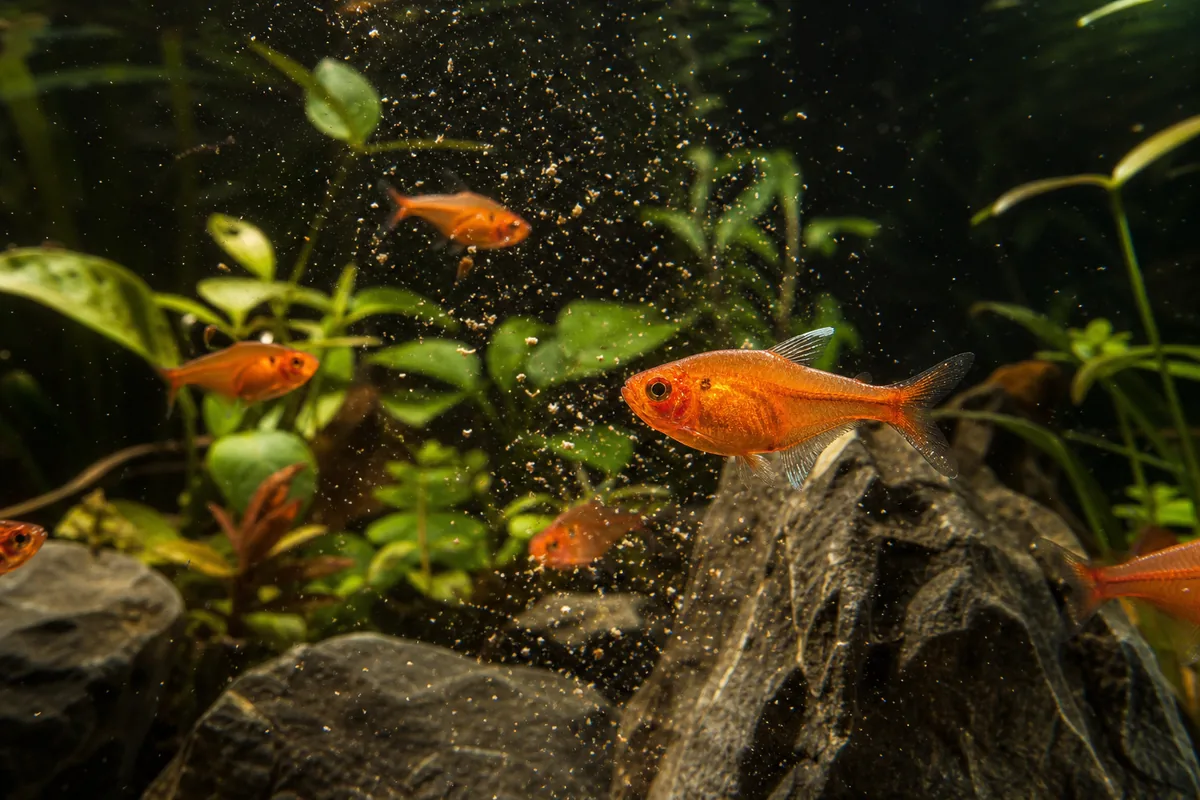
Ember tetras (Hyphessobrycon amandae) were named after Amanda Bleher, the mother of aquarist Heiko Bleher who first collected them in Brazil's Araguaia River basin. They are tiny enough that many beginners overlook them at the fish store, but that is a mistake.
We have kept ember tetras in planted nanos for years. A school of 12 or more in a blackwater setup with dark substrate is one of the most arresting sights in freshwater fishkeeping, and the care requirements are genuinely manageable.
Key facts
- Min Tank
- 10 gallons
- Temp
- 73-84°F
- Ph
- 5.5-7.0
- Lifespan
- 2-4 years
Ember Tetra Tank Setup: Plants and Dark Substrate Are Non-Negotiable
A 10-gallon is the practical minimum for a school of 10 ember tetras. You can stretch it to 12 in a well-planted 10-gallon with regular water changes, but a 15- or 20-gallon long gives you the horizontal swimming space this species genuinely uses.
The tank setup is where most keepers either unlock this fish's full potential or leave color and behavior on the table.
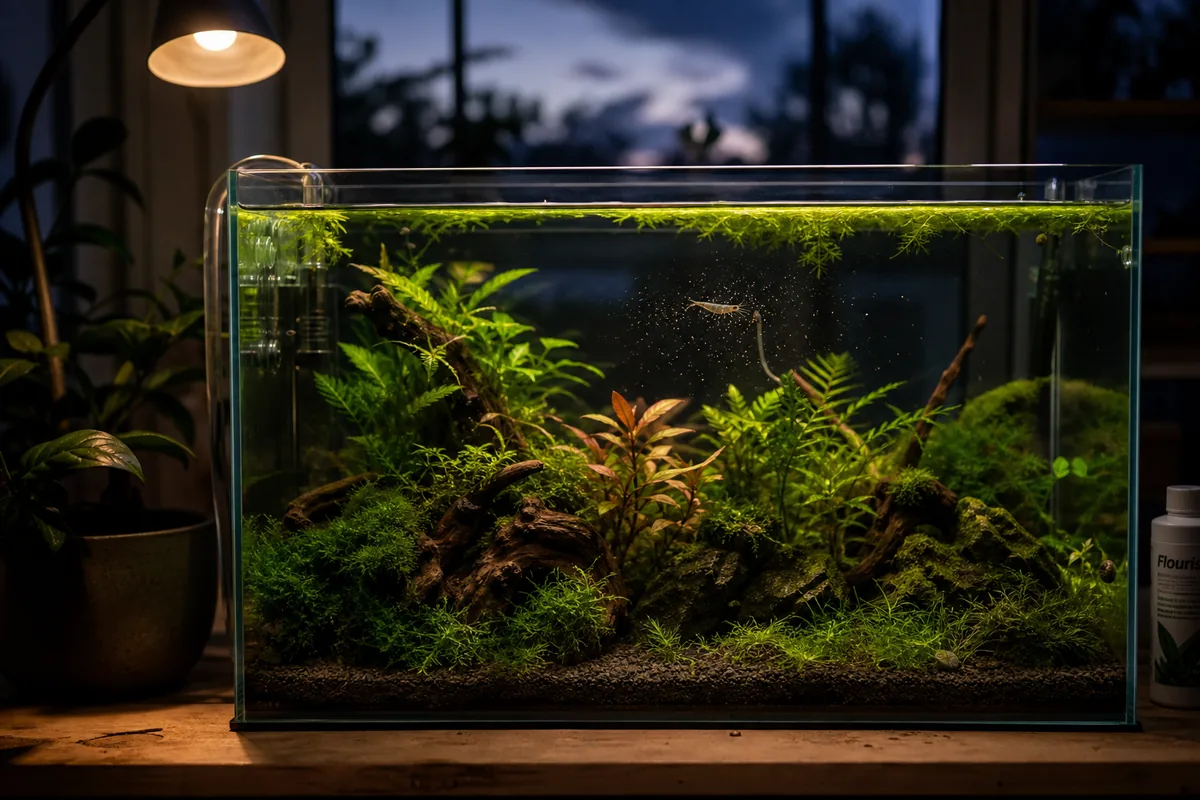
Ember tetras are native to slow-moving, heavily vegetated Brazilian streams with leaf litter and tannins. Replicating that in your tank is not just aesthetics: it directly affects their color, comfort, and immune health.
The blackwater aesthetic is not required, but it is the single biggest upgrade you can make for ember tetra color. A handful of Indian almond leaves and a piece of driftwood will tint the water amber within days.
Floating plants like frogbit or salvinia reduce surface light further and add a natural canopy that ember tetras actively use for cover.
Setting up a planted blackwater tank for the first time involves substrate, CO2, and fertilizer decisions that all interact. Our planted tank setup guide covers those choices in sequence and identifies which fertilizers are safe for the soft acidic water ember tetras need.
For comparison with other small tank options, our small tank stocking guide covers which species actually thrive in nano setups versus which ones just survive.
Water Parameters: Soft, Warm, and Slightly Acidic
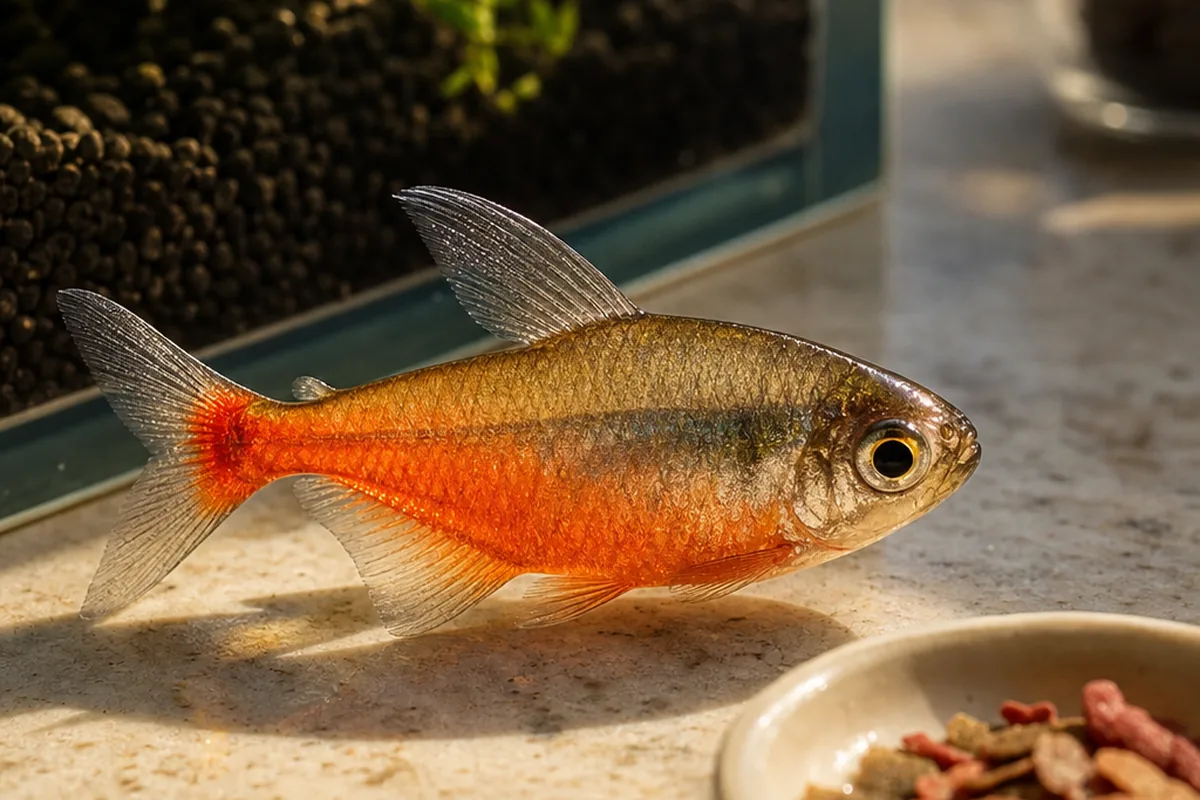
Ember tetras are more parameter-sensitive than beginner-friendly tetras like neons. They tolerate a broad temperature range in theory, but they color up and school tightly only when conditions are close to their natural habitat: warm, soft, and acidic.
Hard alkaline tap water keeps them alive but washes out their color and makes them skittish and prone to illness.
| Parameter | Ideal Range | Acceptable Range |
|---|---|---|
| Temperature | 78-80°F | 73-84°F |
| pH | 6.0-6.8 | 5.5-7.0 |
| Hardness (GH) | 2-6 dGH | 1-10 dGH |
| Ammonia | 0 ppm | 0 ppm only |
| Nitrite | 0 ppm | 0 ppm only |
| Nitrate | Under 10 ppm | Under 20 ppm |
If your tap water is hard (above 10 dGH) or alkaline (pH above 7.4), you have two practical options: use RO water cut with tap to hit target parameters, or let tannins from Indian almond leaves and driftwood do the softening work gradually over time.
Do 20-25% water changes weekly. Ember tetras are small but sensitive to nitrate buildup, and planted tanks can accumulate waste under the substrate if flow is too low.
Diet: Tiny Fish, Tiny Food
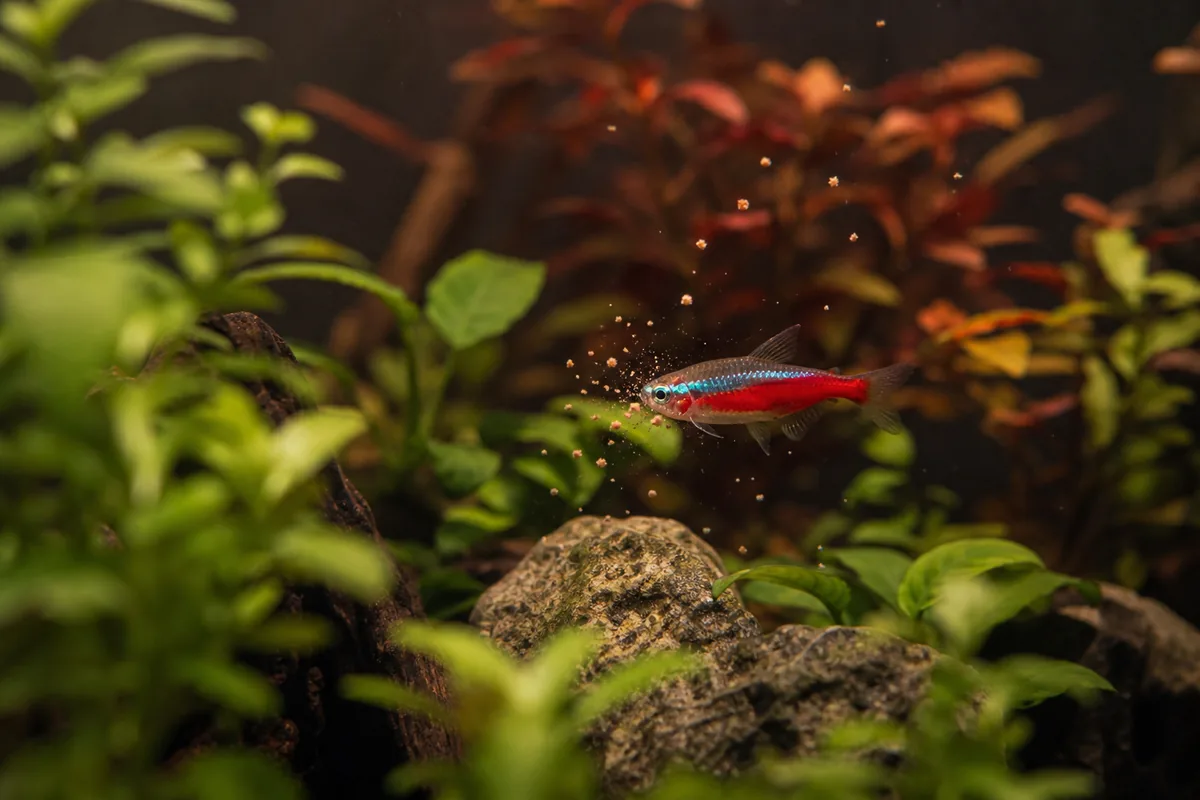
Ember tetras are omnivores, but their mouths are exceptionally small even for nano fish. Standard flake food is too large for them to eat properly, and many keepers assume their ember tetras are eating when the food is actually just dissolving into waste.
Food size is the single most overlooked aspect of ember tetra care.
The right approach is micro-sized prepared foods supplemented with appropriately sized live and frozen protein. A varied diet does more for ember tetra color and health than any water additive.
- Micro pellets: 0.2-0.5mm diameter. Look for Hikari Micro Pellets or similar nano-specific formulations with 40%+ protein
- Crushed flake: Standard flake crushed between your fingers until powdery. works in a pinch but micro pellets are better
- Baby brine shrimp: Freshly hatched or frozen. the single best food for intensifying ember tetra color
- Daphnia: Frozen or live. high in fiber, excellent for digestive health and conditioning for breeding
- Micro worms and vinegar eels: Live culture foods that ember tetras hunt actively, triggering natural feeding behavior
- Cyclops and copepods: Frozen or live. small enough for ember tetras to eat whole, nutritionally dense
Feed twice daily, only what disappears within 90 seconds. Ember tetras have small stomachs and overfeeding fouls the water fast in a nano tank.
Baby brine shrimp are the highest-return food for ember tetra color and conditioning. Our guide on brine shrimp for fish covers how often to feed it and how to thaw it correctly so it sinks to where ember tetras feed rather than floating out of reach.
Skip one day of feeding per week. This allows the digestive system to clear and helps prevent internal fat deposits that shorten lifespan.
Schooling Behavior: Why Group Size Matters More Than Tank Size
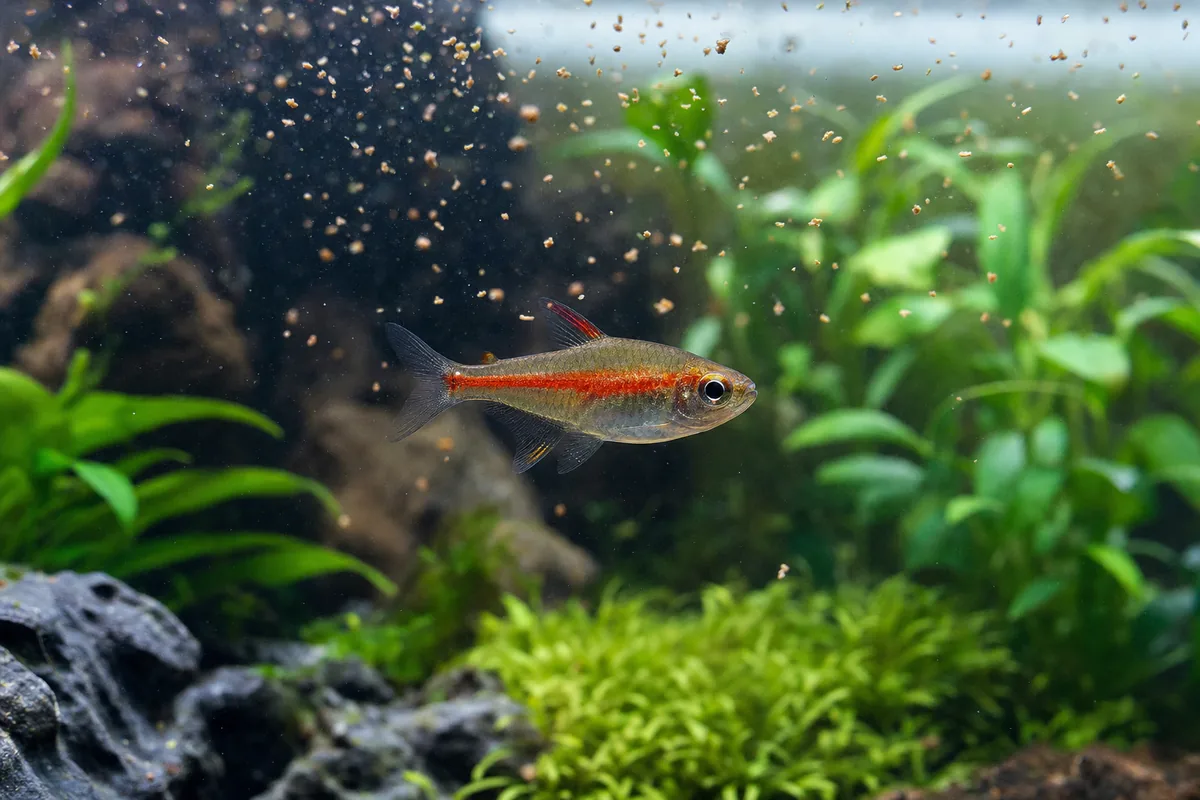
Ember tetras are obligate schooling fish. A group of fewer than 8 produces stressed, skittish fish that hide behind plants and lose color within weeks.
A group of 10 or more produces the opposite: tight, coordinated schools that move through the tank as a single glowing ribbon of orange.
This is the species where group size matters more than almost any other factor.
At 10+ individuals, ember tetras become bold enough to swim in open water, investigate the front glass, and display their full color continuously. At 5 or fewer, they behave like prey animals: darting for cover at any movement near the tank.
For size comparison with closely related species, our neon tetra care guide shows exactly how ember tetras compare in adult size, which affects stocking math in a shared tank.
Harlequin rasboras are another strong schooling species for a soft-water planted tank. Our harlequin rasbora guide covers their water requirements and explains how their larger body size complements an ember tetra school in a 20-gallon community without creating feeding competition.
Tank Mates: Best and Worst Pairings
Ember tetras are peaceful and do not nip fins. They are compatible with any species that is similarly sized, non-aggressive, and prefers soft acidic water.
The primary risk runs the other direction: ember tetras are small enough to be eaten by fish considered community-safe in other contexts.
Pros
- Chili rasboras: same size, same water needs, stunning contrast with ember orange
- Cherry shrimp and amano shrimp: ember tetras are too small to eat adult shrimp. peaceful coexistence
- Corydoras pygmaeus and C. habrosus: nano corys that share the same water requirements
- Otocinclus: algae eating, peaceful, compatible water parameters
- Other micro tetras: Neon tetras, green neon tetras. see <a href='/freshwater-fish/tetras-types/' title='tetra variety guide'>tetra variety guide</a> for full list
- Dwarf shrimp (neocardina and caridina): safe with ember tetras in most cases
Cons
- Betta fish: even a peaceful betta may chase ember tetras. the size difference is too great
- Angelfish: will eat ember tetras. not a community fish for nano species
- Larger barbs (tiger barbs, rosy barbs): fin-nippers that stress small tetras
- Cichlids of any kind: too aggressive and territorial for ember tetra tank mates
- Goldfish: cold-water species incompatible with ember tetra temperature needs
- Aggressive gouramis: pearl and moonlight gouramis are usually fine. three-spot and giant are not
Ember tetras work particularly well alongside fish in nano tanks when the betta is a known calm individual, but this pairing requires careful monitoring. Most keepers maintain a species-only or shrimp-pairing approach to eliminate risk entirely.
The shrimp pairing deserves emphasis: a group of cherry shrimp and a school of ember tetras in a planted 10-gallon is one of the most low-maintenance, visually striking setups in nano fishkeeping. Both species thrive in similar conditions, and adult shrimp are safe from ember tetras.
| Tank Mate | Compatibility | Notes |
|---|---|---|
| Cherry shrimp | Excellent | Adult shrimp are safe. shrimplets may be eaten |
| Chili rasboras | Excellent | Identical care requirements, stunning visual contrast |
| Pygmy corydoras | Excellent | Bottom-level cleaners, no competition |
| Neon tetras | Good | Slightly larger, may out-compete for food |
| Otocinclus | Good | Same water parameters, different feeding niche |
| Betta fish | Risky | Depends entirely on individual betta temperament |
| Angelfish | Avoid | Will eat ember tetras |
| Tiger barbs | Avoid | Chronic fin harassment and stress |
Color: How to Get the Full Orange-Red Display
Ember tetras in a pet store under bright white lights on white or bare substrate often look pale and washed out. Many buyers assume this is the fish's natural color.
It is not.
The full fiery orange-red display requires three conditions: dark substrate, subdued or plant-filtered lighting, and tannin-stained water. Remove any one of these and color intensity drops by half.
- Dark substrate: Black sand or dark gravel reflects the orange upward and creates visual contrast. White or light-colored substrate does the opposite
- Tannins: Indian almond leaves, catappa bark, driftwood, or peat filtration all add humic acids that bring out red and orange pigmentation
- Diet: Baby brine shrimp, cyclops, and carotenoid-rich foods enhance orange pigmentation over weeks of consistent feeding
- Stress reduction: A proper school size of 10+ reduces cortisol. stressed fish chromatophores constrict and color fades. Confident fish display full color
- Correct temperature: 78-80°F keeps metabolism active and pigmentation cells functioning. cooler water produces duller color even in healthy fish
A new school of ember tetras typically takes 2-4 weeks in a proper blackwater setup to show their full potential color. Do not judge this species in the first week.
Chili rasboras are the other nano species most often compared to ember tetras for a blackwater planted tank. Our rummy nose tetra guide also covers how red-pigmented nano fish use water quality as a color signal, a pattern that applies directly to diagnosing color loss in your ember tetra school.
Health and Common Problems
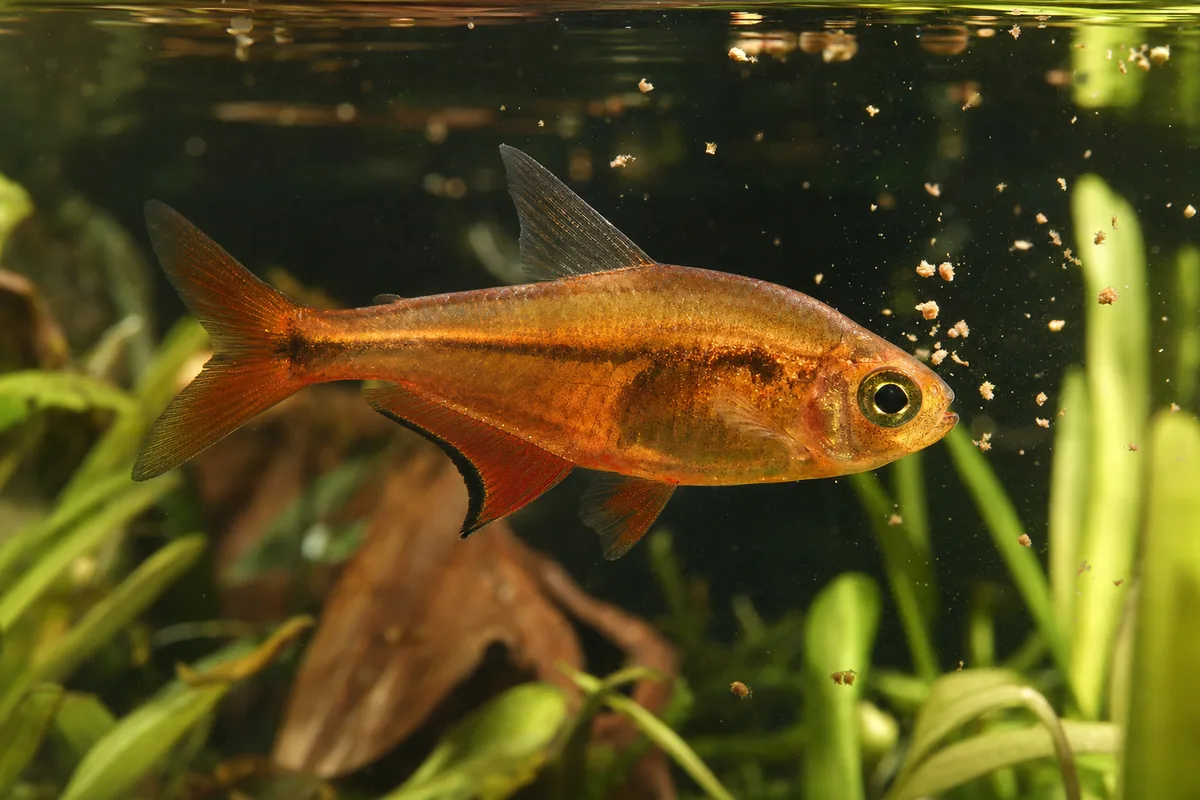
Ember tetras are not sickly fish, but their small size means illness progresses fast and visible symptoms often appear late. The best health strategy is prevention through water quality, not reaction through medication.
Most health problems in ember tetra tanks trace directly to one of three causes: poor water quality, incorrect temperature, or stress from inadequate group size.
- Ich (white spot): Tiny white grains on fins and body. Raise temperature to 82°F over 24 hours and treat with a half-dose of ich medication. Ember tetras are sensitive to full-strength medication doses
- Neon tetra disease (microsporidiosis): White or pale patches spreading from the body. incurable. Remove and euthanize affected fish immediately to protect the school
- Fin clamping: Fins held tight against the body. almost always a water quality issue. Test and correct ammonia, nitrite, or nitrate before reaching for medication
- Emaciation: Sunken belly despite apparent feeding. indicates internal parasites or food size mismatch. treat with Levamisole or switch to appropriately sized live food
Quarantine all new fish for 3 weeks before adding them to an established ember tetra school. Introducing a single sick fish to a tight school is the fastest way to lose the entire group.
A 10-gallon tank serves as an effective quarantine setup for nano species. Our 10-gallon tank guide covers the filtration and heating equipment that keeps a small quarantine tank stable without spending more than the fish cost.
Breeding: Possible but Requires Patience
Ember tetras breed in captivity without much intervention when conditions are right, but they are egg scatterers and will eat their own eggs immediately. Deliberate breeding requires a separate breeding tank.
A dedicated breeding setup is a bare or java moss-covered 5-gallon tank with RO water adjusted to pH 6.0-6.5, temperature at 80-82°F, and very dim lighting. Condition a pair or small group with live baby brine shrimp and daphnia for two weeks before introducing them to the breeding tank.
Females are slightly rounder-bodied than males. Males show a more intense and uniform orange-red coloration through the body.
Eggs are tiny and semi-adhesive, scattered over moss or plants. Remove adults immediately after spawning.
Eggs hatch in 24-36 hours at 80°F and fry become free-swimming within 3-5 days.
Feed fry infusoria or first-stage foods for the first week, then graduate to baby brine shrimp nauplii. Growth is slow. juvenile ember tetras reach sellable size at approximately 3 months.
Panda corydoras are a good bottom-level companion during a breeding project because they leave eggs and fry alone and share the soft acidic water requirements. Our panda corydoras guide covers their care and explains why they are one of the few corydoras species that genuinely thrives in the parameters ember tetras need.
Sources and references
- Hyphessobrycon amandae species description and natural habitat documentationIchthyological Explorations of Freshwaters. Bleher (1986)
- Blackwater aquarium chemistry: tannins, humic acids, and fish physiologyJournal of Experimental Biology. Cambridge Press
- Ornamental fish health, disease prevention, and water quality managementMerck Veterinary Manual. Ornamental Fish Section