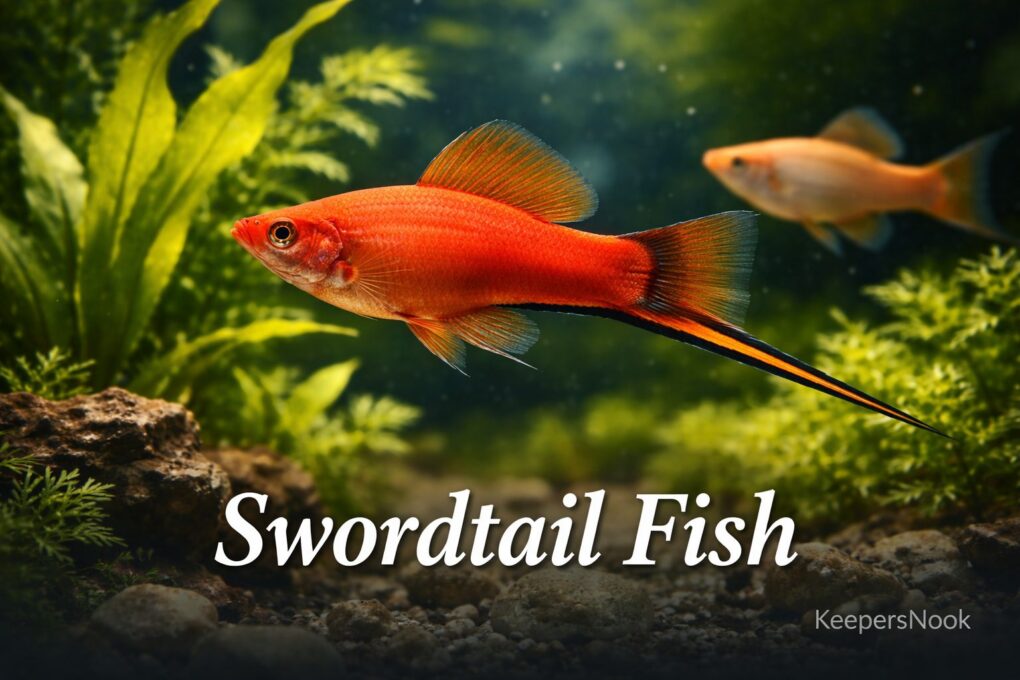
Swordtails belong to the same family as species selection favorites like guppies, mollies, and platies. That shared lineage makes them adaptable to a wide pH band and forgiving of beginner mistakes, as long as the tank is cycled and the lid is secure.
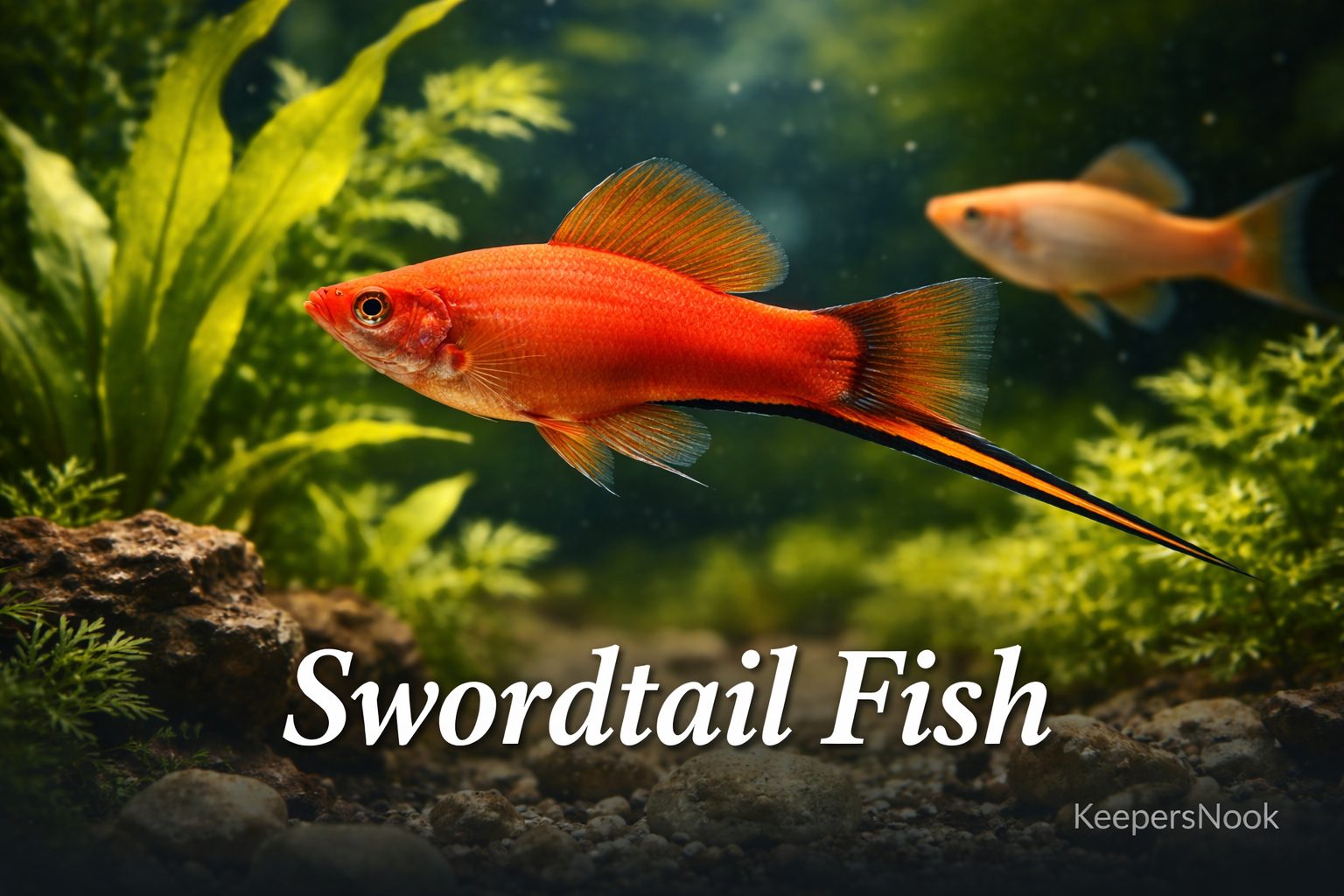
Males reach 4–5 inches total length when you count the sword itself. Females are typically larger in body but lack the sword entirely.
Both sexes are fast, mid-water swimmers that use every inch of horizontal space.
What makes the swordtail sword unique: anatomy across 30+ color varieties
The "sword" is an elongated lower caudal fin ray found only in males. It is not decorative tissue added to the fin. it is the lowermost ray of the tail grown beyond the fin membrane, producing a pointed extension that can equal or exceed the body length.
Remember it later
Planning to try this recipe soon? Save it for a quick find later!
Females never grow it naturally, which makes it the clearest sex indicator in the species.
Swordtails come in over 30 documented color varieties, most of them the product of selective breeding since the mid-1900s. Natural wild-type fish from Mexico and Central America are olive-green with a red lateral stripe, a far cry from the neon reds and patterned fish sold today.
The most common variety in the hobby. Body is solid red to orange-red with a yellow-edged sword on the male.
Hardy and widely available at every price point. A reliable starting point for keepers new to the species.
A wagtail swordtail has a red or orange body paired with solid black fins, including the sword. The contrast is striking under tank lighting.
Wagtail patterning is a distinct genetic trait that breeds true.
The pineapple variety shows a yellow-gold body with a red or orange dorsal stripe and a gold-edged sword. The name comes from the yellow-and-red coloring.
Males in peak condition develop a deep amber tone across the flanks.
Kohaku swordtails display a red-and-white patterned body, similar in name to the koi color class. The pattern is irregular, meaning no two fish look identical.
Kohaku varieties are popular in planted display tanks.
Lyretail swordtails carry a double sword mutation: both the upper and lower caudal rays extend into points, producing a forked tail. The lyretail trait can appear across any body color and is prized for its visual symmetry.
Black swordtails range from deep charcoal to true black across the body and fins. Pure black strains are difficult to maintain without color fading across generations.
Most retail fish labeled "black" are dark-bodied hybrids with some melanin dilution.
Color variety matters for more than aesthetics. When you keep guppies alongside swordtails, the contrast in patterning helps you track individual fish and spot health changes faster.
Pick a variety you enjoy looking at daily, because a healthy swordtail will be visible and active for most of the day.
Swordtail tank setup: 20-gallon minimum with 6 key equipment items
A 20-gallon long is the minimum for a small group of swordtails. The "long" format gives more horizontal swimming space than a tall 20-gallon, which matters for active mid-water fish.
A 29 or 30-gallon is a better choice if you plan to add tank mates.
Swordtails are strong jumpers. A gap of two centimeters at the lid edge is enough for a determined fish to escape.
Use a tight-fitting lid with no open cable slots larger than a pencil diameter.
Filtration matters more than most beginners expect. Swordtails are messy for their size, and a group of six can push ammonia levels up quickly in a tank that lacks adequate biological filtration.
Run the filter for four to six weeks before adding fish, or use established media from a cycled tank to seed the bacteria colony faster.
Plants serve a practical function beyond decoration. Female swordtails under persistent male attention need places to rest out of line of sight.
Java fern, hornwort, and water sprite all grow quickly and provide dense cover without demanding CO2 injection or specialized lighting.
- Aquarium lid: tight-fitting glass or polycarbonate with no gaps larger than 1 cm
- Heater: adjustable, submersible, sized at 5 watts per gallon minimum
- Filter: HOB or canister with sponge baffle on the outlet to reduce surface turbulence
- Thermometer: digital stick-on or submersible probe; check weekly
- Test kit: liquid API Master Kit for ammonia, nitrite, nitrate, and pH readings
- Planting: fast-growing stem plants or floating plants for female cover and nitrate export
If you are evaluating tank stocking options, our guide on 10-gallon tank stocking explains why swordtails need the extra space that a 10-gallon cannot provide.
Swordtail water parameters: pH 7.0–8.3 and why hard water helps
Swordtails originate from the rivers and streams of Mexico, Guatemala, and Honduras, where water tends to be moderately hard and slightly alkaline. That origin point explains their preference for pH above 7.0 and general hardness between 10 and 20 dGH.
Soft, acidic water does not kill swordtails immediately, but it suppresses immune function over time. Fish kept at pH 6.5 or below show higher rates of fin deterioration and susceptibility to ich.
If your tap water is soft and acidic, crushed coral in the filter raises both pH and hardness without chemical additives.
- Temperature: 72–82°F; optimal is 76–78°F for growth and breeding
- pH: 7.0–8.3; most tap water in the 7.2–7.8 range is ideal without adjustment
- General hardness: 10–20 dGH; swordtails tolerate hard municipal water well
- Ammonia and nitrite: 0 ppm at all times; swordtails have no exceptional tolerance for these
- Nitrate: keep below 40 ppm with weekly 25–30% water changes
- Carbonate hardness: 8–12 dKH; buffers pH swings between water changes
Weekly water changes of 25–30% remove nitrate and replenish trace minerals. Swordtails kept in stale water with nitrate above 60 ppm show color fading and reduced activity within two to three weeks.
Swordtail feeding: omnivore diet across 5 food categories
Swordtails eat at every water level and accept almost any food offered. That flexibility is part of what makes them easy to keep, but a varied diet produces noticeably better color and growth than flake alone.
We feed a rotation across five food types, cycling through them across the week.
Overfeeding is the more common problem. Swordtails beg aggressively and will eat past satiation.
Feed only what disappears in two minutes or less, twice per day. Excess food decays into ammonia faster than most beginners account for.
- High-quality flake or micro pellets: base diet, fed daily; choose a formula with fish meal as the first ingredient
- Frozen or live brine shrimp: fed two to three times per week; triggers spawning behavior and enhances red coloration
- Frozen daphnia or bloodworms: once per week; adds protein variety and stimulates hunting behavior
- Spirulina flake or blanched zucchini: once or twice per week; swordtails graze on algae naturally and benefit from plant fiber
- Freeze-dried tubifex or Mysis shrimp: occasional treat; soak in tank water before feeding to prevent digestive bloat
For protein-rich feeding options that apply across livebearer species, our best food for bettas covers many of the same high-quality brands that work well for swordtails, since both species benefit from a meat-forward diet with plant fiber supplementation.
Swordtail tank mates: which species coexist with the 4 best options
Swordtails are active but not aggressive toward most species. Males may chase each other or harass similar-looking fish, but they generally ignore species that look and swim differently.
The main risk is fast-moving, fin-nipping tank mates that target the male's sword.
Avoid keeping swordtails with that are large enough to consume juvenile swordtails, or with tiger barbs, serpae tetras, and other confirmed fin-nippers. The sword is a permanent target for any fish that nips at long finnage.
Good community tank mates include corydoras catfish as a bottom-dwelling companion. Corydoras occupy a completely different water column level, tolerate the same water parameters, and ignore swordtails entirely.
A group of six corydoras in a 29-gallon with swordtails is one of the most stable and visually balanced community setups we recommend.
- Corydoras catfish: peaceful bottom dwellers, same water parameter overlap, no competition
- Cherry barbs: peaceful, slow-moving barbs that don't nip fins; a result of careful species selection is that cherry barbs rarely interact with swordtails at all
- Platies: same family and similar temperament; note the hybridization risk covered below
- Neon tetras: small enough to avoid conflict; you can keep neon tetras with swordtails in a 29-gallon without issue as long as swordtails are not juveniles that could be confused for food
- Bristlenose plecos: algae cleaners that stay on the glass and substrate; you can keep bristlenose plecos in the same tank to control algae growth without any behavioral conflict
Swordtail sex ratio: the 1:3 male-to-female rule and why it matters
A single male swordtail will pursue every female in the tank persistently. Without enough females to distribute that attention, one or two fish absorb constant harassment and develop chronic stress, which suppresses immune function and reduces lifespan.
The standard recommendation across livebearer keepers is a minimum ratio of one male for every three females. In practice, one male to four or five females is better in smaller tanks.
If you want to keep multiple males, increase the female count proportionally and add dense planting to break line of sight.
If you are interested in how livebearer mixing plays out in practice, our article on can live with mollies covers the specific-detail of managing multiple livebearer species in one tank, including population control strategies that apply equally to swordtail setups.
Swordtail sex change: documented female-to-male reversal in 3 conditions
Swordtails are one of the few vertebrates with documented sequential hermaphroditism: females can permanently transition to functional males. This is not a myth or an aquarium rumor.
It has been confirmed in peer-reviewed research, and the mechanism is understood.
The transition is triggered when a female has been kept without males for an extended period. A subset of females carry a latent Y chromosome that the male hormone environment normally suppresses.
Remove the males, and that suppression lifts. The female begins producing male hormones, grows a sword, and eventually becomes reproductively male, capable of fertilizing females.
- Trigger condition: no males present in the tank for an extended period, typically several months
- Visual indicator: the transitioning fish develops the beginning of a sword extension on the lower caudal lobe
- Timeline: behavioral changes may appear within weeks; physical sword growth takes months
- Permanence: the change is irreversible once it begins; the fish will not revert to female function
- Breeding capacity: a sex-reversed male can fertilize females but typically shows lower fertility than genetic males
This biology has a practical implication: a tank of all-female swordtails is not a stable zero-breeding setup. Over time, one or more females will transition and impregnate the remaining females.
If you need a population-controlled tank, the most reliable option is keeping only males, or keeping a mix and removing fry as they appear.
Swordtail health conditions: 4 common diseases with symptoms and treatment
Swordtails are resilient, but they develop predictable health problems when water quality degrades or stress accumulates. The most common issues are ich, fin rot, velvet, and internal parasites.
All four are treatable if caught early.
Weekly observation is the best prevention. A swordtail swimming near the surface and gasping, clamping its fins, or showing reduced appetite is signaling a water quality or illness problem.
Check parameters before reaching for medication.
| Condition | Symptoms | Primary Cause | Treatment |
|---|---|---|---|
| Ich (Ichthyophthirius) | White salt-grain spots on body and fins, scratching against objects, lethargy | Temperature drop, stress, introduction of infected fish | Raise temperature to 82°F, treat with ich medication containing malachite green or copper; 7–10 days |
| Fin rot | Frayed, discolored, or receding fin edges; white or brown border on affected fins | Bacterial infection secondary to poor water quality or physical injury | Water change to reduce nitrates, treat with aquarium salt (1 tablespoon per 5 gallons) or Maracyn antibiotic |
| Velvet (Oodinium) | Gold or rust-colored dust on skin, rapid gill movement, clamped fins | Parasitic dinoflagellate; introduced via new fish, plants, or water | Dim lighting (velvet is photosynthetic), treat with copper-based medication; quarantine all affected fish |
| Internal parasites | Hollow belly despite eating, white or stringy feces, rapid weight loss | Camallanus worms or other nematodes from wild-caught feeder fish or live food | Treat with Levamisole or Fenbendazole in food; remove carbon from filter during treatment |
Quarantine every new fish for a minimum of two weeks in a separate tank before adding it to your display. Most disease introductions in established tanks trace back to skipped quarantine.
A 10-gallon bare-bottom quarantine tank with a sponge filter costs under $40 and prevents most disease outbreaks before they start.
Swordtail breeding and fry care: 28-day gestation with 20–100 fry per batch
Swordtails breed readily in a community tank without any intervention. If you have males and females together, fry will appear.
The gestation period runs 28 days from fertilization, though it can extend to 35 days in cooler water.
A gravid (pregnant) female develops a dark triangular patch near her anal fin called the gravid spot. As she approaches delivery, her belly becomes noticeably square-shaped rather than rounded.
Move her to a separate breeding or fry tank three to five days before the expected drop to avoid fry predation by tank mates, including the male swordtail.
Batch size ranges from 20 to 100 fry, depending on the female's age and size. Younger females produce smaller batches.
A mature female in good condition regularly drops 60 to 80 fry per batch. Fry are born live and free-swimming within hours of birth.
- Fry size at birth: approximately 8–10 mm; large enough to eat micro pellets and baby brine shrimp immediately
- Initial feeding: powdered fry food or crushed flake three times per day; introduce baby brine shrimp within the first week
- Water temperature for growth: 78–80°F accelerates development; expect males to show sword growth by week 6 to 8
- Separation timeline: move fry to a grow-out tank at 2–3 weeks if still in a breeder box; crowding slows growth
- Sexing fry: males begin showing the gonopodium (modified anal fin) at 4–6 weeks; separate before 8 weeks to prevent unwanted breeding among fry
Floating plants like hornwort or water lettuce in the fry tank provide cover and house infusoria, which newly hatched fry graze on before they are large enough for prepared food. Even a thin layer of floating vegetation improves early survival rates noticeably.
If you have more fry than you can grow out, contact a local fish store about a trade-in program, or post to a local aquarium club. Do not release swordtails into local waterways.
They are an invasive species in many parts of the southern United States and Australia.
If you keep mollies alongside swordtails as a result of wanting a mixed livebearer community, expect breeding from both species simultaneously. Managing two livebearer populations in one tank requires more aggressive fry removal or a dedicated grow-out setup.
Where swordtails sit in the freshwater hobby: pros, cons, and who they suit
Swordtails are genuinely beginner-appropriate. They tolerate a wider range of conditions than most tropical fish, eat almost anything, and give clear visual feedback when something is wrong.
The male's sword makes individual fish easy to track over time.
The population control challenge is the main reason experienced keepers sometimes steer beginners toward males-only setups or other species. A single female can generate hundreds of fry in a year.
If you are not prepared to manage that, swordtails can turn a pleasant tank into an overstocking problem within two months.