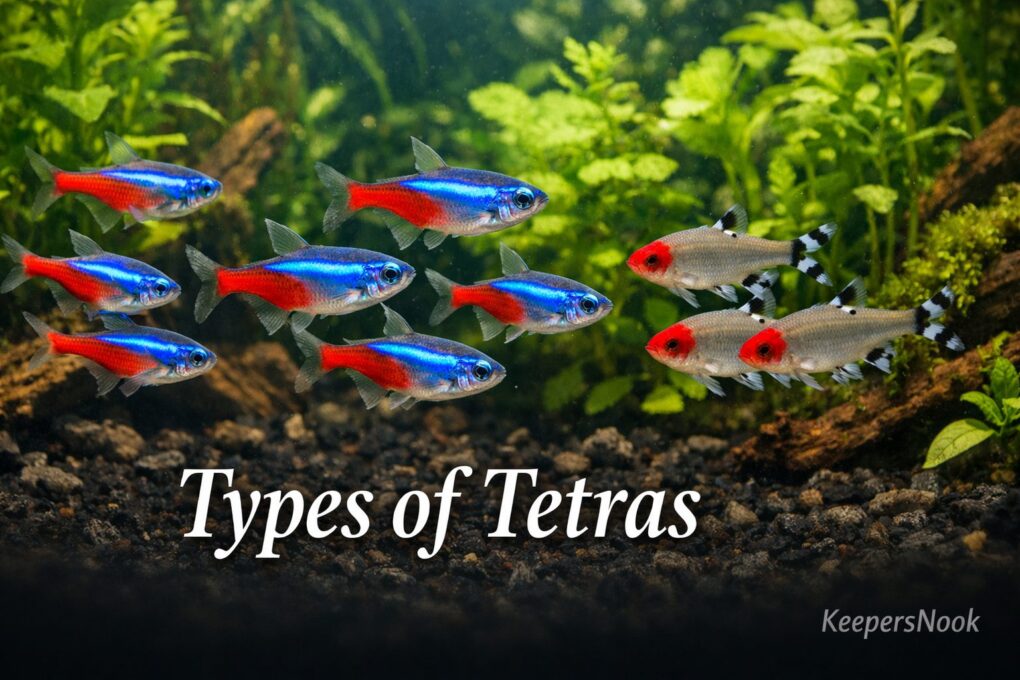
Tetras are the backbone of most community tanks, and choosing the wrong species is the fastest way to end up with torn fins or a stressed-out tank. We ranked ten popular species by temperament, care difficulty, and real-world community performance.
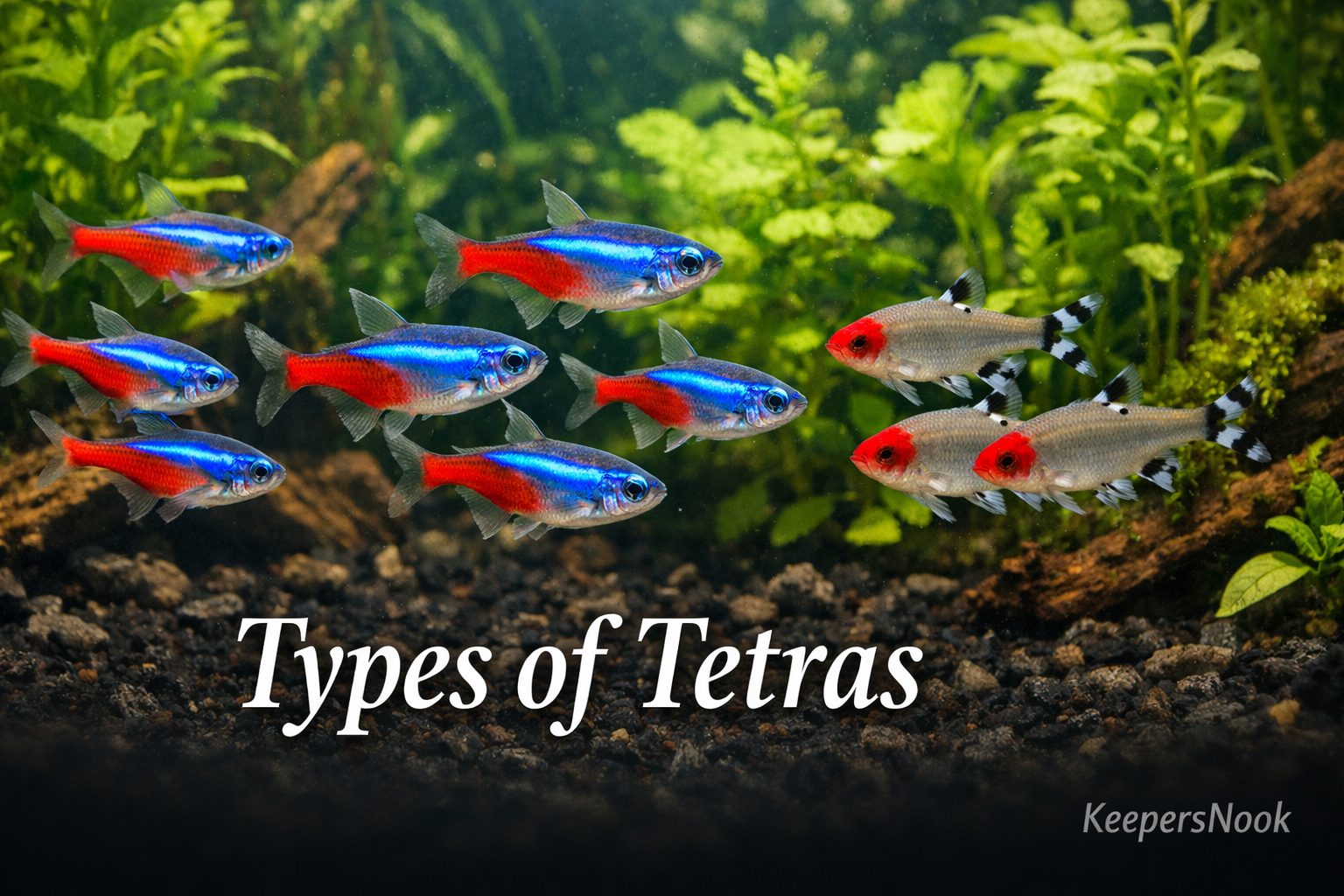
This list covers neon, cardinal, rummy-nose, ember, black neon, serpae, congo, black skirt, glowlight, and lemon tetras. Every species has a place, but only some belong in a mixed community without conditions attached.
What Makes a Tetra Community-Ready: 3 Criteria We Used
Not every tetra earns a spot in a mixed tank. We scored each species on three traits that predict real-world community success.
Remember it later
Planning to try this recipe soon? Save it for a quick find later!
Temperament is the first filter. A beautiful fish that shreds fins disqualifies itself immediately, regardless of color or availability.
Peaceful behavior under crowded conditions is non-negotiable.
Water parameter overlap matters because community tanks can't be tuned perfectly for one species. Tetras that thrive in a 6.5-7.2 pH range at 24-27°C fit most community setups without special adjustments.
The third factor is schooling minimum. A tetra kept in groups below its behavioral threshold becomes stressed, shows washed-out color, and sometimes turns aggressive.
Every species on this list has a different floor.
- Peaceful temperament under mixed-species conditions
- Parameter tolerance that overlaps with common community fish
- School size minimum that's practical for home tank sizes
Use all three to filter your shortlist before buying. A fish that fails one criterion costs you money and tank stability when you have to remove it later.
Size is also a quiet disqualifier. A 1-inch ember tetra and a 3-inch congo tetra exist in completely different feeding and social hierarchies inside the same tank.
Match size ranges when stocking a mixed community.
10 Tetra Species Ranked: Size, Temp, and School Size Compared
The table below captures the hard numbers. Full species breakdowns follow in the ranked sections.
| Species | Max Size | Temp (°C) | Min School | Difficulty |
|---|---|---|---|---|
| Neon Tetra | 4 cm | 22-26 | 6 | Beginner |
| Cardinal Tetra | 5 cm | 26-28 | 6 | Intermediate |
| Rummy-Nose Tetra | 5 cm | 24-28 | 8 | Intermediate |
| Ember Tetra | 2 cm | 24-28 | 6 | Beginner |
| Black Neon Tetra | 4 cm | 22-27 | 6 | Beginner |
| Serpae Tetra | 4.5 cm | 22-27 | 10 | Conditional |
| Congo Tetra | 8.5 cm | 23-27 | 6 | Intermediate |
| Black Skirt Tetra | 6 cm | 20-26 | 6 | Beginner |
| Glowlight Tetra | 4 cm | 22-28 | 6 | Beginner |
| Lemon Tetra | 5 cm | 23-27 | 6 | Beginner |
Temperature is the easiest compatibility check. Neons run cooler (22-26°C) while cardinals prefer warmer water (26-28°C).
Mixing them in the same tank forces a compromise that favors neither species.
Ranked: Each Tetra Species Scored for Community Tanks
We ranked by overall community suitability, not by appearance or popularity. A high rank means the species works reliably in mixed tanks with minimal conditions attached.
1. Neon Tetra (Paracheirodon innesi)
The neon tetra is the most commonly kept aquarium fish in the world, and that popularity is earned. Its blue-and-red stripe reads at a distance, it tolerates a wide pH range from 6.0 to 7.5, and it works in tanks as small as 10 gallons.
The main risk is disease. Neon tetra disease, caused by the microsporidian parasite Pleistophora hyphessobryconis, is common in mass-produced stock.
Read our full neon tetra care guide before buying, and always source from reputable specialty stores rather than big-box retailers.
A school of eight in a planted tank is one of the most reliable beginner setups in the hobby.
- Best for: First community tanks, 10-gallon and larger setups
- Tank mates: bottom-level corydoras, guppies, small rasboras
- Avoid pairing with: Cichlids, large barbs, or any fish over 8 cm
- Minimum school: 6, better at 8-10
Neons rank first because they work in more tank sizes and water conditions than any other species on this list.
2. Cardinal Tetra (Paracheirodon axelrodi)
Cardinal tetras outperform neons on one key trait: the full-body red stripe runs the entire length from head to tail, while the neon's red stripe covers only the rear half. Under good lighting, a school of ten cardinals is the most visually striking thing a freshwater tank can hold.
They are more sensitive during acclimation than neons and prefer warmer, softer water at 26-28°C and a pH of 5.5-7.0. In a stable, established tank they settle quickly and prove hardier than their reputation suggests.
Cardinals are also the safer betta tank mate of the two. Their size and speed reduce risk compared to smaller neons.
See our guide on mixing tetras with bettas for the full breakdown.
- Best for: Planted showcases, warm-water community tanks
- Tank minimum: 20 gallons for a proper school
- Pair with: Discus, apistogramma, corydoras
- Minimum school: 6, ideal at 10-12
Cardinals rank second because they require more precise water conditions than neons, but reward that effort with superior visual impact.
3. Rummy-Nose Tetra (Hemigrammus rhodostomus)
Rummy-nose tetras are the tightest schoolers on this list. A group of twelve moves as a single synchronized unit across the tank, turning in unison in a way that smaller or more loosely shoaling species don't match.
The red nose is a water quality indicator. When parameters drift, the nose color fades before any other symptoms appear.
Experienced keepers treat a pale nose as an early warning and test immediately. This makes rummy-nose tetras useful as well as beautiful.
They need stable, well-cycled water and are not a good choice for tanks under six months old.
- Best for: Mature planted tanks, experienced keepers
- Water needs: 24-28°C, pH 6.0-7.0, zero ammonia tolerance
- Minimum school: 8, better at 12 for proper synchronized movement
- Avoid: New tanks, high-pH setups, aggressive tank mates
Rummy-nose tetras rank third. They are the most rewarding schooling species on this list but require more setup stability than the top two picks.
4. Ember Tetra (Hyphessobrycon amandae)
Ember tetras are the best choice for nano tanks. At under 2 cm, they are the smallest species on this list and stay small enough for a 10-gallon stocking plan without crowding.
Their warm orange coloring brightens heavily planted setups, and their gentle, non-aggressive behavior makes them one of the safest tetras for tanks with slow or delicate fish. They rarely nip, rarely chase, and rarely cause problems of any kind.
Dense planting brings out their best behavior and deepest color. Sparse or bare tanks make them skittish.
- Best for: Nano planted tanks, 10 gallons and under
- Good with: Sparkling gourami, small rasboras, dwarf shrimp
- Not suited for: Tanks with large or boisterous fish over 5 cm
- Minimum school: 6, ideal at 8-10
Embers rank fourth because their nano-compatible size and docile temperament solve a problem no other tetra on this list addresses as cleanly.
5. Black Neon Tetra (Hyphessobrycon herbertaxelrodi)
Despite the name, black neon tetras are not closely related to neon tetras. They are hardier, more forgiving of water chemistry variation, and significantly less prone to neon tetra disease.
For beginners who want reliable performance without the disease risk, black neons are the better buy.
Their black-and-white horizontal stripe reads well even in low-light or densely planted tanks. Tank-bred populations are widely available and noticeably tougher than wild-caught specimens of either neon species.
Black neons shoal loosely rather than in tight formations, occupying the mid-water column where they complement bottom dwellers and surface swimmers.
- Best for: Beginner community tanks, low-light setups
- pH tolerance: 5.5-7.5, one of the widest ranges on this list
- Pair well with: peaceful livebearers like platies, corydoras, small rasboras
- Minimum school: 6
Black neons rank fifth and earn the budget pick designation in our verdict. They deliver consistent results with fewer prerequisites than neons, cardinals, or rummy-nose tetras.
6. Serpae Tetra (Hyphessobrycon eques)
Serpae tetras are visually stunning. The deep red body and black shoulder spot make them one of the most recognizable species in the hobby.
The problem is temperament: serpaes are habitual fin nippers that disqualify themselves from most mixed community tanks.
They are most aggressive when kept in small groups. A school of ten or more keeps the fish focused on each other rather than on tank mates, which reduces but does not eliminate fin-nipping behavior.
Serpaes belong with fast, short-finned fish only. Long-finned varieties of any species are at risk.
This rules out bettas, angelfish, and fancy guppies as tank mates.
- Safe tank mates: fish like cherry barbs, danios, fast-moving barbs
- Avoid pairing with: Bettas, angelfish, guppies, gouramis, any long-finned species
- Minimum school: 10 to reduce aggression between individuals
- Best suited for: Single-species or near-species setups
Serpaes rank sixth because their fin-nipping habit adds conditions that most community keepers don't want to manage. They work in the right setup but fail in a general mixed tank.
7. Congo Tetra (Phenacogrammus interruptus)
Congo tetras are the showpiece species of this list. Males develop iridescent blue-green scales and long, flowing finnage that rivals most other freshwater fish for visual impact.
Females are smaller and plainer but still attractive in a school.
They grow to 7-8 cm, which changes the tank math significantly. A proper group of six needs a minimum 55-gallon tank with space to move.
This rules out most small and medium community setups.
Congo tetras come from the Congo River basin and tolerate a wider pH range than most South American species. They are peaceful toward similar-sized fish but will eat very small tank mates.
- Tank minimum: 55 gallons for a group of 6
- Good with: Medium-sized peaceful cichlids, large rasboras, other robust species
- Avoid pairing with: Neon tetras, ember tetras, any small fish under 3 cm
- Watch for: angelfish large enough to swallow juveniles will do so
Congo tetras rank seventh because their size requirement limits them to tanks that fewer keepers have. In the right setup, they outperform every other species on this list visually.
8. Black Skirt Tetra (Gymnocorymbus ternetzi)
Black skirt tetras are one of the most widely available tetras in the hobby. They are recognizable by their black vertical bars and flowing black anal fin.
Juveniles show the deepest black coloring, which fades to gray with age.
They are hardy, adaptable fish that tolerate a wide temperature range from 20-26°C. This makes them one of the few tetras that work in unheated tanks in warm climates.
Their broad pH tolerance of 6.0-7.5 fits nearly any community setup.
Black skirts can nip long fins occasionally but do so far less than serpaes. Keeping a school of six or more keeps the behavior in check for most community situations.
Avoid pairing them with bettas if fin-nipping is a concern. See how betta tank mate selection works before mixing species.
- Best for: Beginners, unheated or cool-water community tanks
- Temperature tolerance: 20-26°C, widest range on this list
- Avoid long-finned tank mates if the school is kept below 8 fish
- Minimum school: 6
Black skirts rank eighth. They are reliable, forgiving fish that suit beginners well, but their fading coloration and occasional fin-nipping keep them out of the top tier.
9. Glowlight Tetra (Hemigrammus erythrozonus)
The glowlight tetra carries an orange-red horizontal stripe that appears to glow under aquarium lighting, which is where the name comes from. It is hardier than the neon tetra and nearly as visually striking, making it one of the most underrated species on this list.
Glowlights are calm, peaceful fish that hold the mid-water column and rarely cause problems in mixed community tanks. They are one of the best alternatives for keepers who want neon-level impact without the disease risk that comes with mass-produced neon stock.
They tolerate a moderate temperature range of 22-28°C and a pH of 5.5-7.5, which gives them broad community compatibility.
- Best for: Community tanks where disease risk is a concern
- Pairs well with: Neon tetras, small corydoras, peaceful dwarf gouramis
- Good alternative to: Neon tetras in tanks with a history of neon tetra disease
- Minimum school: 6
Glowlights rank ninth. They are a strong pick for disease-cautious keepers but are often overlooked because they are less vibrant than neons or cardinals at first glance.
10. Lemon Tetra (Hyphessobrycon pulchripinnis)
Lemon tetras are subtle fish. Their pale yellow body and bright red eye don't compete with neons or cardinals for immediate visual impact, but a school of ten in a well-lit planted tank creates a soft, warm effect that works well in certain setups.
They are among the most adaptable tetras on this list. A pH range of 6.0-7.5 and a temperature range of 23-27°C covers most community tanks without adjustment.
They shoal loosely and occupy the mid-column, which complements both bottom-feeding corydoras and surface-oriented species like guppies.
Lemon tetras rank last not because they are difficult but because their subtle coloring makes them a secondary pick when brighter species are available at the same price.
- Best for: Mixed community tanks, planted setups with warm lighting
- pH range: 6.0-7.5, good flexibility for varied community water chemistry
- Pair with: Corydoras, small livebearers, other peaceful tetras
- Minimum school: 6
Their broad parameter tolerance is genuinely useful. If your tank runs at a pH where other tetras struggle, lemon tetras are worth reconsidering.
Which Tetra Species Work Together in the Same Tank
Mixing tetra species is possible but requires planning. Not every pair works, and adding too many species fragments the schooling behavior that makes tetras interesting in the first place.
The safest multi-species combinations share the same temperature range, similar size, and a compatible water column position. Neons and black neons work together reliably.
Cardinals and rummy-nose tetras coexist well at warmer temperatures. Ember tetras fit almost any small tank situation without causing problems.
These pairings work reliably in mixed community tanks:
- Neon + Black Neon: Overlapping parameters, similar size, no aggression
- Cardinal + Rummy-Nose: Both prefer warm soft water, compatible schooling behavior
- Ember + Glowlight: Both peaceful, both small, good mid-water companions
- Lemon + Black Neon: Broad pH overlap, similar mid-column position
Avoid mixing serpae tetras with any long-finned species. Avoid mixing congo tetras with any species under 3 cm.
Keep each species in a group of at least six. Split schools between too many species and you end up with no visible schooling behavior at all.
Use this checklist before finalizing your stocking list. Fixing parameter mismatches before purchase costs nothing.
Fixing them after costs fish.
Tetras with Bettas and Angelfish: What Actually Works
Tetras with bettas is one of the most common stocking questions in the hobby, and the answer depends more on the individual betta than on the tetra species. Read our full guide on tetra and betta compatibility before mixing the two.
The general rule: fast, mid-sized tetras with round fins are safer with bettas than small or long-finned species. Ember tetras and black neon tetras work in larger tanks with dense planting.
Neon tetras are riskier because their red coloring can trigger aggression in some betta males.
Angelfish are a separate issue. Check whether angelfish eat neon tetras before assuming they coexist.
Adult angelfish will eat any tetra small enough to fit in their mouth, which includes neons, embers, and glowlights. Congo tetras are the one species on this list large enough to safely coexist with most adult angelfish.
- Safest with bettas: Black neon tetra, ember tetra (in 20+ gallon tanks with heavy planting)
- Risky with bettas: Neon tetra (red coloring), serpae tetra (fin-nipping)
- Safe with angelfish: Congo tetra only
- Unsafe with angelfish: Neon, ember, glowlight, lemon, cardinal (all small enough to eat)
See our complete guide to best betta tank mates and the betta care guide for the full temperament context before stocking decisions.