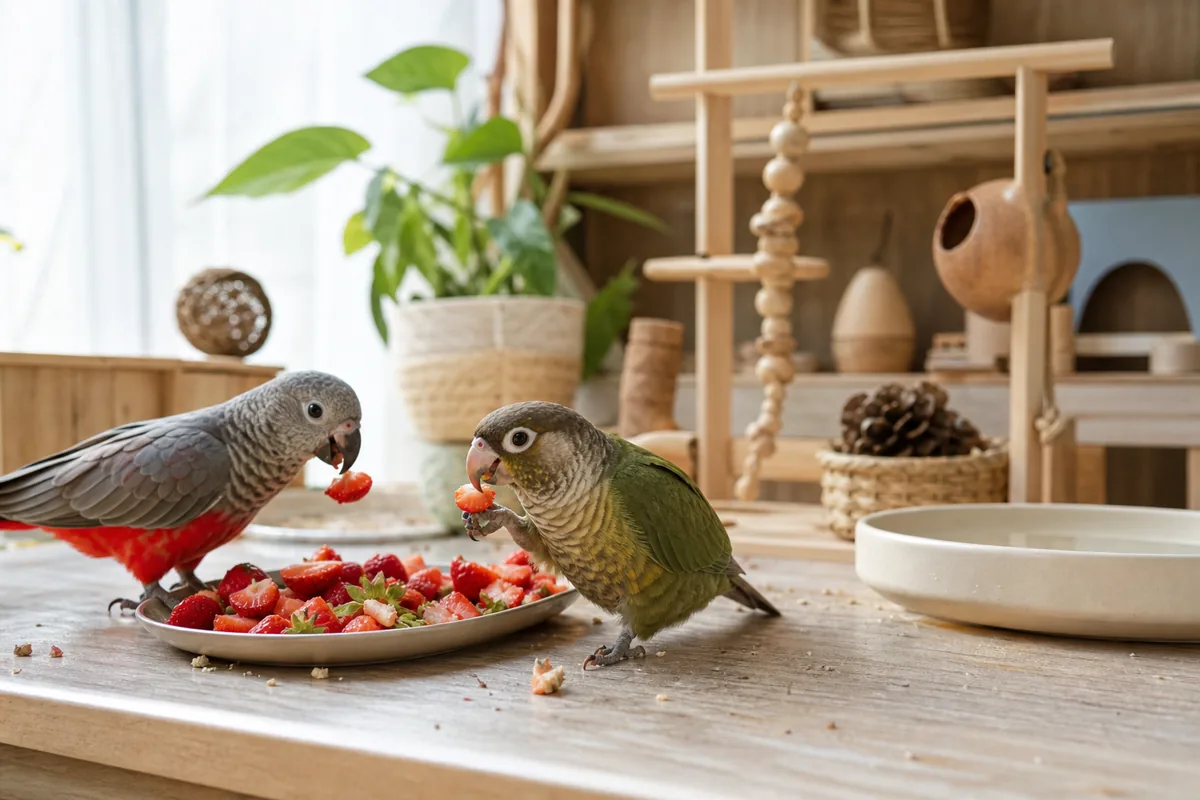
Strawberries are one of the safest and most nutritionally balanced fruits you can add to a pet bird's feeding routine. Their vitamin C content rivals many other bird-safe fruits, and the relatively low sugar load means you can offer them more frequently than grapes or bananas.
Unlike some fruits where specific parts pose hazards, every edible part of a strawberry is safe for birds. The seeds embedded in the surface are soft and tiny, posing no choking or toxicity risk whatsoever.
Strawberries for Pet Birds
- Flesh and seeds (fully safe)Safe
- skin is edible after thorough washingSafe
- NoneUnsafe
- green cap and white stem should be removed as a precautionUnsafe
Prep: Wash under running water for 30 seconds, remove green cap and stem, slice into small pieces Freq: 3-4 times per week Amount: 1 small strawberry or 2-3 slices for medium birds; half a strawberry for small birds
Strawberry Nutrition: 4.9g Sugar per 100g Makes This a Low-Sugar Fruit
At just 4.9g of sugar per 100g, strawberries sit near the bottom of the sugar scale for common bird fruits. Grapes have over three times that amount, and bananas have nearly five times as much.
The vitamin C content is the standout: 58.8mg per 100g, which is exceptional for a fruit. Folate and manganese round out a profile that delivers real nutritional value rather than just palatability.
Strawberries work well as a training reward for budgies and our budgie care guide covers how to use fresh fruit alongside millet in daily sessions.
Grapes complement strawberries in a mixed fresh fruit serving, and our seedless grape portion guide confirms they are safe alongside other berry-type fruits.
Our plain popcorn treat guide is a useful reference for any keeper wondering which human snack foods are safe to share.
- Vitamin C: 58.8mg per 100g, one of the highest of any common bird treat
- Sugar: 4.9g per 100g, lower than most other popular bird fruits
- Folate: 24mcg per 100g, supports cell replication and feather growth
- Manganese: 0.39mg per 100g, aids enzyme function and bone health
- Water: 91%, excellent hydration source in warm weather
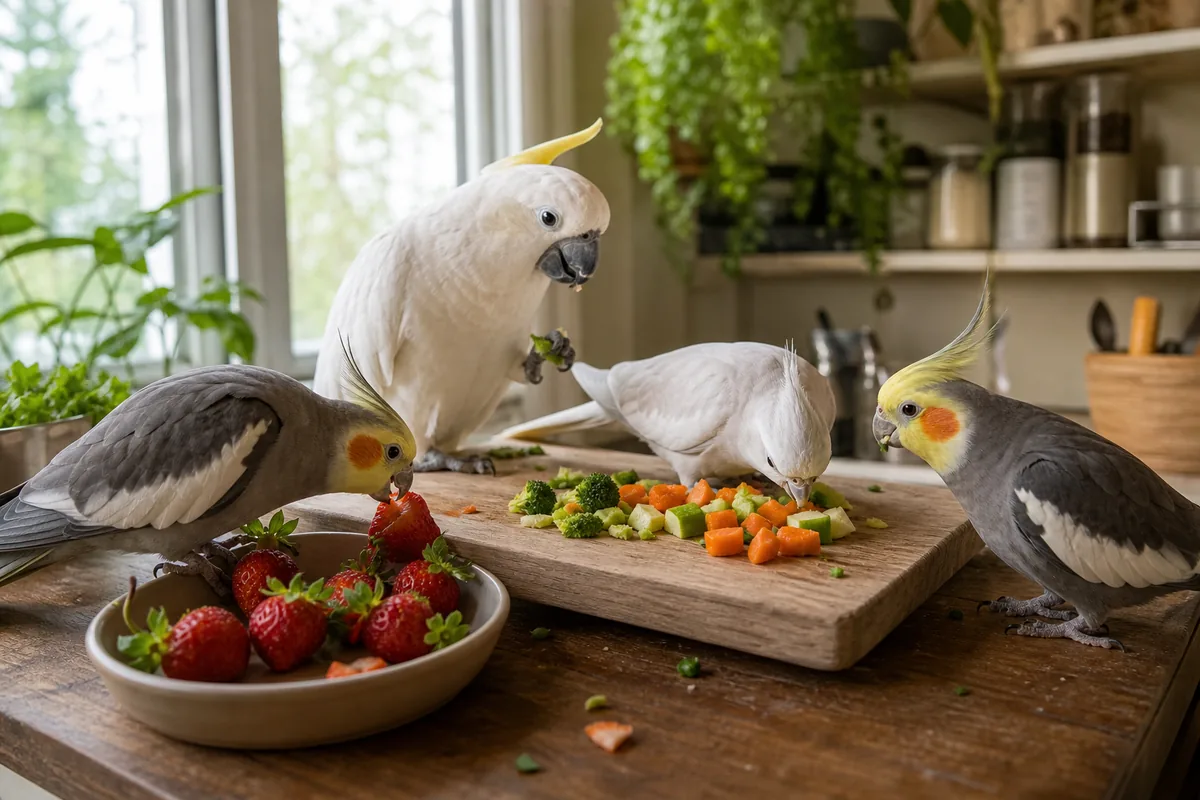
Parts Safety: The Green Cap Is the Only Part to Remove
The flesh, tiny embedded seeds, and red skin are all edible and safe. The green leafy cap (calyx) and the white stem are not toxic but have no nutritional value and can introduce more pesticide residue than the flesh, so we remove them as a matter of routine.
Strawberries are on the Environmental Working Group's annual high-pesticide list, consistently ranking in the top five most contaminated produce items. Washing is not optional.
Finches enjoy strawberry pieces placed on the aviary floor and our finch care guide recommends varying the fresh food offered to keep foraging behavior active.
Mango rounds out a berry-heavy rotation well, and our vitamin-A mango guide covers the correct preparation for small and large bird species.
- Red flesh: Fully safe, high vitamin C, soft texture for all beak sizes
- Embedded seeds: Fully safe, tiny and soft, no cyanogenic compounds
- Red skin: Safe after thorough washing, contains anthocyanin antioxidants
- Green cap and leaves: Remove; no nutritional value, higher pesticide surface area
How to Prepare Strawberries for Birds
Prep time is under a minute. The key steps are washing, cap removal, and sizing pieces appropriately for the bird receiving them.
Blueberries and strawberries are often offered together as a mixed berry bowl, and our anthocyanin blueberry guide covers the correct frequency for both.
High-water fruits like watermelon pair well with strawberries in warmer months, and our summer fruit rotation guide confirms it is a safe rotation choice.
Portion by Bird Size: Half a Berry for Small Species
Even with low sugar content, strawberries should remain a treat category food, not a daily staple. Total fruit should not exceed 10-15% of daily diet.
A pellet-and-vegetable base diet should come first.
Apple is a natural companion to strawberries in a fresh food rotation, and our quercetin apple guide covers preparation steps for safe serving.
Knowing which fruits are toxic is as important as knowing which are safe, and our article on persin avocado toxicity covers the most dangerous fresh produce item.
| Bird Type | Example Species | Max Serving | Frequency |
|---|---|---|---|
| Very small | Budgie, parrotlet | 1-2 small slices (about ¼ berry) | 3x per week |
| Small | Cockatiel, lovebird | Half a small strawberry | 3-4x per week |
| Medium | Conure, caique | 1 small or medium strawberry | 4x per week |
| Large | African grey, Amazon | 1-2 medium strawberries | 4x per week |
| Extra large | Macaw, cockatoo | 2-3 medium strawberries | 4-5x per week |
Signs of Trouble: What to Watch After Feeding Strawberries
Adverse reactions to strawberries are rare in birds. The most common issue is loose droppings from the high water content, which is temporary and harmless.
Banana softness makes it easy to mix with cut strawberries in a shared bowl, and our peel-free banana guide confirms that combination is safe.
New keepers choosing their first bird will benefit from our best birds for beginners guide, which addresses fresh food basics alongside species selection.
Bread is a low-value food that should not crowd out nutritious options like strawberries, and our sodium bread caution guide explains why.
Chocolate must never be offered and our theobromine toxicity guide covers the life-threatening mechanism.
Peanuts are an occasional treat that pairs with berry-based fresh food days, and our aflatoxin peanut safety guide covers when to offer them.
- Bright pink or red-tinted droppings: Normal after eating strawberries; the pigment passes through harmlessly
- Watery droppings for 1-2 hours: Expected due to 91% water content; not a health concern unless prolonged
- Skin redness around beak: Rare contact reaction to berry juice; wipe beak clean after feeding and monitor
- Refusal of regular food: If a bird skips pellets in favor of waiting for strawberries, reduce treat frequency temporarily
Sources and references
- Pesticide residue levels in strawberries and implications for companion animal exposureEnvironmental Working Group Produce Report, 2023
- Vitamin C content and antioxidant activity in fruits commonly fed to psittacine birdsof Animal Physiology and Animal Nutrition, 2020
- Dietary fruit recommendations for companion parrotsAssociation of Avian Veterinarians, 2022