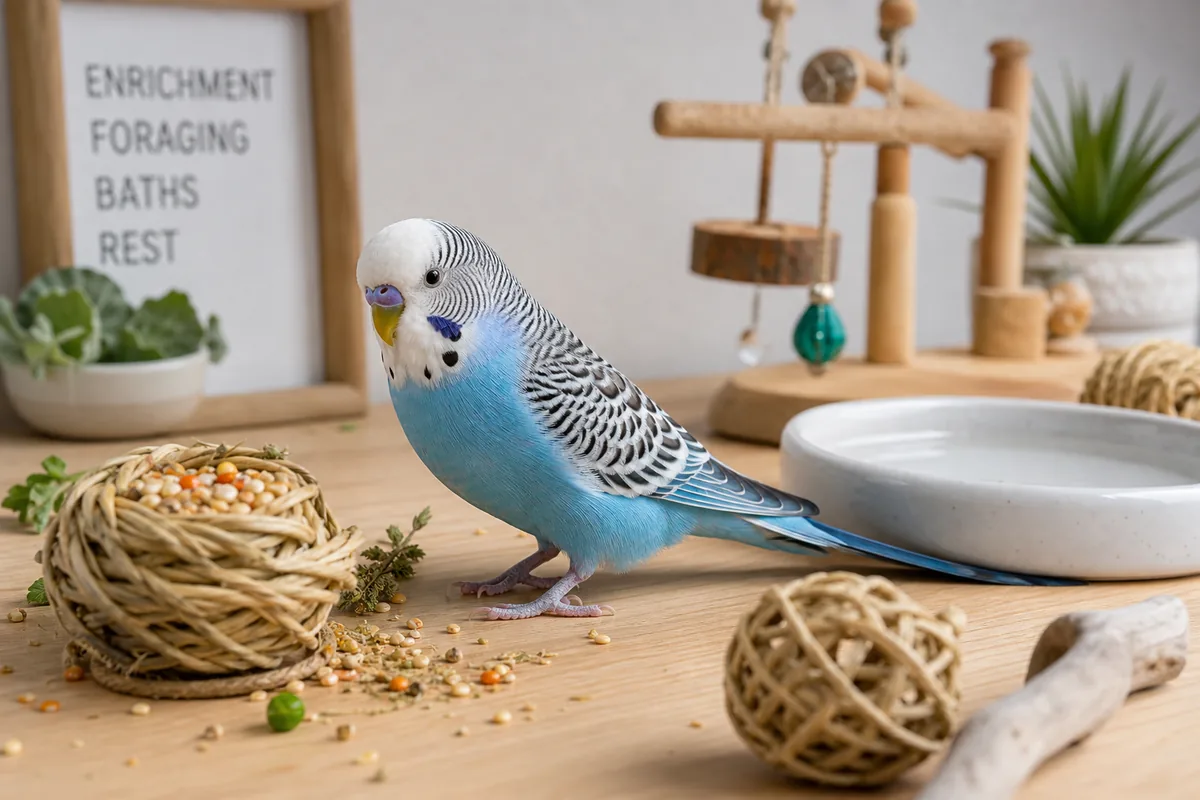
The budgie (Melopsittacus undulatus) packs more personality per gram than almost any other pet. Native to the open grasslands of Australia, budgies live in massive wild flocks and carry that social drive into your home.
Our pet bird care guides cover the full spectrum, but few birds match the budgie's combination of affordability, adaptability, and genuine affection for their keepers.
They're available in over 30 color mutations, from the classic green-and-yellow wild type to pure white albinos and violet show birds. That variety, combined with a price tag under $30 at most pet stores, makes them the entry point for countless bird keepers.
Key facts
- Lifespan
- 7-12 years
- Length
- 7-8 inches
- Noise Level
- Low-Medium
- Talking
- Good (50-100+ words)
Budgie Appearance: Colors, Mutations, and Telling Sexes Apart
Wild budgies are green and yellow with black barring on the wings and back. Captive breeding has produced a staggering range of mutations: blues, whites, yellows, grays, violets, and pieds.
Show-quality English budgies run larger than the "American" or "standard" type sold in most pet shops, with rounder heads and fuller feathering.
Sexing budgies comes down to the cere, the fleshy area above the beak. Adult males have a bright blue cere.
Adult females show a tan or brown cere, which deepens during breeding condition. Juveniles of both sexes start with pink or purple-pink ceres that shift with maturity around 3-4 months.
If you enjoy small parrots, cockatiel care covers a species that shares many of the budgie's adaptable qualities but grows nearly twice the size.
Households deciding between the two most popular small parrots should read our budgie vs cockatiel comparison before committing.
- Green series: The wild-type coloring, yellow base with blue producing green
- Blue series: White base factor removes yellow, producing sky blue, cobalt, or mauve
- Yellow-face: Blue series birds with yellow pigment restricted to the face
- Lutino/Albino: Red-eyed yellow (lutino) or white (albino) from ino mutation
- Violet: A modifier gene that deepens blue into a rich violet shade
Personality: What to Expect From a Daily Companion
Budgies are flock animals that transfer their bonding instincts entirely onto their keeper when housed alone. A single budgie kept with daily out-of-cage interaction will become deeply attached, landing on your shoulder, preening your eyebrows, and chattering at you constantly.
Two budgies are more independent but provide each other company during the hours you're away.
Males talk more readily than females. Some males build vocabularies of 100-200 words with consistent training, while females rarely go beyond a handful of sounds.
Both sexes whistle, chirp, and mimic environmental sounds like phones and microwaves.
Parrots that bond strongly to a single keeper often appeal to the same households, and lovebird care explains the commitment that species demands.
First-time bird keepers researching their options will find the budgie near the top of our best birds for beginners list.
Pros
- Quiet enough for apartments
- Learns to talk reliably
- Low food and vet costs
- Long lifespan for a small bird
- Bonds deeply with patient keepers
Cons
- Needs 2+ hours out-of-cage daily
- Males can be nippy during hormonal periods
- Dusty feathers irritate some people
- Cage requires daily cleaning
- Females prone to chronic egg laying
Cage and Housing: Minimum Space for a Healthy Bird
The minimum cage for a single budgie is 18 x 18 x 18 inches, but that's a floor, not a goal. Budgies fly horizontally, so a wide cage beats a tall one.
A pair needs at least 30 x 18 x 18 inches. Bar spacing must be no wider than ½ inch to prevent head entrapment.
Place the cage at eye level against a wall, never in a kitchen (Teflon and cooking fumes are lethal to birds) and never in direct sun without shade access.
Perch variety matters more than most keepers realize. Uniform dowel perches cause pressure sores on the feet.
Offer at least one rope perch, one natural wood branch with irregular diameter, and one concrete conditioning perch for nail wear.
The term "parakeet" is used loosely in pet stores, so our parakeet care guide clarifies the key differences from the standard budgerigar.
Male budgies rank among the most reliable small talkers, which is why the species appears prominently in our best talking birds guide.
Diet: Seeds, Pellets, and Fresh Foods That Keep Birds Healthy
The classic all-seed diet is the single biggest driver of early budgie death. Seeds are high in fat and deficient in vitamins A and D3.
A healthy budgie diet is 60-70% pellets, 20% fresh vegetables, and no more than 10% seeds used as treats or training rewards.
Pellets designed for small parrots work well for budgies. Harrison's Bird Foods Fine and Roudybush Maintenance are reliable options.
Introduce pellets by mixing them with seeds and gradually reducing the seed portion over 4-6 weeks.
Fresh fruit rounds out a pellet-based diet well, and our guide on safe apple preparation walks through serving size for small parrots.
Soft fruits like banana work well for introducing new foods, and our article on banana for pet birds covers portion size for small parrots.
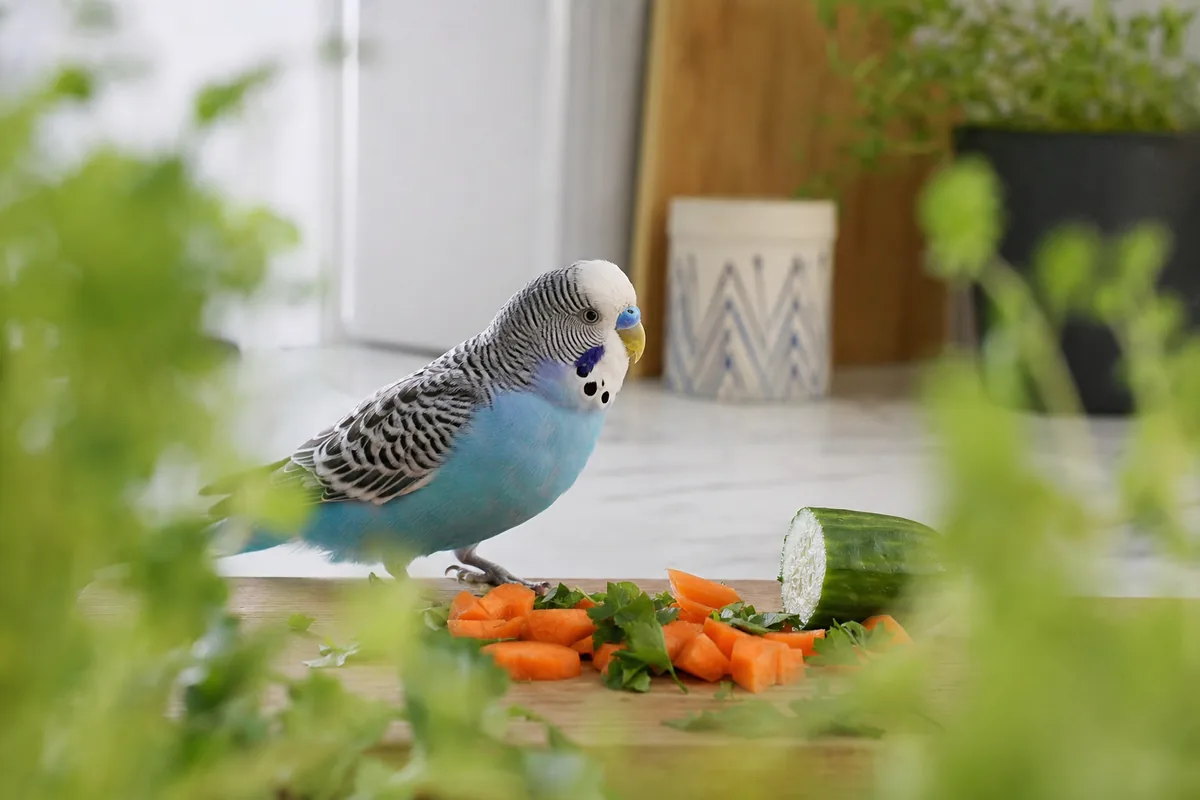
- Safe vegetables: Kale, carrot, broccoli, sweet pepper, cucumber, zucchini
- Safe fruits: Apple (no seeds), mango, blueberries, melon. Offer 2-3x per week in small amounts
- Seeds as treats: Millet spray is the highest-value reward for training
- Toxic foods: Avocado, onion, garlic, chocolate, caffeine, fruit pits, and anything with xylitol
Health: Common Problems and Lifespan Factors
A budgie on a good diet with out-of-cage exercise and regular vet checks routinely lives 10-12 years. Poor diet, lack of stimulation, and undetected illness push that number down to 5-7 years in many pet budgies.
The most common causes of early death are fatty liver disease from seed-only diets and Psittacosis, a bacterial infection that's also transmissible to humans.
Find an avian vet before you bring a budgie home. General practice vets often lack the equipment to assess small birds properly.
Annual wellness exams catch problems before they become emergencies.
Grapes are a popular treat choice, and our guide on grapes for pet birds covers the seedless-only rule that applies to all species.
Keepers wanting a quieter cage companion alongside their budgie often consider finches, so check our finch care guide for housing compatibility notes.
- Scaly face/leg mites: Crusty, honeycomb-textured buildup on cere or legs, treatable with ivermectin
- Fatty liver disease: Caused by seed-only diets, presents as lethargy and overgrown beak
- Psittacosis: Bacterial infection causing respiratory symptoms and watery droppings
- Tumors: Budgies are prone to fatty tumors and reproductive tumors, especially females
Training Budgies: Step-Up, Recall, and Talking
Training starts with hand-taming, which takes 1-3 weeks with a newly acquired budgie. Sit next to the cage and talk softly for 15 minutes twice daily.
Once the bird approaches the cage bars, offer millet through the bars, then through an open door, then on your hand inside the cage. Move at the bird's pace.
The step-up command is the foundation. Press your finger gently against the bird's lower chest and say "step up" in a consistent tone.
Most budgies learn this in 3-5 sessions once they're comfortable with your hand.
Antioxidant-rich berries make excellent training rewards, and our article on strawberries for birds covers how often to offer them.
Sources and references
- Psittacosis (Parrot Fever) in Pet BirdsMerck Veterinary Manual, 2023
- Avian Nutrition and Diet-Related Diseaseof Avian Medicine and Surgery, 2021
- Melopsittacus undulatus (Budgerigar)Animal Diversity Web, of Michigan
American vs. English Parakeet: Two Types With Different Needs
Most pet stores sell American parakeets (the small, slender budgerigar bred from wild Australian stock). English parakeets, also called show budgies, are larger, calmer, and less active, with a fuller head and chest profile.
American parakeets are livelier, better fliers, and generally longer-lived. English parakeets are more docile and easier to handle but have a shorter average lifespan of 6-10 years due to intensive selective breeding.
For most beginners, the American budgie is the better starting point.
The budgerigar is technically a parakeet species and our budgie care guide covers the specific variety most commonly sold under that name in North American pet stores.
Sunflower seeds are a common parakeet treat but require portion control, and our sunflower seed portion limits guide covers the frequency appropriate for regular use.
Grapes can be offered to parakeets cut in half and our grape serving size guide explains the correct portions for small to medium parrot species.