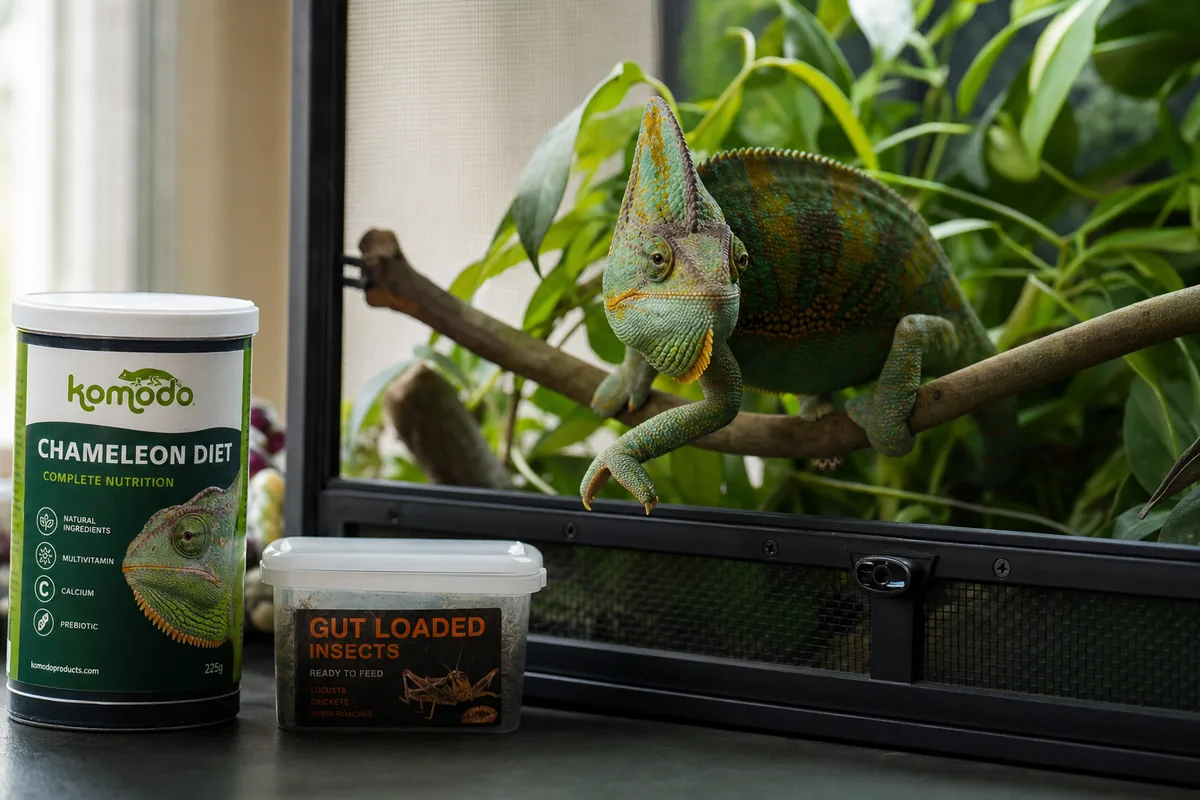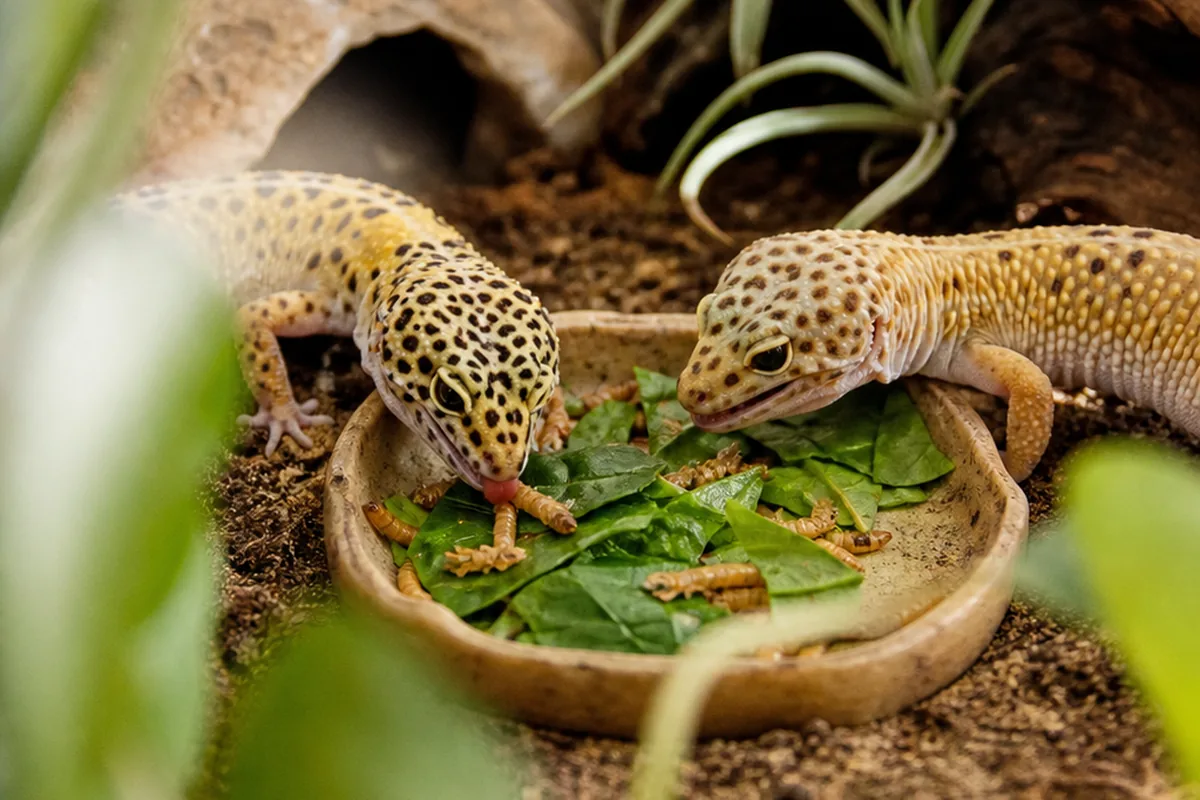
Mealworms are the most commonly kept feeder insect in the hobby, and for good reason. They're available year-round, easy to store at home for weeks, accepted by almost every leopard gecko, and nutritionally solid when properly gut-loaded.
For leopard gecko feeding, mealworms rank as one of the two or three most practical staple feeders available.
The main critique of mealworms is their fat content. At 12.7% fat in live form, they run higher than crickets.
That's a real consideration for managing body weight, not a reason to avoid them entirely.
Mealworms for Leopard Geckos
- Full live mealworm (larval stage of Tenebrio molitor)Safe
- freeze-dried mealworms as an occasional treat onlySafe
- Mealworm beetles (adult stage): exoskeleton is too hard and fibrous for most leopard geckosUnsafe
- dead or rotting mealworms carry bacterial riskUnsafe
Prep: Gut-load 24-48 hours before feeding with nutritious vegetables and grains; dust with calcium supplement at each feeding and D3 supplement twice weekly Freq: Can be offered at every feeding as a staple; rotate with crickets or dubia roaches for nutritional balance Amount: 2-3 mealworms per inch of body length, offered every other day for juveniles; every 3-4 days for adults
Mealworm Nutrition: The Real Numbers
Live, gut-loaded mealworms deliver 20.3% protein, 12.7% fat, 1.7% calcium, and 62% moisture. The protein content is competitive with crickets.
The fat content is where mealworms separate from leaner feeders like dubia roaches.
Gut-loading transforms the nutritional value. An ungut-loaded mealworm has a Ca:P ratio of roughly 1:7, one of the worst of any feeder insect.
Gut-loading with calcium-rich vegetables like collard greens and kale for 24-48 hours before feeding raises that ratio meaningfully.
Dubia roaches are the best direct comparison to mealworms on nutrition, offering a better Ca:P ratio and lower fat content.
| Feeder | Protein % | Fat % | Ca:P Ratio | Moisture % |
|---|---|---|---|---|
| Mealworm | 20.3 | 12.7 | 1:7 (improved by gut-loading) | 62 |
| Cricket | 21.3 | 6.0 | 1:9 | 69 |
| Dubia roach | 23.4 | 7.2 | 1:3 | 65 |
| Waxworm | 15.5 | 22.2 | 1:7 | 58 |
| Superworm | 19.7 | 17.9 | 1:8 | 58 |
Dubia roaches come out ahead on Ca:P ratio and fat content. Mealworms beat them on ease of sourcing and storage, which is why most keepers keep both on hand.
Crickets are the leaner alternative to mealworms and work well as a rotation partner for balancing weekly fat intake.
Gut-Loading: Non-Negotiable for Nutritional Value
A mealworm's nutritional content reflects what it ate in the 24-48 hours before being fed to your gecko. Pet store mealworms often arrive on oat-only diets, which is nutritionally sparse for a feeder insect destined to transfer nutrients to a strict insectivore like the leopard gecko.
Effective gut-loading uses a combination of leafy greens high in calcium, beta-carotene, and B vitamins, supplemented with dry grains as the substrate the mealworms live in. The greens do the nutritional heavy lifting.
- Collard greens: highest calcium content of common gut-load greens, core item
- Kale: excellent vitamin A and K source, use 2-3 times weekly in gut-load
- Carrots: beta-carotene and moisture, accepted readily by mealworms
- Sweet potato: caloric density for mealworm growth, vitamin A
- Dandelion greens: high calcium, no oxalates, excellent gut-load green
Our leopard gecko care guide covers enclosure setup and substrate choices that affect how you present feeders and manage escaped insects.
Calcium Dusting and D3 Supplementation
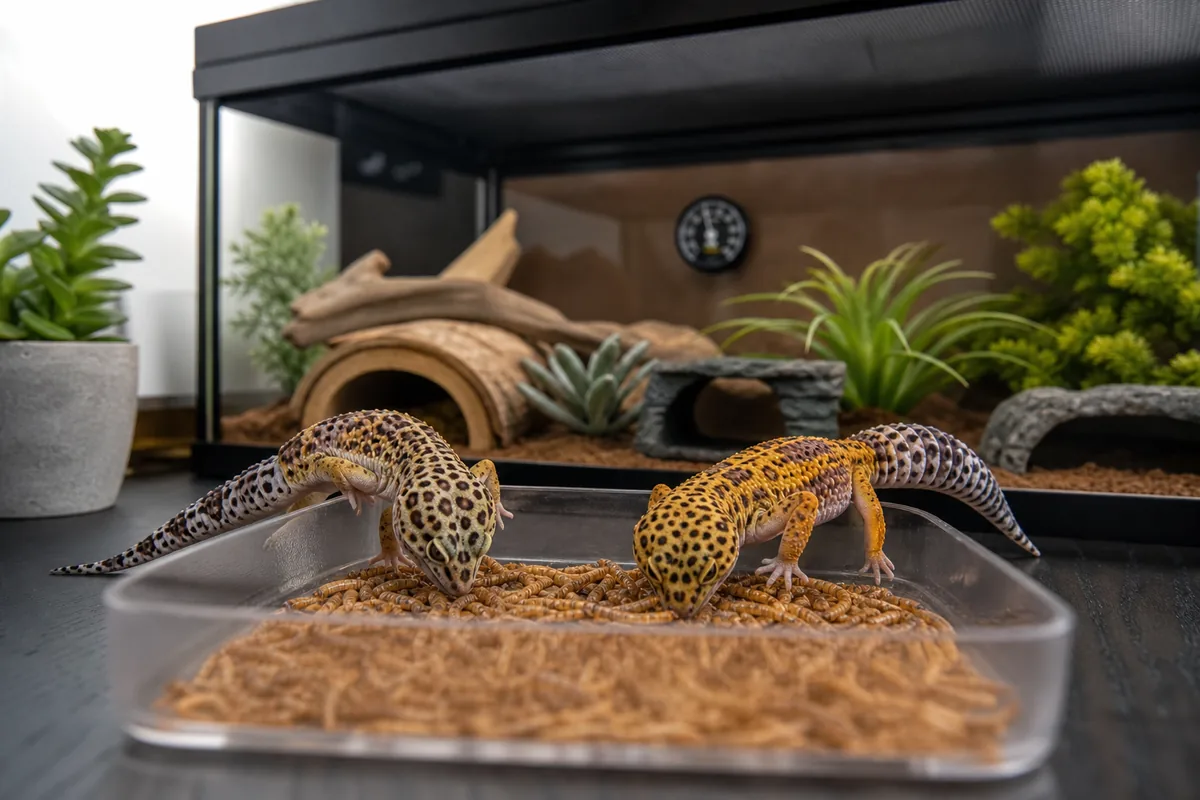
Calcium supplementation at every feeding is standard practice for mealworm-heavy diets because the base Ca:P ratio is poor. Place 2-3 mealworms in a small plastic bag with a pinch of calcium powder, shake gently, and feed the dusted mealworms immediately.
Leopard geckos kept under UVB lighting need calcium without D3 at every feeding and calcium with D3 twice weekly. Geckos kept without UVB (still common in the hobby) need calcium with D3 at every feeding to compensate for the absence of UV-driven D3 synthesis.
Waxworms are the high-fat treat that most keepers reach for alongside mealworms, but their 22.2% fat content means monthly use only.
Managing Fat Intake Over Time
Adult leopard geckos fed exclusively mealworms over months tend to accumulate fat in the tail at a rate that can become excessive. The tail should be plump but not wider than the gecko's head.
A tail noticeably wider than the head indicates overconditioned fat stores.
The practical fix is rotating mealworms with crickets or dubia roaches on alternating feeding days. This brings the weekly fat average down without requiring calorie restriction, which is stressful to implement accurately with reptiles that eat no plant matter.
Superworms are larger and fattier than mealworms, making them a rotation option for adult enrichment rather than daily use, with their mandible risk requiring care.
Butterworms are the other common high-fat treat alongside waxworms, worth comparing to mealworms on caloric density.
Keepers choosing between leopard geckos and other reptiles will find diet complexity varies significantly. Our bearded dragon care guide shows how an omnivore's feeding schedule differs from a strict insectivore like the leopard gecko.
Ball pythons are another popular reptile with a completely different feeding model based on prey animals. Our ball python care guide covers how rodent-based feeding compares to insect-based diets.
Sources and references
- Nutritional Composition of Commonly Used Feeder InsectsZoo Biology, 2012
- Leopard Gecko Husbandry and Nutritional SupportAssociation of Reptilian and Amphibian Veterinarians, 2021
- Tenebrio molitor (Mealworm) Nutritional ProfileUSDA Agricultural Research Service, 2020