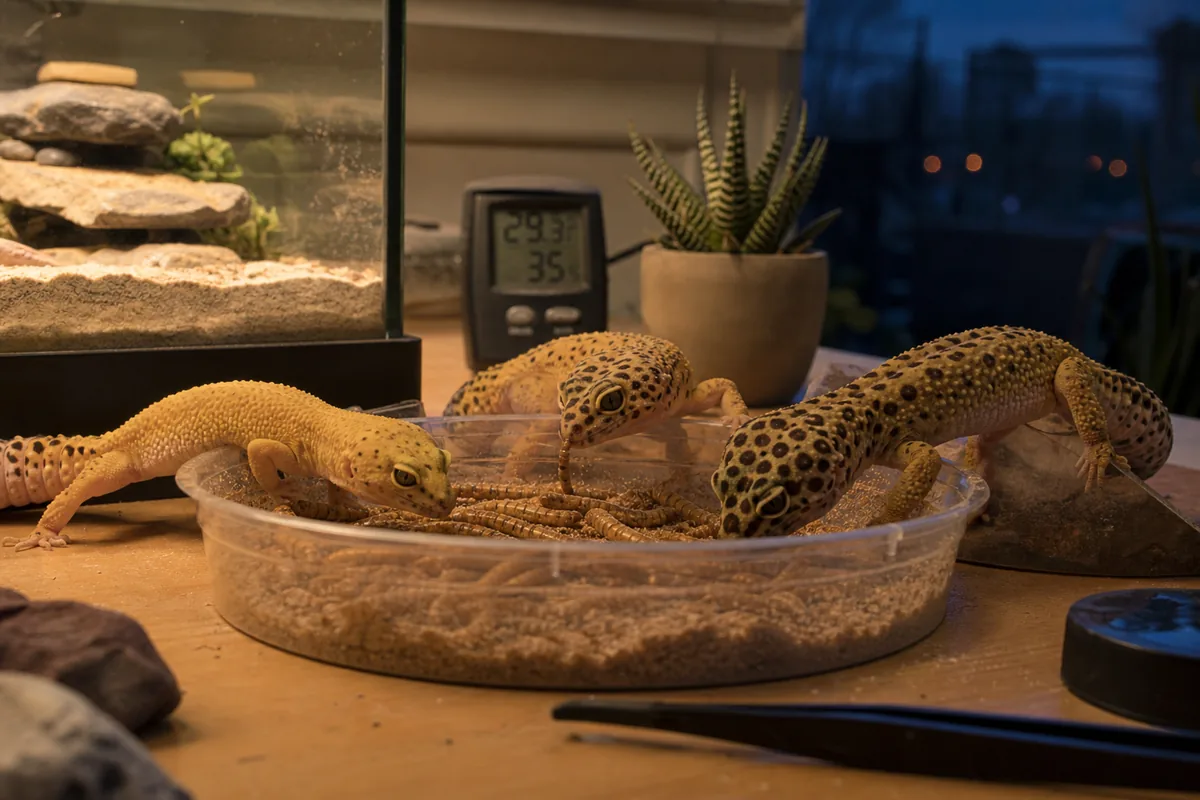
Superworms earn a place in a well-rounded feeding rotation for reptile keepers managing adult leopard geckos. They're larger than mealworms, more nutritious, and trigger an active hunting response that provides behavioral enrichment.
For leopard gecko feeding, they sit between mealworms and dubia roaches: better than mealworms on protein, higher on fat than ideal, but a useful rotation option for healthy adults.
The size limitation is real. A superworm averages 5-6cm in length, which is manageable for an adult leopard gecko but carries impaction and bite risk for juveniles.
The mandibles are strong enough to bite back and cause injury inside the gecko's mouth.
Superworms for Adult Leopard Geckos
- Full live superworm (larval stage of Zophobas morio) for adult geckosSafe
- smaller specimens (3-4cm) for sub-adults 4-6 months oldSafe
- Superworm beetles (Zophobas morio adults): hard exoskeleton not suitable for leopard geckosUnsafe
- dead or decaying superworms carry bacterial contamination riskUnsafe
Prep: Gut-load 24-48 hours before feeding with nutritious greens; dust with calcium supplement at every feeding; pinch the head between thumb and forefinger just before feeding to prevent biting inside the gecko Freq: 1-2 times weekly as a rotation feeder for adults; not a daily staple due to fat content Amount: 2-4 superworms per feeding session for adults depending on gecko size; offered after confirming gecko is at healthy weight
Superworm Nutrition vs Mealworm Nutrition
Superworms are the larval stage of Zophobas morio, a different species from the mealworm's Tenebrio molitor. Despite looking like large mealworms, they're nutritionally distinct.
Superworms deliver 19.7% protein versus mealworms' 20.3%, but the real difference is moisture at 58% versus mealworms' 62%.
The fat content at 17.9% is the primary limitation. Mealworms run 12.7% fat.
Superworms are 41% fattier, which puts them closer to waxworm territory for caloric density than most keepers realize.
- Protein: 19.7%, slightly below mealworms, well above waxworms
- Fat: 17.9%, significantly higher than mealworms, limits feeding frequency
- Moisture: 58%, lower than crickets and mealworms, less hydration contribution
- Chitin: higher than mealworms due to larger size, provides gut motility benefit
- Base Ca:P: approximately 1:8 ungut-loaded, requires consistent calcium dusting
Mealworms are the lower-fat alternative for daily feeding. Compare the 12.7% fat baseline against superworms' 17.9% when building a weekly schedule.
The Mandible Risk: Why Juveniles Are Off-Limits
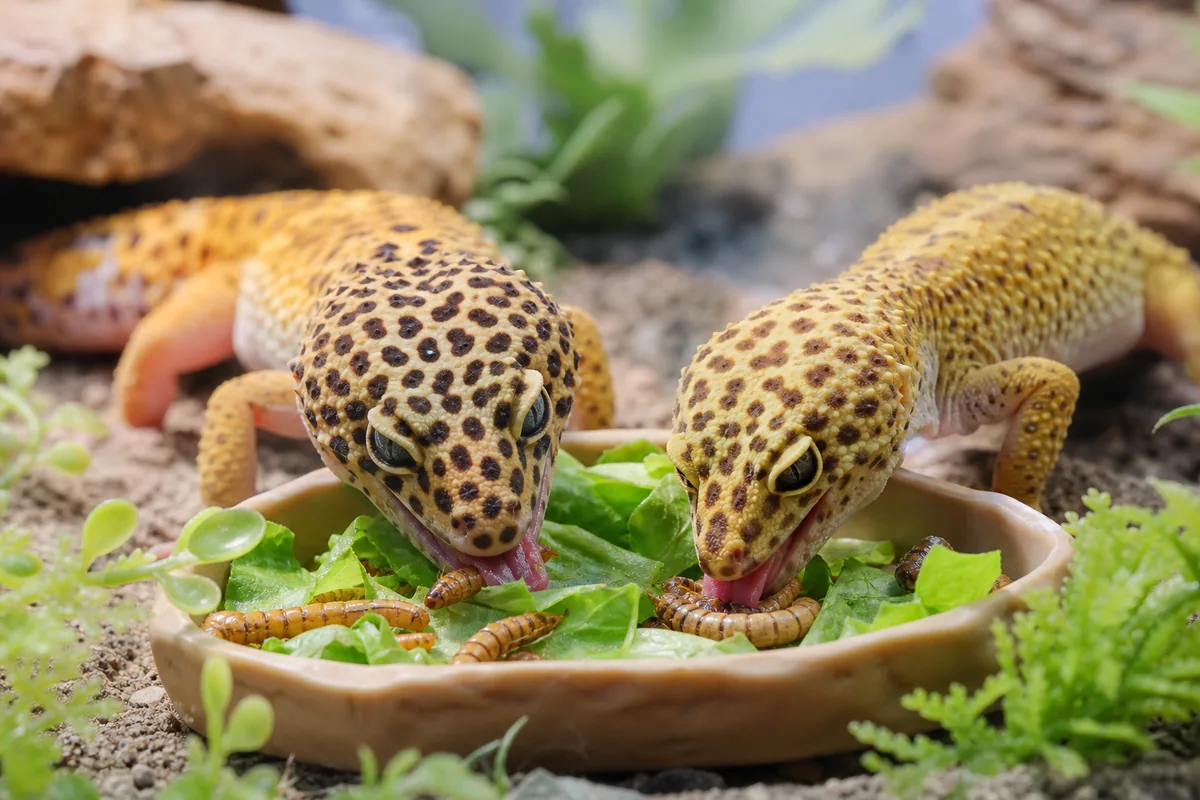
Superworms have functional, strong mandibles that they use defensively. A superworm placed in a gecko's enclosure that isn't immediately eaten will attempt to escape, and if cornered or grasped without full commitment by a small gecko, can bite the inside of the mouth or throat.
Adult leopard geckos (over 6 months, typically 15cm or more in length) have the jaw strength and strike speed to subdue a superworm before the mandibles engage. Juveniles under 6 months have neither.
Never offer superworms to geckos under 15cm total length.
For sub-adults still developing strike speed and jaw strength, crickets sized to the gecko's body length provide the same movement-based hunting stimulation without the mandible risk.
Gut-Loading Superworms
Superworms accept the same gut-load foods as mealworms, but their larger size means they can eat more substantial pieces. Whole collard green leaves, carrot chunks, and sweet potato pieces work well.
The gut-load material should be replaced every 24 hours to prevent mold in the warm room-temperature storage environment.
A 48-hour gut-load before feeding produces meaningful nutritional improvement. Superworms that have been gut-loading actively are visually distinct: their gut content shows through the pale exoskeleton as a darker midline stripe.
Waxworms sit even higher on the fat scale than superworms, running above 22% fat. Factor that ceiling into the rotation before combining both high-fat feeders in the same weekly schedule.
Building a Rotation That Includes Superworms
Superworms work best as one component in a 3-feeder rotation alongside crickets and dubia roaches. This keeps weekly fat averages lower than mealworm-heavy feeding while offering size and movement variety that prevents prey habituation.
A practical adult leopard gecko weekly rotation might look like: crickets Monday and Thursday, dubia roaches Wednesday, and superworms Saturday. This delivers three different fat profiles across four feeding sessions, keeping the weekly average closer to the cricket and dubia baseline than the superworm's 17.9% would suggest in isolation.
| Feeding Day | Feeder | Fat % | Amount |
|---|---|---|---|
| Monday | Crickets | 6.0 | 6-8 adult crickets |
| Wednesday | Dubia roaches | 7.2 | 4-5 medium roaches |
| Thursday | Crickets | 6.0 | 6-8 adult crickets |
| Saturday | Superworms | 17.9 | 2-3 superworms |
The weekly fat average across these four sessions comes out to roughly 9.3%, which is close to cricket-only feeding and well within a healthy range for a non-breeding adult gecko.
Dubia roaches are the leanest feeder in any rotation. Their 7% fat content anchors a balanced weekly schedule when paired with higher-fat feeders like superworms.
Butterworms run even higher on fat, sitting above 20%. The same once-monthly frequency cap that applies to them applies here for exactly the same reason.
Leopard geckos are obligate insectivores: plant matter, including fruit, has no nutritional role in their diet regardless of which species is offering it.
Feeder rotation makes most sense once temperature gradients, lighting schedules, and enclosure dimensions are dialed in. The leopard gecko care guide covers all three alongside feeding frequency benchmarks by age.
Sources and references
- Zophobas morio Proximate Composition and Comparison with Other Feeder InsectsZoo Biology, 2014
- Feeder Insect Husbandry and Nutritional Enhancement for Reptilesof Herpetological Medicine and Surgery, 2018
- Leopard Gecko Husbandry GuidelinesAssociation of Reptilian and Amphibian Veterinarians, 2022