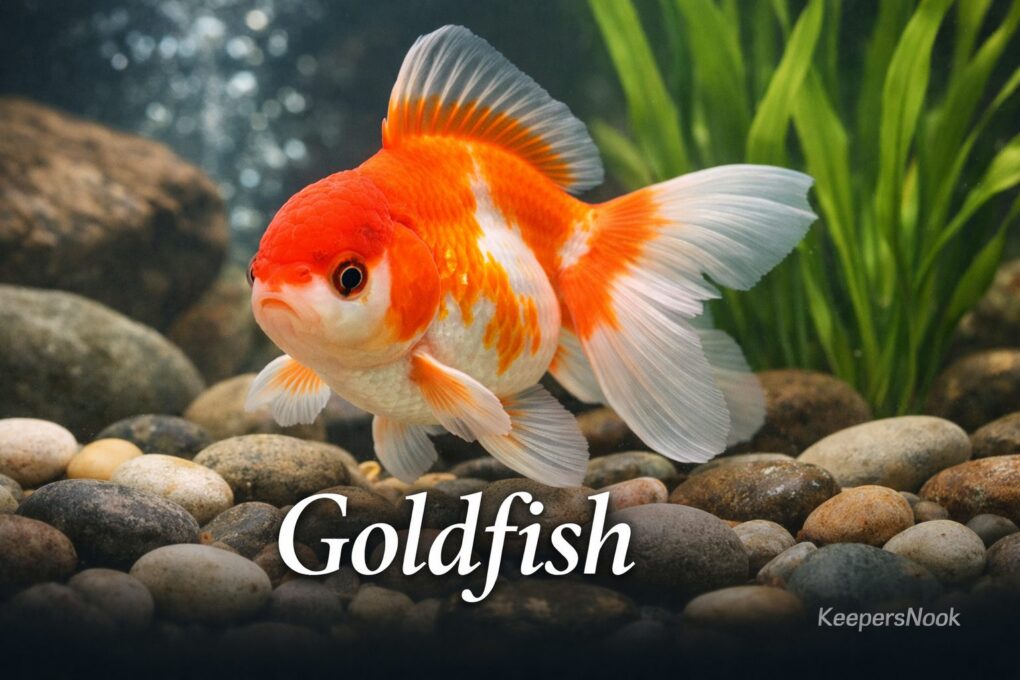
Goldfish reward stable care more than fancy decoration. Volume, filtration, and temperature control do the heavy lifting.
Goldfish (Carassius auratus) are one of the most misrepresented fish in the hobby. Proper tank maintenance is the single biggest factor in whether yours lives 2 years or 20.
We've seen keepers do everything right except tank size, and it costs them every time.
The bowl era is over. Modern goldfish care is built on volume, filtration, and cold water.
Get those three things right and goldfish become rewarding long-term pets.
Why goldfish bioload at 3-4× normal makes tank size non-negotiable
Goldfish are messy. They produce significantly more ammonia per body weight than most freshwater fish. roughly 3-4 times the bioload of an equivalent-sized tropical species.
Remember it later
Planning to try this recipe soon? Save it for a quick find later!
That waste accumulates fast in small volumes, pushing ammonia and nitrite into toxic ranges within days.
The old "goldfish grow to the size of the bowl" claim is a myth based on stunting, not biology. A goldfish that stops growing in a small container is not thriving. it is being poisoned by its own waste and suffering organ compression from deformed skeletal development.
- Single-tail goldfish (comets, commons) need a minimum 75 gallons as adults and are best suited for ponds
- Fancy goldfish (orandas, ryukins, black moors) need a 20-gallon minimum for one fish, plus 10 gallons per additional fish
- Filtration rating should be 4-10× tank volume per hour to compensate for high ammonia output
- Weekly water changes of 25-30% are the baseline; heavy stocking pushes that to twice weekly
- Substrate vacuuming at every water change removes the decomposing matter goldfish constantly deposit
If you are wondering whether a 10-gallon tank can work as a temporary setup, read our 10-gallon tank stocking guide for an honest breakdown of what fits and what doesn't. The short answer for goldfish: it cannot, even temporarily.
Cycling the tank before adding fish is mandatory. The nitrogen cycle establishes the beneficial bacteria colonies that convert ammonia to nitrite to nitrate.
Skipping this step with a goldfish. one of the heaviest ammonia producers in freshwater. creates a crash within the first week.
Goldfish cold water requirements mean no heater in most homes
Goldfish are temperate, cold-water fish. Their optimal range is 65-75°F (18-24°C).
Most homes sit in this range year-round, which means you typically do not need a heater at all.
Running a goldfish tank too warm causes real damage. Warm water holds less dissolved oxygen, speeds up metabolism, and accelerates the bacterial and parasitic life cycles that cause disease.
Goldfish kept consistently above 75°F show shortened lifespans and increased susceptibility to infection.
This cold-water requirement is also why you cannot mix goldfish with most tropical species. Bettas, tetras, and cichlids need 76-82°F water.
If you are curious why the two won't mix, we covered this in detail: with bettas causes problems for both species.
- Optimal range: 65–72°F for long-term health and maximum lifespan
- Upper tolerance: 75°F short-term; above this, dissolved oxygen drops dangerously
- Lower tolerance: 50°F; below this, goldfish enter partial torpor and stop eating
- Temperature swings above 5°F in 24 hours stress immune systems and trigger ich outbreaks
No heater also means no heater failure. One of the most common tank disasters is a heater malfunction cooking a tropical tank overnight.
Goldfish keepers do not face that risk.
Fancy vs. single-tail goldfish: 2 types with completely different care needs
Calling all goldfish the same is like calling all dogs the same. The two broad categories have different body plans, different space requirements, and different health vulnerabilities.
The varieties table below covers the full range of goldfish types commonly available in the hobby.
| Variety | Type | Adult Size | Min Tank | Difficulty |
|---|---|---|---|---|
| Common Goldfish | Single-tail | 10–14 in | Pond | Easy |
| Comet | Single-tail | 10–12 in | Pond | Easy |
| Shubunkin | Single-tail | 9–12 in | 75 gal / Pond | Easy |
| Oranda | Fancy | 7–9 in | 20 gal | Moderate |
| Ryukin | Fancy | 6–8 in | 20 gal | Moderate |
| Black Moor | Fancy | 6–8 in | 20 gal | Moderate |
| Ranchu | Fancy | 5–7 in | 20 gal | Intermediate |
| Telescope Eye | Fancy | 5–7 in | 20 gal | Intermediate |
| Lionhead | Fancy | 5–6 in | 20 gal | Intermediate |
| Butterfly Tail | Fancy | 6–8 in | 20 gal | Intermediate |
Goldfish tank mates: which 4 species actually work at cold water temperatures
Most freshwater fish are off the table as goldfish tank mates because they require warmer water. The species that do work share the 65-75°F range and are tough enough to handle goldfish-level water quality fluctuations.
For fancy goldfish specifically, tank mates must also be slow enough that they don't outcompete fancies for food. We have a full breakdown in our to goldfish-compatible tank mates, but here are the options that hold up in practice.
Zebra danios are the most practical schooling fish for single-tail goldfish tanks. They are fast enough to avoid being bothered, tolerate a wide temperature range, and are inexpensive to replace if something goes wrong.
Keep them in groups of 6 or more.
Bristlenose plecos are sometimes recommended for algae control in goldfish tanks, but their temperature preference skews warmer than ideal. Read our bristlenose pleco care guide for the full picture before adding one.
If the bottom of your tank needs a cleanup crew, goldfish setup typically provides.
Goldfish diet: 3 feeding rules that prevent 80% of swim bladder problems
Goldfish are omnivores that will eat almost anything you offer. That flexibility is also the problem. overfeeding and wrong food types cause the majority of health problems in fancy varieties, particularly swim bladder disorder.
The right feeding protocol for goldfish is simpler than most keepers think. Frequency, volume, and food type are the three variables that matter.
- Pellets over flakes: Gel food and sinking pellets do not cause air ingestion the way floating flakes do
- 2x daily, 2-minute rule: Feed only what the fish consume in 2 minutes, twice per day
- Fast one day per week: A weekly fast prevents constipation, which directly causes swim bladder compression in fancies
- Vegetables matter: Blanched zucchini, shelled peas, and leafy greens 2-3 times weekly provide fiber that offsets protein-heavy pellet diets
Goldfish can eat cucumber, which provides hydration and fiber. Check our post on fish can eat cucumber for prep details and serving size.
Similarly, bread is one food to permanently rule out: our piece on fish can eat bread explains why it causes bloating and water quality problems.
Do not feed goldfish food formulated for other species. Goldfish have specific protein and fiber requirements, and formulated for maximum protein are too high in animal protein for goldfish digestive systems long-term.
Common goldfish diseases: swim bladder and ich account for most keeper losses
Two diseases cause the majority of goldfish deaths in home aquariums: swim bladder disorder and ich. Both are preventable with proper husbandry, and both are treatable if caught early.
Swim bladder disorder is not a single disease. It is a set of symptoms with several root causes.
Fancy goldfish with compressed body shapes are structurally predisposed to it, but diet and water quality are the most common triggers in fish that start out healthy.
- Swim bladder symptoms: Fish floats sideways, tilts, sinks to bottom, or cannot reach the surface to breathe
- Diet-related causes: Constipation from high-protein diets or air ingestion from floating food
- Treatment: Fast the fish for 3 days, then feed a shelled, blanched green pea to clear the digestive tract
- Ich symptoms: White spots resembling salt grains across fins and body, scratching against surfaces
- Ich treatment: Gradually raise temperature to 75-78°F for 10-14 days to break the life cycle, combined with ich medication
- Ich prevention: Quarantine all new fish for 2-4 weeks before adding to the main tank
Other diseases to watch for: fin rot (fraying, discolored fin edges from bacterial infection), dropsy (pinecone-like scale raising from kidney failure. difficult to treat), and anchor worm or fish lice (visible parasites requiring manual removal and antiparasitic treatment).
Setting up a goldfish tank: 5-gallon stocking myths and what you actually need
The stocking myths around goldfish are some of the most persistent in the hobby. Retailers sell goldfish alongside small tanks, and the pairing implies compatibility that does not exist.
A 20-gallon tank is the minimum for a single fancy goldfish. This is not a conservative recommendation. it is the size at which the water volume is large enough to dilute goldfish ammonia output between water changes without crashing the nitrogen cycle.
For anyone curious why a 5-gallon simply cannot work for any goldfish, our to 5-gallon tank stocking covers what fish actually fit in that volume.
- 20-gallon long (30" × 12" × 12") is preferable to a 20-gallon high for a single fancy goldfish
- Filtration: Canister filter or HOB rated for 40+ gallons minimum on a 20-gallon goldfish tank
- Substrate: Bare bottom or large smooth river rock (gravel traps waste and small gravel causes impaction)
- Decor: Smooth-edged only; fancy goldfish with telescope eyes will injure themselves on sharp edges
- Plants: Goldfish eat most soft plants; use java fern, anubias, or hornwort (often left alone)
The platy is occasionally suggested as a goldfish tank mate because it tolerates a wide pH range, but the temperature mismatch makes it a poor fit in practice. Read our platy care guide for their actual requirements before deciding.
Goldfish breed readily in well-maintained tanks and ponds, often in spring when water temperatures rise from winter lows. Triggering a spawn in captivity requires simulating seasonal temperature change.
Lower the tank temperature to 58-60°F over several weeks, then gradually increase it to 68-72°F over 2-4 weeks. This temperature rise mimics spring and activates spawning behavior.
Males develop white breeding tubercles (small bumps) on their gill plates and pectoral fins during this period.
- Spawning behavior: Males chase females persistently; females scatter adhesive eggs across plants and surfaces over several hours
- Egg count: A single spawn can produce 500-5,000 eggs depending on female size and condition
- Parental care: None. Adults will eat eggs and fry immediately. Remove eggs to a separate tank
- Incubation: 4-7 days at 68-72°F; fry are free-swimming within 2-3 days of hatching
- Fry feeding: Infusoria or liquid fry food for the first week, then baby brine shrimp and finely crushed pellets
- Culling: Serious breeders cull deformed fry at 4-6 weeks to maintain line quality; this is a personal decision
Goldfish hybridize freely with each other but not with koi despite popular belief. Koi (Cyprinus carpio) and goldfish (Carassius auratus) are different species.
They can occupy the same pond but do not produce viable offspring.