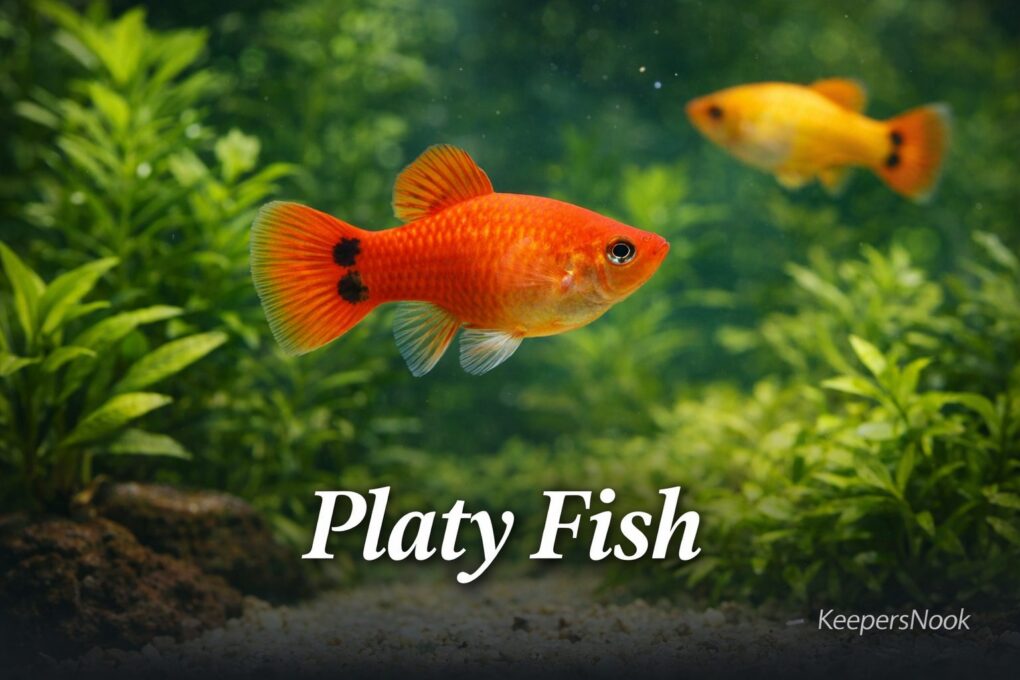
Platys (Xiphophorus maculatus and Xiphophorus variatus) are livebearers native to the rivers and lakes of Mexico and Guatemala. Decades of selective breeding have produced a fish that barely resembles its wild ancestors in color, yet retains every bit of that original hardiness.
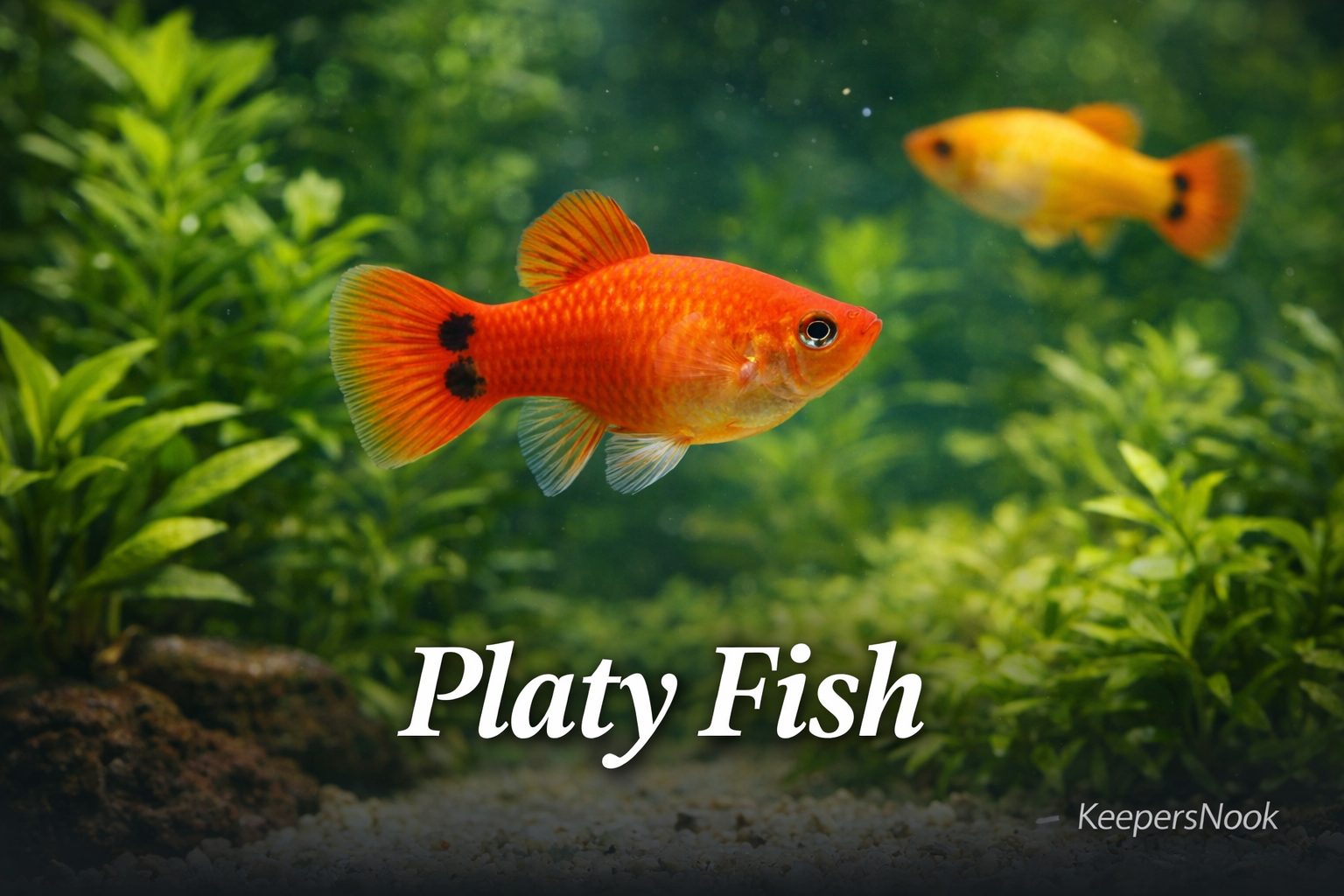
We have kept platys in community tanks ranging from 10-gallon beginner setups to 75-gallon planted displays. They perform reliably in all of them, and they are one of the few fish we recommend without caveats to first-time keepers.
Platy Color Varieties: 20+ Forms from Mickey Mouse to Wagtail
Selecting a platy at the fish store is almost its own hobby. Breeders have developed an extensive range of body colors and fin patterns, and many of these varieties are now standard stock at most local fish stores.
Remember it later
Planning to try this recipe soon? Save it for a quick find later!
Understanding the naming system makes shopping much easier. Most variety names combine a body color descriptor with a pattern marker.
The table below covers the varieties you will encounter most often.
| Variety | Body Color | Pattern / Marker | Notes |
|---|---|---|---|
| Mickey Mouse | Yellow-gold or red | Three black spots at tail base form a "Mickey" silhouette | Most recognizable variety; widely available |
| Sunburst | Deep orange-red fading to yellow | Gradient body; clear or lightly pigmented fins | Vivid under warm lighting; popular for planted tanks |
| Wagtail | Red, blue, or gold body | Black dorsal, caudal, and ventral fins | High contrast; the black fins are the defining trait regardless of body color |
| Salt and Pepper | Silver or white | Dense black speckle pattern across body and fins | Less common; striking in dark-substrate tanks |
| Tuxedo | Bicolor: light front half, dark rear half | Sharp color divide at mid-body | Common; variants include red tuxedo and blue tuxedo |
| Rainbow | Multi-color: blue, red, yellow | Iridescent sheen; no single dominant color | Males more vivid than females; color intensifies with age |
| Hi-Fin / Lyretail | Any color form | Extended dorsal or forked caudal fin | Fin mutation layered on top of any color variety |
Purchasing a group of three to four different varieties in the same tank produces a visually dynamic display without any extra maintenance cost. Color varieties do not affect behavior, water needs, or compatibility.
Platy Tank Setup: 10-Gallon Minimum, 20-Gallon for a Community
Platys are active mid-level swimmers that need horizontal space more than vertical height. A 10-gallon tank is the true floor for a small group of three to four fish.
That volume keeps water chemistry stable between weekly changes and gives each fish room to establish loose territories without conflict.
For a mixed community with other species, a 20-gallon is the starting point we recommend. The extra volume buffers waste, reduces aggression during feeding, and gives you room to stock a visually complete tank.
Our 10-gallon tank stocking guide covers realistic limits if you want specific numbers.
Dense planting along the back and sides is the single best thing you can do for platy health. Java fern, hornwort, and water sprite grow fast without CO2 injection and give fry a survival refuge when adults breed.
- Substrate: Fine gravel or sand. Dark substrate enhances color contrast on vivid varieties like sunburst and wagtail.
- Filtration: Hang-on-back or sponge filter rated for at least 1.5 times the tank volume. Platys produce consistent bioload as active livebearers.
- Flow: Slow to medium. Platys do not need strong current and fry can be pulled into a filter intake without a pre-filter sponge.
- Lid: Required. Platys jump when startled, and gaps around equipment are enough for an escape.
Leave an open swimming area in the front third of the tank. Platys cruise this zone constantly, and open water reduces the stress that builds in tightly planted tanks with no clear sightlines.
Cycle the tank fully before adding fish. Run the filter with an ammonia source for four to six weeks, or use a bottle of beneficial bacteria starter if you need to speed the process.
Adding platys to an uncycled tank is the fastest way to lose them.
Platy Water Parameters: Why 7.0–8.2 pH Makes Them Beginner-Proof
Platys evolved in the hard, alkaline rivers of Central America. They thrive in water conditions that would stress many other tropical species, and that tolerance is the foundation of their beginner-friendly reputation.
| Parameter | Ideal Range | Tolerance Limit |
|---|---|---|
| Temperature | 74–78°F | 70–80°F |
| pH | 7.2–7.8 | 7.0–8.2 |
| Hardness (GH) | 10–25 dGH | 5–30 dGH |
| Ammonia | 0 ppm | 0 ppm |
| Nitrite | 0 ppm | 0 ppm |
| Nitrate | <20 ppm | <40 ppm |
Test water weekly during the first month after setup. Once the tank is fully cycled and parameters have held stable across three consecutive tests, bi-weekly testing is sufficient for a mature platy tank.
Avoid the temptation to correct a stable reading. A tank sitting at 7.6 pH and 14 dGH is running well even if the numbers are not dead-center on the ideal range.
Stability beats perfect numbers every time.
Platy Diet: 2-Minute Feeding Rule for Omnivores
Platys eat almost anything you offer. That flexibility makes feeding simple, but it is also how keepers fall into the trap of feeding one food exclusively and producing fish with dull color and compromised immune systems.
A quality tropical flake or micro-pellet with fish meal or spirulina as the first ingredient should make up 60–70% of their diet. Cheap fillers produce more waste and slower growth.
The same feeding principles that apply to high-quality betta diets apply here: protein source and ingredient quality matter more than brand name.
Supplement the staple diet with frozen or live food two to three times per week. Daphnia, baby brine shrimp, and bloodworms all improve color saturation and reproductive health in breeding adults.
- Staple (60–70%): Quality tropical flake or micro-pellet with spirulina or fish meal as first ingredient
- Protein supplement (2–3x weekly): Frozen daphnia, baby brine shrimp, or bloodworms
- Vegetable supplement (2x weekly): Blanched zucchini or spinach clipped to the glass
- Fry food: Crushed flake or powdered fry food, fed 3–4 times daily for the first three weeks
Feed once or twice daily, offering only what the fish consume within two minutes. Overfeeding spikes ammonia faster than any other single factor in a small platy tank.
Remove any uneaten food promptly.
Platy Tank Mates: 10+ Compatible Species for a 20-Gallon Community
Platys are peaceful mid-water swimmers. They will not fin-nip, pursue tank mates aggressively, or hold territory against similarly-sized fish.
That makes them one of the easiest community fish to stock around.
The main constraint is temperature. Platys need 70–80°F, which rules out cold-water species.
Beyond that, avoid anything large enough to view a platy as a snack.
The livebearer community is the easiest place to start. Guppies share nearly identical water parameters and peaceful temperaments.
Adding mollies to the same tank works well when water hardness is in the mid-to-upper range where all three species overlap. Swordtail compatibility is particularly strong because swordtails are in the same genus (Xiphophorus) and have identical water needs.
For schooling mid-water companions, keeping neon tetras with platys works in a 20-gallon or larger with pH maintained between 7.0 and 7.4 to satisfy both species. Cherry barb results are consistently positive: they are peaceful, stay small, and occupy a similar water level without conflict.
Bottom-level cleanup is best handled by cory catfish. Corydoras occupy a completely different tank zone, require no special accommodation, and will work through any leftover food that sinks past the platys.
Bristlenose plecos are another reliable bottom-level option, though they need a tank of at least 20 gallons to avoid territory overlap.
If you are working with a smaller tank, check our 5-gallon tank stocking options before adding platys to a nano setup. A 5-gallon is genuinely too small for platys alongside other species.
Platy Breeding: 20–80 Fry Every 28–30 Days
Platys breed without any encouragement from you. If you keep both sexes together, fry will appear within four to six weeks of your first purchase.
This is not a problem if you plan for it. It becomes a problem the moment a 10-gallon tank has 40 fish in it.
Females are livebearers that carry developing fry internally and give birth to fully-formed, free-swimming fish. A healthy female drops 20–80 fry every 28–30 days.
She can store sperm from a single mating and continue producing multiple batches for up to six months without another male present.
Sexing platys is simple. Males are smaller and slimmer, with a gonopodium: a modified anal fin that is rod-shaped rather than fan-shaped.
Females are noticeably larger-bodied, especially as they approach birth, and their anal fin fans out normally.
As birth approaches, the female's belly becomes distinctly boxy when viewed from above. A dark "gravid spot" near her anal fin deepens in color.
This is the visual signal to move her.
Transfer the female to a breeding box or a separate planted tank one to two days before you expect birth. Remove her immediately after she delivers.
Platys eat their own fry without hesitation. This is not aberrant behavior; it is opportunistic feeding and every adult in the tank will participate.
Feed fry crushed flake or powdered fry food three to four times daily for the first three weeks. They grow quickly.
At eight to ten weeks, young platys are large enough that adults ignore them as food.
- Day 0: Birth. Move fry to nursery tank or remove mother from breeding box immediately.
- Weeks 1–3: Feed powdered fry food or crushed flake 3–4 times daily. Water changes every 2 days in a small nursery tank.
- Weeks 4–6: Switch to standard crushed flake. Fry reach 0.5 inches and begin showing early coloration.
- Weeks 8–10: Fry are large enough to enter the display tank or be traded to a local fish store for credit.
If you do not want fry, the cleanest solution is keeping only one sex. An all-male platy tank works well.
Males may spar occasionally for position without females present, but they will not cause injury. Maintain a 2:1 female-to-male ratio in mixed tanks to reduce male harassment of individual females.
Most local fish stores accept healthy juvenile platys as trade-ins for store credit. Build that relationship before your tank population outpaces your space.
Common Platy Diseases: 4 Conditions to Watch For
Platys are hardy fish, but their immune systems follow the same rule as every other tropical species: water quality dictates disease resistance. The fish that get sick are almost always in tanks with chronic low-level ammonia, temperature swings, or persistent stress from overcrowding.
- Ich (white spot): Fine white grains on body and fins, caused by Ichthyophthirius multifiliis. Raise temperature to 82°F gradually and treat with a copper-based ich medication. Act within 24 hours of first signs.
- Fin rot: Frayed or receding fin edges, often with a white or dark border. Almost always secondary to a water quality problem. Fix parameters first before reaching for antibiotics.
- Velvet: Gold or rust-colored dust on the body, more visible under a flashlight than overhead tank lighting. Spreads aggressively. Treat with copper medication and dim the tank completely during treatment.
- Wasting disease: Gradual weight loss over weeks in a fish that still feeds. Internal parasites are the most common cause. Treat with metronidazole in a quarantine tank.
Quarantine every new fish for two weeks in a separate tank before adding them to your display. This single practice prevents the majority of disease introductions.
Platy Lifespan: Reaching 3–5 Years with Basic Maintenance
The average platy lives 3 to 5 years in a well-maintained aquarium. That range is genuinely achievable without advanced equipment.
The fish that die young are almost always victims of one of three avoidable problems: ammonia spikes from overfeeding or overstocking, temperature swings from an unreliable heater, or disease introduced without a quarantine period.
Perform weekly 25–30% water changes as the non-negotiable foundation. Vacuum the substrate each time to pull out trapped waste, and rinse filter media in removed tank water, never tap water, to preserve the bacterial colony.
Test parameters monthly once the tank is mature.
Older platys slow down and may lose some color intensity. This is normal aging.
Reduce feeding slightly for older fish and make sure they can reach food before faster tank mates take it. A separate feeding area using a small feeding ring on one side of the tank helps.
The long lifespan is also a reason to buy from a reputable local breeder or a fish store with healthy stock rather than a chain store with visibly stressed fish. A platy that is already sick when you buy it starts its time in your tank behind.
A healthy young fish from a good source gives you the full 3–5 year window.