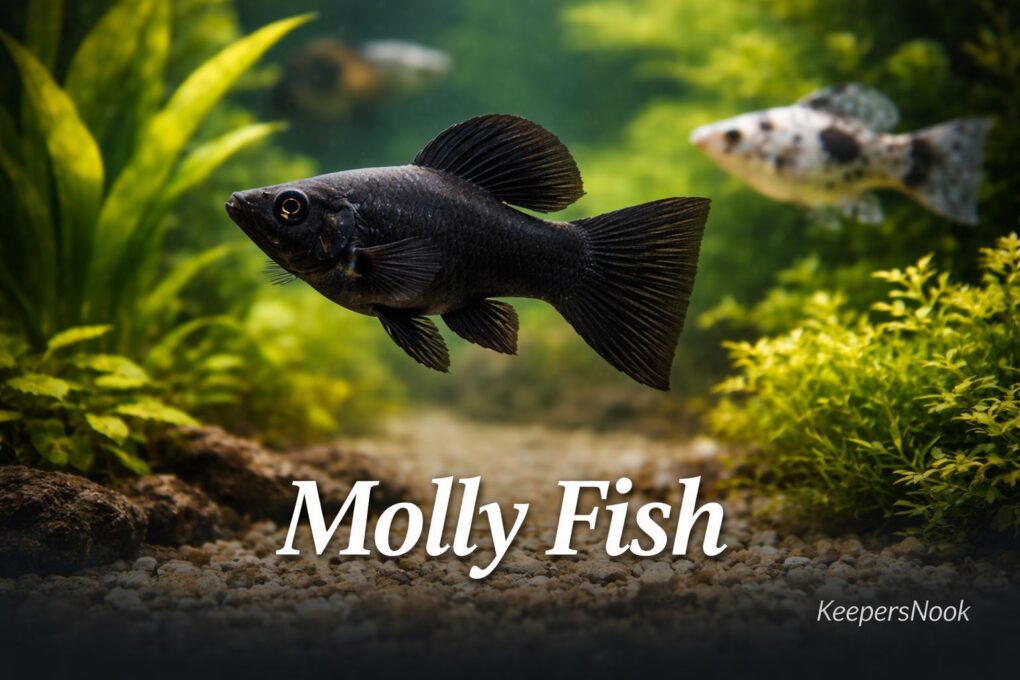
Molly Fish Varieties: 30+ Color Forms Across 4 Body Types
Most keepers encounter mollies as a single species, but the group spans four distinct body types and more than 30 recognized color and fin variants in the hobby. Knowing which type you have changes the tank size and care requirements significantly.
Remember it later
Planning to try this recipe soon? Save it for a quick find later!
The four main body types are: short-finned mollies (the standard form, Poecilia sphenops), sailfin mollies (Poecilia latipinna), balloon mollies (selectively bred rounded body), and lyretail mollies (extended caudal fin variants).
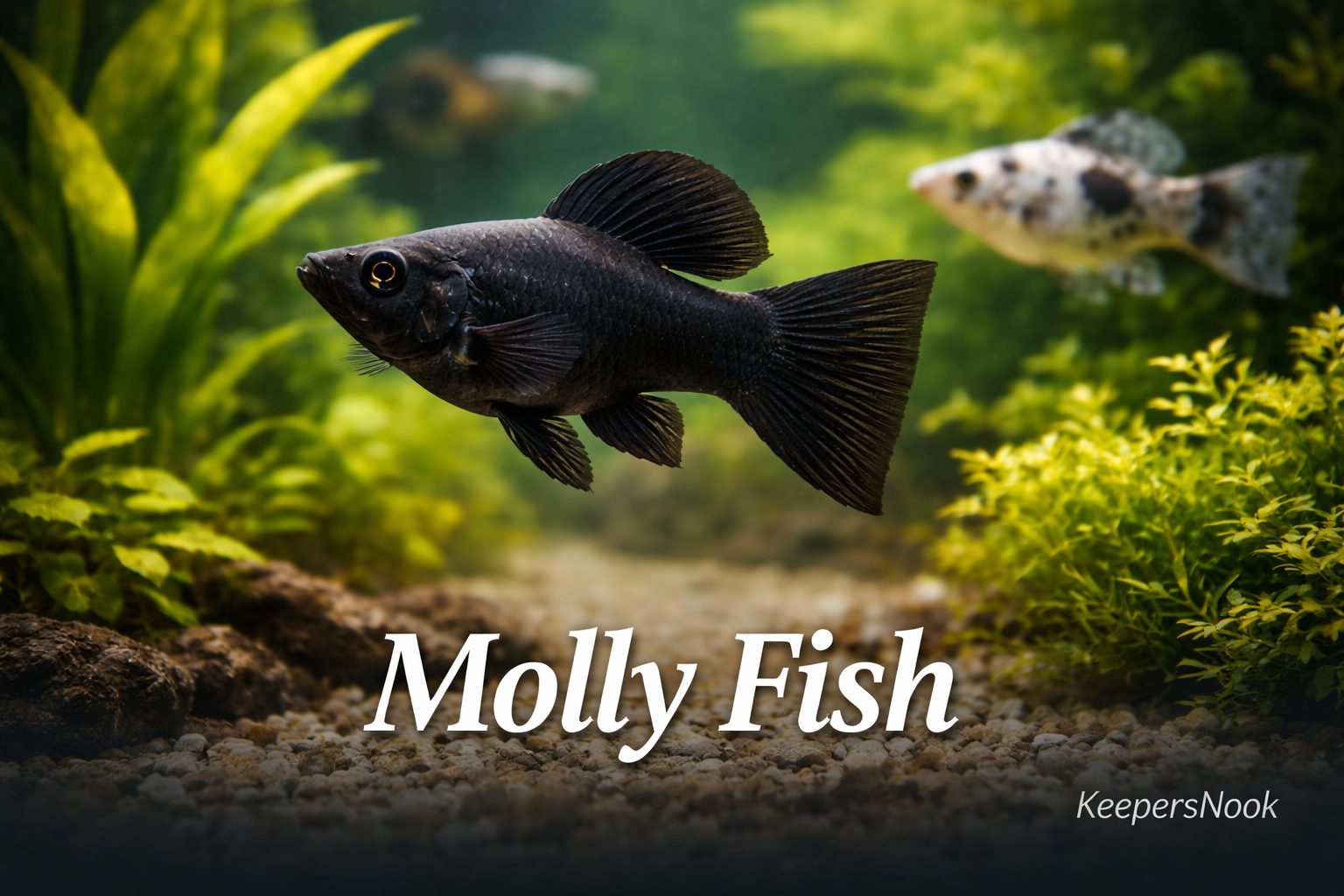
- Black molly. The most common short-finned variant. Solid velvety black across the entire body. Hardy and beginner-appropriate. Reaches 3–4 inches.
- Dalmatian molly. White or silver base with irregular black spots. Highly variable patterning; no two fish look identical. Equally hardy as the black form.
- Sailfin molly. Large, fan-shaped dorsal fin that can span the full height of the fish when raised. Males reach 4–5 inches and need a minimum 30-gallon tank.
- Balloon molly. Round, compressed body from selective breeding. Slower swimmer than standard mollies. Needs extra space and calm water flow because the body shape limits mobility.
- Gold dust molly. Yellow-orange base with a shimmering metallic sheen. A short-finned variant with the same care requirements as the black molly.
- Creamsicle lyretail. Orange and white coloration with an elongated, split tail. More fragile fins require calmer water and no fin-nipping tank mates.
Color morphs within these four types include marble, orange, silver, and platinum forms. All share the same core water chemistry requirements regardless of color.
When selecting mollies at a store, skip any fish with clamped fins, visible white spots, or a shimmying swimming motion. Those are early disease signs that are difficult to reverse once introduced to an established tank.
Molly Brackish Tolerance: The 1.5-tsp/gal Salt Range Explained
Mollies are euryhaline, meaning they regulate their body chemistry across a range of salinities. Wild populations of Poecilia sphenops and Poecilia latipinna inhabit coastal estuaries, mangrove margins, and tidally influenced river mouths where salinity shifts with the season.
This biology gives aquarium mollies a unique advantage: they handle hard, mineral-heavy tap water that would stress soft-water species like neon tetras and most corydoras catfish. You do not have to fight your tap water chemistry to keep mollies healthy.
Salt is optional in a freshwater molly tank, but it becomes useful in three specific situations:
- Very soft tap water. If your tap water measures under 8 dGH, low-dose salt (1 teaspoon per 5 gallons) reduces the osmotic gap between the fish's body and the water.
- Ich treatment. Salt at 1–2 teaspoon per gallon inhibits the ich parasite and reduces osmotic stress on the fish simultaneously.
- Breeding condition. A low salt dose supports female health during the final week of gestation, when osmotic demands on the female's body are highest.
- New fish acclimation. A short 1–2 week salt period helps new mollies settle into an established tank, particularly fish coming from high-salinity store conditions.
The upper limit for mollies in a brackish setup is approximately specific gravity 1.010. Beyond that, you need a true brackish or marine setup with different filtration and substrate considerations.
Most molly keepers never need to approach this threshold.
If your tank includes that prefer acid water, skip salt entirely. It will stress acid-preferring species before it benefits your mollies, and the water chemistry difference makes long-term mixed keeping difficult regardless.
Molly Tank Setup: 20-Gallon Minimum with Hard, Alkaline Water
A 20-gallon long is the starting point for a small group of short-finned mollies. Sailfin variants need a 30-gallon minimum, and balloon mollies do best in a 29-gallon where their slower swimming does not lead to territory conflicts.
Mollies are active, mid-to-upper-level swimmers that need horizontal swimming room more than vertical height. A long, shallow tank outperforms a tall, narrow one of the same volume.
Filtration is not optional and not a place to cut costs. Mollies produce a heavy bioload for their size, and organic waste in warm, alkaline water breaks down into ammonia rapidly.
A filter rated for double your tank volume is not excessive for a fully stocked molly tank.
Plant the back and sides with dense vegetation. Hornwort, java moss, and water sprite all tolerate the high pH and hardness that mollies prefer.
Leave the center open for swimming. Fry survival rates in a planted community tank are low but nonzero, which is usually enough for most keepers.
For a compact community setup, check our guide on 10-gallon stocking options before committing to mollies in a smaller tank. The 20-gallon requirement is not flexible for adults.
Molly Water Parameters Table: Ideal vs. Tolerance Range
| Parameter | Ideal Range | Tolerance Limit |
|---|---|---|
| Temperature | 77–80°F | 75–82°F |
| pH | 7.8–8.2 | 7.5–8.5 |
| Hardness (GH) | 20–30 dGH | 15–35 dGH |
| Salinity (optional) | 1 teaspoon per 5 gallons | 0 to SG 1.010 |
| Ammonia | 0 ppm | 0 ppm |
| Nitrite | 0 ppm | 0 ppm |
| Nitrate | Under 20 ppm | Under 40 ppm |
Weekly 25–30% water changes are the most reliable way to keep nitrates under 20 ppm. Mollies generate more waste than guppies or platys, so skipping a water change shows up in behavior faster than it would with smaller livebearers.
Test hardness and pH monthly if you use crushed coral or buffer supplements. Parameters drift slowly in a stable tank, but drift in the wrong direction over several months causes the shimmying and disease issues that frustrate new molly keepers.
Molly Diet: Algae-Eating Omnivores That Need Plant Matter Daily
Mollies are omnivores with a stronger herbivore lean than most livebearers. Algae and plant matter should form a consistent part of their diet, not an occasional supplement.
In a well-lit planted tank, mollies graze actively on soft algae growing on glass, decor, and plant leaves. This is healthy natural behavior.
Do not scrub every surface clean. Let a thin layer develop on the back glass.
- Staple flake or pellet. A spirulina-enriched tropical flake covers base nutrition. Feed twice daily, only what they finish in two minutes.
- Blanched vegetables. Zucchini, cucumber, and spinach slices clipped to the glass two to three times per week. Remove after 24 hours to prevent fouling.
- Frozen protein. Daphnia and baby brine shrimp two to three times per week. Supports color in males and breeding condition in females.
- Algae wafers. Useful when tank algae growth is minimal. Place one wafer every two days as a supplement, not a staple.
For feeding guidance that applies across the freshwater community, our guide on staple diets for livebearers covers the same nutritional principles. The protein-to-plant ratio matters for molly health the same way it does for bettas.
Overfeeding is the most common beginner mistake with mollies. Their constant browsing behavior makes them look perpetually hungry.
Feed small amounts twice daily and let them forage on biofilm between meals.
Molly Tank Mates: Compatible Species at pH 7.5–8.5
Mollies are peaceful community fish with one hard constraint: their water preferences eliminate most soft-water and acid-preferring species as long-term tank mates. Choose tank mates that match the alkaline, hard water environment rather than trying to compromise parameters for both.
The best tank mates are other Poeciliidae livebearers. nearly identical water chemistry requirements and similar temperament.
match the alkaline preference and comparable adult size. from the same family work in the same water chemistry with minor overlap.
For bottom level cleanup, tolerate hard, alkaline water and serve as an effective algae crew without competing for mid-water resources.
- Platys. Excellent. Identical water requirements, same family, peaceful.
- Swordtails. Excellent. Alkaline preference matches; active but non-aggressive.
- Guppies. Good. Slightly lower pH preference but workable overlap at 7.5–7.8.
- Bristlenose plecos. Good. Bottom-level algae control, ignores mollies completely.
- Neon tetras. Avoid. Neon tetras need pH 5.5–7.0 and soft water; mollies need pH 7.5–8.5 and hard water.
- Cherry barbs. Use caution. tolerate moderately hard water but prefer slightly lower pH; workable in a compromise setup at pH 7.2–7.5.
We cover the full compatibility breakdown in our dedicated guide on guppies with mollies together, including male ratio management and which color forms coexist best.
Molly Live Birth: Fry Production Every 25–30 Days
Mollies are livebearers. Females carry developing fry internally and give birth to fully-formed, free-swimming fish every 25–30 days.
A healthy female delivers 20–100 fry per birth depending on her size, age, and condition.
You will not need to trigger spawning. Preventing uncontrolled breeding requires more active management than causing it.
Females store sperm after a single mating and produce multiple consecutive broods without another male present. A female purchased from a store may already be pregnant on arrival.
Identifying a gravid female is straightforward: look for a visibly swollen, rounded belly and a darkening gravid spot just above the anal fin. As delivery approaches, the belly becomes square-shaped when viewed from above, and fry may be visible through the skin on pale-colored variants.
Move a gravid female to a separate nursery tank or a floating breeder box one to two days before expected delivery. Remove her immediately after she gives birth.
Mollies eat their own fry.this is not aggression, it is opportunistic feeding and it happens fast.
Feed fry crushed flake, powdered spirulina, and baby brine shrimp three to four times daily. They grow quickly and reach juvenile size in five to six weeks.
To prevent breeding entirely, keep only one sex. Males have a modified, pointed anal fin called a gonopodium.
Females have a fan-shaped anal fin. Separating by sex is the only reliable method when tanks are mixed.
Live birth is one of the traits that makes mollies compelling to keep. Watching a female deliver fry in real time is an experience most new keepers do not expect.
The practical challenge is fry management: a single pair in a 20-gallon will produce more fish than most tanks can absorb within a few months.
Plan your fry management strategy before you mix sexes. That means either a dedicated nursery tank, a fish store with a return policy, or a decision to keep single-sex groups.
Molly Diseases: Shimmying Signals Water Chemistry Problems
Mollies are more disease-prone than their reputation suggests, and most disease episodes trace directly to water quality. Their susceptibility increases sharply when water softens, temperature drops, or nitrates climb above 30 ppm.
- Ich (white spot). Salt-grain-sized white dots on body and fins. Raise temperature to 82°F and treat with copper-based ich medication for 7 days. Mollies' brackish tolerance means they handle ich treatment better than soft-water species.
- Fin rot. Frayed or disintegrating fin edges, most common in pale-colored variants. Almost always secondary to elevated nitrates or ammonia. Fix water quality before adding antibiotic treatment.
- Dropsy. Raised scales giving a pinecone appearance, often combined with bloating. Indicates advanced internal bacterial infection. Quarantine immediately and treat with kanamycin or a broad-spectrum antibiotic. Prognosis is poor once scales raise.
- Velvet. Fine gold or rust-colored dust on skin, visible under a flashlight beam. More aggressive spread than ich. Treat with copper-based medication and dim the tank.
Always quarantine new mollies for two to three weeks in a separate tank before introducing them to an established community. Mollies from retail stores carry ich and internal parasites at rates that surprise most beginners.
One infected fish can require full tank treatment within a week.
Molly Lifespan: 3–5 Years With Stable Water Chemistry
Mollies live 3 to 5 years under stable conditions. That ceiling is consistently cut short by chronic low-level water chemistry stress, usually from keeping mollies in soft, neutral water to accommodate their tank mates.
The most common long-term failure is prioritizing the wrong fish's preferences. If your water is soft and acidic, add crushed coral and choose tank mates that can tolerate the resulting harder, more alkaline conditions.
Build the tank around mollies' requirements and select companions that fit, not the reverse.
Perform weekly 25–30% water changes, vacuum substrate to remove organic debris, and test hardness monthly. Salt replacement is proportional: only water you remove takes salt with it, not water that evaporates.
Replace only the salt proportion that left with your removed water during changes.
Older mollies often develop fatty liver from overfeeding. Feed only what they consume in two minutes, once or twice daily.
Lean their diet toward plant matter and vegetables as they age past two years. Protein-heavy diets that support breeding condition in young adults become a health burden after that point.