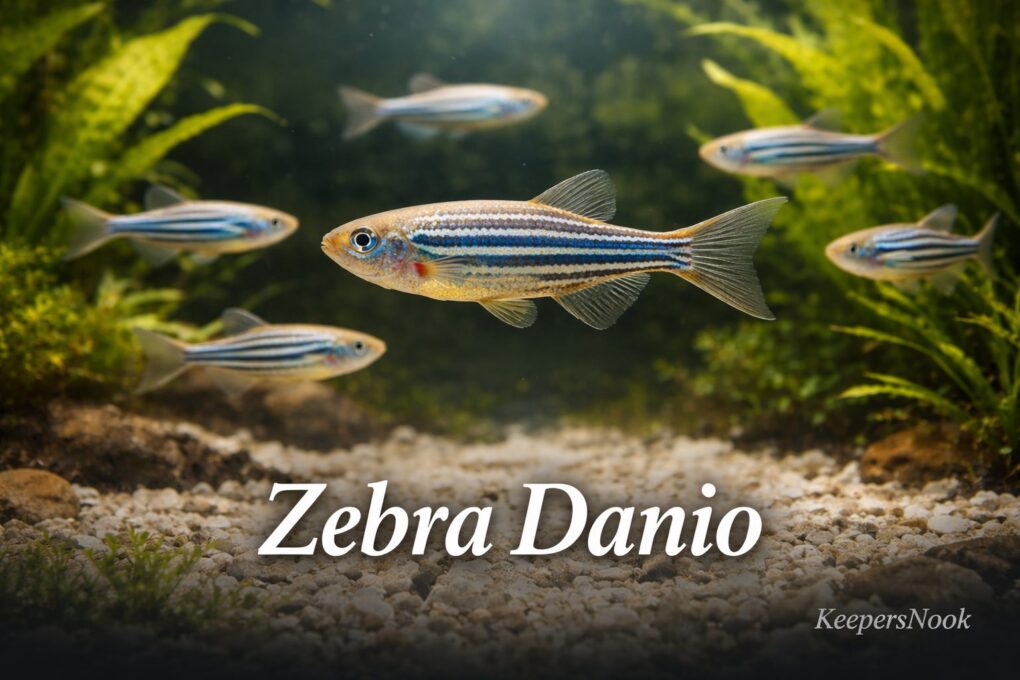
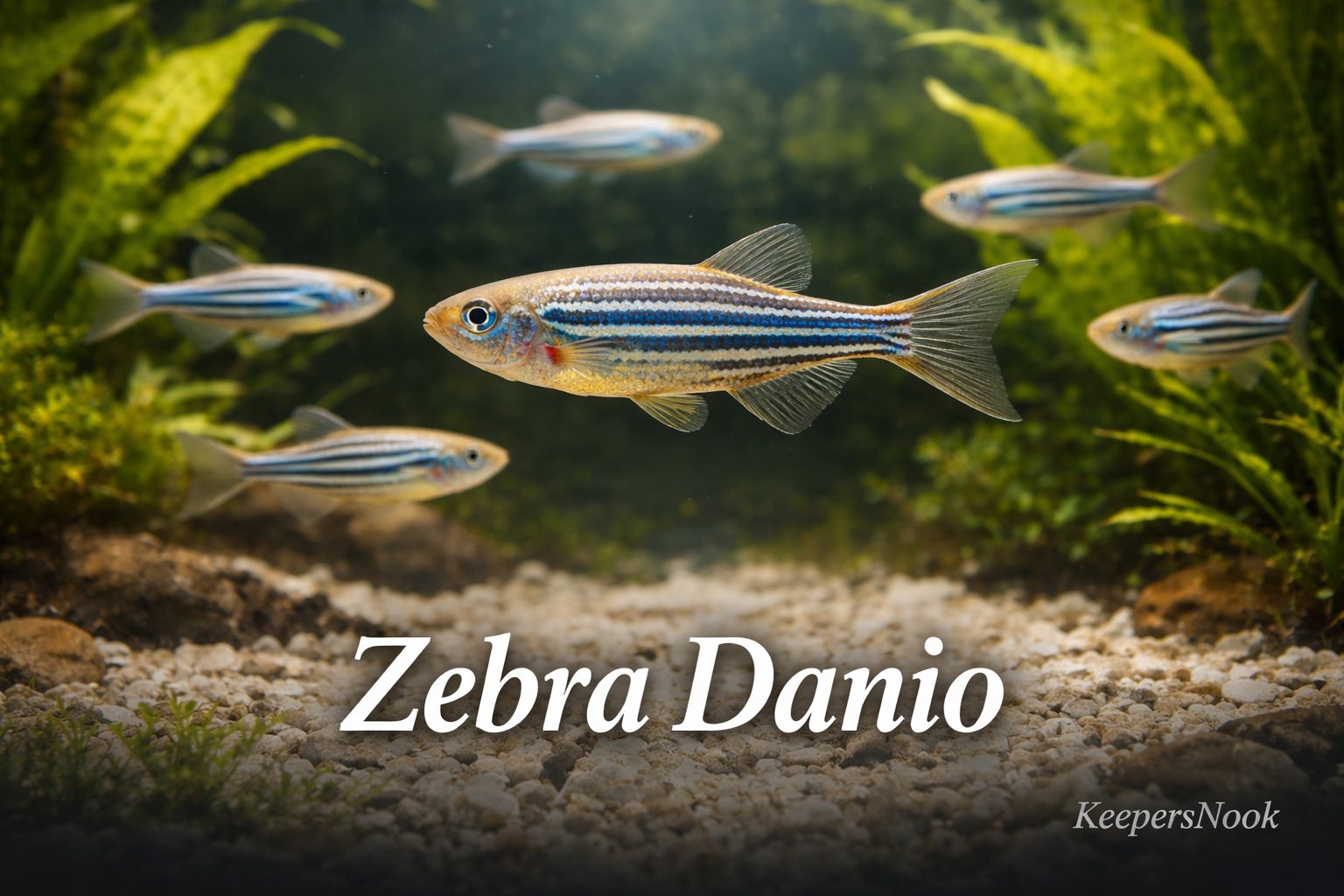
Zebra danios get their name from the five horizontal blue-and-silver stripes running the full length of their body. Adults reach 1.5-2 inches.
They are native to fast-moving streams and flooded rice paddies across South Asia, from India through Nepal and Bangladesh into Myanmar.
That origin explains everything about their care: they are built for turbulent, variable, well-oxygenated water. In a home aquarium, they adapt to conditions that would stress or kill most other tropical fish species.
One practical note before setup: zebra danios are strong jumpers. Any gap in the lid, even a small one around filter tubing, is an escape route.
A tight-fitting lid is not optional.
Zebra Danio Tank Setup: 10-Gallon Minimum, 20-Gallon Long for Best Behavior
A 10-gallon tank fits a school of six zebra danios at the lower end. A 20-gallon long is the better starting point if you plan a mixed community.
Remember it later
Planning to try this recipe soon? Save it for a quick find later!
Danios are constant horizontal swimmers, and a longer tank gives the school room to form a proper formation instead of turning in tight circles.
If you are still deciding how many fish fit a smaller tank, our guide on 10-gallon tank stocking breaks down the numbers by species. For a danio-only nano setup, check a 5-gallon can work (short answer: it is too small for a proper school, but the math is there).
Substrate choice does not affect zebra danio health. Sand, gravel, and bare-bottom setups all work.
Danios are midwater and upper-water swimmers and spend almost no time near the bottom. Choose substrate based on the other fish and plants in your tank.
Zebra Danio Water Parameters: Temperature 64–77°F Is the Widest Range of Any Common Tropical Fish
Zebra danios are the most-studied vertebrate in genetic research. Danio rerio is used in thousands of laboratory studies annually precisely because it survives experimental conditions that kill other species.
In a home aquarium, this translates to real-world hardiness that new keepers notice immediately.
That hardiness has limits. "Survives" is not "thrives." Danios kept at the edges of their tolerance range live shorter lives and show more stress-related illness than fish maintained in the ideal center of that range.
| Parameter | Ideal Range | Tolerance Limit |
|---|---|---|
| Temperature | 68–75°F | 64–77°F (short-term: 60–82°F) |
| pH | 6.8–7.2 | 6.5–7.5 |
| Hardness (GH) | 5–12 dGH | 2–20 dGH |
| Ammonia / Nitrite | 0 ppm | Survives spikes that kill other species |
| Nitrate | <20 ppm | <40 ppm |
| Dissolved Oxygen | High (surface agitation) | Tolerates brief low-oxygen events |
Weekly 25% water changes keep nitrates below 20 ppm in most stocked tanks. Danios are more sensitive to chronic elevated nitrates than their reputation suggests.
A school that seems fine at 40 ppm nitrate is aging faster than one maintained at 20 ppm or below.
Test your water with a liquid test kit rather than test strips. Strips have wide error margins that mask problems until fish start dying.
Feeding Zebra Danios: Small Mouths, Active Feeders, 2-Minute Rule
Zebra danios are omnivores that eat insects, zooplankton, algae, and small crustaceans in the wild. In captivity, they accept virtually anything offered.
The feeding challenge is not getting them to eat. It is keeping them from eating everything before slower tank mates get their share.
A quality micro-pellet or crushed tropical flake is the right daily staple. Danios have small mouths and feed at the surface or in the water column.
They rarely pick food off the substrate. Pellets too large for them to swallow whole will be ignored or spat out.
- Daily staple: Micro-pellets or crushed tropical flake, twice daily, amount eaten in 2 minutes
- Three times weekly: Frozen daphnia or baby brine shrimp for nutritional variety
- Once weekly maximum: Frozen bloodworms (high fat; useful for conditioning breeders)
- Avoid: Bread, rice, crackers, or any starchy human food
- Avoid: Overfeeding. uneaten food spikes ammonia within hours in a warm tank
- Feed in two spots: Drop food at both ends of the tank simultaneously so timid tank mates get access
The two-spot feeding method matters in a mixed community. A school of danios intercepts surface food across the full tank width faster than most other fish can react.
Adding a second feeding point distracts part of the school and gives slower species a realistic chance to eat.
For bottom-dwelling tank mates like corydoras, use sinking pellets dropped into a clear area of substrate. Danios feed in the water column and will not compete for food that reaches the bottom before they can intercept it.
Zebra Danio Tank Mates: 12-Species Compatibility Matrix
Zebra danios work in most community tanks with one consistent caveat: they will nip long, flowing fins. This is not occasional or unpredictable.
A school of danios placed with a betta will nip the betta's fins reliably, particularly in tanks smaller than 30 gallons with dense planting. The same applies to angelfish and fancy guppies with long tail fins.
The fin-nipping problem has one reliable solution: keep the school at eight or more fish in a tank large enough that danio energy is directed inward at the school rather than outward at tank mates. Under-schooled danios in small tanks are the fin-nippers.
A proper school in a proper tank is calmer.
| Species | Compatibility | Temperature Overlap | Notes |
|---|---|---|---|
| Bottom-layer balance with corydoras | Excellent | 68–75°F | Completely different tank zones; corydoras are ignored by danios |
| Peaceful barb alternative | Excellent | 72–77°F | Cherry barbs are active but non-aggressive; activity levels match well |
| White Cloud Mountain Minnow | Excellent | 64–72°F | Both species are cold-tolerant; ideal unheated tank pairing |
| Harlequin Rasbora | Good | 72–77°F | Shoal separately; similar size and temperament; no fin-nipping risk |
| livebearer comparison with platies | Good | 70–77°F | Platies tolerate similar pH; danios may outcompete at surface feeding |
| Bristlenose Pleco | Good | 68–77°F | Bottom dweller; ignores danios completely; helps with algae |
| Calmer schooling tetras | Moderate | 72–77°F | Neons prefer softer, darker water; danio activity level can stress them |
| Less active guppies | Moderate | 72–77°F | Danios may nip fancy guppy tail fins; short-finned guppies are safer |
| Similar cold-tolerance to goldfish | Moderate | 64–72°F | Temperature overlaps when goldfish are young; size mismatch grows over time |
| Swordtail | Moderate | 72–77°F | Swordtail sword fin may attract nipping; monitor for the first two weeks |
| Bettas (high nipping risk) | Poor | 72–77°F | Danios nip betta fins reliably; only attempt in 30+ gallons with dense planting |
| Angelfish | Poor | 74–78°F | Danios nip long angelfish fins; adult angels eventually eat danios as prey |
For species pairings across the freshwater hobby that work in practice, our full tank mate compatibility guide covers water parameter overlaps and temperament matches in detail.
GloFish Zebra Danios: Same Care, Fluorescent Color, 5 Variants
GloFish are genetically modified zebra danios. The original line was developed by scientists inserting a fluorescent gene from sea anemones and jellyfish into fertilized zebra danio eggs.
The result was danios that express fluorescent color under blue LED light.
Yorktown Technologies acquired the patent and began selling them in the United States in 2003. They are the first genetically modified animal sold as a pet in the U.S.
Care requirements for GloFish danios are identical to standard zebra danios in every respect. Same temperature range, same tank size, same feeding, same schooling needs.
The fluorescent color is genetic, not a dye or treatment. It does not fade, does not harm the fish, and does not require any special care to maintain.
- Starfire Red: Vivid red fluorescence under blue light; orange-red in white light
- Electric Green: Bright green fluorescence; the first commercially sold GloFish color
- Sunburst Orange: Orange-yellow fluorescence; pairs well with blue-spectrum lighting
- Cosmic Blue: Blue-violet fluorescence; most visible under actinic blue LEDs
- Galactic Purple: Purple fluorescence; newest in the GloFish danio line
GloFish can be kept with standard zebra danios without problems. They school together, eat the same foods, and show the same behavior.
A mixed school of standard and GloFish danios is common and works well. The only difference: GloFish cost significantly more, typically $5–10 per fish versus $1–3 for standard danios.
Blue or actinic LED lighting dramatically enhances GloFish fluorescence. Standard white LED lighting still shows the color, but the effect is subtle.
If GloFish are the point of your tank, invest in a fixture with a blue-spectrum mode.
Zebra Danio Common Diseases: Ich, Velvet, and Swim Bladder Issues Explained
Zebra danios are resistant to many common diseases, but that resistance is conditional on stable water parameters and proper quarantine protocols. Fish sourced from crowded pet store tanks are the most common disease vector.
Quarantine all new fish for two weeks in a separate tank before introducing them to an established community. This is the single most effective disease-prevention practice in the hobby, and it applies to danios as much as to any other species.
- Ich (white spot disease): White pinhead dots across body and fins; fish flash against surfaces. Treat by raising temperature to 82°F over 24 hours and adding copper-based medication for 7 days. Danios tolerate treatment temperature well.
- Velvet (Oodinium): Fine gold or rust-colored dust on the body; visible in raking sidelight. Treat with copper medication and black out the tank for 3–4 days. The parasitic stage requires light to reproduce.
- Swim bladder disorder: Fish swims tilted, sideways, or floats at the surface. Usually diet-related. Fast the fish for 48 hours, then feed daphnia as a laxative. Reduces constipation that compresses the swim bladder.
- Fin rot: Frayed, ragged fin edges that recede toward the body. Usually bacterial, triggered by poor water quality or fin-nipping wounds. Address water quality first; treat with a broad-spectrum antibiotic if no improvement after 72 hours of clean water.
- Mycobacteriosis (fish TB): Wasting despite normal feeding, skin ulcers, progressive color loss over months. No reliable cure. Euthanize affected fish and disinfect the tank with a 10% bleach solution before restocking.
Ich is the most common disease new keepers encounter. The lifecycle of the ich parasite makes early treatment essential.each visible white spot represents one parasite, but hundreds more are in the water column as free-swimming theronts.
Treatment must run long enough to kill the free-swimming stage, not just the visible cysts.
Zebra Danio Breeding: Egg Scatterers That Spawn Weekly With the Right Setup
Zebra danios are among the easiest egg-laying fish to breed in captivity. A healthy, well-fed pair in good water conditions will spawn with minimal intervention.
The challenge is protecting the eggs from the adults, who eat them immediately after laying.
Step 1: Set up the breeding tank. Use a 5–10 gallon tank with no substrate. Cover the bottom with glass marbles or a layer of coarse plastic mesh.
Eggs fall through the gaps and land out of reach. Add a sponge filter on low setting.
Fill with aged tank water at 68–70°F.
Step 2: Condition the breeding pair. Over 7–14 days before breeding, feed the pair live or frozen daphnia and baby brine shrimp twice daily. Well-conditioned females visibly widen as eggs develop.
Males are slimmer and may develop a faint pinkish tinge on the belly.
Step 3: Transfer the fish. Move the conditioned pair or a trio (two females, one male) to the breeding tank in the evening. Keep the room dark.
Spawning typically occurs the following morning when light hits the tank.
Step 4: Spawning. The male chases the female across the tank while she scatters eggs. He fertilizes them as she releases them.
A single spawning event can produce 200–500 eggs in a healthy pair. The whole process takes 30–90 minutes.
Step 5: Remove the adults immediately. Once spawning behavior stops, remove the adults. They will eat every egg they can reach through the marble gaps if left in the tank.
Step 6: Incubation. Eggs hatch in 48–72 hours at 72°F. Newly hatched fry are tiny and cling to the tank walls and glass for 24–48 hours while they absorb their yolk sac.
Do not feed yet.
Step 7: First feeding. When fry become free-swimming (24–48 hours after hatching), begin feeding infusoria or commercial liquid fry food four times daily. Transition to baby brine shrimp within one week.
Step 8: Growth. Danio fry grow fast. They reach juvenile size in 4–5 weeks and adult coloration by 8–10 weeks.
At 8 weeks, they can be moved to a community tank if all tank mates are appropriately sized. Do not place juvenile danios with fish large enough to swallow them.
GloFish danios are sterile and cannot breed, though they go through courtship behavior. If you have a mixed school, spawning will produce no viable eggs from GloFish pairs.
Zebra danios will attempt to spawn any time a conditioned female is present and light conditions change. You do not need a breeding tank to trigger spawning.you need one to produce surviving fry.
Eggs laid in a community tank are eaten within minutes.
Zebra Danio Lifespan: 3–5 Years With the 3 Factors That Shorten It
The average lifespan for zebra danios in a home aquarium is 3 to 5 years. Well-maintained specimens occasionally reach 6 years.
Laboratory-kept danios have lived over 7 years under optimized conditions, though those conditions include precise water control not practical for most home aquarists.
Three factors cut danio lifespans more than any others. Temperature stress is the most common: danios kept at 78–80°F long-term to suit warmer-water tank mates age faster.
School size matters too.a group that drops below four fish through attrition becomes visibly more stressed, less active, and more disease-prone. Top up your school before numbers fall below six.
The third factor is chronic nitrate exposure. Danios tolerate short-term nitrate spikes better than most fish, but long-term exposure above 40 ppm correlates with reduced lifespan and reproductive failure.
Weekly 25–30% water changes are not optional maintenance.they are the primary lifespan extension tool available to the keeper.
- Water temperature above 78°F long-term: Accelerates metabolism and aging; keep at 68–75°F
- School size below 4 fish: Chronic stress from insufficient schooling partners; top up immediately
- Nitrate above 40 ppm long-term: Organ stress over time; weekly water changes keep this manageable
- Overcrowded tank: Elevated waste, elevated disease pressure; stock responsibly
- Chronic fin-nipping stress: Fish targeted repeatedly by tank mates waste energy and develop infections
Danios sourced from reputable breeders rather than mass-market fish farms tend toward the longer end of the lifespan range. Farm-raised fish often carry latent stress from crowded holding conditions and have a higher baseline rate of mycobacteria.