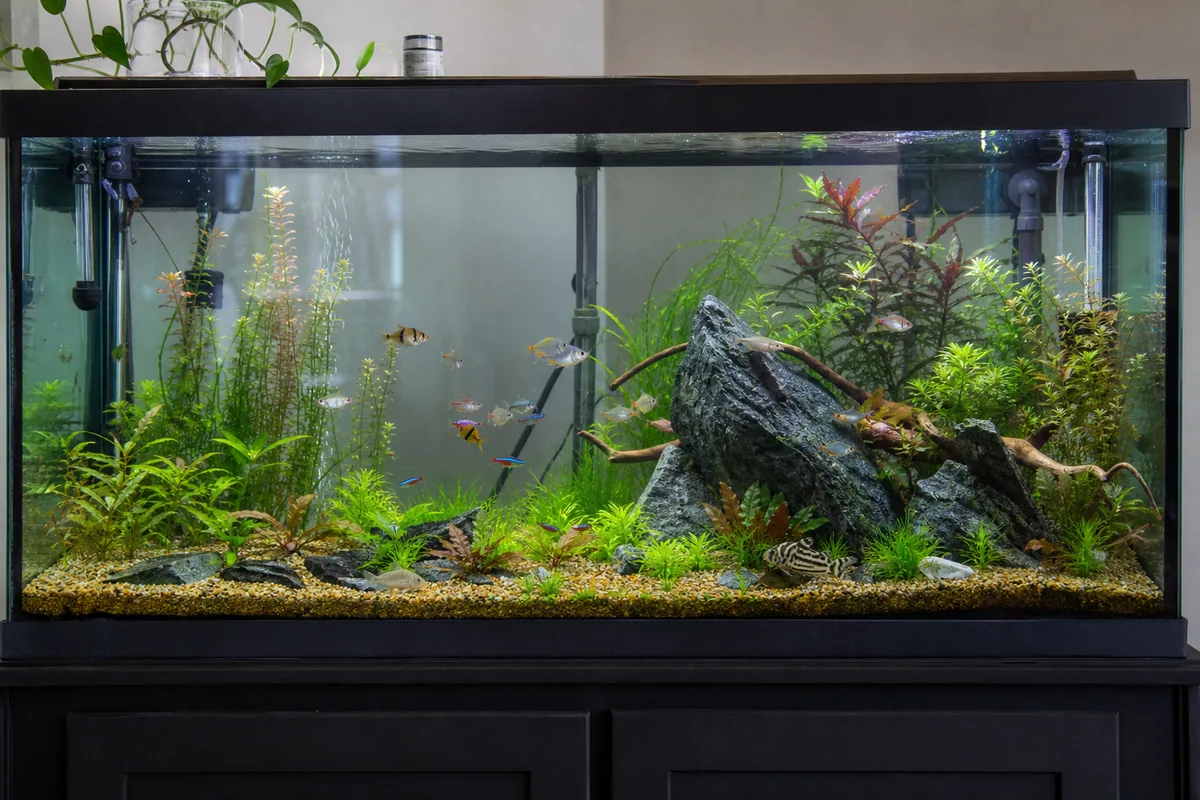
Why 75 Gallons Is a Different Category of Tank
A 75-gallon tank measures 48 x 18 x 21 inches. That 18-inch width is the number that matters.
A 55-gallon tank is also 48 inches long but only 13 inches wide: a full 5 inches narrower.
That width difference changes what you can stock. Wide-bodied fish like oscars and discus need front-to-back swimming room that a 55-gallon floor plan cannot provide.
A discus at 8 inches wide cannot turn comfortably in 13 inches of depth. In 18 inches, it can.
For a direct size comparison with the smaller option, see our 55-gallon stocking guide. If your shortlist already fits at 55 gallons, stop here.
If you want oscars, discus, or a clown loach school, the 75 is the minimum you need.
Three things separate a 75-gallon from smaller community tanks: the bioload each species generates, the filtration required to handle it, and the maintenance routine that keeps it stable. Each combo below is built with all three in mind.
Key facts
- Dimensions
- 48 x 18 x 21 inches
- Usable Volume
- ~65-68 gallons after substrate and hardscape
- Filled Weight
- ~850 lbs
- Width Vs. 55-Gallon
- 18' vs 13' front-to-back
- Filtration
- 400-600+ GPH canister or sump
- Heating
- Two 200W heaters
- Cycle Time
- 4-6 weeks; 1-2 weeks with seeded media
- Water Changes
- 25-30% weekly; 30-50% twice weekly for discus
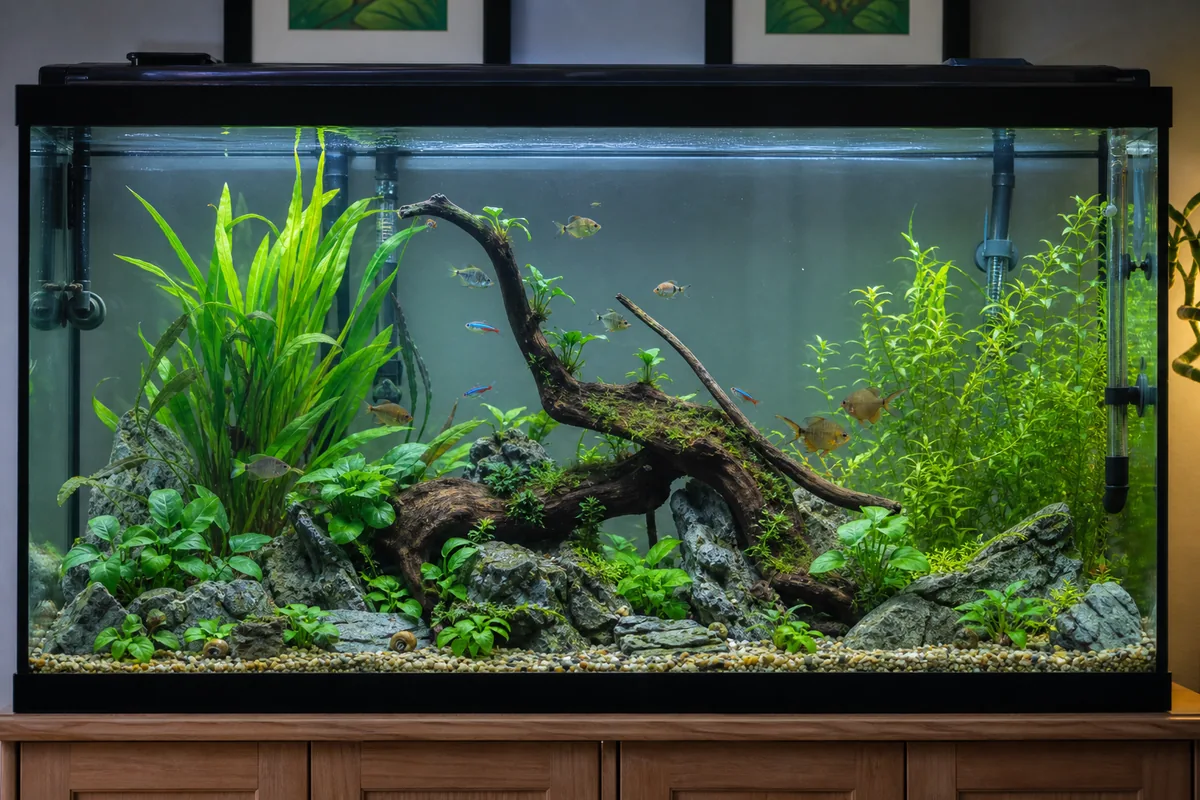
75 Gallon Tank Stocking: 4 Proven Combinations
These combinations are selected for compatibility, parameter overlap, and real-world track records in the hobby. Pick one and build around it.
Do not mix combos.
| Combo | Featured Species | Difficulty | Temp / pH | Min Filter GPH |
|---|---|---|---|---|
| Oscar Tank | Oscar + large pleco + silver dollars | Intermediate | 74-81°F / 6.8-7.5 | 600+ |
| Discus Showpiece | Discus + cardinal tetras + sterbai corys | Advanced | 82-86°F / 6.0-7.0 | 500+ |
| Large Community | Angels + rainbowfish + tetras + corys | Beginner-Intermediate | 76-82°F / 6.8-7.4 | 450+ |
| African Cichlid Peacock Tank | 15-20 mixed peacock cichlids | Intermediate | 76-82°F / 7.8-8.5 | 600+ |
Combo 1: Oscar Tank
One as a starter species fills a 75-gallon as a personality-first display. Oscars reach 12-14 inches and produce waste at a rate that overwhelms undersized filtration.
The 75 is the minimum tank size for a single adult. Do not attempt this in a 55-gallon.
A large pleco, either a sailfin or a common, handles algae and provides a species that the oscar largely ignores. Silver dollars complete the upper water column: a school of 5-6 is fast enough to evade oscar attention and large enough that the oscar does not see them as food.
- Oscar: one fish only. Two oscars require a minimum 125-gallon tank, even as a bonded pair.
- Large pleco: sailfin or common pleco at 6+ inches. Smaller plecos become oscar food.
- Silver dollars: school of 5-6. They occupy the upper and mid zones and require open horizontal swimming space.
- Avoid: any fish under 5 inches. Oscars are opportunistic predators and will eat anything that fits in their mouth.
Oscars redecorate tanks constantly: uprooting plants, moving substrate, and repositioning any decoration they can move. Skip live plants entirely.
Heavy rockwork anchored to the tank floor is the practical hardscape choice. For detailed oscar care, including feeding schedule and growth rates, see our full oscar guide.
Combo 2: Discus Showpiece
Six in their proper tank dimensions is one of the most visually impressive freshwater setups possible. A 75-gallon fits six adults comfortably with room for a full support cast beneath them.
Fifteen cardinal tetras fill the mid and lower water column with movement and color contrast. Ten sterbai corydoras clean the substrate and tolerate the elevated temperatures discus require, which most other corydoras species cannot handle.
This is one of the few corydoras species rated for 82-86°F.
- Discus: minimum group of 6 to distribute aggression and prevent pair bullying. Four or fewer leads to one fish being constantly harassed.
- Cardinal tetras: 15 is the target count. They school visually and provide movement at a scale that complements the discus without competing with them.
- Sterbai corydoras: 10 fish. Sterbai specifically: they are the temperature-tolerant corydoras species. Others at this temperature will suffer.
- Avoid: cool-water fish, most other corydoras species, and any fish that nips at discus fins.
Discus require soft, acidic water and pristine water quality. This is the most demanding combo on this list.
Daily feeding, frequent water changes (30-50% twice weekly), and consistent temperature monitoring are baseline requirements. This is not the setup for a keeper who travels frequently or skips maintenance weeks.
Combo 3: Large Community
The large community build is the most versatile combo on this list and the most forgiving for intermediate keepers making the step up from smaller tanks.
Six angelfish anchor the upper water column. Eight rainbowfish provide active, fast-moving contrast in the mid zone.
Twelve tetras, either rummy-nose or cardinals, school in the lower mid zone. Two bristlenose plecos handle algae on glass and wood without the bioload of a common pleco.
Ten corydoras, any species matched to your water temperature, clean the substrate.
Rainbowfish are one of the most underused centerpiece species for large community tanks. Our rainbowfish care guide covers the species differences between boesemani, turquoise, and threadfin varieties so you can pick the right size and temperament for your build.
| Species | Count | Zone | Role |
|---|---|---|---|
| Angelfish | 6 | Upper | Centerpiece |
| Rainbowfish | 8 | Mid | Active schooler |
| Rummy-nose or cardinal tetras | 12 | Lower mid | Schooling contrast |
| Bristlenose pleco | 2 | Bottom | Algae control |
| Corydoras (species-appropriate) | 10 | Bottom | Substrate cleanup |
This setup tolerates a moderate range of water parameters and does not require the precision maintenance of the discus combo. It is an appropriate first 75-gallon build for a keeper moving up from a 29 or 40-gallon tank.
Adding live plants to a large community build improves water quality by absorbing nitrates and gives angelfish the territory markers they use to reduce aggression. Our planted tank setup guide covers which substrate, lighting, and easy beginner plants work best in this size tank.
Combo 4: African Cichlid Peacock Tank
Fifteen to twenty mixed peacock cichlids from Lake Malawi create a high-movement, intensely colored display that requires almost no live plants and thrives in water conditions opposite from most other freshwater setups.
Peacock cichlids need hard, alkaline water at pH 7.8-8.5. This rules out mixing with any other combo on this list.
They are an African rift lake species that requires its own dedicated chemistry. African cichlid tank builds are a separate discipline from general freshwater community setups.
- 15-20 mixed peacocks: heavy stocking dilutes aggression across multiple targets rather than concentrating it on one or two fish. Underfilled African cichlid tanks have more aggression problems than appropriately stocked ones.
- All-male or species-specific groups: all-male groups produce the most color. Mixed-sex groups breed heavily and require a plan for fry management.
- Large flat rocks and cave structures: cichlid-appropriate hardscape is functional, not decorative. Territory boundaries defined by rock reduce fight frequency.
- No live plants: peacock cichlids uproot everything and need the alkaline substrate conditions that most aquatic plants cannot tolerate.
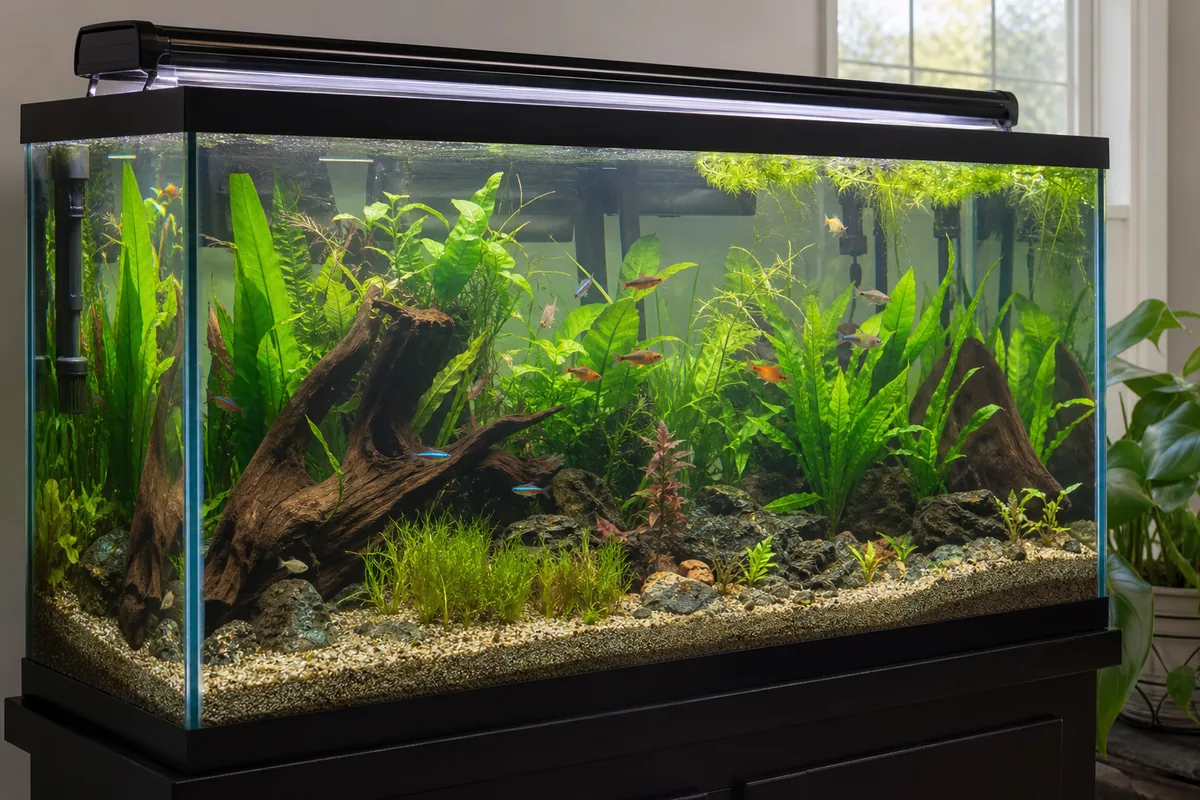
Equipment for a 75-Gallon Tank
Filtration is where most 75-gallon setups fail in the first year. The tank volume is large enough that keepers assume a single adequate filter will handle it.
It does not.
A canister filter rated at 400+ GPH, or a sump system, is the baseline for every combo on this list except the large community, which can run a pair of hang-on-back filters at 350 GPH combined. For the oscar or African cichlid combo, run a canister plus a secondary filter for a combined 600+ GPH.
Oscars produce bioload that stacks waste faster than most single filters can process.
75 Gallon Tank Stocking: How to Set Up Before Fish Go In
The setup sequence matters as much as the species list. A 75-gallon filled, cycled, and stable before fish are added performs far better than one rushed into stocking.
Follow this order regardless of which combo you chose.
- Confirm your floor and stand can hold 850 lbsCheck your stand's rated capacity before anything else. Upper-floor installations should be assessed by a contractor. A failure at this size causes structural damage, not just a spill.
- Install substrate before fillingAdd 2-3 inches of substrate matched to your combo: aragonite sand for African cichlids, fine pool sand for corydoras builds, or planted substrate for discus and community setups. Rinse until runoff is clear.
- Place hardscape before waterPosition driftwood, rocks, and caves first, then fill slowly around them. Anchor hardscape for oscar and cichlid builds where rearrangement is likely.
- Install filtration, heaters, and thermometerMount filters per manufacturer instructions. Place both heaters on opposite sides of the tank. Set a separate thermometer on the far end to verify even heat distribution.
- Fill and treat the waterFill to the waterline and dose water conditioner fully. Run all equipment for 24 hours before starting the nitrogen cycle.
- Cycle for 4-6 weeksDose ammonia to 2 ppm and test every 2-3 days. The cycle is complete when ammonia and nitrite both read 0 ppm. Seeding with established media cuts this to 1-2 weeks.
- Stock one species at a timeAdd your first species after a 50% water change post-cycle. Start with the hardiest species in your combo and wait 2 weeks between each addition. Test parameters after every new group.
The nitrogen cycle is the single most important concept to understand before any fish go in. Our tank cycling guide explains how to read ammonia, nitrite, and nitrate test results accurately and confirms exactly when a 75-gallon is safe to stock.
Filtration and Heating: What 75 Gallons Actually Requires
Filter turnover of 5-10x tank volume per hour means 375-750 GPH for a 75-gallon. Rated flow overstates real-world flow: a filter labeled 400 GPH delivers roughly 250-300 GPH through loaded media.
Size up, not down.
Pairing two filters beats one large unit. If one needs maintenance, the second keeps biological filtration running while you clean the first.
- Never clean both filters in the same week. Stagger maintenance by 2-3 weeks to preserve the bacterial colony in the second filter.
- Rinse filter media in removed tank water only, never tap water. Chlorine kills beneficial bacteria on contact.
- Replace mechanical media (sponge, floss) when flow drops noticeably. Replace biological media (ceramic rings, bio balls) only when it physically degrades, not on a schedule.
- Check impeller condition every 3-4 months. A worn impeller reduces flow significantly without triggering a visible warning.
Heating a 75-gallon tank with two 200W units rather than one 400W unit is the standard approach for any combination with expensive fish. Discus especially require this redundancy.
The dual-heater approach is also relevant to species like clown loaches, which are sensitive to temperature drops and costly to replace at adult size.
Sources and references
- Water Quality Criteria for Warm Water Fish Species: Temperature, pH, and Dissolved Oxygen TolerancesSouthern Regional Aquaculture Center, SRAC Publication No. 4601
- Biological Filtration and Nitrification in Recirculating Aquaculture Systemsof Florida IFAS Extension, Circular FA-16
- Social Behavior and Aggression in Cichlidae: Implications for Captive Managementof Fish Biology, Vol. 96, Issue 4, 2020