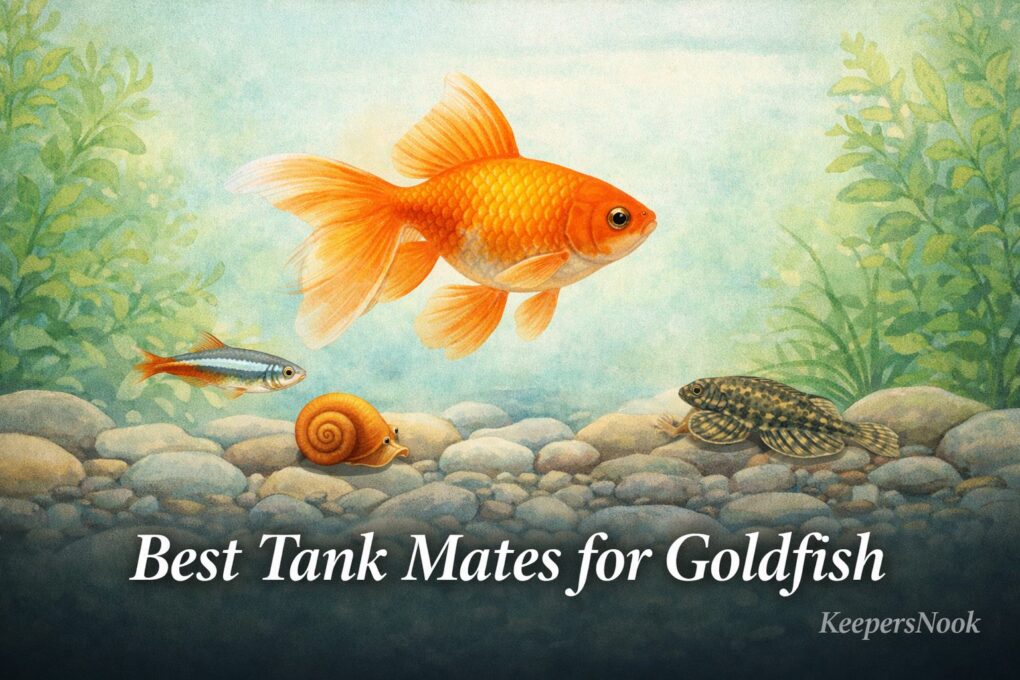
Most goldfish community tanks fail within six months. The fish die, the keeper blames bad luck, and the actual cause never gets diagnosed.
The real cause is almost always a 10°F temperature gap nobody warned them about.
We pulled every species that fish forums, pet stores, and compatibility listicles recommend as goldfish companions. Then we filtered by the four requirements below.
Eight species survived the cut. Here they are, ranked.
Why Goldfish Tank Mates Fail: The 65-75°F Requirement
Goldfish need 65-75°F to stay healthy long-term. That is not a preference.
Remember it later
Planning to try this recipe soon? Save it for a quick find later!
It is a biological requirement tied to their immune function, digestion, and lifespan.
Tropical fish need 76-82°F. Those two ranges share zero degrees of overlap.
Goldfish also produce 3-4x the ammonia of most tropical species at the same size. Any tank mate you add must tolerate elevated nitrogen levels while you maintain water changes.
The third issue is food competition. Goldfish are aggressive eaters, and slow or small tank mates get pushed out of feeding zones entirely.
The species that work are cold-water natives or cold-tolerant fish with enough speed, size, or armor to hold their own in a high-waste, competitive tank.
What Makes a Good Goldfish Tank Mate: 4 Requirements
Every candidate on the ranked list below passes all four of these filters. A species that fails even one does not belong in a goldfish tank, regardless of what a pet store label says.
Most tropical community fish pass one or two of these. Almost none pass all four.
That is why the workable list is short.
The eight species below pass all four. We ranked them by how cleanly they fit, not by how popular they are at your local fish store.
8 Best Goldfish Tank Mates, Ranked
Each entry covers temperature range, minimum tank size, school size, and whether it works with fancy or single-tail goldfish.
1. White Cloud Mountain Minnow
White Cloud Mountain Minnows are the most natural goldfish tank mate in the hobby. They come from cold, fast-moving streams in the mountains of southern China, where 60-72°F is not a tolerance range.
It is home.
Their temperature range overlaps with goldfish almost perfectly. You do not need to warm the tank for them or cool it for the goldfish.
Both fish stay in their preferred zone at the same thermostat setting.
At 1.5 inches, they are too fast to be caught and too small to threaten any goldfish. School eight or more for a confident group that holds its position in midwater rather than hiding at the edges.
A tight school moving through a well-planted goldfish tank is one of the better-looking community setups you can build at a beginner budget.
- Temperature: 60-72°F
- Min tank: 20 gallons with goldfish
- School size: 8 or more
- Fancy goldfish compatible: Yes, with single-point feeding
- Rating: Best Overall
White Clouds are also inexpensive and widely available. If you only add one species to a goldfish tank, this is the one.
2. Dojo Loach
Dojo Loaches are built for cold water. Misgurnus anguillicaudatus is native to muddy streams and rice paddies across East Asia, where water temperatures drop to 40°F in winter.
They are one of the hardiest fish in the freshwater hobby for unheated setups.
They grow to 6-10 inches, which puts them well outside goldfish predation risk. Their eel-like body and burrowing behavior keeps them in the substrate zone where goldfish rarely focus.
They need sand or very fine gravel to burrow comfortably. Hard substrate chips their barbels over time, which leads to infection.
They are social in a low-key way and do better with at least one companion of their own species.
- Temperature: 60-75°F
- Min tank: 30 gallons
- Group size: 2 or more
- Fancy goldfish compatible: Yes, bottom-dwellers do not compete for surface food
- Rating: Best Bottom Dweller
Their appetite for leftover food reduces the waste burden in a high-output goldfish tank. They also respond to barometric pressure changes before storms by becoming unusually active, which makes them one of the more interesting fish to observe in a cold-water setup.
3. Bristlenose Pleco
Bristlenose Plecos sit at the borderline of goldfish temperature compatibility. Their preferred range runs 65-80°F, which overlaps with the upper end of goldfish water.
An indoor tank kept consistently at 68-72°F works for both.
Read our armored pleco compatibility guide before purchasing if your room runs cold in winter. Fluctuations below 65°F push them into immune vulnerability faster than most keepers expect.
They stay under 5 inches, which is why they work where a common pleco would not. Their armored body and spiny fins make goldfish lose interest quickly after the first curious nip.
They handle the algae and biofilm buildup that a heavily fed goldfish tank generates.
- Temperature: 65-80°F
- Min tank: 30 gallons
- Group size: Solo or pair
- Fancy goldfish compatible: Yes, no food competition at the bottom
- Rating: Best Algae Eater
Keep the temperature stable. A bristlenose that experiences repeated dips below 65°F will develop stress-related disease more quickly than the goldfish it shares water with.
4. Rosy Barb
Pethia conchonius is the cold-water exception in the barb family. Most barbs need tropical temperatures.
Rosy Barbs thrive at 64-72°F, which aligns directly with goldfish. Males develop deep pink coloring during breeding that makes them one of the most visually striking choices on this list.
Their active swimming style keeps them in constant motion. Goldfish cannot catch them.
The catch is the same one that applies to any active barb: keep six or more. A small group with no schooling outlet will nip fins.
With six-plus fish focused on each other, nipping behavior drops to near zero.
- Temperature: 64-72°F
- Min tank: 30 gallons
- School size: 6 or more
- Fancy goldfish compatible: No. Their speed wins every food race against slow fancy varieties
- Rating: Best Color
Pair Rosy Barbs only with single-tail goldfish. Their activity level and competitive feeding are exactly the wrong combination for ranchus or orandas.
5. Hillstream Loach
Hillstream Loaches (genus Sewellia or Gastromyzon) are the most specialized option on this list. They evolved in fast, highly oxygenated mountain streams at 65-75°F.
Goldfish tanks, which benefit from strong filtration and surface agitation, already provide close to the right conditions.
Their flat, ray-like body lets them cling to glass and smooth rocks in current that would knock other fish around. They are completely peaceful with goldfish and will not be bothered in return.
The one strict requirement is water quality. Hillstream Loaches are the first indicator species to suffer when ammonia or nitrite climbs.
A goldfish tank must be fully cycled and well-filtered before adding them.
- Temperature: 65-75°F
- Min tank: 30 gallons with strong flow
- Group size: 3 or more
- Fancy goldfish compatible: Yes, one of the few species that works with ranchus
- Rating: Best for High-Flow Tanks
In a mature, high-flow setup with a cycled goldfish tank, Hillstream Loaches are among the most interesting fish on this list to observe. They are not for beginners who are still dialing in water chemistry.
6. Mystery Snail
Mystery Snails are the easiest goldfish tank mate you can buy. They tolerate 65-82°F, eat algae and leftover food, and require no schooling minimum or special substrate.
Drop one in a cycled goldfish tank and it gets to work.
Their shell is the key to compatibility. Goldfish are curious and will mouth a Mystery Snail immediately.
The shell is too large to swallow and too hard to crack. After one attempt, most goldfish ignore them entirely.
- Temperature: 65-82°F
- Min tank: Any cycled goldfish setup
- Group size: Solo or group
- Fancy goldfish compatible: Yes, the safest option for slow fancy varieties
- Rating: Best Budget
They do breed in freshwater, so control population by keeping one sex. A mature goldfish will eat snail eggs and hatchlings, which keeps numbers in check in most tanks naturally.
Their waste contribution is minimal compared to the goldfish already in the tank.
7. Zebra Danio
Zebra Danios have the widest temperature tolerance of any commonly available schooling fish. They handle 64-77°F and are one of the very few species that crosses the tropical-to-cold boundary.
Our cold-tolerant danios profile covers the full range, but the short version is this: they work in goldfish tanks kept at 68-72°F.
They are fast, schooling fish that goldfish cannot catch. Keep six or more.
A small group becomes skittish and erratic, which creates stress in the tank. A full school of danios moves as a unit and holds the midwater zone confidently.
- Temperature: 64-77°F
- Min tank: 20 gallons
- School size: 6 or more
- Fancy goldfish compatible: Borderline. They are faster feeders than fancy varieties
- Rating: Most Cold-Tolerant Tropical
Do not keep Zebra Danios in tanks that regularly drop below 65°F. Their cold tolerance is real, but extended time at the low end pushes them toward immune stress the same way warm water does to goldfish.
8. Variatus Platy
The Variatus Platy (Xiphophorus variatus) is the cold-tolerant cousin of the common platy. Standard platies need 72-78°F.
Variatus Platies tolerate as low as 60°F and thrive at 65-75°F. That range makes them one of the few livebearers that can share a goldfish tank without a heater.
Check our variatus platy identification guide for visual ID tips. They are often sold mixed with common platies at retail, and buying the wrong species by mistake is a common error.
- Temperature: 60-75°F
- Min tank: 20 gallons
- Group size: 3 or more
- Fancy goldfish compatible: Borderline. Keep same-sex groups to avoid population growth
- Rating: Best Livebearer
Variatus Platies breed readily, and goldfish tanks already carry a heavy bioload. Keep only males or only females to prevent population growth.
Goldfish will eat fry, which limits runaway breeding, but the added ammonia from a breeding population on top of goldfish waste is a filtration problem you do not need.
8 Goldfish Tank Mates Compared: Full Data Table
Use this table for side-by-side specs before making a purchase decision. Ratings reflect overall fit in a standard goldfish community setup.
| Species | Temp Range | Min Tank | School/Group | Fancy Compatible | Rating |
|---|---|---|---|---|---|
| White Cloud Mountain Minnow | 60-72°F | 20 gal | 8+ | Yes | Best Overall |
| Dojo Loach | 60-75°F | 30 gal | 2+ | Yes | Best Bottom Dweller |
| Bristlenose Pleco | 65-80°F | 30 gal | Solo/pair | Yes | Best Algae Eater |
| Rosy Barb | 64-72°F | 30 gal | 6+ | No | Best Color |
| Hillstream Loach | 65-75°F | 30 gal | 3+ | Yes | Best High-Flow |
| Mystery Snail | 65-82°F | Any | Solo/group | Yes | Best Budget |
| Zebra Danio | 64-77°F | 20 gal | 6+ | Borderline | Most Cold-Tolerant |
| Variatus Platy | 60-75°F | 20 gal | 3+ | Borderline | Best Livebearer |
Temperature range is the first column to check. If a species cannot tolerate 65-72°F, nothing else in the table matters.
Species to Never Put with Goldfish
The wrong pairing does not just stress one fish. It accelerates disease in both.
The species below fail the temperature test and belong in tropical tanks only.
Every species on that avoid list fails the first requirement: cold-water tolerance. No amount of acclimation fixes a biological temperature mismatch.
We documented the specific stress markers that appear when incompatible pairings are forced together in our betta incompatibility breakdown. The immune failure timeline is faster than most keepers expect.
For tropical setups with multiple species competing for tank mates, our betta community rankings cover a completely separate candidate list suited to warm-water tanks.
Fancy vs. Single-Tail Goldfish: Why Your Tank Mate List Changes
Not all goldfish are equal candidates for community tanks. The variety you keep changes which species from this list are safe to add.
The problem is not aggression between species. It is food access for the goldfish itself.
A slow fancy goldfish loses every feeding race to Rosy Barbs, White Cloud Minnows, and Zebra Danios. If you keep fancy varieties, feed in two spots simultaneously or use a feeding ring that separates the goldfish from faster tank mates.
Size also matters across time. A 12-inch comet in a 55-gallon tank will eat anything that fits in its mouth.
White Cloud Minnows may be safe at juvenile goldfish sizes but become prey as the goldfish grows. Plan for adult size, not the size at purchase.
Goldfish are among the highest bioload fish in the hobby. The standard formula of 1 inch of fish per gallon fails completely for goldfish because it ignores waste output.
Use these minimums as your baseline:
- 1 fancy goldfish: 20 gallons minimum, 30 preferred
- Each additional fancy goldfish: +10 gallons
- 1 single-tail (comet, common): 40 gallons minimum
- Each additional single-tail: +20 gallons
- Tank mate school (White Clouds, Danios, Barbs): +10 gallons per school
A single fancy goldfish with a school of 8 White Cloud Minnows needs at minimum a 30-gallon tank with a filter rated for double the volume. Our undersized tank breakdown covers why underpowered filtration is the second most common failure point after temperature mismatch.
A 10-gallon tank is not suitable for goldfish community stocking under any configuration. Review our minimum tank sizing rules if you are working with smaller setups that may be better suited to other species.
Goldfish communities work best when the tank is sized for the goldfish first, then tank mates are added to the remaining space, not the other way around.
What to Feed a Mixed Goldfish Community Tank
Feeding a mixed tank requires a different approach than a species-only setup. Goldfish are surface and midwater feeders that vacuum food aggressively.
Bottom dwellers and slower species need food to reach them without being intercepted.
- Sinking pellets: drop these first for Dojo Loaches, Bristlenose Plecos, and Hillstream Loaches before adding surface food
- Goldfish flakes or pellets: add to the surface after sinking food is already in transit to the bottom
- Algae wafers: place in a corner at lights-out for nocturnal bottom feeders
- Cucumber and zucchini slices: valid supplement for Bristlenose Plecos and Mystery Snails. See our cucumber feeding guide for prep details
- Avoid bread entirely: it creates ammonia spikes in any tank, and goldfish tanks already run high. Our bread feeding risks article covers the water quality consequences
Feed small amounts two to three times per day. Goldfish produce enough waste on a standard feeding schedule.
Overfeeding compounds the nitrogen problem fast in any community tank.