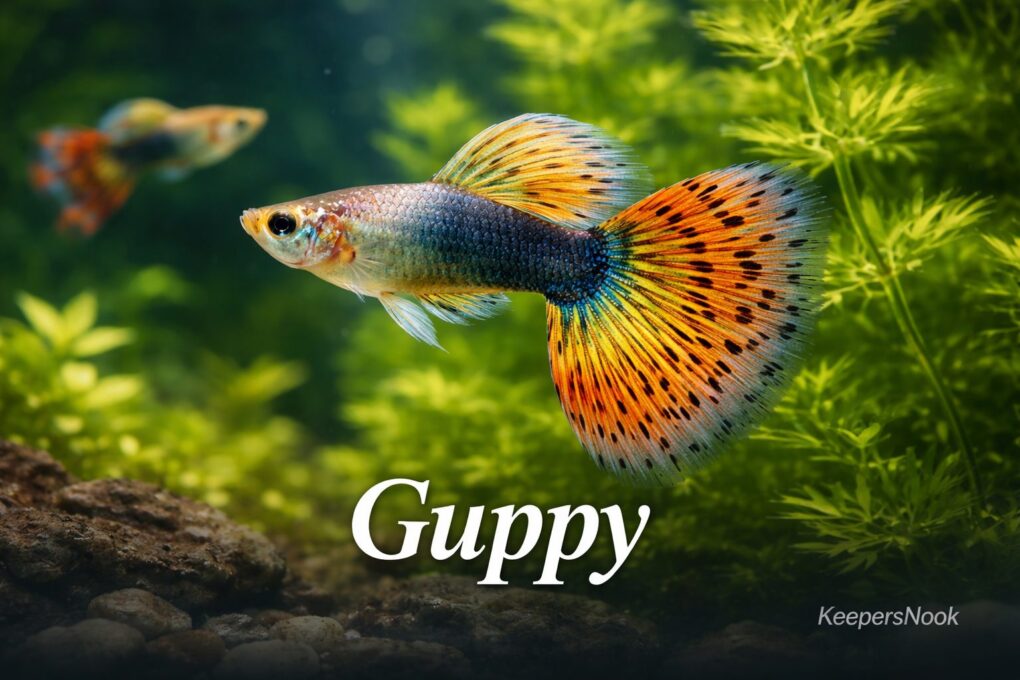
Guppies (Poecilia reticulata) were first described scientifically in 1859 and have since become the most widely kept freshwater fish on the planet. Wild populations live in Venezuela, Trinidad, and surrounding Caribbean drainages, where they inhabit warm, slow-moving water with dense vegetation.
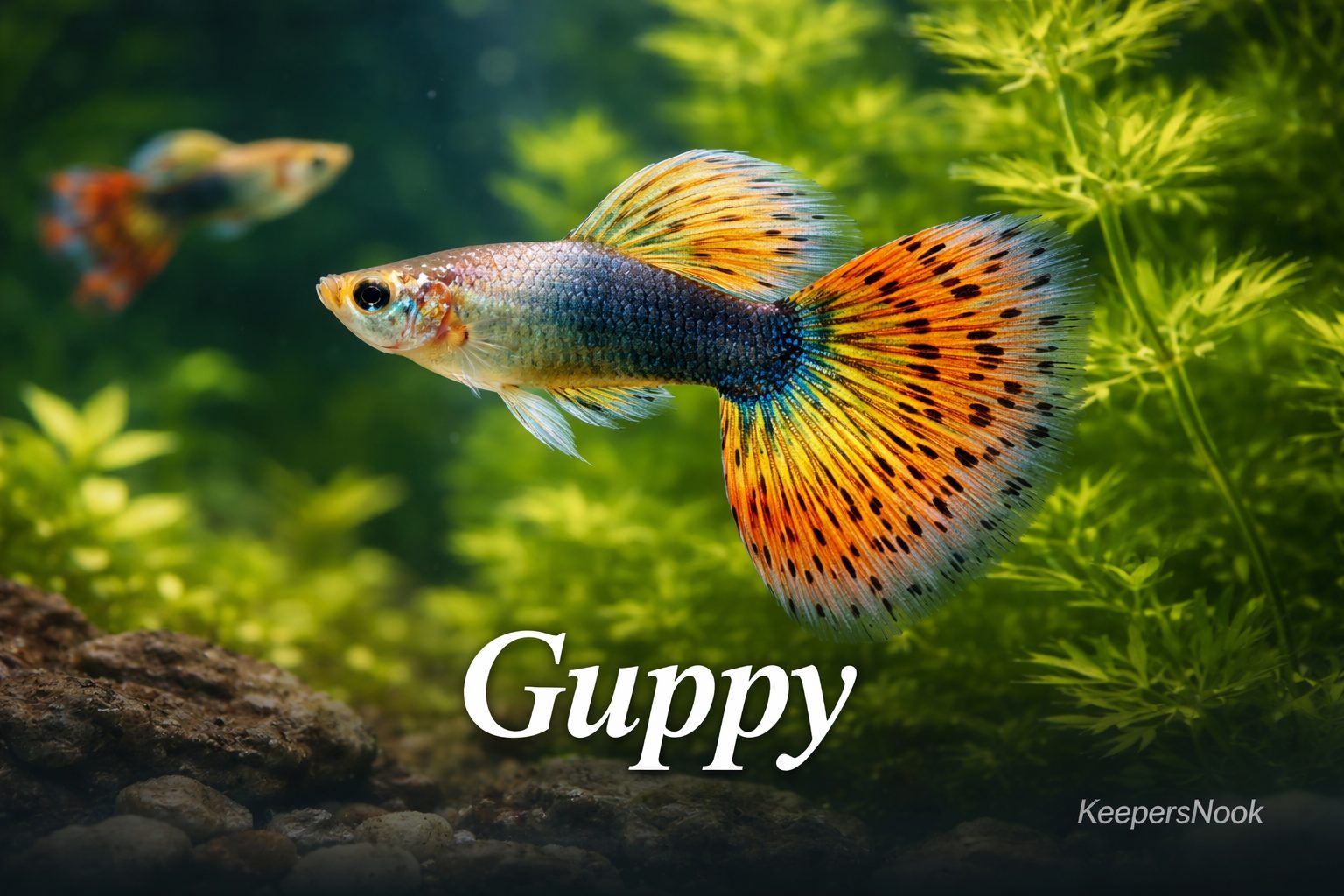
The ornamental strains sold in shops today descend from decades of selective breeding.
We keep guppies in this guide as the complete picture: tank setup, water parameters, feeding, compatible tank mates, breeding, and the color classification system that makes collecting them so satisfying.
Guppy Tank Setup: 10 Gallons Is the True Minimum for a Trio
Many shops sell guppies with a "works in any tank" label, and that half-truth has killed countless fish. A 5-gallon tank destabilizes too fast for a mixed-sex group.
Remember it later
Planning to try this recipe soon? Save it for a quick find later!
Check our 5-gallon tank stocking guide to see what actually works at that size. Guppies need room to establish social hierarchies without constant stress.
A 10-gallon tank holds three guppies: one male and two females. That 1:2 male-to-female ratio keeps males from over-pursuing a single female.
You can stock a 20-gallon to hold six to eight fish without crowding. Our 10-gallon tank stocking breakdown shows exactly how many fish fit safely at different bioloads.
Filtration matters more than most beginners expect. Guppies produce bioload continuously, and a tank without an established nitrogen cycle will swing ammonia fast.
Use a sponge filter in breeding tanks or a hang-on-back with the outflow baffled so fry are not sucked in.
- Substrate: fine gravel or sand. Bare-bottom tanks work for breeding setups but stress display fish.
- Plants: java moss, hornwort, or guppy grass provide cover for fry and reduce male aggression.
- Lighting: 8–10 hours per day. No special spectrum required. standard LED works fine.
- Water changes: 25–30% weekly. Nitrates should stay under 20 ppm between changes.
- Temperature stability: swings beyond 4°F in 24 hours trigger ich outbreaks. A quality heater with a built-in thermostat prevents this.
Guppy Water Parameters: pH 6.8–7.8 Covers the Full Range
Guppies are often called "adaptable," but that word hides important nuance. They tolerate pH 6.8–7.8 and hardness between 8–12 dGH.
Soft, acidic water below pH 6.5 shortens their lifespan and suppresses immune function over months. Alkaline tap water at pH 7.4–7.6 is actually ideal for most strains.
Temperature range is 72–82°F, with 76–78°F as the target for general keeping. At the high end of the range, metabolism accelerates, breeding increases, and lifespan shortens.
At the low end, immunity weakens and ich risk rises. Keep the heater at a consistent midpoint and you avoid both problems.
- Ammonia: 0 ppm at all times. Any detectable ammonia is a water change trigger.
- Nitrite: 0 ppm. Elevated nitrite causes brown blood disease in small fish fast.
- Nitrate: under 20 ppm. Weekly 25% changes maintain this in most stocked tanks.
- Hardness (dGH): 8–12 is the sweet spot. Below 4 and above 20 both cause long-term stress.
Guppy Diet: 3 Daily Feedings Produce the Best Color and Fin Growth
Guppies are omnivores with a lean toward protein. Wild fish eat mosquito larvae, small invertebrates, and algae.
In captivity, high-quality flake or micro-pellet food as a base, supplemented with frozen or live foods, produces the richest color development and strongest fin growth.
Variety matters for color expression. Spirulina-enhanced flakes boost red and blue pigmentation.
Frozen bloodworms and brine shrimp provide protein that drives fin length in show strains. Avoid feeding live tubifex worms. they carry a high parasite load and are not worth the risk.
- Base diet: high-quality micro-pellet or flake with 45%+ protein, no wheat as the first ingredient.
- Protein supplements: frozen brine shrimp, daphnia, or bloodworms, 2–3 times per week.
- Vegetable matter: spirulina flakes or blanched spinach once or twice a week for gut health.
- Fry diet: powdered flake, infusoria, or vinegar eels for the first 2 weeks after birth.
Guppy Tank Mates: 8 Compatible Species and 3 to Avoid
Guppies are peaceful and mid-water swimmers, which makes them compatible with most non-aggressive community fish. The risks come from two directions: fin-nippers that shred guppy tails, and larger predators that treat guppies as live food.
Males with long, flowing tails are especially vulnerable to species like tiger barbs.
One question we get constantly is whether can live with guppies. The short answer is: sometimes.
A calm female betta in a well-planted 20-gallon with male guppies may ignore them. An aggressive male betta will shred fins in hours.
Test with a divider first. For community builds without that risk, keeping guppies with mollies is a safer default: both species share similar water requirements and peaceful temperament.
Platies are another reliable choice that shares the livebearer care profile with guppies. Both prefer slightly hard, neutral-to-alkaline water.
You can keep them together in a 20-gallon with a standard community setup and both will thrive. Mollies also work, though they prefer slightly warmer and harder water, so check parameters before mixing.
Neon tetras coexist with guppies provided the temperature stays at 76°F or below, which sits at the bottom of the neon's range. At 78°F+, tetras show stress over weeks.
For a bottom-level cleanup crew, corydoras are the top choice: they ignore guppies entirely and scavenge the substrate layer guppies never use. Combining both means you cover all three tank levels without any aggression risk.
For a broader view of which species fit a mixed community, our tank mate selection framework covers the key variables: temperament, temperature overlap, and fin vulnerability. Swordtails also pair well with guppies. both are livebearers, and their size difference prevents interbreeding.
Guppy Color Varieties: 50+ Recognized Strains Across 5 Classification Categories
The International Fancy Guppy Association (IFGA) recognizes over 50 distinct strains, classified by body color, pattern, and tail shape. The table below covers the major categories and the most widely available strains in each.
| Category | Example Strains | Tail Shape | Key Feature |
|---|---|---|---|
| Solid Color | Red, Blue, Green, Purple, Yellow | Fan, Veil, Delta | Uniform single-color body and fin |
| Multi-Color | Moscow Blue, Neon, Flamingo | Delta, Lyretail | Body and fin carry distinct contrasting colors |
| Metallic / Iridescent | Platinum, Gold, Cobra | Fan, Roundtail | Reflective scales that shift color under light |
| Patterned | Cobra, Snakeskin, Tuxedo | Delta, Lyretail, Pin | Repeating scale pattern on body or fin |
| Albino / Lutino | Albino Red, Albino Blue, Lutino | Any | Red eyes, pink or pale body, lacks dark pigment |
| Show / Pedigree | IFGA Certified Red, Moscow | Delta (min. 45°) | Bred to strict IFGA standards for competition |
Tail shape is as much a classification marker as color. Delta tails spread at a minimum 45-degree angle and are the most common.
Lyretails have two extended lobes at the top and bottom. Pintails narrow to a single point.
Roundtails are exactly as described: a circular fin with no extensions. The IFGA tracks each combination separately in show competition.
- Delta tail: broad, triangular spread, the standard show tail shape, spans from top to bottom caudal base.
- Lyretail: top and bottom lobes elongate into points, with a concave edge between them.
- Veil tail: drooping, flag-like fin that hangs lower than a delta and is wider at the base.
- Double sword: top and bottom caudal rays extend into symmetric points, body fin is shorter.
- Pintail / needle: caudal fin tapers to a single central point, rare in pet stores, common in specialty breeding.
Red Guppy: the most widely kept solid strain. Males show full-body red with a matching red tail.
Females are silver-gray with faint red in the tail. Bred from wild Venezuelan populations.
Blue Guppy: body ranges from cobalt to sky blue depending on the breeding line. Moscow Blue is the most saturated variant and was developed in Russia in the 1970s.
Purple Guppy: rarer in shops. True purple requires careful selective breeding to maintain color stability across generations.
Often shifts toward blue in poor-quality lines.
Yellow / Blonde: a recessive blonde gene removes the dark pigment layer. Yellow blondes show bright lemon-gold tails without any black edging.
Cobra Guppy: the most recognizable pattern strain. Vertical barring on the body resembles snakeskin, with a contrasting tail color.
Orange, yellow, and blue cobra variants exist.
Snakeskin: similar to cobra but with a finer, more reticulated scale pattern. Often metallic.
Crosses with delta-tail lines produce snakeskin deltas that are popular in shows.
Tuxedo: the rear half of the body is darker than the front, creating a two-tone effect. Can appear in combination with most tail colors.
Half-black tuxedos have a clean black posterior section.
Platinum Guppy: the body carries a reflective, chrome-like sheen from iridescent pigment cells (iridophores). Pairs with any tail color.
Platinum reds and platinum blues are common in specialty shops.
Gold / Metallic Gold: gold pigment replaces the standard gray body scale. Distinct from blonde: gold is a dominant gene, blonde is recessive.
Albino: red eyes, pink skin, and reduced melanin throughout. Colors appear lighter and warmer than the equivalent non-albino strain.
Albino reds are bright orange-red rather than deep crimson.
Guppy Breeding: One Female Drops 20–80 Fry Every 28 Days
Guppies breed constantly without any intervention from the keeper. A single pregnant female can produce 20–80 live fry per drop, every 21–35 days.
The challenge is not getting them to breed. it is managing the population and keeping fry alive past the first 48 hours.
Sexing guppies is possible at 4–6 weeks of age. Males develop color early and show a long, thin gonopodium (modified anal fin) instead of the triangular anal fin females carry.
Females grow larger, remain silver-gray with faint markings, and develop a gravid spot (dark patch near the anal fin) when pregnant.
Gestation: 21–35 days depending on temperature. At 80°F, expect the shorter end.
At 72°F, closer to 35 days. The gravid spot darkens as the fry eyes become visible through the body wall in the final week.
Dropping: females drop fry one by one, not all at once. The process takes 1–6 hours.
Fry are born free-swimming and immediately seek cover. Adult guppies, including the mother, will eat fry.
Separate the female into a breeder box or heavily planted section 48–72 hours before the expected drop date.
Breeder box vs.separate tank: a separate 5-gallon fry tank with a sponge filter is better than a floating breeder box. Boxes stress the mother and expose fry to ammonia spikes in a very small volume.
A dedicated fry tank with live plants and the same water parameters as the main tank is the safer option.
Fry care: feed 3–4 times per day in tiny amounts. Powdered flake, baby brine shrimp, and infusoria all work.
Fry require 25% water changes every 3–4 days. They show sex at 4–6 weeks.
Separate males before 6 weeks to prevent unplanned breeding and inbreeding within the batch.
Controlling population: the easiest method is keeping all males or all females. For a display tank, an all-male group shows maximum color with no breeding.
If you want to breed selectively, keep one strain per tank and cull non-conforming fry at 6 weeks before color sets fully.
An all-male tank is the simplest way to enjoy guppy color variety without managing population. Six males in a 10-gallon with corydoras and a few plants make a striking display with zero breeding complexity.
The males will spar with fin flares but rarely cause injury without females driving competition.
Guppy Health: 4 Most Common Diseases and Their Treatments
Guppies are hardy but not indestructible. Most disease outbreaks trace back to a single cause: poor water quality or temperature instability.
A guppy that drops fins, clamps its tail, or hides in a corner is almost always reacting to something wrong in the water column before any pathogen is involved.
- Ich (white spot): fine white dots covering the body and fins, often after a temperature drop. Treat with raised temperature (82°F) plus copper-based medication or ich-X. Remove carbon from the filter during treatment.
- Fin rot: frayed, receding fin edges, often with a gray or black border. Caused by bacteria thriving in high-nitrate water. Fix water quality first, then use erythromycin or kanamycin if bacterial infection persists.
- Guppy disease (Tetrahymena): a protozoan that causes patchy, discolored skin and shimmying behavior. More lethal than ich and resistant to standard ich treatments. Requires formalin-based medication.
- Swim bladder disorder: fish swims sideways or sinks. Often dietary. constipation from overfeeding. Fast the tank for 48 hours and add daphnia to the diet. If structural, the condition is usually not treatable.
Quarantine new fish for 2–3 weeks before adding them to an established tank. Most disease introductions come from skipping this step.
A bare 10-gallon quarantine tank costs less than a single round of disease treatment in a populated community tank.