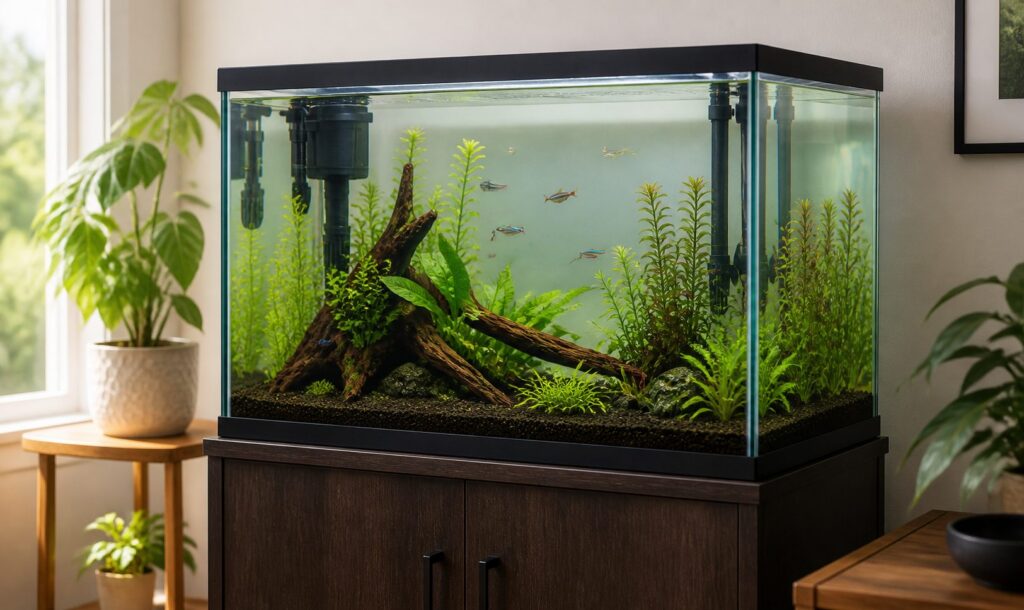
This guide covers four proven stocking combos, the equipment that supports them, and the cycling process that makes any combo last.
Why the 20-Gallon Tank Is the Real Starting Point for 20 Gallon Stocking
The hobby has a running joke that a 10-gallon is is a beginner tank and a 20-gallon is where beginners who actually know what they are doing start. That joke exists for good reason.
Remember it later
Planning to try this recipe soon? Save it for a quick find later!
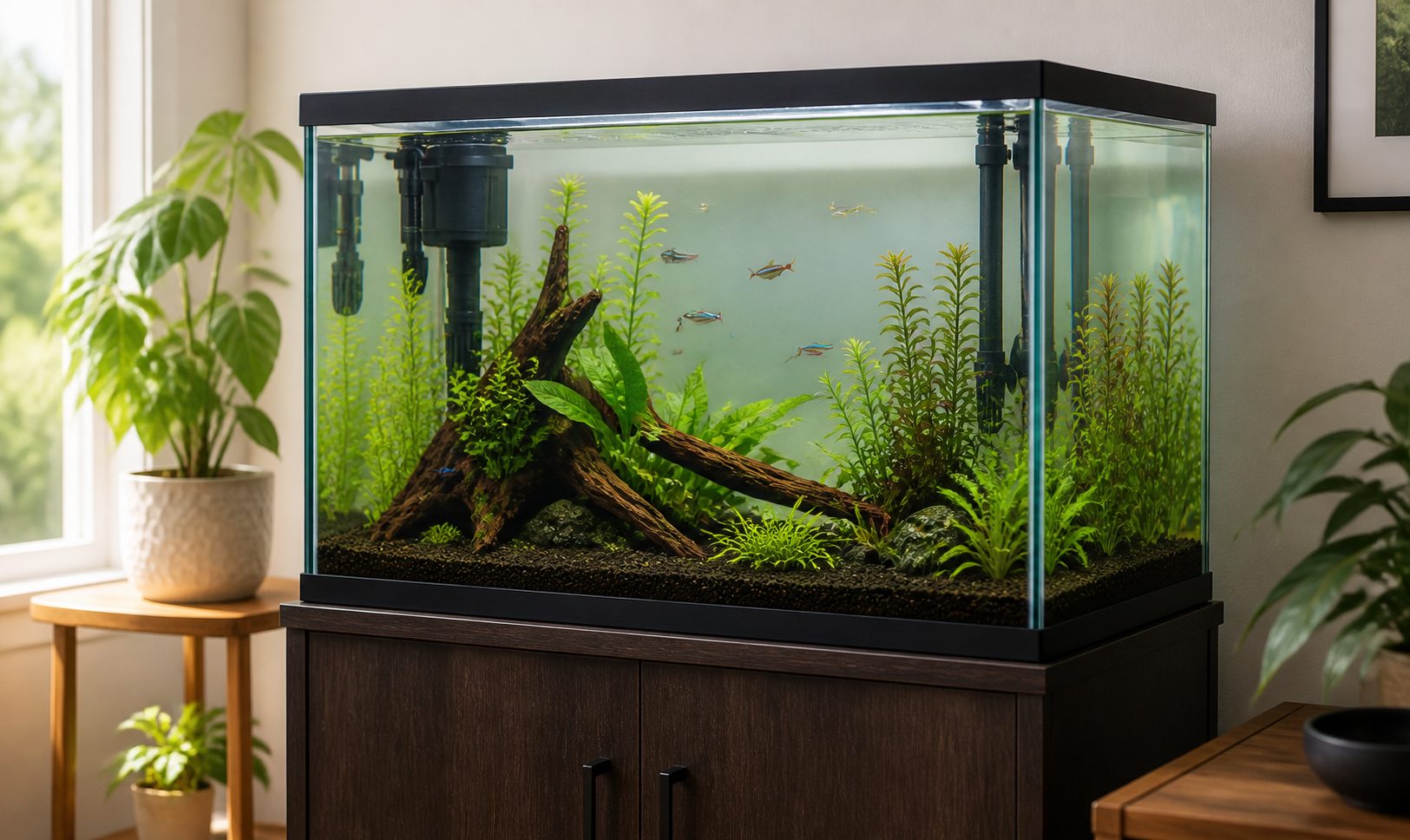
A 20-gallon gives gives you roughly 17-18 gallons of actual water volume after substrate, decorations, and filter equipment displace the rest. That extra volume buffers against parameter swings, supports a proper cleanup crew, and lets you run species in appropriate group sizes without immediately maxing out bioload capacity.
Before you stock, compare what you want to what fits in a smaller tank option or a 10 gal comparison. Some species on your shortlist may belong there instead.
Stock by adult size, swimming behavior, waste output, and territorial needs. The combos in this guide are built on those variables, not ruler math.
Two tank shapes are sold as "20-gallon .." The Long model (24 x 12 x 16 inches) gives more horizontal swimming space and is better for active mid-water schoolers. The High model shares similar dimensions but prioritizes vertical space.
For the fish in this guide, choose the Long. Active schooling species use horizontal distance, not height.
4 Proven 20 Gallon Stocking Combos
Each combo below is built around three variables: bioload balance, swimming zone coverage, and water parameter overlap. Choose one and build around it.
Mixing combos leads to overstocking and parameter conflicts you cannot resolve without rehoming fish.
| Combo | Species | Count | Difficulty | Temp / pH |
|---|---|---|---|---|
| Community Classic | Neon tetras + Dwarf gourami + Corydoras | 8 + 1 + 6 | Beginner-Intermediate | 74-80°F / 6.8-7.2 |
| Betta Community | Male betta + Cherry barbs + Corydoras | 1 + 6 + 4 | Intermediate | 76-80°F / 6.8-7.2 |
| Livebearer Mix | Guppies + Platies + Corydoras | 6 + 4 + 4 | Beginner | 74-82°F / 7.0-7.8 |
| Shrimp Showcase | Cherry shrimp + Ember tetras + Otocinclus | 20+ + 6 + 3 | Intermediate | 72-78°F / 6.8-7.4 |
Each combo is covered in full below. Water temperature and pH ranges are the target overlap zones where all species in that combination thrive without compromise.
Harlequin rasboras are a common substitute for neon tetras in the community classic build. They prefer identical water parameters, school just as tightly, and are hardier through the first months of a new tank.
Combo 1: Community Classic (8 Neon Tetras + 1 Dwarf Gourami + 6 Corydoras)
This is the most requested 20-gallon setup in the hobby, and it works because the three species occupy distinct zones without competing. the schooling fish pick claim the mid-water column in formation.
The dwarf gourami owns the upper zone with surface access. Corydoras work the substrate, consuming leftover food and detritus that the other two ignore.
Bioload is manageable at this count. Eight neon tetras produce minimal waste individually.
One dwarf gourami adds moderate bioload. Six corydoras add moderate bioload spread across the bottom.
- Neon tetras: minimum 6, eight is where schooling behavior becomes consistent. Keep in a tight group and they move as a single unit.
- Dwarf gourami: one male only. Two males in 20 gallons will establish overlapping territories and fight.
- Corydoras: minimum 4 for the social species. Six gives you a proper group with observable shoaling behavior on the substrate.
Dense planting at the back and sides with open mid-water swimming space gives all three layers room to express natural behavior. Java fern and anubias on driftwood in the back, open sand in the foreground for the corydoras to root through.
The dwarf gourami is one of the few centerpiece fish that stays under 3.5 inches and does not outgrow a 20-gallon as it matures.
Keepers who want to avoid dwarf gourami iridovirus risk should consider the honey gourami as a direct substitute. It fills the same surface zone, stays the same size, and carries none of the disease susceptibility that affects dwarf gourami imported from Southeast Asia.
Combo 2: Betta Community (1 Betta + 6 Cherry Barbs + 4 Corydoras)
A as the centerpiece option in 20 gallons has enough space to claim a territory without pressuring tank mates. The key is species selection.
Cherry barbs are one of the few barb species that do not fin-nip, school tightly enough to avoid provoking the betta, and prefer the same soft, slightly acidic water.
Six cherry barbs in the mid column keep the betta's attention diluted across a moving group rather than fixating on a single target. Four bottom layer corydoras complete the crew without entering the betta's claimed surface zone.
- Male betta: one only. Introduce him last, after cherry barbs are established. A betta added to an already-inhabited tank is less likely to treat it as exclusive territory.
- Cherry barbs: keep 2 females per male within the group to reduce male display competition. Mix of colors is fine.
- Corydoras: use emerald or sterbai corydoras in this setup. Both tolerate the 76-80°F temperature the betta prefers.
Monitor the betta for the first two weeks. Occasional flaring at the barb group is normal display behavior.
Active chasing and cornering means insufficient cover. Add more plants or rearrange hardscape before the behavior becomes a pattern.
The corydoras pairing is reliable across most betta temperaments. The full breakdown of why that pairing works is in our betta and corydoras compatibility guide, including which corydoras species to avoid with aggressive males.
Combo 3: Livebearer Mix (6 Guppies + 4 Platies + 4 Corydoras)
The livebearer combo is the most beginner-accessible setup on this list. All three species tolerate hard, alkaline tap water that many municipal supplies deliver without treatment beyond dechlorination.
Guppies occupy the upper and mid zones with constant activity. Platies are larger and slower, holding the mid zone with deliberate swimming.
Four corydoras maintain the substrate. No territory conflicts, no parameter compromises, and all three are hardy enough to survive beginner mistakes during the first months.
- Guppies: run all-male for color and no breeding pressure. Use a 1M:2F ratio only if you want fry, and have a plan for juvenile management before the tank overcrowds.
- Platies: mix colors freely. Like guppies, they breed readily. Keep same-sex groups or accept fry cycles.
- Corydoras: use bronze or peppered corydoras here. Both tolerate the harder, more alkaline water livebearers prefer.
Combo 4: Shrimp Showcase (20+ Cherry Shrimp + 6 Ember Tetras + 3 Otocinclus)
This is the highest-visual-reward-per-dollar setup on the list. Cherry shrimp at 20-plus individuals establish a self-sustaining colony.
Ember tetras at 1.5 inches are small enough that they do not predate adult shrimp and add warm orange color to the mid column. Three otocinclus graze algae off glass, plants, and hardscape without competing with the shrimp for biofilm.
This setup requires more careful sourcing than the fish-only combos. Otocinclus are sensitive fish that need a mature, algae-producing tank before introduction.
Do not add them to a tank under 8 weeks old.
- Cherry shrimp: start with 20-30. The colony self-regulates toward tank capacity through natural attrition and breeding.
- Ember tetras: minimum 6, eight is better. They school tightly and leave adult shrimp alone. Avoid larger tetra species that will pick off shrimp.
- Otocinclus: 3 minimum. They are social and decline rapidly when kept alone. Quarantine before introduction as they are stress-sensitive at purchase.
What 20-Gallon Stocking Combos Get Wrong
These species get added to 20-gallon setups constantly by beginners acting on pet store advice. None of them belong there long-term.
| Species | Why It Fails in 20 Gallons | Minimum Tank |
|---|---|---|
| Angelfish | Reach 6 inches tall; standard 20-gal is only 16 inches high. Adults fin-nip smaller tank mates. | 29 gallons (tall) |
| Tiger barbs | Fin-nippers that need 8+ fish. Eight tiger barbs overcrowd 20 gallons quickly. | 30 gallons |
| Common goldfish | Reach 10-12 inches, produce extreme waste. A single fish can foul 20 gallons within 24 hours. | 40+ gallons per fish |
| Rainbow fish (most species) | Reach 4-6 inches, active horizontal swimmers that pace glass in confined spaces. | 30 gallons |
| Oscar fish | Reach 12+ inches. A juvenile outgrows a 20-gallon in under a year. | 55 gallons minimum |
| Jack Dempsey cichlid | Territorial aggression in any tank under 55 gallons. Will claim and defend the entire 20-gallon. | 55 gallons |
Cycling a 20-Gallon Tank Before You Add Fish
Cycling builds the bacterial colony that converts fish waste (ammonia) into nitrite, then nitrite into nitrate. Without a complete cycle, ammonia spikes to lethal levels within days of adding fish.
Our complete tank cycling guide walks through both the fishless ammonia method and the seeded media shortcut in detail, including how to read test results that stall in the nitrite phase.
A 20-gallon takes the same time to cycle as any other size: four to six weeks from scratch, one to two weeks with established filter media from an existing tank.
It is also harder to manage because you have to do partial water changes to keep ammonia below lethal levels while trying to grow bacteria that need ammonia to eat.
20-Gallon Tank Equipment: What You Actually Need
A 20-gallon community tank requires less equipment than beginners expect and more quality than most starter kits deliver. Every item below serves a function that cannot be skipped.
Corydoras barbels abrade on sharp gravel and develop bacterial infections within weeks. If any corydoras species is in your combo, fine sand or smooth substrate is not optional.
Our corydoras care guide covers substrate requirements in full.
Keepers adding live plants to any of the four combos above will find substrate choice, light duration, and low-tech species selection covered in our freshwater planted tank setup guide. Java fern and anubias require no special soil or CO2, making them the default choice for community tanks.
Maintenance Schedule for a 20-Gallon Community Tank
A 20-gallon is more forgiving than a 5-gallon or 10-gallon because larger water volume dilutes waste faster. That margin exists to protect fish from keeper mistakes, not to justify doing less maintenance.
These are the minimum intervals for any of the four combos above. If nitrate climbs above 20 ppm between water changes, increase change volume or frequency before adding more fish.
- Weekly 25% water change with temperature-matched, dechlorinated water
- Test ammonia, nitrite, and nitrate every week for the first 3 months
- Rinse filter media in removed tank water every 2-4 weeks, never under tap water
- Vacuum substrate lightly at each water change to remove settled waste
- Check heater reading against external thermometer monthly
- Wipe algae from glass as needed, typically every 1-2 weeks
Filter media rinsed under tap water loses beneficial bacteria. Always use water removed during a water change to rinse sponges and ceramic media.
The bacterial colony you are protecting took weeks to build. Tap water kills it in seconds.
Pick one combo, cycle the tank fully before adding fish, and stock one species at a time over several weeks. The community classic (8 neon tetras, 1 dwarf gourami, 6 corydoras) is the most beginner-accessible starting point with the highest visual payoff.
If livebearers suit your water supply better, the guppy and platy combo is just as forgiving and requires even less chemistry management. See our neon tetra schooling guide and corydoras care guide for species-specific setup details before you stock.