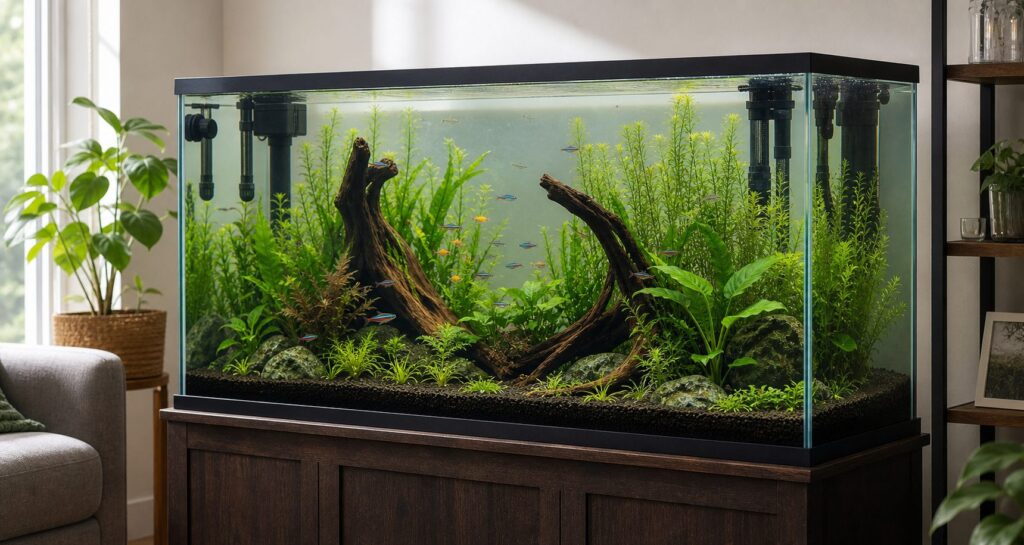
This guide covers four proven medium tank planning combinations, the equipment that keeps them stable, and the stocking rules that apply at this size.
Why the 40-Gallon Breeder Is a 40 Gallon Tank Stocking Sweet Spot
The 40-gallon breeder breeder (36x18x16 inches) holds roughly 34-36 gallons of actual water after substrate, hardscape, and filter displacement. That is enough volume to keep angelfish pairs, properly sized rainbow schools, and biotope setups that would fail in a 29-gallon.
Remember it later
Planning to try this recipe soon? Save it for a quick find later!
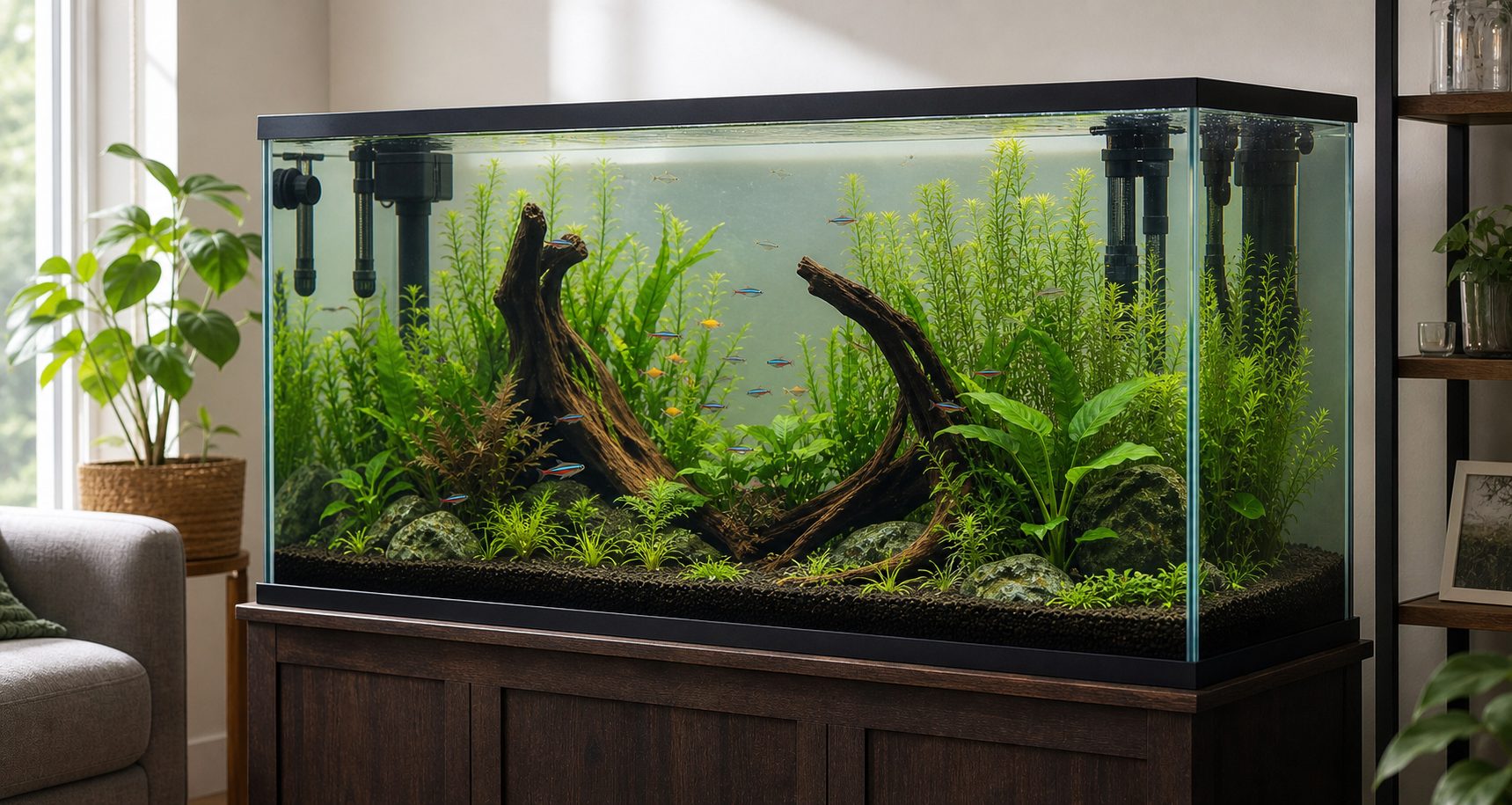
The footprint is the real advantage. Most 40-gallon tanks tanks are 48 inches long but only 12 inches wide.
The breeder format gives you 18 inches of width, which means corydoras have a larger foraging area, bottom-dwelling species are not constantly in each other's path, and planted layouts actually look proportional.
If you are stepping up from a smaller tank, compare what you had there to what fits here. Our option in a 29-gallon guide shows what you leave behind when you move up in volume.
Most of those setups transfer directly with room to add a school or a second species.
The 40-gallon breeder breeder is also one of the best sizes for planted tank builds. The shallow depth keeps lighting efficient across the entire substrate, and the wide base gives aquascape layouts enough horizontal space to use proper foreground, midground, and background zones without crowding.
Three rules apply to every combination in this guide: species must share overlapping water parameters, swimming zones should be distributed across upper, mid, and bottom levels, and no single species should dominate more than one zone.
Add a second cleanup crew species or an extra school and you are past the bioload the tank can handle without a canister filter running full capacity. Stock to 80% of theoretical capacity and let the filter handle the rest.
40 Gallon Tank Stocking Combos: 4 Proven Options
Each combination below was built around three criteria: compatible water parameters across all species, non-overlapping swimming zones, and enough group size for schooling species to behave naturally. Pick one combination and stay with it.
| Combo | Species | Count | Difficulty | Water Temp / pH |
|---|---|---|---|---|
| Angelfish Community | Angels + rummy-nose tetras + sterbai corys + bristlenose | 2 + 10 + 8 + 1 | Intermediate | 78-82°F / 6.5-7.0 |
| Rainbow Community | Boesemani rainbows + cherry barbs + corydoras | 8 + 8 + 6 | Intermediate | 74-80°F / 7.0-7.8 |
| Amazon Biotope | German blue rams + cardinal tetras + corys + kuhli loaches | 2 + 12 + 8 + 6 | Advanced | 80-84°F / 5.5-6.8 |
| Livebearer Paradise | Platies + mollies + swordtails + bristlenose pleco | 8 + 6 + 6 + 1 | Beginner | 74-80°F / 7.2-8.0 |
Each combination is detailed below with species notes, zone distribution, and what to watch during the first month.
Combo 1: Angelfish Community
A pair of angel pair setup anchors the upper-mid zone with vertical presence that no other freshwater fish matches at this size. Ten rummy-nose tetras form a tight school in the mid-water column, and eight sterbai corydoras handle the substrate.
One bristlenose pleco stays on glass and wood surfaces, consuming algae without competing for floor space.
This is the classic South American community. All four species share overlapping Amazon basin origins, prefer soft and slightly acidic water, and do not compete for the same food sources.
The sterbai corydoras are the best corydoras match for angelfish tanks specifically specifically because they tolerate the higher temperatures angels need, where most other corydoras species struggle above 78°F.
- Angel pair selection: buy a proven pair or purchase 4-6 juveniles and allow them to pair naturally, then rehome the unpaired fish. Forcing two unmatched adults together often results in one being harassed constantly.
- Rummy-nose count: ten is the minimum for formation schooling. Fewer than eight and they scatter nervously rather than moving as a unit.
- Sterbai temperature tolerance: verified for 78-84°F. Do not substitute with peppered corydoras or emerald corydoras, which prefer 72-76°F.
- Bristlenose pleco: one only. A second bristlenose will compete for the same algae territory and may not coexist peacefully once mature.
Feed the angels at the surface with medium pellets or frozen bloodworms. The corydoras clean up anything that sinks.
The rummy-nose tetras take flake or micro-pellets at mid-level. Zone-separated feeding prevents competition and keeps the angels from targeting the smaller fish at food time.
Combo 2: Rainbow Community
Eight schooling mid-level boesemani rainbows in a 40-gallon breeder use every inch of the wide footprint. Rainbowfish are active horizontal swimmers, and the 36-inch length gives them enough run to reach full speed without constant course corrections at the glass.
Eight cherry barbs add color in the mid-lower zone, and six corydoras complete the bottom level.
This combination runs slightly harder water than the angelfish community, which is an advantage in tap water regions with naturally high mineral content. Rainbowfish and cherry barbs both tolerate pH 7.0-7.8 without complaint, and the water change schedule is more forgiving because the hardness buffers pH swings.
- Boesemani rainbows: males develop the brightest color. A ratio of 3-4 males to 4-5 females encourages display behavior without excessive male competition.
- Cherry barbs: peaceful schoolers that stay in the lower mid-zone. Keep minimum six for natural behavior. Males display red coloration more intensely when competing for female attention.
- Corydoras species: bronze, emerald, or peppered corydoras all fit this combo's parameter range. Any of the three works at the temperature and pH this combination requires.
Combo 3: Amazon Biotope
Two centerpiece fish in German blue ram form anchor the bottom-mid zone of this setup. Twelve cardinal tetras school above them, eight corydoras work the substrate, and six kuhli loaches occupy the substrate margins and caves.
Driftwood and leaf litter recreate the Rio Negro basin conditions all four species originate from.
This is the most demanding combination in this guide. German blue rams require stable warm temperatures at 80-84°F and clean, soft, acidic water at all times.
Their immune systems are sensitive, and any parameter instability triggers disease susceptibility. Cardinals share the same temperature and pH range, which makes them the correct tetra for this setup.
Neon tetras, by contrast, prefer cooler water at 72-76°F and do not belong in a ram ram tank.
- Temperature minimum: do not run this combination below 80°F. Rams kept cooler show pale coloration, reduced activity, and elevated disease rates within weeks.
- Substrate: fine sand is required. Kuhli loaches and corydoras both burrow and sift, and sharp gravel damages their barbels. Dark sand also enhances the biotope appearance and encourages bolder ram coloration.
- Driftwood: two to three pieces of Malaysian driftwood or spider wood lower pH naturally through tannin release and give kuhli loaches the hiding structure they need to feel secure.
- Ram pair sourcing: buy from reputable breeders, not chain stores. Wild-caught or quality-bred rams from local breeders are significantly healthier than imported mass-farmed stock.
This combination is not for new keepers. Run the 40-gallon for at least three months with a simpler combo before attempting the Amazon biotope.
A fully cycled, stable tank with established bacterial colonies handles the ram's sensitivity demands far better than a newly set-up system.
Our corydoras care guide covers the substrate and temperature requirements that keep the bottom-dwelling members of this biotope healthy alongside the rams.
Combo 4: Livebearer Paradise
Eight platies, six mollies, six swordtails, and one bristlenose pleco create a high-activity, colorful community suited to tap water that runs naturally hard and alkaline. Livebearer species from this group share compatible parameters and do not compete meaningfully for swimming zones or food sources.
This is the most beginner-accessible combination on this list. All three livebearer species tolerate pH 7.2-8.0 without modification, accept most prepared foods without supplemental feeding, and are hardy enough to handle the minor parameter fluctuations that happen in the first months of a new tank.
- Sex ratios: keep two females per male across all three species. Males constantly pursue females, and outnumbered females become exhausted and stressed within days.
- Population control: all three species breed readily. Have a plan for fry before the tank population doubles in two months. Dense planting gives fry some survival cover, but most will be eaten by adults.
- Molly salt requirement: mollies tolerate and often prefer low-level aquarium salt (1 tablespoon per 5 gallons). Platies and swordtails accept this concentration. Do not keep true brackish-only mollies in this combination.
40 Gallon Tank Equipment: What You Need
A 40-gallon breeder requires more equipment than smaller tanks, and the upgrade cost is worthwhile. Underfiltration is the most common reason a 40-gallon stocking combination fails within the first year.
| Equipment | Specification | Notes |
|---|---|---|
| Filter | Canister, 200+ GPH | Canister recommended over HOB at this size. Better mechanical and biological filtration, less surface turbulence. |
| Heater | 150-200W adjustable | Use 5W per gallon as the baseline. Two 100W heaters are more reliable than one 200W: if one fails, the second maintains minimum temperature. |
| Thermometer | Digital, external probe | Never trust the heater's built-in dial. External thermometers mounted on the opposite side of the tank show real temperature distribution. |
| Lighting | Full-spectrum LED, 36-inch | Planted spectrum if live plants are in the build. A 36-inch LED bar covers the breeder footprint with even coverage. |
| Substrate | Fine sand or planted substrate | Sand is required for corydoras, kuhli loaches, and bottom-feeding species. Pool filter sand is the most affordable option. |
| Test kit | API Liquid Master Kit | Liquid test kits, not strips. Covers ammonia, nitrite, nitrate, and pH. Weekly testing during the first three months. |
A canister filter at 200+ GPH for a 40-gallon is not overkill. Manufacturers rate filters at empty-tank turnover, not real-world loaded turnover.
Biological media reduces actual flow rate by 20-30%, so a 200 GPH canister delivers roughly 140-160 GPH of effective filtration under load. That is the correct range for the stocking levels in this guide.
Invest in a canister for any combination that includes sensitive species or larger bioloads.
40-Gallon Tank Stocking Setup Checklist
Follow this checklist before adding any fish. Each item prevents a category of failure that commonly happens when setups are rushed.
The quarantine step is the one most keepers skip and regret. Introducing a disease-carrying fish to a fully stocked 40-gallon means treating the entire tank.
A two-week quarantine in a separate tank catches most bacterial and parasitic infections before they reach your display tank.
Water Parameters and Weekly Maintenance
A 40-gallon holds enough water volume to forgive minor maintenance lapses, but that forgiveness ends with overstocking. The combinations in this guide run at 70-80% of theoretical maximum bioload.
That margin exists to absorb the occasional missed water change, not to accommodate more fish.
- Change 25-30% weekly with temperature-matched, dechlorinated water
- Test ammonia, nitrite, and nitrate every week for the first 3 months
- Rinse canister media in removed tank water every 4-6 weeks, never under tap
- Vacuum substrate with a gravel siphon at each water change, covering the full footprint
- Verify heater temperature against the external thermometer monthly
- Clean filter intakes and spray bars monthly to maintain rated flow rate
Nitrate is the primary maintenance signal at this tank size. If nitrate climbs above 20 ppm before your next scheduled change, your bioload is near the limit of what the filter and water change schedule can handle.
Increase change volume to 40% weekly before adding any additional fish.
Frequently Asked Questions About 40 Gallon Tank Stocking
Choose one of the four combinations in this guide, stock it to 80% of capacity, run a canister filter at 200+ GPH, and maintain weekly 25-30% water changes. That routine keeps every combination in this guide stable for years.
If you want a smaller starting point, our smaller option guide covers what fits in 29 gallons before you size up.