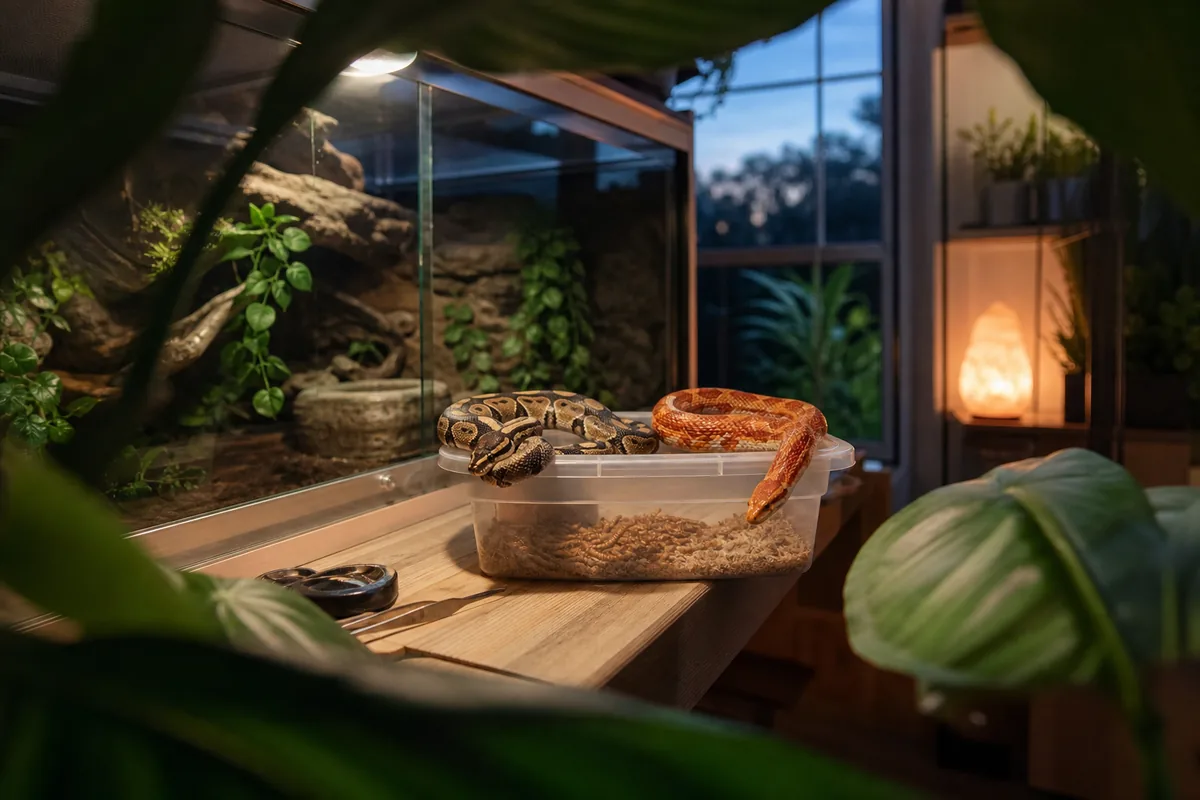
Ball Python vs Corn Snake: Two Different Personalities in a Snake-Shaped Package
The ball python vs corn snake debate comes down to one thing: do you want a snake that hides or a snake that moves? Both species are excellent for keepers new to snakes, but they deliver completely different experiences in the enclosure.
Start with the full reptile care hub before committing to either species.
Keepers drawn to ball python care usually want a snake that spends 20-23 hours per day in a hide, rarely moves around the enclosure, and is almost impossible to stress out during handling. By contrast, corn snake keeping suits people who want an active, curious animal that will test every seam and gap in the enclosure.
Both are excellent at what they are, just very different animals.
| Factor | Ball Python | Corn Snake |
|---|---|---|
| Adult size | 3-5 feet, 1,200-1,800g | 3-5 feet, 200-900g |
| Adult weight comparison | Heavy-bodied, thick | Slender, light |
| Enclosure size | 4x2x2 ft PVC enclosure | 4x2x1 ft enclosure |
| Heating method | UTH or radiant heat panel | UTH or low-watt basking lamp |
| Warm hide temp | 88-92°F | 85-88°F |
| Humidity requirement | 60-80% | 40-60% |
| Feeding schedule (adult) | Every 10-14 days | Every 7-10 days |
| Prey type | Mice or rats (frozen/thawed) | Mice (frozen/thawed) |
| Activity level | Low (hides 20+ hours) | High (active explorer) |
| Escape tendency | Low | Very high |
| Lifespan | 20-30 years | 15-20 years |
| Setup cost | $195-$830 | $100-$400 |
| Morph variety | Thousands of combinations | Hundreds of combinations |
Best overall: Ball Python
Ball Python is the better fit when you want the stronger everyday experience described in this comparison.
Best value: Corn Snake
Corn Snake makes more sense when cost, setup simplicity, or beginner forgiveness matter more than the premium pick.
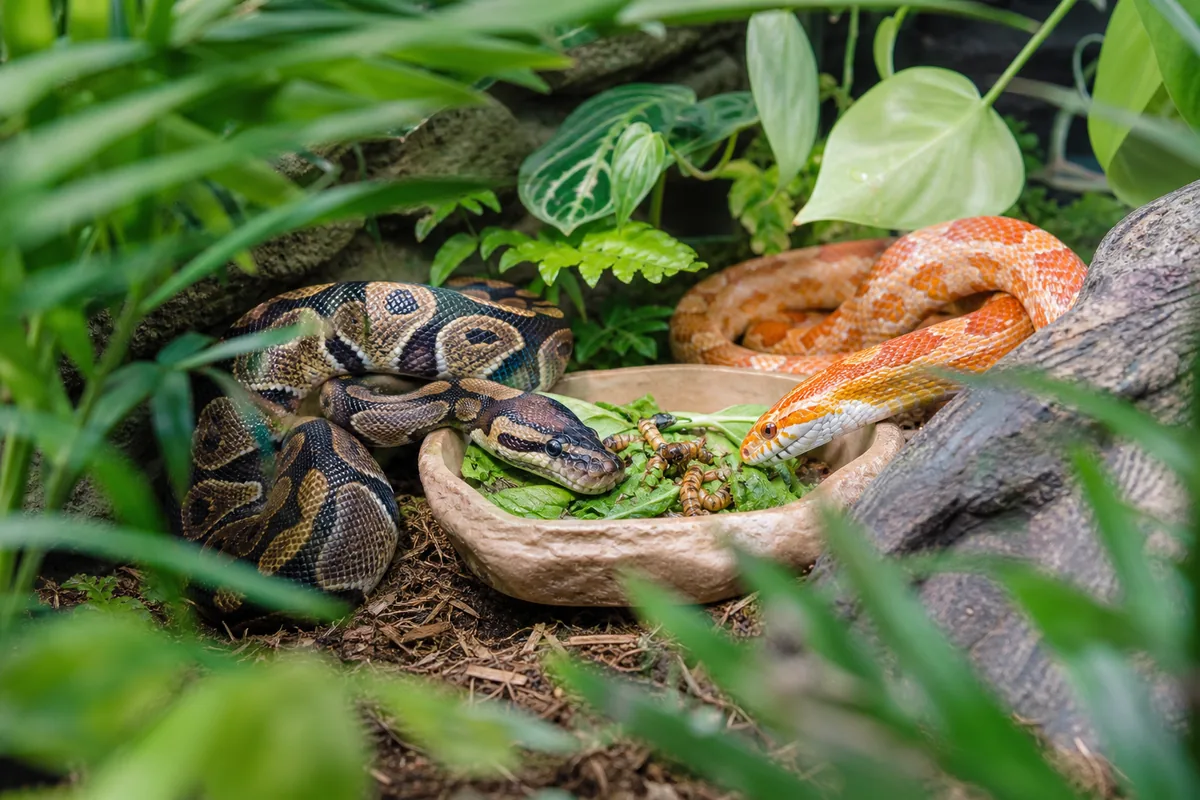
Ball Python: The Champion of Calm Snake Keeping
Ball pythons earn their name from their defense behavior: when threatened, they curl into a tight ball with the head tucked in the center. This instinct makes them almost impossible to injure themselves or bite defensively once they are comfortable with handling.
The downside is feeding reliability.
Ball pythons are infamous for feeding strikes that last weeks to months, particularly in males during breeding season (October through March).
For the full enclosure requirements that minimize strike triggers, see the ball python enclosure setup guide.
A snake that refuses 10 consecutive meals sends many first-time keepers into a panic, but a healthy adult ball python can safely go 3-4 months without food.
- Temperament: Calm, defensive (curls), rarely bites
- Activity level: Low, spends most time in hide
- Feeding reliability: Prone to seasonal strikes, especially males in fall/winter
- Morph availability: Thousands of genetic combos, prices from $50 to $10,000+
- Humidity needs: 60-80%, requires PVC or wood enclosure
Pros
- Extremely calm and handleable from an early age
- Thousands of color morphs at all price points
- Feeds only every 10-14 days as adult
- 20-30 year lifespan in captivity
- Heavy body makes handling satisfying
Cons
- Frequent feeding strikes stress new keepers
- Requires 60-80% humidity (glass tanks don't work)
- Needs PVC or wood enclosure for humidity
- Activity level is very low, rarely visible
- Males go off food for weeks in breeding season
Corn Snake: The Active Explorer With an Escape Artist's Resume
Corn snakes are native to the southeastern United States and are naturally active, diurnal explorers. In captivity, they use every inch of their enclosure, climb decor, investigate new objects, and will probe every seam and gap for weaknesses.
The escape tendency is the defining challenge. Corn snakes can push through gaps as small as ¼ inch.
Any enclosure must have secure latches on every door, and every wire pass-through must be sealed with foam or mesh. A missing corn snake in a house is a difficult problem.
If that higher activity level sounds appealing, the king snake care guide is another useful comparison point because it combines strong feeding reliability with a bolder personality.
- Temperament: Curious, active, flighty when young but tames quickly
- Activity level: High, frequently visible in the enclosure
- Feeding reliability: Extremely consistent, rarely refuses food
- Morph availability: Hundreds of color and pattern combos, most $30-$100
- Humidity needs: 40-60%, manageable in glass tanks
Pros
- Consistent feeder, rarely refuses frozen-thawed mice
- Lower humidity needs work in standard glass tanks
- More affordable setup than ball python
- More active, visible more often in the enclosure
- Shorter feeding intervals means more interaction around meals
Cons
- Escape artist, requires locked enclosure with zero gaps
- Can be nippy and flighty as juveniles
- Less body mass makes handling feel less substantial
- Narrower range of color morphs compared to ball pythons
- Not as tolerant of handling errors as ball pythons
Feeding Comparison: Corn Snakes Win on Reliability
Corn snakes eat consistently throughout the year with almost no seasonal variation. Adult corn snakes accept frozen-thawed adult mice every 7-10 days without complaint.
This predictability makes feeding one of the easiest parts of corn snake keeping.
Ball python feeding is a different story. Males in breeding condition may refuse all food from October through February.
Even outside breeding season, a stress event like a new enclosure, a move, or an unusual smell can trigger a multi-week strike.
Which Snake Is Right for You?
Choose a ball python if you want a handleable, calm snake and can tolerate an animal that spends most of its time hidden. Choose a corn snake if you want visible activity, consistent feeding, and a lower-cost setup, and can secure an escape-proof enclosure.
If you are still deciding between snakes and lizards, our beginner reptile ranking puts both species beside leopard geckos and bearded dragons.
Keepers who want the calmness of a heavier-bodied snake but a more reliable feeding response should read the king snake care guide next.
- Want a calm, low-drama snake: Ball python
- Want an active, frequently visible snake: Corn snake
- Tight budget: Corn snake wins on setup and morph cost
- Interested in morph collecting: Ball python has the deepest catalog
- Concerned about feeding strikes: Corn snake wins on reliability
- Want a 20-30 year companion: Ball python
Sources and references
- Python regius Captive Biology and HusbandryAfrican of Herpetology, 2019
- Pantherophis guttatus Natural History and Captive ManagementHerpetological Conservation and Biology, 2017
- Captive Snake Feeding Behavior: Species ComparisonZoo Biology, 2021