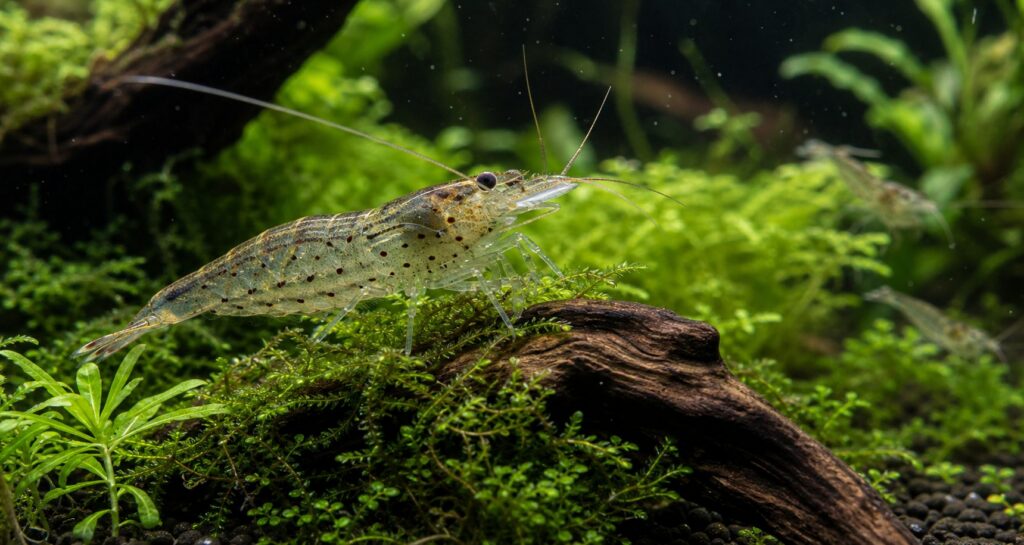
They are the foundation of any planted tank crew worth building.
What Is an Amano Shrimp? The Algae Eater Takashi Amano Introduced to the World
The Amano Shrimp is is named after Takashi Amano, the Japanese photographer and aquascaper who pioneered the Nature Aquarium style and popularized these shrimp as a biological algae control method in the 1980s and 1990s.
Remember it later
Planning to try this recipe soon? Save it for a quick find later!
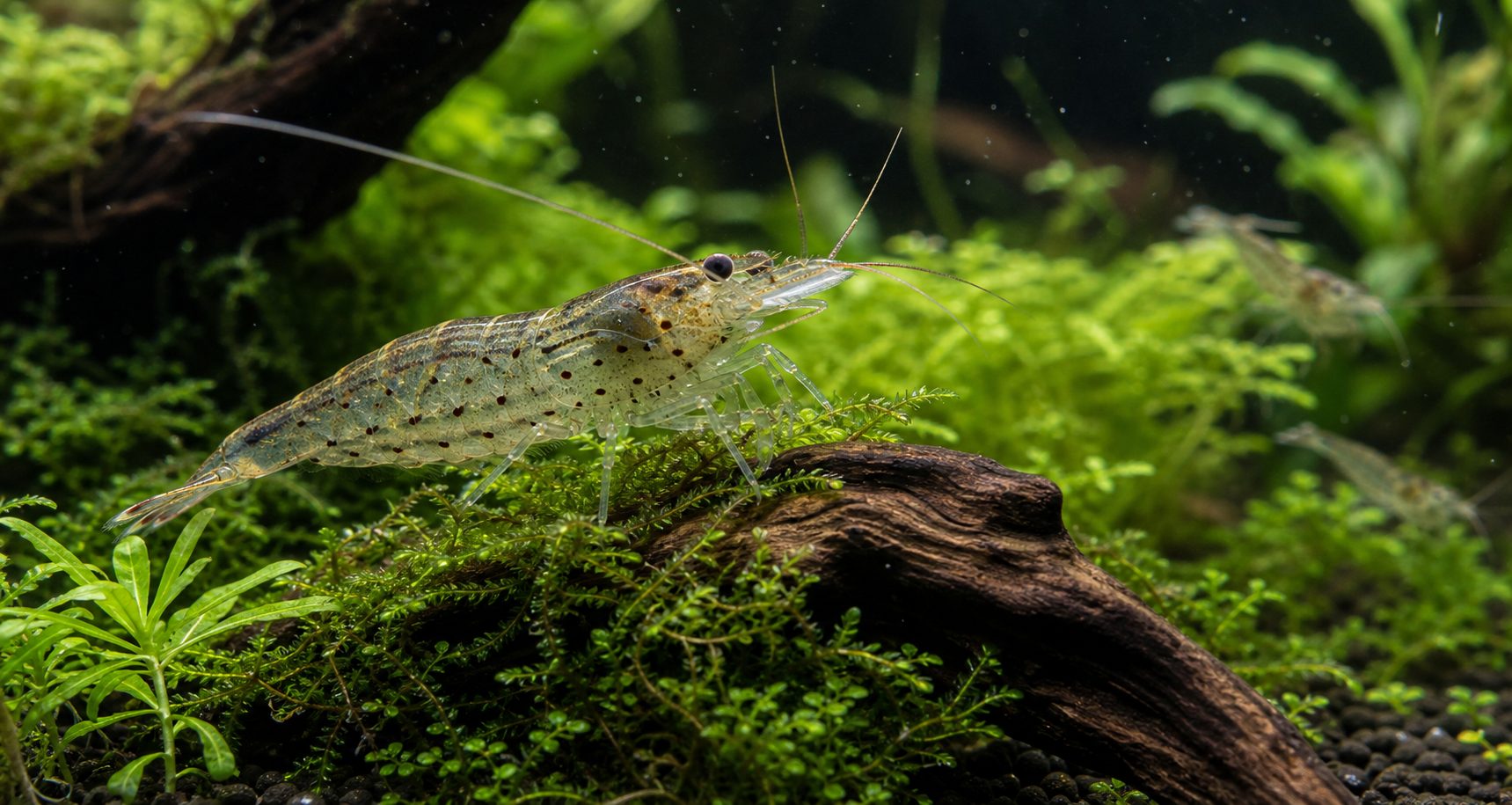
Before Amano began using them, Caridina multidentata was largely unknown in the aquarium hobby. Today, they are the standard algae-control recommendation for planted tanks worldwide.
They originate from streams and rivers in Japan and Taiwan, where they live in in fast-moving, well-oxygenated water with heavy vegetation. That native habitat explains every parameter and setup preference they have in captivity.
The body is transparent to pale gray with a a distinctive row of reddish-brown dots and dashes running along each side. Females carry visible green eggs in the saddle area behind their head, and females grow noticeably larger than males.
Both sexes are transparent enough that you can see their internal organs and the contents of their digestive tract.
That temperature range is wide by design. Amano Shrimp are are genuinely adaptable to a broad sweep of community tank conditions, which is part of why they pair with so many different species.
The 2-3 year lifespan is shorter than many keepers expect. A healthy, well-fed group in stable water will reach the upper end of that range, but the early losses from poor acclimation or water quality spikes cut that number quickly.
Amano Shrimp Tank Setup: 10 Gallons Minimum, Plants and Flow Preferred
A 10-gallon tank is the practical minimum for a group of 5 Amano Shrimp. The minimum group size for effective algae control is not one or two shrimp eating timidly in a corner.
It is a coordinated crew working across every surface in the tank.
In tanks larger than 20 gallons, scale the group up accordingly. A 40-gallon planted tank with a a serious algae problem benefits from 10-15 shrimp.
The general rule is one shrimp per 2 gallons as a starting baseline, then adjust based on algae load.
Plants are strongly preferred but not strictly required. Amano Shrimp came from vegetated streams, and they use plants as foraging terrain, shelter from perceived threats, and molting cover.
A tank with moss moss, java fern, or any low-light plant is a better environment than a bare tank with the same water parameters.
Filtration matters more for shrimp than for most fish. Shrimp are sensitive to ammonia spikes and dissolved organics.
A sponge filter or an HOB filter with a pre-filter sponge over the intake keeps the flow gentle while maintaining excellent water quality. Strong direct flow from a filter intake is a real drowning hazard for small or freshly molted individuals.
Lighting for Amano Shrimp is primarily a plant-support consideration. They do not have specific lighting requirements themselves, but a consistent 8-10 hour light cycle encourages the algae growth they eat and supports the live plants that make their tank environment functional.
A quality LED light on a timer keeps the cycle consistent without any manual adjustment. Our LED aquarium light guide identifies which models work well over planted tanks without triggering the algae blooms that shrimp can only partially control.
Amano Shrimp Water Parameters: Stable Is More Important Than Perfect
Amano Shrimp tolerate a wide range of parameters on paper, but they are sensitive to change. A tank with pH 7.8 that is stable is safer for them than a tank that swings between 6.8 and 7.4 depending on CO2 injection schedules or the buffering capacity of your substrate.
The single most important parameter is ammonia. Shrimp have no meaningful ammonia tolerance.
Any detectable level causes gill damage and stress behavior, visible as erratic swimming near the surface. This is why adding shrimp to an uncycled tank is a reliable way to kill them.
| Parameter | Ideal Range | Tolerable Range |
|---|---|---|
| Temperature | 72-76°F | 64-80°F |
| pH | 7.0-7.5 | 6.5-8.0 |
| Ammonia | 0 ppm | 0 ppm only |
| Nitrite | 0 ppm | 0 ppm only |
| Nitrate | <20 ppm | <40 ppm |
| GH (Hardness) | 6-8 dGH | 4-14 dGH |
| TDS | 150-250 ppm | 100-300 ppm |
Before adding Amano Shrimp, test for copper with an aquarium copper test kit. If you have treated the tank with any medication in the past 4-6 weeks, run activated carbon for two weeks and test before adding shrimp.
Water changes of 15-20% weekly keep nitrates in range without causing the parameter swings that stress shrimp. Use dechlorinated water matched to the tank temperature within 2°F.
A cold-water change in a warm tank triggers premature molting, which is dangerous and can kill freshly molted shrimp if they are caught between moltings without enough minerals to harden the new shell.
If you are setting up a planted shrimp tank from scratch, our planted tank setup guide covers substrate choices, CO2 options, and fertilizer dosing in a way that accounts for shrimp safety at every step.
Amano Shrimp Diet: Algae Crew by Day, Bold Food Thief by Night
Amano Shrimp are omnivores that spend most of their active time grazing continuously on algae, biofilm, and decaying plant matter. They eat with their front legs, holding food pieces and rotating them rapidly while their mouth parts work.
This feeding behavior is one of the most entertaining things to watch in a planted tank.
They are effective against hair algae, green dust algae, soft green spot algae at early stages, and the biofilm that accumulates on glass and hardscape. They are not effective against mature black beard algae, coralline-style encrusted algae, or cyanobacteria mats.
In a tank with abundant algae, supplemental feeding is still worthwhile. In a clean, well-maintained planted tank with little algae, it is necessary.
Underfed Amano Shrimp become noticeably bolder, stealing food from other shrimp and picking at slow-moving fish. That aggression is a hunger signal, not a personality flaw.
- Algae wafers: a quarter wafer dropped at night gives the group a reliable supplemental food source beyond whatever they graze
- Blanched spinach or zucchini: drop a coin-sized piece to the substrate, weighted if needed, remove within 12 hours
- Snowflake pellets: a shrimp-specific food made from soybean hulls that breaks down slowly without fouling water
- Shrimp-specific granules: Hikari Shrimp Cuisine or similar sinking formulas that reach the bottom before fish intercept them
- Biofilm and leaf litter: Indian almond leaves and dried mulberry leaves added to the tank provide a constant slow-decay food source
Feed lightly and frequently rather than large quantities at once. Amano Shrimp do not overeat.
Excess food sitting on the substrate fouls water and spikes ammonia, which harms the shrimp more than missing a feeding does.
Amano Shrimp Tank Mates: Size Is the Only Rule That Matters
The compatibility rule for Amano Shrimp is straightforward: any fish that can fit the shrimp in its mouth will eventually eat it. At 2 inches, Amano Shrimp are too large for most small community fish to bother, but they are not immune to predation from medium and large fish.
They work exceptionally well alongside peaceful community fish like neon tetras, which are small enough to ignore the shrimp and share similar parameter requirements. A planted tank with neon tetras and a group of Amano Shrimp is one of the most balanced community shrimp setups in the hobby.
The question of fish compatibility with shrimp comes up most often with bettas. Bettas have individual personalities, and some ignore shrimp entirely while others actively hunt them.
Amano Shrimp are large enough that most bettas leave them alone after initial curiosity, but this varies by individual fish. A heavily planted tank with plenty of cover is the safer setup if you want to try the combination.
| Fish | Compatibility | Notes |
|---|---|---|
| Neon Tetra | Excellent | Small mouth, peaceful, overlapping parameters |
| Betta | Variable | Individual-dependent. heavy planting reduces risk |
| Corydoras | Excellent | Bottom dwellers that ignore shrimp completely |
| Bristlenose Pleco | Good | An algae team member that complements rather than competes |
| Guppies | Good | Too small to threaten adult Amano Shrimp |
| Angelfish | Poor | Large mouth, predatory instinct toward shrimp |
| Cichlids | Avoid | Most cichlid species treat shrimp as food |
| Goldfish | Avoid | Cold-water requirement mismatch plus shrimp predation |
Amano Shrimp can coexist with cherry shrimp in the same tank, but they will dominate feeding situations. If you keep both species, ensure enough food reaches the substrate so the smaller cherry shrimp can access it.
Amano Shrimp will grab the food first, hold it, and eat it themselves. The nano mate options that work for tetras usually work for shrimp tanks with the same logic: small, peaceful, and non-predatory.
Cherry shrimp are the most popular companion for Amano Shrimp in planted tanks. Our cherry shrimp care guide covers their breeding biology and water requirements, which overlap closely enough with Amano Shrimp that both species thrive under the same maintenance routine.
Why Amano Shrimp Cannot Breed in Freshwater
This is the most important fact about Amano Shrimp that most keepers do not learn until they have been keeping them for a while. They cannot complete their reproductive cycle in freshwater.
The larvae are hatched in freshwater, drift to estuaries and coastal saltwater, develop through multiple larval stages in brackish to full saltwater, and then migrate back upstream to freshwater as juveniles.
Replicating this in captivity requires saltwater rearing tanks, specialized larval food, and months of management. Virtually no home aquarist does it.
The result is that every Amano Shrimp sold in a fish store is wild-caught or bred in commercial facilities with saltwater infrastructure.
This has two practical implications for keepers. First, your population is self-limiting.
Unlike cherry shrimp, which breed freely in freshwater and can quickly overpopulate a tank, Amano Shrimp numbers only increase when you buy more. Second, they cost more per shrimp than cherry shrimp precisely because of this supply constraint.
Expect to pay $4-8 per shrimp at most retailers.
- Females carry green eggs in the saddle behind their head. this is visible but will not result in juvenile shrimp in a freshwater tank
- Larvae hatch after 4-5 weeks and must enter brackish or saltwater within hours or they die
- Commercial breeding facilities in Asia supply most of the hobby's stock
- Population management is simple: the number you buy is the number you have
This self-limiting population is actually a feature in planted tanks. Cherry shrimp colonies grow until they strain the tank's bioload.
Amano Shrimp stay exactly at the number you chose, making them predictable to plan around.
Amano Shrimp Molting: What to Expect and When to Worry
Shrimp grow by molting, shedding their old exoskeleton and expanding before the new shell hardens. Amano Shrimp molt roughly once every 4-6 weeks in stable conditions.
You will find empty shells in the tank on a regular basis and this is completely normal.
The empty shell looks like a dead shrimp. It holds its shape for 24-48 hours before dissolving.
Leave it in the tank. The shrimp eat the shed shell to recover the minerals used to build the new one. Removing it deprives them of those minerals and can contribute to failed moltings.
A freshly molted shrimp is pale, nearly white, and soft. It hides for 24-48 hours while the new shell hardens.
This is the most vulnerable period. Fish that ignored the shrimp before may investigate and injure a soft-bodied individual.
Good hiding spots in the tank matter most for this reason.
Otocinclus catfish are an excellent molting-period companion because they ignore shrimp entirely and clean algae from the same surfaces Amano Shrimp work. Our otocinclus care guide covers their water requirements, which align closely with what Amano Shrimp need.
- Normal molt: shell left behind, shrimp reappears after 1-2 days, color returns to normal
- Failed molt: shrimp cannot escape old shell, dies stuck partway through. caused by low GH, low iodine, or sudden parameter changes
- Stress molt: triggered by sudden water changes, temperature swings, or copper exposure. shrimp molt prematurely and may not survive
- Mineral support: maintain GH above 4 dGH to give shrimp sufficient calcium and magnesium for shell formation
Amano Shrimp Health and Common Problems
Amano Shrimp in a well-maintained tank are remarkably trouble-free. Most problems trace back to three sources: poor water quality at introduction, copper exposure, or inadequate acclimation during purchase.
The most common post-purchase death pattern is shrimp dying within 24-72 hours of introduction. This is almost always an acclimation failure.
Osmotic shock from moving between water of different parameters damages their gills and internal organs in ways that play out over the following day rather than immediately.
- Rapid death after purchase: osmotic shock from inadequate acclimation. prevent with a 60-90 minute drip acclimation process
- White body, loss of transparency: bacterial infection or severe stress response. improve water quality and reduce stressors before considering medication
- Lethargy and hiding during daytime: normal if newly introduced. abnormal if ongoing after 1 week, suggesting water quality or predation stress
- Sudden mass death: copper contamination is the most common cause. test water and review any recent medications or fertilizer additions
- Failure to molt: low GH or iodine deficiency. raise GH to 6-8 dGH with a shrimp mineral supplement and add dried seaweed as an iodine source
Avoid all medications that contain copper, formalin, or malachite green in tanks housing shrimp. If the fish in the tank need treatment, move the shrimp to a separate holding tank first.
Most antiparasitic medications safe for fish are harmful to invertebrates.
They will not breed and overrun your tank, they will not bother your community fish, and they will work every surface in your aquarium for the 2-3 years they live. If you are building a planted tank and want something that actually manages hair algae, this is the shrimp.